
International Research Journal of Engineering and Technology (IRJET) e-ISSN: 2395-0056
Volume: 13 Issue: 05 | May 2026 www.irjet.net p-ISSN: 2395-0072
International Research Journal of Engineering and Technology (IRJET) e-ISSN: 2395-0056
Volume: 13 Issue: 05 | May 2026 www.irjet.net p-ISSN: 2395-0072
K. Venkata Bhargav1 , V. Priyanka2 , K. Mallikarjuna Rao3 , S. Vijaya Bhaskar4
1PG Student, Department of Civil Engineering, S.V.U College of Engineering, Andhra Pradesh, India
2PG Student, Department of Civil Engineering, S.V.U College of Engineering, Andhra Pradesh, India
3Professor, Department of Civil Engineering, S.V.U College of Engineering, Andhra Pradesh, India
4Academic Consultant, Department of Civil Engineering, S.V.U College of Engineering, Andhra Pradesh, India
Abstract - This study investigates the stabilization of expansive clayey soil using metakaolin and shell lime to improve its geotechnical properties for subgrade applications. Expansive soils exhibit significant volume changes due to moisture variation, causing structural instability and pavement distress. Soil samples collected from Gajulamandyam, Tirupati, were classified as highly plastic clay (CH) with high liquid limit and free swell index. Laboratory tests including Atterberg limits, Standard Proctor compaction, Unconfined Compressive Strength (UCS), and California Bearing Ratio (CBR) were conducted on untreated and treated soil samples. Metakaolin was added in varying percentages of 5–20%, while shell lime was introduced in proportions of 2–10%. Combined stabilization was also carried out using the optimum metakaolin content. The results showed that metakaolin reducedtheliquidlimitandplasticityindexwhileimproving strength characteristics, with optimum performance observed at 15% replacement. Shell lime further enhanced soil properties through cation exchange, flocculation, and pozzolanicreactions,withsignificantstrengthimprovement at6–8%addition.Thecombineduseofmetakaolinandshell lime produced higher strength and stiffness due to the formation of cementitious compounds. The study concludes that metakaolin and shell lime are effective, sustainable, and economical stabilizing agents for expansive soils and canbesuccessfullyusedinpavementsubgradeapplications.
Key Words: Expansive Soil, Highly Plastic Clay, Metakaolin, Pavement Subgrade, Shell Lime.
Expansive soils, commonly known as black cotton soils, undergosignificantswellingandshrinkageduetochanges in moisture content. These soils are highly plastic, finegrained,andpossesslowstability,whichcausesdamageto pavements and foundations. The volume change behavior mainly depends on the mineralogical composition of the clayparticles.
Soil stabilization is necessary to improve the engineering properties of expansive soils. Metakaolin is a highly reactive pozzolanic material produced by calcination of kaolin clay at temperatures between 650°C and 800°C. In the presence of moisture, it reacts with calcium
compoundstoformcementitiousproductssuchascalcium silicatehydrates(C–S–H),whichimprovethestrengthand stability of soil. Therefore, metakaolin can be effectively used for stabilization of expansive soils in subgrade applications.
To determine the engineering properties of untreatedexpansivesoil.
Tostudytheeffectofmetakaolinandshelllime onexpansivesoil.
To determine the optimum percentage of metakaolinandshelllimeforstabilization.
To evaluate the improvement in strength characteristicsusingUCSandCBRtests.
To assess the suitability of stabilized soil for subgradeapplications.
1.2.1
Previous studies reported that metakaolin effectively improves the engineering properties of expansive soils. The addition of metakaolin reduces liquid limit and plasticity index while increasing UCS and CBR values through pozzolanic reactions and formation of cementitious compounds. The stabilized soil exhibits improved strength, durability, and reduced compressibility, making metakaolin a sustainable stabilizingmaterialforexpansivesoils.
1.2.2
Studies on lime stabilization showed significant improvement in expansivesoilproperties.Lime treatment reduces swelling potential and plasticity characteristics while enhancing compaction, UCS, and CBR values. The improvement is mainly due to cation exchange, flocculation, and pozzolanic reactions. Lime stabilization also increases the bearing capacity and durability of subgrade soils, making it suitable for pavement applications.
International Research Journal of
Volume: 13 Issue: 05 | May 2026 www.irjet.net
Expansive soils exhibit significant swelling and shrinkage behavior due to variations in moisture content under constantstressconditions.Thesesoilsarecommonlyfound in semi-arid regions and are highly problematic for pavement and foundation construction. In the present study, expansive soil was collected from Gajulamandyam Industrial Area, Tirupati, to evaluate its geotechnical propertiesandsuitabilityforstabilizationusingmetakaolin andshelllime.
2.1.2 Metakaolin
Metakaolin is a highly reactive pozzolanic material produced by the controlled calcination of kaolin clay at temperaturesrangingfrom650°Cto800°C.Duringheating, the crystalline structure of kaolinite loses chemically bound water and transforms into an amorphous reactive material known as metakaolin. In this study, metakaolin wascollectedfromFNZLaboratory,Bangalore,andusedas astabilizingagentforexpansivesoil.
Table -2: PropertiesofMetakaolin
2.1.3
Shelllimeisacalcium-basedmaterialobtainedbyburning snail shells rich in calcium carbonate (CaCO₃). It acts as a natural and sustainable source of lime and is widely used for soil stabilization due to its cementitious properties. In the present study, shell lime was obtained from Antony Cool Tile, Chennai, and used to improve the engineering propertiesofexpansivesoil.
Table -3: PropertiesofShellLime
International Research Journal of Engineering and Technology (IRJET) e-ISSN: 2395-0056
Volume: 13 Issue: 05 | May 2026 www.irjet.net p-ISSN: 2395-0072
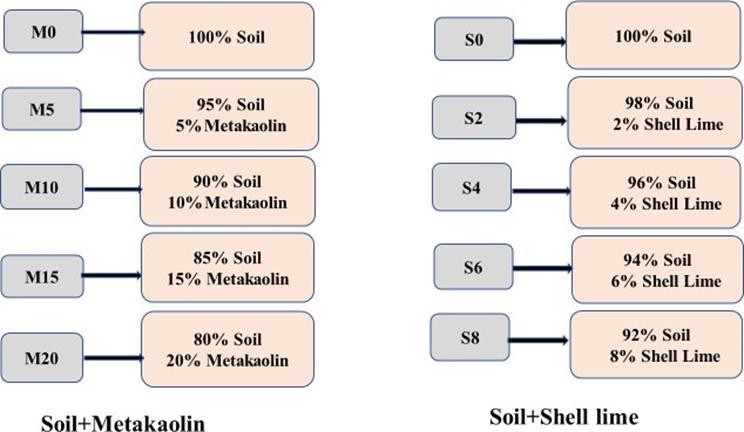
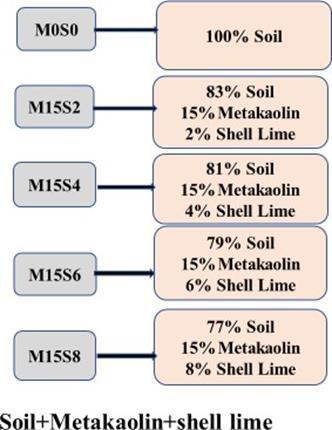
This study investigates the stabilization of expansive soil collected from Gajulamandyam Industrial Area, Tirupati using metakaolin and shell lime. The untreated soil was first tested for its basic geotechnical properties, including Atterberg limits, compactioncharacteristics, UCS,andCBR asperISstandards.Metakaolinwasthenaddedinvarying proportions (5%–20%) to identify the optimum content. Based on this, further stabilization was carried out by adding shell lime (2%–10%) along with the optimum metakaolin content. All soil mixtures were compacted at their OMC and MDD and tested to evaluate improvements in engineering behavior. The results of treated soils were compared with untreated soil to determine the most effectivecombinationforstabilization.
2.2.1
3. RESULTS AND DISCUSSION
3.1
3.1.1
Atterberglimitsofthetreatedsoilweredeterminedasper IS: 2720 (Part 5) – 1985. The liquid limit shows variation with the increase in percentage of metakaolin. The plastic limit also changes with the addition of stabilizers. The
variation of liquid limit with percentage of stabilizers is shown in Fig. 1,and the variation of plastic limit is shown in Fig. 2. The plasticity index of soil with varying percentagesofmetakaolinispresentedinFig.3
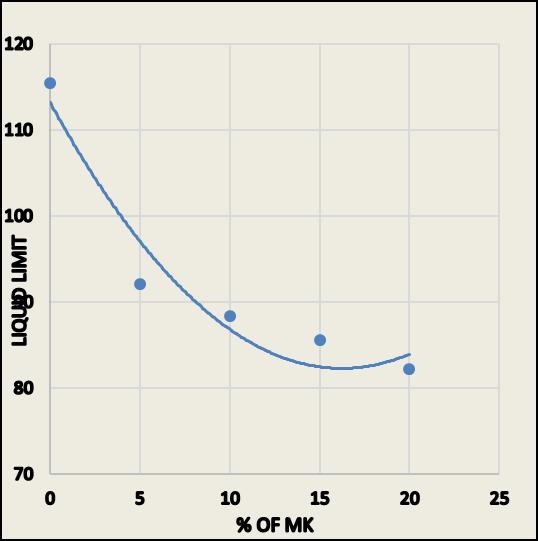
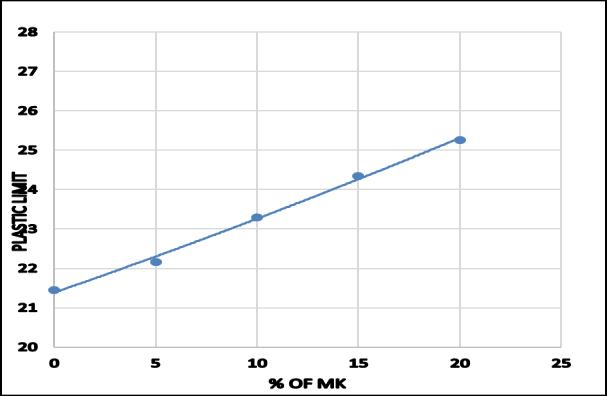
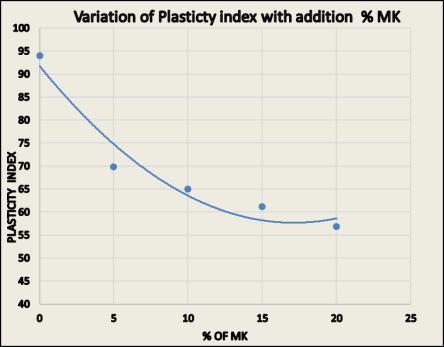
The Atterberg limits show notable improvement with increasing metakaolin content. The liquid limit decreases from 115.5% to 82.2%, while the plastic limit increases from 21.5% to 25.3%, leading to a reduction in plasticity indexfrom94%to56.9%. This improvementisattributed to cation exchange, flocculation–agglomeration, and reduced diffuse double layer thickness, which modify the soilstructureandloweritswateraffinity.
International Research Journal of Engineering and Technology (IRJET) e-ISSN: 2395-0056
Volume: 13 Issue: 05 | May 2026 www.irjet.net p-ISSN: 2395-0072
The Compaction characteristics of natural soil and stabilized soil mixtures were determined in accordance withIS:2720(Part7)–1980.StandardProctortestswere conducted to determine the Optimum Moisture Content (OMC) and Maximum Dry Density (MDD) for soil blended withvaryingpercentagesofMetakaolin(MK).
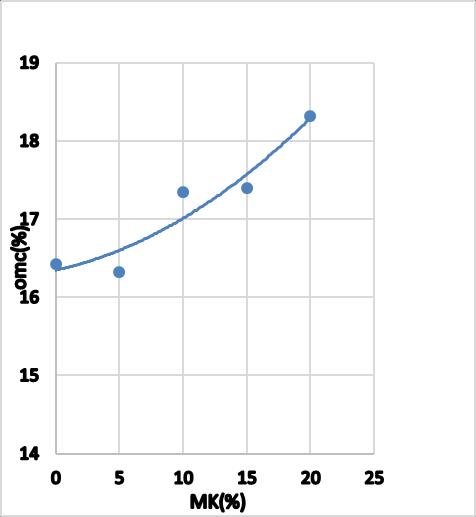
-4: VariationofOMCwithadditionof%Metakaolin
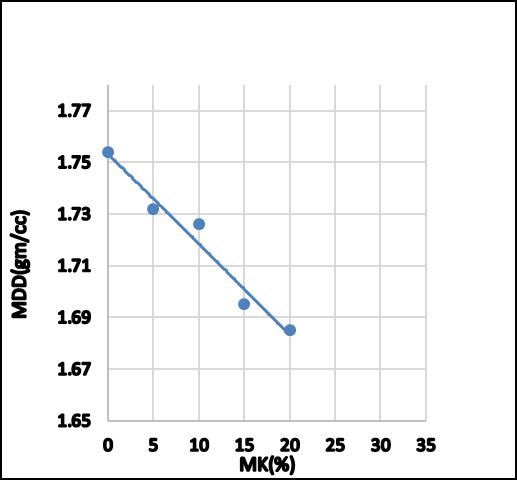
Fig -5: VariationofMDDwithadditionof%Metakaolin
The compaction results show that with increasing metakaolincontent,theOptimumMoistureContent(OMC) increases from 16.43% to 18.32% due to higher water demand caused by its large surface area and pozzolanic activity. At the same time, the Maximum Dry Density (MDD)decreasesfrom1.754g/ccto1.685g/ccbecauseof thelowerspecificgravityofmetakaolinandformationofa flocculatedsoilstructure.Overall,metakaolinmodifiessoil behaviorbyincreasingmoisturerequirementandreducing drydensity.
3.1.3
To evaluate the strength characteristics and effectiveness of stabilization, the Unconfined Compressive Strength (UCS)testwasconductedonnaturalsoilandsoilstabilized withvaryingpercentagesofMetakaolininaccordancewith IS:2720(Part10)–1991.
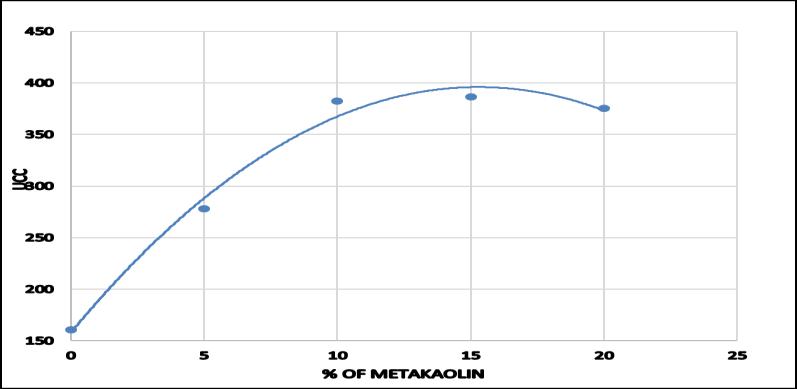
Fig -6: VariationofUCCofsoilmixedwithadditionof Metakaolinindifferentpercentages
The UCC increased from 160.78 kPa for natural soil to a maximum of 386.61 kPa at 15% metakaolin, indicating significant strength enhancement due to pozzolanic reactions. A slight reduction at 20% suggests excess stabilizer beyond the optimum level. Therefore, 15% metakaolin is identified as the optimum dosage for strengthimprovement.
3.2.1
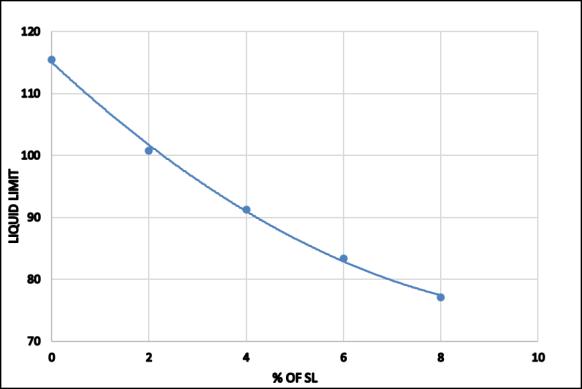
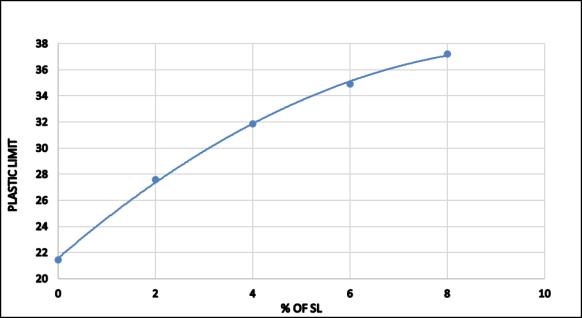
TheAtterberglimitsofthetreatedsoilweredeterminedas per IS: 2720 (Part 5) – 1985.The liquid limit shows variationwiththeincreaseinpercentageofshelllime.The plastic limit also changes with the addition of stabilizers. The variation of liquid limit with percentage of stabilizers isshowninFig.7,andthevariationofplasticlimitisshown in Fig. 8. The plasticity index of soil with varying percentagesofshelllimeispresentedinFig9.
International Research Journal of Engineering and Technology (IRJET) e-ISSN: 2395-0056
Volume: 13 Issue: 05 | May 2026 www.irjet.net p-ISSN: 2395-0072
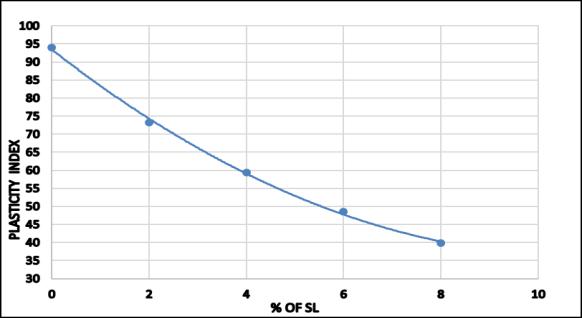
-9:VariationofPlasticityIndexwithaddition%Shell Lime
The addition of metakaolin resulted in a progressive decrease in liquid limit and plasticity index, while plastic limit increased with dosage. The plasticity index reduced from 94.00% to 39.90% at 20% metakaolin, indicating significant reduction in soil plasticity due to pozzolanic reactionsandflocculationmechanisms.
Compaction characteristics of natural soil and stabilized soil mixtures were determined in accordance with IS: 2720 (Part 7) – 1980. Standard Proctor tests were conducted to determine the Optimum Moisture Content (OMC) and Maximum Dry Density (MDD) for soil blended withvaryingpercentagesofShellLime.
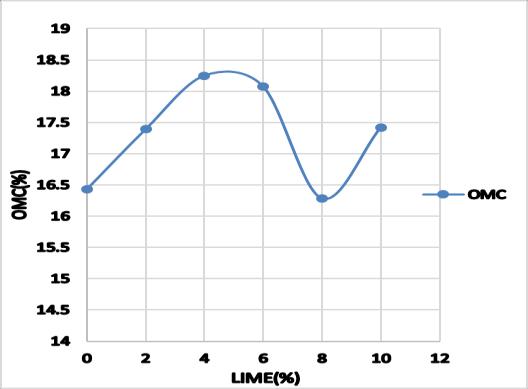
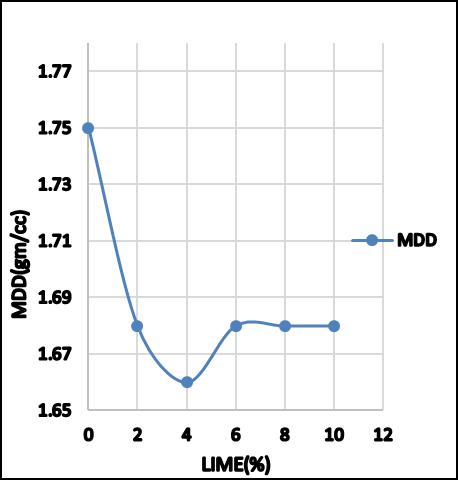
The OMC increased from 16.43% to 18.25% at 4% lime content due to hydration and flocculation reactions, followed by minor fluctuations at higher dosages. The MDDdecreasedfrom1.75g/ccto1.66g/ccandremained nearlyconstantthereafter.Theseresultsindicatethatlime addition increases moisture demand while slightly reducingdrydensity.
To evaluate the strength characteristics and effectiveness of stabilization, the Unconfined Compressive Strength (UCS)testwasconductedonnaturalsoilandsoilstabilized withvaryingpercentagesofShellLimeinaccordancewith IS:2720(Part10)–1991.
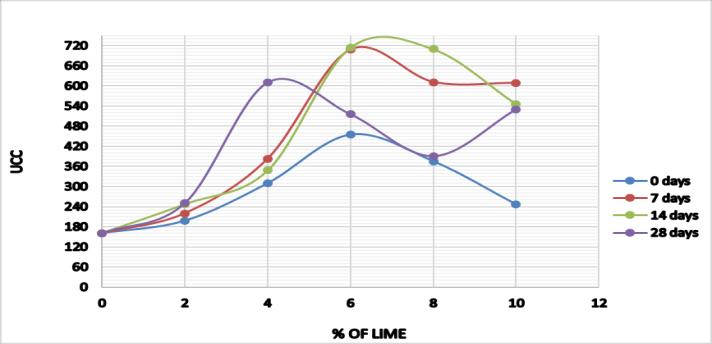
Fig -12: VariationofUCCofsoilmixedwithadditionof Metakaolinindifferentpercentages
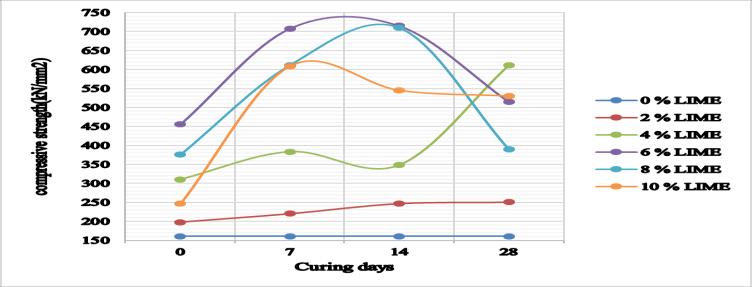
Fig -13: VariationofUCCofsoilmixedwith% Metakaolinandcuringdays
International Research Journal of Engineering and Technology (IRJET) e-ISSN: 2395-0056
Volume: 13 Issue: 05 | May 2026 www.irjet.net p-ISSN: 2395-0072
TheUCSofthesoilincreaseswithlimeadditionandcuring time,reachinganoptimumatabout6–8%limecontent.In thisstudy,strengthrosefrom160.78kPa(untreated)toa maximum of 715.07 kPa at 6% lime after 14 days of curing,butdecreasedathigherlimecontentsduetoexcess unreacted lime, increased voids, and carbonation effects. Overall, lime significantly improves soil strength up to an optimumdosage,afterwhichtheimprovementreduces.
3.3.1
The compaction characteristics of natural soil and stabilized soil mixtures were determined in accordance withIS:2720(Part7)–1980.StandardProctortestswere conducted to determine the Optimum Moisture Content (OMC)andMaximumDryDensity(MDD).Inthisstudy,the soil was first stabilized with the optimum percentage of metakaolin and then blended with varying percentages of shell lime(2%, 4%,6%,8%,and10%).The effectof shell lime on the compaction behavior of the metakaolintreated soil was evaluated by determining the corresponding OMC and MDD values. The variations in OMC and MDD with increasing shell lime content are presented in Table and illustrated in the corresponding figures.
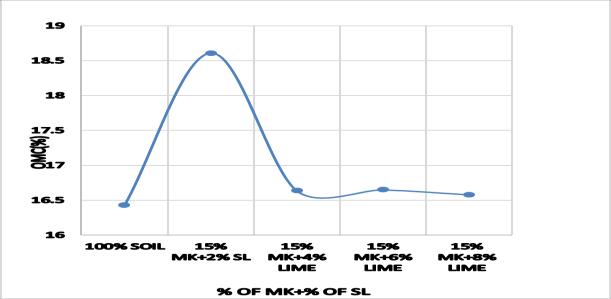
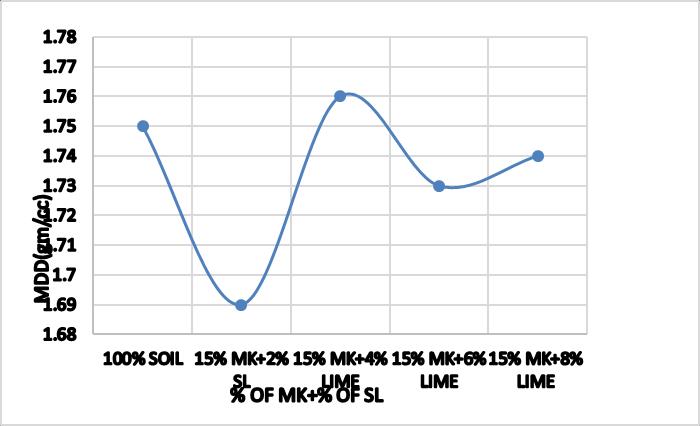
Thecompactioncharacteristicsofsoilstabilizedwith15% metakaolin and varying shell lime contents show that the OptimumMoistureContent(OMC)increasesfrom16.43% (untreated) to 18.61% at 2% lime due to flocculation and hydration effects, with only minor variations at higher limedosages.TheMaximumDryDensity(MDD)decreases initially to 1.69 g/cc at 2% lime and then remains nearly stable between 1.73–1.76 g/cc. Overall, lime addition increases moisture demand and causes slight changes in densityduetosoilstructuremodification.
To evaluate the strength characteristics and effectiveness of stabilization, the Unconfined Compressive Strength (UCS)testwasconductedonnaturalsoilandsoilstabilized with optimum metakaolin varying percentages of Shell LimeinaccordancewithIS:2720(Part10)–1991.
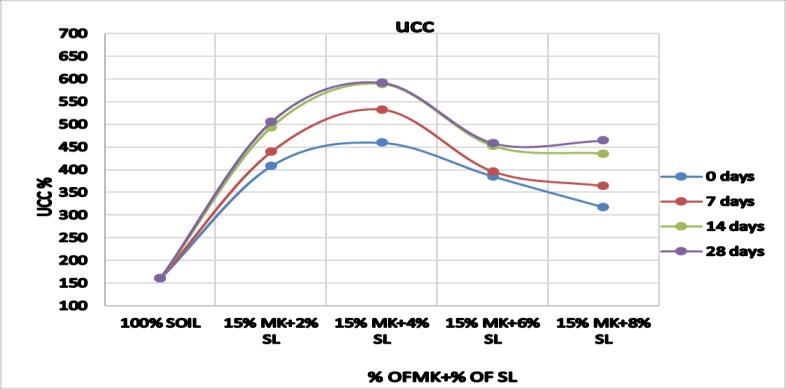
Fig -16:VariationofUCCofsoilmixedwithadditionof Metakaolinindifferentpercentages
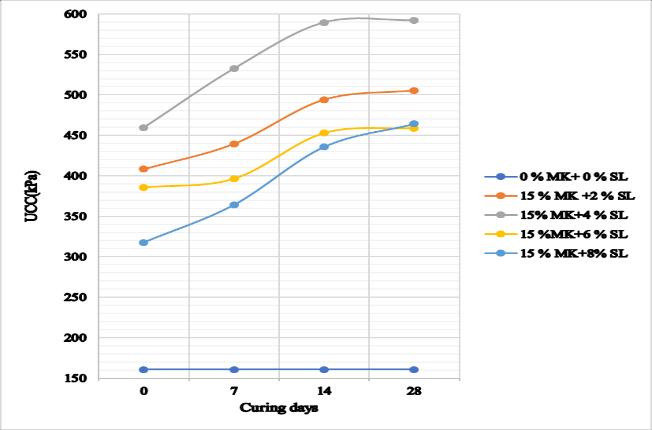
Fig -17:VariationofUCCofsoilmixedwithadditionof Limeatdifferentcuringdays(0,7,14,28)
The UCS of soil improves significantly with the combined use of metakaolin (MK) and shell lime (SL), along with curing time, reaching an optimum at MK15+SL4. The strength increases from 160.78 kPa (untreated) to a maximum of 592.07 kPa after 28 days of curing, but
International Research Journal of Engineering and Technology (IRJET) e-ISSN: 2395-0056
Volume: 13 Issue: 05 | May 2026 www.irjet.net p-ISSN: 2395-0072
decreases at higher lime contents. This improvement is due to the synergistic reaction between lime and metakaolin, leading to the formation of cementitious compounds (C–S–H and C–A–H) through cation exchange, flocculation, and pozzolanic reactions. Overall, the combined stabilizers significantly enhance soil strength andalteritsbehavior.
CBRofnaturalsoilandblendedmixesweredeterminedas per IS: 2720 (Part XVI) – 1991. The Fig. 18 and Fig. 19 shows the CBR curves of soil mixed with optimum MetakaolinandvaryingpercentagesofShellLime.
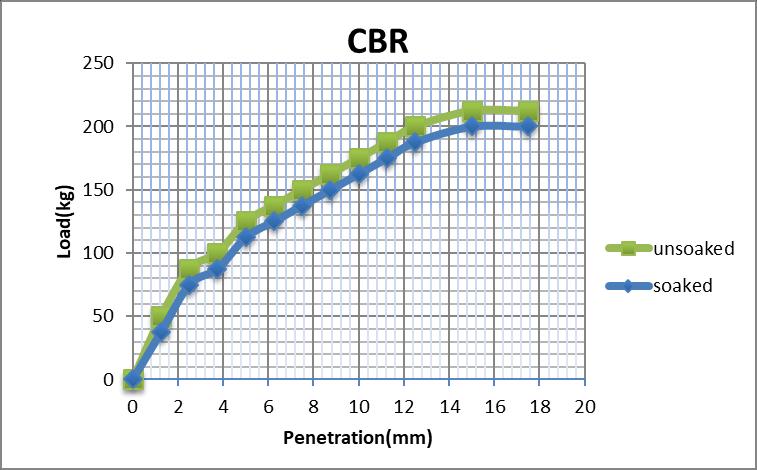
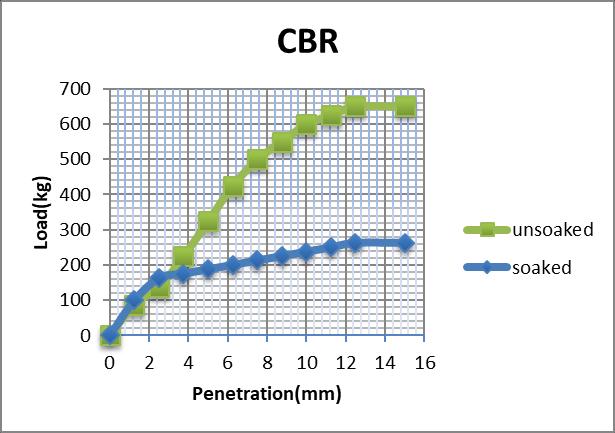
The CBR values show a significant improvement after stabilizationwith15% metakaolinand4%shell lime. The untreatedsoilhaslowstrengthwithCBR values of6.39% (unsoaked) and 5.47% (soaked), indicating poor loadbearing capacity. After treatment, the values increase to 15.82% (unsoaked) and 11.86% (soaked). This improvement is due to pozzolanic reactions between metakaolin and lime, forming cementitious compounds likeC–S–HandC–A–S–H,whichenhancesoilstrength.
The study shows that stabilization of expansive soil using metakaolin, shell lime,andtheircombinationsignificantly improves its engineering properties. With increasing metakaolin content, the liquid limit and plasticity index decrease while the plastic limit increases. The OMC increases and MDD shows variation, while UCS improves uptoanoptimumof15%metakaolin,reachingabout2.41 timesthatofuntreatedsoil.Similarly,shelllimetreatment reducesplasticity,increasesOMC,andimprovesUCSupto 6% lime, giving a maximum strength of about 4.40 times the untreated soil. For the combined treatment, the optimum mix of 15% metakaolin and 4% lime gives the best performance, with UCS increasing to 3.66 times after 28 days of curing. The same mix also significantly improves CBR values, increasing unsoaked CBR from 6.39%to15.82%andsoakedCBRfrom5.47%to11.86%, confirming enhanced strength and load-bearing capacity ofthetreatedsoil.
[1] H. Seed, and R. J. Woodward, “Prediction of Swelling Potential for Compacted Clays” ASCE, Volume 88, Issue3,53-88(1962).
[2] D. H. Van der Merwe and J. J. J. M. Garcia, “Lime stabilization of expansive soil from Sergipe –Brazil”, Trans.SAIns.Civ.Eng,6,103-107(1964).
[3] Textbookon“FoundationonExpansiveSoils”byF.H. Chen, Elsevier Scientific Publishing Co., New York, 1975.
[4] V.Barbosa, Masters Thesis, "Geotechnical Characterization and Lime Stabilization of Expansive ClaySoil fromCabrobó-PE" - UniversidadeFederal de Pernambuco(2013).x
[5] A. R. Estabragh and H. Rafatjo, “Treatment of an expansive soil by mechanical and chemical techniques”,GeosynthInt,21,233-243(2014).
[6] S.BhuvaneshwariandR.G.Robinson,“Characterization ofDispersiveSoils”,IGJ,44,278-293(2014).
[7] EmekaSegunNnochiri andOlumide Moses Ogundipe, “Effects of Snail Shell Ash on Lime Stabilized Lateritic Soil” Malaysian Journal of Civil Engineering 30(2):239-253(2018).
[8] D. B. Eme1and C. Nwaobakata, “Investigating the Suitability of Snail Shell Ash as Partial Replacement for Soil Cement Stabilization”, ISSN (Online): 24559024, International Research Journal of Advanced Engineering and Science, Volume 4, Issue 1, pp. 111114,2019.
International Research Journal of Engineering and Technology (IRJET) e-ISSN: 2395-0056
Volume: 13 Issue: 05 | May 2026 www.irjet.net p-ISSN: 2395-0072
[9] F.O.AyodeleandO.O.Popoola “Potential ofsnail shell and palm kernel shell powders in improving engineering properties of clay”, Journal / Journal of Applied Sciences and Environmental Management / Vol.23No.8(2019)/Articles.
[10] O.O. Amu And O.A. Adetayo, “Modification Of Cement Stabilized Structural Lateritic Pulverized Snail Shell”, A CTA TechnicaCorviniensis– Bulletin of Engineering TomeXII[2019]|Fascicule4[October–December]
[11] O Ofuyatanand A Olowofoyeku, “Effect of snail shell ash on black cotton soil”, Journal of Physics: Conference Series, Volume 1734, International Conference on Recent Trends in Applied Research (ICoRTAR)202014-15August2020,Nigeria
[12] Olaolu George Fadugba andAdeyemi Amos Ojo, “Assessment of the Microstructure and Geotechnical Characteristics of Lime-Improved Lateritic Soil with the Addition of Pulverised Snail Shell and SawdustAshforSustainableHighwayInfrastructure”20 23,https://papers.ssrn.com/sol3/papers.cfm?abstract _id=4536028
[13] Olaolu George Fadugba and Adeyemi Amos Ojo, “Performance evaluation of lime- improved lateritic soil with the addition of of pulverised snail shell and sawdust ash for sustainable highway infrastructure”, springernaturelink,Vol.1,articlenumber122,(2024)
[14] H. Gupta and A. K. Saxena, “Strength Properties of Steel Slag in Concrete,” International Journal of EngineeringResearch&Technology(IJERT),vol.6,no. 11,pp.93–97,2017.
[15] A.J.Jeya,M.Hemavathy,andM.Gouthampriya,“Partial Replacement Of Cement By Ground Granulated Blast Furnace Slag In Concrete,” Archaeology Of Egypt/Egyptology, vol. 17, no. 7, pp. 10021–10029, 2020.
[16] M. M. Salman, K. M. Owaid, and D. R. Hussein, “StudyingtheEffectofIraqiSteelSlagAdditiononthe PhysicalandMechanicalPropertiesofCementMortar, ”JournalofEngineeringandSustainableDevelopment, pp24-35,2017.
[17] F.Kazem,I.K.Jumea,andT.Jasim,“InfluenceofUsing the Local Slag on the Porosity and Absorption of the HighPerformanceConcrete,”IraqiAcademicScientific Journal of Techniques (IASJ), vol.24, no. 2, pp. A42–A56,2011.
[18] D. Suresh and K. Nagaraju, “Ground Granulated Blast Slag (GGBS) In Concrete – A Review, ” Journal of MechanicalandCivilEngineering(IOSRJMCE),vol.12, no.4,pp.76-82,2015.
[19] A. V. Bhat and S. K. Tengli, “Behaviour of ground granulated blast furnace slag concrete in marine environment under chloride attack,” International Journal of Innovative Technology and Exploring Engineering (IJITEE), vol. 9, no. 1, pp. 1659–1664, 2019,doi:10.35940/ijitee.A4699.119119.
[20] WangQiang,YanPeiyu.Hydrationpropertiesofbasic oxygen furnace steel slag. Construction and Building Materials24(2010)11341140.http://dx.doi.org/10.10 16/j.conbuildmat.2009.12.028