International Research Journal of Engineering and Technology (IRJET)
e-ISSN: 2395-0056
Volume: 13 Issue: 05 | May 2026
p-ISSN: 2395-0072
www.irjet.net
ONLINE RECRUITMENT FRAUD (ORF) DETECTION USING DEEP LEARNING APPROACHES P. Hima Bindhu1 Mr.S Muni Kumar 2 1student, Mca 2nd Year Kmmips, Tirupati, Affiliated To S.V. University, Tirupati, A.P, India
2Associate professor, Dept Of Mca, Kmmips, Tirupati, Affiliated To S.V. University, Tirupati, A.P, India
---------------------------------------------------------------------***----------------------------------------------------------------------
ABSTRACT - Most companies nowadays are using digital
through job portals, in which they mention job descriptions, including requirements, salary packages, job advertisements were inflated during the global pandemic of COVID 2019. According to the World Economic Outlook Report, the International Monetary Fund (IMF)estimated that the unemployment rate increased to 13% at the peak time of the COVID-19 pandemic in 2020. These statistics were only 7.3% in 2019 and 3.9% in 2018. During the outbreak, many companies decided to post job openings online to provide facilities to job seekers. But, where a facility is provided to the public, it also allows online fraudsters to take advantage of their pessimism. An employment scam is one of the considerable problems in the realm of online recruitment fraud (ORF). Although an online recruitment system benefits job seekers and recruiters, it can also be deleterious for them if it is not administered carefully.
platforms for the recruitment of new employees to make the hiring process easier. The rapid increase in the use of online platforms for job posting has resulted in fraudulent advertising. The scammers are making money through fraudulent job postings. Online recruitment fraud has emerged as an important issue in cybercrime. Therefore, it is necessary to detect fake job postings to get rid of online job scams. In recent studies, traditional machine learning and deep learning algorithms have been implemented to detect fake job postings; this research aims to use two transformerbased deep learning models, i.e., Bidirectional Encoder Representations from Transformers and Robustly Optimized BERT-Pertaining Approach (Roberta) to detect fake job postings precisely. In this research, a novel dataset of fake job postings is proposed, formed by the combination of job postings from three different sources. Existing benchmark datasets are outdated and limited due to knowledge of specific job postings, which limits the existing models’ capability in detecting fraudulent jobs. Hence, we extend it with the latest job postings. Exploratory Data Analysis (EDA) highlights the class imbalance problem in detecting fake jobs, which tends the model to act aggressively toward the minority class. Responding to overcome this problem, the work at hand implements ten top-performing Synthetic Minority Oversampling Technique (SMOTE) variants. The models’ performances balanced by each SMOTE variant are analysed and compared. All implemented approaches are performed competitively. However, BERT+SMOBD SMOTE achieved the highest balanced accuracy and recall of about 90%
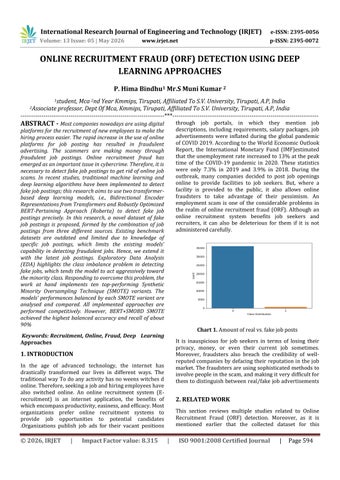
Chart 1. Amount of real vs. fake job posts
Keywords: Recruitment, Online, Fraud, Deep Learning Approaches
It is inauspicious for job seekers in terms of losing their privacy, money, or even their current job sometimes. Moreover, fraudsters also breach the credibility of wellreputed companies by defacing their reputation in the job market. The fraudsters are using sophisticated methods to involve people in the scam, and making it very difficult for them to distinguish between real/fake job advertisements
1. INTRODUCTION In the age of advanced technology, the internet has drastically transformed our lives in different ways. The traditional way To do any activity has no weens witches d online. Therefore, seeking a job and hiring employees have also switched online. An online recruitment system (Erecruitment) is an internet application, the benefits of which encompass productivity, easiness, and efficacy. Most organizations prefer online recruitment systems to provide job opportunities to potential candidates .Organizations publish job ads for their vacant positions
© 2026, IRJET
|
Impact Factor value: 8.315
2. RELATED WORK This section reviews multiple studies related to Online Recruitment Fraud (ORF) detection. Moreover, as it is mentioned earlier that the collected dataset for this
|
ISO 9001:2008 Certified Journal
|
Page 594