
International Research Journal of Engineering and Technology (IRJET) e-ISSN: 2395-0056
Volume: 13 Issue: 03 | Mar 2026 www.irjet.net p-ISSN: 2395-0072
International Research Journal of Engineering and Technology (IRJET) e-ISSN: 2395-0056
Volume: 13 Issue: 03 | Mar 2026 www.irjet.net p-ISSN: 2395-0072
Dr. Ch. V. Phani Krishna1 , D. Sreeja Reddy2 , Ch.Alekhya3 , B.Dinesh Reddy4 , D.Lakshmikanth5
1 Professor & HOD, Department of Computer Science and Engineering
2,3,4,5 B.Tech Students, Department of Computer Science and Engineering Teegala Krishna Reddy Engineering College , Telangana, India
Abstract - In educational institutions, evaluating student performance in laboratory courses requires faculty members to manually record and calculate marks across multiple sessions.Thismanualprocessistime-consuming,error-prone, and inefficient. To address these challenges, this research proposes an OCR-based web application that automates the extraction and calculation of student laboratory marks. The system uses Optical Character Recognition (OCR) and image processingtechniquestocaptureandanalyzeimagesof mark sheets. Techniques such as image preprocessing, cell segmentation, and digit recognition are employed to accurately extract numerical values from structured tables. Theextractedmarksareautomaticallyprocessedtocompute total scores and average performance of students. The proposed system integrates computer vision and machine learningtechniques,includingConvolutionalNeuralNetworks (CNNs),toimproverecognitionaccuracy.Thewebapplication providesauser-friendlyinterfacethatallowsfacultymembers to capture images of lab evaluation sheets and instantly obtain calculated results. This automated solution significantly reduces manual workload, minimizes human errors, and improves the efficiency of academic evaluation processes. The system also ensures standardized and reliable assessment of laboratory performance. The proposed OCR calculator can be effectively adopted by educational institutions to enhance digital transformation in academic evaluation systems.
Key Words: Optical Character Recognition, OCR, Digit Recognition, Image Processing, CNN, Web Application.
Optical Character Recognition (OCR) is a powerful technologythatconvertsprintedorhandwrittentextfrom imagesorscanneddocumentsintomachine-readabledigital text.Ithasbecomeanessentialtoolfordigitizingphysical documentsandautomatingdataextractionprocesses.OCR systems use a combination of image processing, pattern recognition, and machine learning techniques to analyze imagesandrecognizecharacterswithhighaccuracy.
The OCR process typically includes several stages such as image acquisition, preprocessing, segmentation, feature extraction,andcharacterrecognition.Duringpreprocessing, techniquessuchasnoiseremoval,thresholding,andimage enhancement are applied to improve image quality. After
preprocessing, segmentationtechniques isolateindividual characters or digits from the image. Machine learning models, particularly deep learning algorithms like Convolutional Neural Networks (CNNs), are then used to recognizetheextractedcharacters.
OCR technologyhasbeen widelyadopted in manysectors includingbanking,healthcare,documentmanagement,and education. In educational institutions, OCR can be used to digitizeacademicrecords,automategradingprocesses,and simplifyadministrativetasks.Despitetheseadvancements, manylaboratoryevaluationsystemsstillrelyonmanualdata entry and calculation of marks, which can be timeconsumingandpronetohumanerror.
Facultymembersoftenneedtomanuallyrecordmarksfor eachstudentacrossmultiplelaboratorysessionsandlater calculatethetotalandaveragescores.Thisprocessbecomes increasingly difficult when dealing with large numbers of students.Therefore,thereisastrongneedforanautomated system that can simplify and speed up this evaluation process.
This project proposes an OCR-based calculator web applicationdesignedtoautomatetheevaluationofstudent laboratory performance. The system captures images of mark sheets, extracts numerical values using OCR techniques, and automatically calculates the total and average marks. By integrating image processing, machine learning, and web application technology, the proposed systemimprovesefficiency,reducesmanualworkload,and ensuresaccuratestudentperformanceevaluation.
OpticalCharacterRecognition(OCR)playsasignificantrole in converting physical documents into digital formats. It enablestheautomaticextractionoftextualinformationfrom images and scanned documents, allowing the data to be stored, edited, and processed electronically. Modern OCR systemsrelyonadvancedalgorithms,deeplearningmodels, andpatternrecognitiontechniquestoachievehighaccuracy in character recognition. In the context of educational institutions, OCR can simplify many administrative tasks, including grading, document digitization, and record management. By using OCR technology, information from printedorhandwrittendocumentscanbequicklyconverted
International Research Journal of Engineering and Technology (IRJET) e-ISSN: 2395-0056
Volume: 13 Issue: 03 | Mar 2026 www.irjet.net p-ISSN: 2395-0072
intodigital data thatcanbe easilyprocessedbycomputer systems. The proposed OCR calculator system uses image processingtechniquestocaptureimagesoflaboratorymark sheets and extract the marks assigned to students. The systemthenperformsautomaticcalculationstodetermine the total marks and average scores. This automation significantlyreducesmanualeffortandimprovesthespeed andaccuracyoftheevaluationprocess.
Ineducationalenvironments,evaluatingstudentlaboratory performanceoftenrequiresmanualentryandcalculationof marks. Faculty members must record marks for multiple studentsacrossdifferentlabsessionsandcalculatethefinal consolidated results. This process is repetitive, timeconsuming, and prone to errors. Additionally, manual evaluation processes increase the workload for faculty members and reduce the time available for teaching and researchactivities.Automatingthisprocesscansignificantly improveefficiencyandaccuracy.
OCRtechnologyoffersapracticalsolutionforthischallenge by enabling automatic extraction of numerical data from mark sheets. By integrating OCR with web application technology, faculty members can easily capture images of mark sheets and automatically calculate student performancemetrics.Thismotivatesthedevelopmentofan OCR-based web application that simplifies the evaluation process.
Inlaboratory-basedcourses,facultymembersmustevaluate studentperformancebasedonmarksobtainedinmultiple lab sessions. Traditionally, this process involves manually recordingmarksfromlabevaluationsheetsandcalculating consolidatedscoresforeachstudent.Thismanualapproach is inefficient and susceptible to human errors, especially whendealingwithalargenumberofstudents.Furthermore, the time spent on manual calculations reduces the time availableforacademicactivitiessuchasteaching,mentoring, andresearch.Errorsinmanualdataentrycanalsoaffectthe accuracyandfairnessofstudentassessments.
To address these issues, there is a need for an automated system that can capture marks directly from evaluation sheetsandperformcalculationsautomatically.Theproposed OCRcalculatorsystemaimstosolvethisproblembyusing imageprocessingandOCRtechniquestoextractnumerical valuesandcomputeperformancemetricsinstantly.
Themainobjectivesoftheproposedsystemare:
1. To develop a web application that automates the evaluation and consolidation of student laboratory marksusingOCRtechnology.
2. Toimproveefficiencybyreducingthemanualworkload involvedinrecordingandcalculatingmarks.
3. To enhance accuracy by minimizing human errors in dataentryandcalculation.
4. Toimplementrobustimageprocessingtechniquesfor preprocessingandsegmentationofmarksheetimages.
5. To provide instant calculations of total marks and averagescoresbasedonextracteddata.
6. To design a user-friendly interface that allows faculty memberstoeasilycaptureandprocessimagesofmark sheets.
TheproposedsystemintroducesanautomatedOCR-based web application designed to simplify and improve the evaluation process of student laboratory performance. Traditionalevaluationmethodsrequirefacultymembersto manuallyrecordmarksfromlaboratorysheetsandcalculate totals and averages. This process is time-consuming and susceptibletoerrors.Theproposedsystemaddressesthese limitationsbyusingOpticalCharacterRecognition(OCR)and image processing techniques to automatically extract and processnumericaldatafrommarksheets.
The system allows faculty members to capture images of laboratory evaluation sheets using a web application. The captured images are processed through several stages including image preprocessing, cell segmentation, digit recognition,anddataconsolidation.Theseprocessesenable the system to accurately identify marks from structured tablesandautomaticallycomputeperformancemetricssuch astotalmarksandaveragescores.
By integrating computer vision algorithms and machine learningtechniquessuchasConvolutionalNeuralNetworks (CNNs),theproposedsystemensuresreliablerecognitionof numericcharactersevenundervaryinglightingconditions and image quality. The automated system significantly reducesmanualeffort,improvesaccuracyinevaluation,and providesinstantfeedbacktoeducators.
Theproposedsystemisimplementedasawebapplication designed to provide a user-friendly interface for faculty members.Thewebappactsasthecentralplatformwhere users can capture images of laboratory mark sheets and processthemautomatically.
The application allows users to upload or capture images using the device camera. Once the image is captured, the systemprocessestheimageandextractsrelevantdata.The interface is designed to be simple and intuitive so that
International Research Journal of Engineering and Technology (IRJET) e-ISSN: 2395-0056
Volume: 13 Issue: 03 | Mar 2026 www.irjet.net p-ISSN: 2395-0072
faculty members can easily operate the system without requiringtechnicalexpertise.
The web application also displays the calculated results, including the extracted marks, total scores, and average performance of students. This helps educators quickly analyzestudentperformanceandmaintaindigitalrecords.
Image processing plays a crucial role in improving the quality of captured images before performing OCR. The capturedimagesmaycontainnoise,shadows,ordistortions that can affect recognition accuracy. Therefore, preprocessing techniques are applied to enhance image quality.
These preprocessing techniques include noise reduction, grayscale conversion, thresholding, and image normalization.Edgedetectionalgorithmsarealsoappliedto identifythestructureoftablesandgridspresentinthemark sheet.
Byenhancingimageclarityandstructure,thepreprocessing stageensuresthattheOCRsystemreceivescleanandwellstructured input data, thereby improving the accuracy of digitrecognition.
Cellsegmentationistheprocessofidentifyingandisolating individualcellswithinthetablestructureofthemarksheet. Sincemarksareusuallywrittenintabularformat,detecting the boundaries of each cell is essential for extracting the correct values. The system uses techniques such as edge detection and Hough Transform to detect lines and grid structures within the image. Once the grid structure is identified, the image is divided into individual cells corresponding to different marks. Each segmented cell is then processed individually to extract the digits present within it. This segmentation step ensures that the OCR systemfocusesonlyonrelevantregionscontainingmarks, therebyimprovingrecognitionaccuracy.
OpticalCharacterRecognition(OCR)isthecorecomponent oftheproposedsystem.TheOCRmoduleisresponsiblefor extracting textual or numerical information from the segmentedcells.
TheOCRengineanalyzestheprocessedimageandidentifies characters using pattern recognition techniques. Machine learningmodels,particularlyConvolutionalNeuralNetworks (CNNs), are used to recognize digits accurately. The OCR module converts the detected characters into machinereadabletext.
This recognized text represents the marks assigned to students in laboratory sessions. The OCR module ensures accurateextractionofnumericaldataevenwhendigitsare handwrittenorslightlydistorted.
AftertheOCRprocessextractsthenumericalvaluesfromthe mark sheet, the data consolidation module organizes the recognizednumbersintoastructuredformat.Theextracted marks are mapped to the corresponding students and lab sessions.Thesystemthenperformsautomaticcalculations suchascomputingtotalmarksandaveragescoresforeach student. These results are displayed within the web application for quick analysis. This automated calculation processeliminatesmanualeffortandreducesthepossibility of human errors in mark consolidation. It also allows educators to instantly evaluate student performance and maintaindigitalrecordsefficiently.
TheimplementationoftheproposedOCR-basedcalculator system involves integrating image processing techniques, machine learning algorithms, and web application development. The system is designed to automatically capture images of laboratory evaluation sheets, extract numerical marks using OCR, and calculate performance metrics such as total and average marks. The implementation focuses on ensuring accurate digit recognition, efficient data processing, and a user-friendly interfaceforfacultymembers.
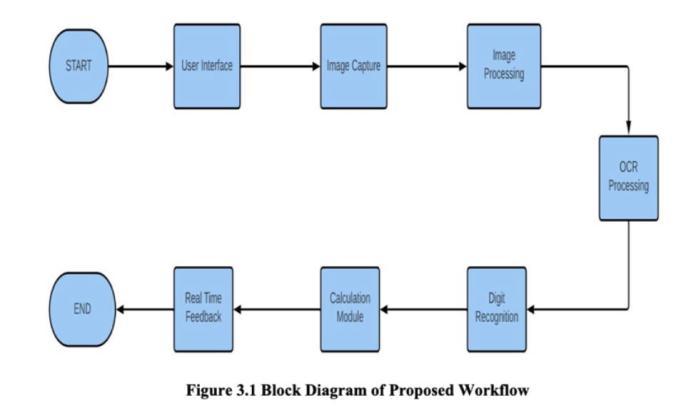
Thesystemfollowsastructuredworkflowwhereeachstage performs a specific task such as image capture, preprocessing, segmentation, recognition, and calculation. Thesecomponentsworktogethertoautomatetheevaluation processandprovideinstantresults.
Thesystemarchitectureillustratestheoverallstructureand workflowoftheproposedOCR-basedevaluationsystem.It showshowdifferentcomponentsinteractwitheachotherto process inputimagesandgeneratecalculatedresults. The architecture consists of several modules including image capture, image preprocessing, cell segmentation, OCR processing, digit recognition, and data consolidation. Initially,theusercapturesanimageofthelaboratorymarks sheetusingthewebapplication.Thecapturedimageisthen sent to the preprocessing module, where noise reduction andimageenhancementtechniquesareapplied.
Afterpreprocessing,thesystemperformscellsegmentation to detect table structures and isolate individual cells containingmarks.Eachsegmentedcellisthenprocessedby theOCRmoduletorecognizedigitsusingmachinelearning algorithmssuchasConvolutionalNeuralNetworks(CNNs).
International Research Journal of Engineering and Technology (IRJET) e-ISSN: 2395-0056
Volume: 13 Issue: 03 | Mar 2026 www.irjet.net p-ISSN: 2395-0072
Therecognizednumericalvaluesarethensenttothedata consolidation module, where calculations such as total marks and average scores are performed. Finally, the calculatedresultsaredisplayedtotheuserthroughtheweb applicationinterface.
The first stage of the system involves capturing images of laboratoryevaluationsheetsusingthewebdevicecamera. Theapplicationallowsuserstoeithercaptureimagesinreal timeoruploadpreviouslycapturedimagesfromthedevice storage.
The image acquisition module ensures that the captured images have sufficient clarity and brightness for further processing. Proper alignment and focus are important to ensureaccuraterecognitionofdigitsduringlaterstages.
Imagepreprocessingisperformedtoimprovethequalityof thecapturedimagesandremoveunnecessarynoise.Since raw images may contain distortions, shadows, or uneven lighting, preprocessing techniques are applied to enhance theimageforaccurateOCRprocessing. Thepreprocessing stage includes operations such as grayscale conversion, noise reduction, thresholding, and image normalization. These operations help highlight textual and numerical regions within the image while removing unwanted background elements. By improving image quality, the preprocessingstageincreasestheaccuracyofsegmentation andcharacterrecognition.
Inlaboratoryevaluationsheets,marksareusuallyrecorded intabularform.Therefore,detectingthetablestructureand isolating individual cells is an important step in the implementation.Thesystemusestechniquessuchasedge detection and the Hough Transform to identify horizontal andverticallinesintheimage.Thesedetectedlinesareused to locate the boundaries of the table and divide it into individual cells. Each segmented cell corresponds to a
specificmarkentry.Thesecellsareextractedandforwarded totheOCRmodulefordigitrecognition.
TheOCRmoduleisresponsibleforrecognizingcharacters and digits from the segmented cells. The system analyzes eachcellimageandidentifiesnumericalvaluesusingpattern recognition and machine learning techniques. A Convolutional Neural Network (CNN) model is used to classifythedigitsextractedfromtheimages.TheCNNmodel istrainedusingdatasetssuchasMNIST,whichcontainlarge collectionsofhandwrittendigits.TheOCRmoduleconverts the detected digits into machine-readable text, which represents the marks assigned to students in different laboratorysessions.
After digit recognition,the extracted numerical valuesare processed by the data consolidation module. This module organizes the recognized marks into a structured format correspondingtoindividualstudentsandlabsessions.The system automatically performs calculations such as total marksandaveragescoresforeachstudent.Thesecalculated resultsarethendisplayedonthewebapplicationinterface, allowing faculty members to quickly analyze student performance. The automated calculation process significantlyreducesmanualworkloadandensuresaccurate evaluationoflaboratoryperformance.
The proposed OCR-based calculator system was implemented and tested to evaluate its effectiveness in extractingandprocessinglaboratorymarksfromevaluation sheets. The system was evaluated based on its ability to accurately recognize digits, process tabular data, and computetotalandaveragemarksautomatically.Theresults demonstratethattheproposedsystemsignificantlyreduces manual effort and improves the accuracy of student performanceevaluation.
Thetestingprocessinvolvedcapturingimagesoflaboratory mark sheetsusinga webapplicationandprocessingthem throughthedevelopedapplication.Thesystemsuccessfully performed image preprocessing, table detection, cell segmentation,digitrecognition,andresultcalculation.The extracted marks were then used to compute the total and averagescoresforstudents.
The OCR module was tested using different mark sheet images containing numerical values written in tabular format. The system successfully detected table structures andsegmentedindividualcellscontainingmarks.Eachcell was processed through the OCR engine to recognize numericaldigits.
International Research Journal of Engineering and Technology (IRJET) e-ISSN: 2395-0056
Volume: 13 Issue: 03 | Mar 2026 www.irjet.net p-ISSN: 2395-0072
TheexperimentalresultsshowedthattheOCRsystemwas able to accurately recognize digits from well-structured tables. Image preprocessing techniques such as grayscale conversion, thresholding, and noise removal significantly improved recognition accuracy. The use of Convolutional NeuralNetworks(CNNs)furtherenhancedtheperformance ofdigitrecognition.
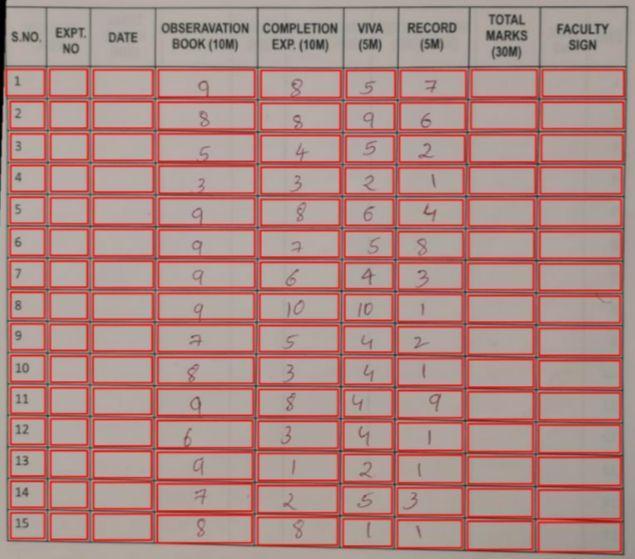
The above figure illustrates the input of the OCR system wheredigitsareextractedfromthesegmentedcellsofthe marksheet.
4.2
AftertheOCRmoduleextractednumericalvalues,thesystem automaticallycalculatedthetotalmarksandaveragescores for each student. The automated calculation module processedtherecognizeddigitsandgeneratedconsolidated results. sThis feature eliminates the need for manual calculation and ensures accurate evaluation of student laboratory performance. The system displays the results instantlyonthewebapplicationinterface,enablingfaculty memberstoquicklyanalyzetheperformanceofstudents.
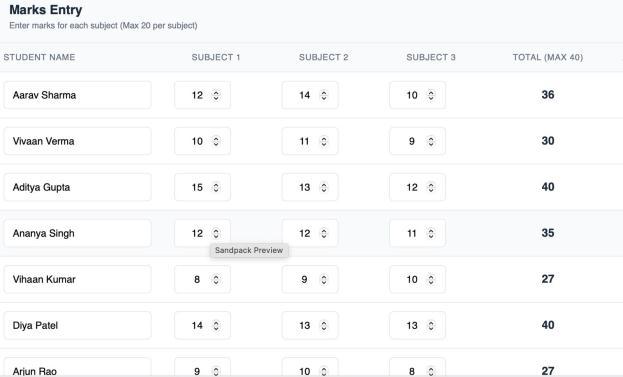
The figure above shows the final output generated by the system, where extracted marksare processedto calculate totalandaveragescores.
The performance of the proposed system was evaluated based on recognition accuracy, processing speed, and usability.Theresultsindicatethatthesystemachieveshigh accuracyinrecognizingdigitsfromstructuredmarksheets. The preprocessing and segmentation techniques helped improve OCR accuracy by providing clean input images. Additionally,thewebapplicationinterfaceallowedfaculty memberstoeasilycaptureimagesandobtainresultswithout requiringcomplextechnicalknowledge.Theoverallsystem performance demonstrates that the proposed solution is efficient, reliable, and suitable for practical use in educational institutions. The implementation of the OCRbased evaluation system significantly reduces manual workload, minimizes calculation errors, and improves the overallefficiencyoflaboratoryperformanceassessment.
In this research, an OCR-based calculator system was developedtoautomatetheevaluationofstudentlaboratory performance.TheproposedsystemutilizesOpticalCharacter Recognition (OCR), image processing techniques, and machine learning algorithms to extract numerical values from laboratory mark sheets and perform automatic calculations. By capturing images of evaluation sheets throughawebapplication,thesystemprocessestheimages usingpreprocessing,cellsegmentation,anddigitrecognition techniques to accurately identify the marks assigned to students. The implementation of this system significantly reduces the manual effort required for recording and calculatingstudentmarks.Italsominimizeshumanerrors thatmayoccurduringmanualdataentryandcomputation. The use of deep learning techniques, particularly Convolutional Neural Networks (CNNs), improves the accuracyofdigitrecognitionandensuresreliableextraction of numerical data from structured documents. The experimentalresultsdemonstratethattheproposedsystem caneffectivelydetecttablestructures, extractmarksfrom individual cells, and compute total and average scores automatically.Thewebapplicationprovidesauser-friendly interface that allows faculty members to easily capture imagesandobtaininstantresults.
Overall,theOCRcalculatorsystemenhancestheefficiency, accuracy,andreliabilityofstudentlaboratoryperformance evaluation.Theproposedsolutioncanbeeffectivelyadopted by educational institutions to simplify the assessment process and support digital transformation in academic evaluationsystems.
International Research Journal of Engineering and Technology (IRJET) e-ISSN: 2395-0056
Volume: 13 Issue: 03 | Mar 2026 www.irjet.net p-ISSN: 2395-0072
Although the proposed OCR-based calculator system successfullyautomatestheevaluationofstudentlaboratory performance,severalimprovementscanbeimplementedin futureworktoenhanceitsfunctionalityandperformance. One possible enhancement is improving the accuracy of character recognition for handwritten digits. While the current system performs well with clearly written digits, more advanced deep learning models and larger training datasets can be used to improve recognition accuracy for differenthandwritingstyles.Anotherfutureimprovementis theintegrationofcloud-basedstoragesystems.Bystoring extracted data and calculated results in a cloud database, institutionscanmaintaincentralizedacademicrecordsand access them from multiple devices. This would also allow faculty members to track student performance over time. Thesystemcanalsobeextendedtosupportrecognitionof complete text fields such as student names, roll numbers, and subject codes in addition to numerical marks. This wouldallowthesystemtoautomaticallygeneratecomplete digitalrecordsoflaboratoryevaluations.Furthermore,the application can be integrated with existing Learning Management Systems (LMS) or academic management softwareusedbyeducationalinstitutions.Thisintegration would enable automatic updating of student marks in institutional databases. In the future, the system can also incorporateadvancedfeaturessuchasreal-timeanalytics, performancedashboards,andautomatedreportgeneration. These features would help educators analyze student performancemoreeffectivelyandimprovedecision-making in academic evaluation. Overall, future enhancements will focusonimprovingrecognitionaccuracy,expandingsystem capabilities,andintegratingthesolutionwithmoderndigital educationplatforms.
[1] Abhash Sinha, Martin Jenckel, Syed Saqib Bukhari and AndreasDengel,“UnsupervisedOCRModelEvaluationUsing GAN,”2019InternationalConferenceonDocumentAnalysis andRecognition(ICDAR),pp.1256–1259,IEEE,2019.
[2]VenkataNagaSaiRakeshKamisetty,P.Jeyanthi,Bodapati Sohan Chidvilas, V. Maria Anu, S. Revathy, and L. Mary Gladence, “Digitization of Data from Invoice using OCR,” 2022 6th International Conference on Computing MethodologiesandCommunication(ICCMC),pp.1842–1847, IEEE,2022.
[3] Áron Zoltán Kaló and Miklós László Sipos, “Key-Value Pair Searching System via Tesseract OCR and Post Processing,”2021IEEE19thWorldSymposiumonApplied Machine Intelligence and Informatics (SAMI), pp. 978–1–7281–8053–3,IEEE,2021.
[4] Yann LeCun, Léon Bottou, Yoshua Bengio, and Patrick Haffner, “Gradient-Based Learning Applied to Document
Recognition,” Proceedings of the IEEE, vol. 86, no. 11, pp. 2278–2324,1998.
[5]RaySmith,“AnOverviewoftheTesseractOCREngine,” Proceedings of the Ninth International Conference on DocumentAnalysisandRecognition(ICDAR),vol.2,pp.629–633,IEEE,2007.
[6]A.Graves,S.Fernández,F.Gomez,andJ.Schmidhuber, “Connectionist Temporal Classification: Labelling Unsegmented Sequence Data with Recurrent Neural Networks,” Proceedings of the 23rd International ConferenceonMachineLearning,pp.369–376,2006.
[7] J. Redmon and A. Farhadi, “YOLOv3: An Incremental Improvement,”arXivpreprintarXiv:1804.02767,2018.
[8]D.Doermann,“TheIndexingandRetrievalofDocument Images: A Survey,” Computer Vision and Image Understanding,vol.70,no.3,pp.287–298,1998.