International Research Journal of Engineering and Technology (IRJET)
e-ISSN: 2395-0056
Volume: 13 Issue: 05 | May 2026
p-ISSN: 2395-0072
www.irjet.net
Ocean-based Carbon Capture Ships (OCCS) A.BASKAR1, A.MURUGAN2, G.PETER PACKIARAJ3, C.INDRAKUMAR4 1Final Year B.E Marine, PSNCET, Tirunelveli, Tamil Nadu, India
2Professor, Dept Of Marine Engineering PSNCET, Tirunelveli, Tamil Nadu, India 3,4Assistant Professsor, Dept Of Marine Engineering PSNCET, Tirunelveli, Tamil Nadu, India
---------------------------------------------------------------------------------***----------------------------------------------------------------------------This process mimics natural CO₂ absorption but at an ABSTRACT-Ocean-based carbon capture ships (OCCS) accelerated rate. present a promising solution to reduce atmospheric CO2 levels by taking advantage of oceanic processes. These specialized vessels capture CO2 from the atmosphere, convert it into a form that can be safely stored in ocean water, and actively contribute to mitigating global warming. This report examines the technical principles, operational aspects, potential impact, and challenges associated with OCCS.
Bicarbonate conversion: By reacting CO₂ with alkaline substances, OCCS convert CO₂ into stable bicarbonate ions that can be safely dissolved in seawater. Solidification: In some proposed models, CO₂ is mineralized into solid carbonates, which are stored in deep-sea locations. 1.3 Energy and resource requirements
Keywords: Ocean-Based Carbon Capture (OCCS), Direct Air Capture (DAC),Carbon Sequestration, Marine Technology, Renewable Energy,CO₂ Dissolution, Bicarbonate Conversion, Climate Mitigation, Oceanic Carbon Sink, Sustainable Engineering.
OCCS are typically powered by renewable energy sources, such as onboard solar panels or wind turbines, to reduce the carbon footprint of the capture process. Additionally, the ships propulsion and energy storage systems are optimized for efficiency to allow extended operations in remote ocean regions.
1. INTRODUCTION Climate change has intensified the need for innovative carbon capture and sequestration (CCS) methods. While terrestrial CCS systems are growing, ocean-based approaches offer substantial potential. Oceans naturally absorb approximately 25% of global CO2 emissions, making them an important carbon sink. The OCCS model is based on this principle, aiming to increase oceanic carbon absorption while minimizing adverse ecological impacts. 1.1 Carbon capture technology OCCS systems typically use direct air capture (DAC) technology to extract CO₂ from the air. These DAC units use a chemical solvent to bind CO₂, which is then isolated and compressed for separation or transformation. Recent advances in DAC technology have improved the energy efficiency of capture processes, making OCCS more viable.
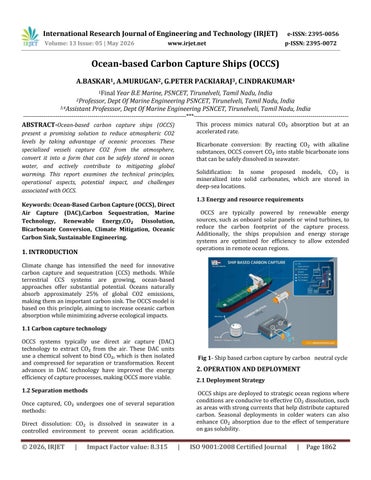
Fig 1- Ship based carbon capture by carbon neutral cycle
2. OPERATION AND DEPLOYMENT 2.1 Deployment Strategy
1.2 Separation methods
OCCS ships are deployed to strategic ocean regions where conditions are conducive to effective CO₂ dissolution, such as areas with strong currents that help distribute captured carbon. Seasonal deployments in colder waters can also enhance CO₂ absorption due to the effect of temperature on gas solubility.
Once captured, CO₂ undergoes one of several separation methods: Direct dissolution: CO₂ is dissolved in seawater in a controlled environment to prevent ocean acidification.
© 2026, IRJET
|
Impact Factor value: 8.315
|
ISO 9001:2008 Certified Journal
|
Page 1862