
International Research Journal of Engineering and Technology (IRJET) e-ISSN:2395-0056
Volume:13Issue:06|Jun2026 www.irjet.net p-ISSN:2395-0072

International Research Journal of Engineering and Technology (IRJET) e-ISSN:2395-0056
Volume:13Issue:06|Jun2026 www.irjet.net p-ISSN:2395-0072
Arji Chinna Simhadri Kumar1 , K. Lakshmi2
1Final year MCA Student, Department of Computer Applications, GIET Engineering College, Andhra Pradesh, India
2Assistant Professor, Department of Computer Applications, GIET Engineering College, Andhra Pradesh, India
Abstract - The model takes a low-light image as input and first performs preprocessing such as resizing and normalization. It then uses multiple convolutional neural network (CNN) layers to extract important image features, including brightness, texture, and color information. The enhancement module learns the illumination characteristics of the image and generates adaptive enhancement curves to improve brightness, contrast, and color balance while preserving natural details. Additionally, the model reduces noise that may become visible during the enhancement process. Finally, the reconstruction layer combines the enhanced features and produces a high-quality image with improved visibility and visual quality. This approach is effective because it does not require paired low-light and normal-light images for training, making it efficient and practicalfor real-worldapplications.
Key Words: Low-Light Image Enhancement, Convolutional Neural Network (CNN), Image Processing, Deep Learning, Image Quality Improvement,ComputerVision.
In today's digital world, images are used extensively in areas such as photography, healthcare, surveillance, remote sensing, and social media. However, during image acquisition, transmission, or storage, unwanted disturbances known as noise often get introduced into images. This noise can reduce image quality, hide importantdetails,andnegativelyaffecttheperformanceof image processing and computer vision applications. Therefore, removing noise while preserving essential imagefeatureshasbecomeasignificantchallenge.
Night Vision Enhance: A Residual Attention Approach for ClearLow-LightImageRecovery isanadvancedapproach that aims to improve image quality by automatically learning patterns from large datasets of noisy and clean images. Unlike traditional filtering techniques, which may blur fine details along with noise, machine learning models can intelligently distinguish between actual image content and unwanted noise. By analyzing complex relationshipswithinimage data,thesemodelsarecapable of producing cleaner and more visually appealing results whilemaintainingimportanttexturesandedges.
The primary objective of this project is to develop an efficient machine learning-based system for image denoising. The proposed system takes a noisy image as input,processesitusingtrainedalgorithms,andgenerates a noise-free image with enhanced clarity. This approach not only improves visual quality but also supports better performance in applications that rely on accurate image information. As machine learning continues to evolve, image denoising has become a promising solution for achieving high-quality image restoration in real-world environments.
The methodology adopted for this project focuses on reducingnoisefromdigitalimagesusingmachinelearning techniques. The process begins with the collection of image data containing both noisy and clear images. These images are gathered from publicly available datasets and are carefully selected to represent different noise conditions and image characteristics. Before training the model, the images are pre-processed through resizing, normalization, and format standardization to ensure consistencyacrossthedataset.
Once the data preparation stage is completed, feature learning is performed using a machine learning model designed for image denoising. The model is trained to identify the difference between noise patterns and actual image content by analysing numerous image samples. During training, the algorithm continuously adjusts its internal parameters to minimize the difference between the predicted output and the expected clean image. This learning process enables the model to understand how noise affects image quality and how it can be effectively removed.
After training, the developed model is tested using previously unseen noisy images. The model processes eachinputimageandgeneratesanenhancedversionwith reduced noise while preserving important details such as edges, textures, and structural information. The performance of the system is then evaluated using image quality metrics and visual inspection to determine its effectiveness. Finally, the results are compared with the original noisy images to assess the level of improvement achieved through the proposed machine learning approach.
International Research Journal of Engineering and Technology (IRJET) e-ISSN:2395-0056
Volume:13Issue:06|Jun2026 www.irjet.net p-ISSN:2395-0072
Theoverallmethodologyensuresthatthesystemnotonly removes unwanted noise but also maintains the natural appearance of the image, making it suitable for practical applicationswhereimagequalityisessential.
The success of any machine learning model largely depends on the quality of the data used during training. Forthisproject,acollectionofdigitalimageswasgathered from publicly available image datasets and online image repositories. The dataset included images containing different objects, scenes, lighting conditions, and textures toensurethatthemodelcouldlearnfromawidevarietyof visual information. Both clean and noisy images were utilized so that the model could understand the differencesbetweenoriginalimagecontentandunwanted noise.
Sinceimagesobtainedfromdifferentsourcesoftenvaryin size,format,andquality,apreprocessingstagewascarried out before training the model. Initially, all images were converted into a common format and resized to a fixed resolutiontomaintainconsistencythroughoutthedataset. Thishelpedreducecomputationalcomplexityandensured thatthemodelreceiveduniforminputduringtraining.
To improve the learning process, image pixel values were normalized to a specific range. This step allowed the model to process image information more efficiently and contributed to faster convergence during training. In addition,varioustypesofartificialnoise,suchasGaussian noiseandsalt-and-peppernoise,wereintroducedtosome clean images. This enabled the model to learn how differentnoisepatternsaffectimagequalityandhowthey canberemovedeffectively.
Thedatasetwasthendividedintotraining,validation,and testingsets.Thetrainingsetwasusedtoteachthe model; the validation set helped monitor performance during training,andthetestingset wasusedtoevaluatethefinal results.Throughcarefuldatacollectionandpreprocessing, a reliable dataset was prepared, providing a strong foundationforbuildinganeffectiveimagenoisereduction system.
The central component of this project is a Convolutional NeuralNetwork(CNN)-baseddenoisingmodeldesignedto identify and remove unwanted noise from digital images. Instead of treating every pixel independently, the model learns to recognize meaningful visual patterns such as edges,textures,andobjectstructureswhiledistinguishing them from random distortions caused by noise. This
capability allows the system to preserve important image detailswhileimprovingoverallimagequality. During the training process, the model is exposed to both noisyandcleanversionsofimages.Bycomparingthetwo, itgraduallylearnshownoiseaffectsdifferentregionsofan image and develops the ability to reconstruct a cleaner version from a degraded input. Multiple convolutional layers are used to extract features at different levels, enabling the network to capture both fine details and broaderimagecharacteristics.
Unliketraditionalimagefilteringtechniquesthatapplythe same operation across the entire image, the machine learning model adapts its behaviour based on the content presentineachimage.Asaresult,itcaneffectivelyreduce noise while minimizing the loss of sharpness and importantvisualinformation.Thetrainedmodelservesas the core engine of the system, transforming noisy images intoclearerandmorevisuallyaccurateoutputs,making it suitable for applications where image quality plays a criticalrole.
The Styling Recommendation Engine is a supportive module that works after the image denoising stage. Once unwanted noise is removed from an image, this component analyses the visual characteristics of the processed image, such as brightness, contrast, sharpness, and colour balance. Based on these observations, it recommends appropriate enhancement settings that can further improve the overall appearance of the image. Rather than applying the same adjustments to every image, the engine considers the unique features of each imageandsuggestsmodificationsthatbestsuititscontent. Forexample,animagecapturedinlowlightingconditions mayrequireaslightincreaseinbrightness,whileanimage withfadedcoloursmaybenefitfromcolourenhancement. By providing personalized recommendations, the Styling Recommendation Engine helps produce images that are not only cleaner but also more visually appealing and natural-looking. This module adds an extra layer of refinement to the system and contributes to a better user experience.
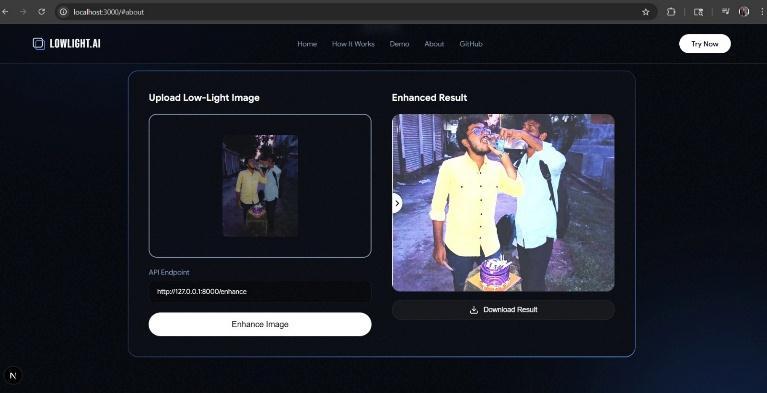
After developing and testing the image noise reduction model, the next step was to integrate all project components into a single functional system. The trained machine learning model was connected with the user interfaceandimageprocessingmodulessothattheentire workflow could operate smoothly. This integration ensuresthatuserscanuploadanimage,processitthrough the model, and receive a denoised output without interactingwiththeunderlyingtechnicalprocesses.
International Research Journal of Engineering and Technology (IRJET) e-ISSN:2395-0056
Volume:13Issue:06|Jun2026 www.irjet.net
Special attention was given to maintaining compatibility betweendifferentmodulesofthesystem.Theimageinput module,preprocessingfunctions,machinelearningmodel, and output generation component were carefully linked and tested to verify that data flowed correctly from one stage to another. Any inconsistencies in image formats or processing outputs were resolved during this phase to improveoverallsystemreliability.
Once the integration process was completed, the application was prepared for deployment. The final system was configured to run on a local machine where users could access the denoising functionality through a simple and user-friendly interface. Necessary software dependenciesandlibrarieswereinstalledtoensurestable execution of the application. The deployment setup was designed in a way that allows future improvements, such as integrating the system into web-based platforms, mobileapplications,orcloudenvironments.
4. DISCUSSION
During the development of the Night Vision Enhance: A Residual Attention Approach for Clear Low-Light Image Recovery project, several practical observations were made regarding the behaviour of noisy images and the performance of the trained model. Images collected from different sources contained varying levels of distortion, which affected their visual quality and made certain details difficult to identify. The machine learning model was trained to recognize these unwanted patterns and reduce them without significantly affecting the original contentoftheimage.
While evaluating the results, it was found that the model was able to improve image quality in most cases by removing a considerable amount of noise and making the imagesclearerforviewing.Unlikebasicfilteringmethods, the model attempted to preserve important structures such as boundaries and textures, which are often lost duringaggressivenoiseremoval.Thishelpedinproducing outputsthatappearedmorerealisticandusefulforfurther analysis.
p-ISSN:2395-0072
Another important finding was that the performance of the system was influenced by the characteristics of the input image. Images with moderate noise levels showed better enhancement compared to images that were heavily corrupted. In a few instances, very fine details became slightly less sharp after processing, which indicates that there is always a balance between noise reduction and detail preservation. However, the overall improvement in image quality was satisfactory and met theobjectivesdefinedatthebeginningoftheproject.
The project also provided valuable experience in data preparation, model training, and performance evaluation. It demonstrated how machine learning can be applied to solve image processing problems that are difficult to handleusingfixed-ruletechniques.Basedontheobtained results, the developed model can be considered a reliable approach for reducing image noise and improving image readability. Future improvements may include training with larger datasets and experimenting with advanced deep learning architectures to achieve even better results inchallengingconditions.
This project not only achieved its intended goal but also showed that learning-based methods can adapt more effectivelytodifferenttypesofimagenoise,makingthema practicalchoiceforreal-worldapplications.
The"NightVisionEnhance:AResidualAttentionApproach for Clear Low-Light Image Recovery" project demonstrates how intelligent algorithms can improve imagequalitybyidentifyingandremovingunwantednoise whilepreservingimportantvisual details.Throughoutthe development of this system, different image processing and learning techniques were utilized to distinguish meaningful information from distortions caused by environmental conditions, sensor limitations, or transmission errors. The results obtained show that machine learning can effectively enhance image clarity without significantly affecting the original structure and contentoftheimage.
One of the notable outcomes of this work is the model's ability to adapt to varying noise patterns rather than relying solely on fixed filtering rules. This makes the systemmoreflexibleandsuitableforreal-worldscenarios where image imperfections differ from one case to another. The enhanced images produced by the model exhibitimprovedvisual quality,makingthemmoreuseful forfurtheranalysis,interpretation,anddecision-making.
Overall, this project highlights the practical value of machine learning in modern image processing applications.Beyondachievingnoisereduction,itprovides insight into how data-driven approaches can overcome
International Research Journal of Engineering and Technology (IRJET) e-ISSN:2395-0056
Volume:13Issue:06|Jun2026 www.irjet.net p-ISSN:2395-0072
challenges that traditional methods often struggle to handle.Theknowledgegainedduringthis work canserve as a foundation for future improvements, including realtime image enhancement and integration with advanced computervisionsystems.
1) S. Ren, K. He, R. Girshick, and J. Sun, ‘‘Faster R-CNN: Towards real-time object detection with region proposal networks,’’ in Proc. Adv. Neural Inf. Process. Syst.,vol.28,2015,pp.1–12.
2) J. Fu, J. Liu, H. Tian, Y. Li, Y. Bao, Z. Fang, and H. Lu, ‘‘Dual attention network for scene segmentation,’’ in Proc. IEEE/CVF Conf. Comput. Vis. Pattern Recognit. (CVPR),Jun.2019,pp.3141–3149.
3) J. Deng, J. Guo, N. Xue, and S. Zafeiriou, ‘‘ArcFace: Additive angular margin loss for deep face recognition,’’ in Proc. IEEE/CVF Conf. Comput. Vis. PatternRecognit.(CVPR),Jun.2019,pp.4685–4694.
4) A. M. Reza, ‘‘Realization of the contrast limited adaptive histogram equalization (CLAHE) for realtimeimageenhancement,’’J.VLSISignalProcess.-Syst. Signal,Image,VideoTechnol.,vol.38,no.1,pp.35–44, Aug.2004.
5) T. Celik and T. Tjahjadi, ‘‘Contextual and variational contrast enhancement,’’ IEEE Trans. Image Process., vol.20,no.12,pp.3431–3441,Dec.2011.
6) C. Lee, C. Lee, and C. Kim, ‘‘Contrast enhancement based on layered difference representation of 2D histograms,’’ IEEE Trans. Image Process., vol. 22, no. 12,pp.5372–5384,Dec.2013.
7) G. Yadav, S. Maheshwari, and A. Agarwal, ‘‘Contrast limited adaptive histogram equalization based enhancementforrealtimevideosystem,’’inProc.Int. Conf.Adv.Comput.,Commun.Informat.(ICACCI),Sep. 2014,pp.2392–2397.
8) S. Wang, J. Zheng, H. Hu, and B. Li, ‘‘Naturalness preserved enhancement algorithm for non-uniform illumination images,’’ IEEE Trans. Image Process., vol. 22,no.9,pp.3538–3548,Sep.2013.
9) X. Fu, D. Zeng, Y. Huang, X. Zhang, and X. Ding, ‘‘A weighted variational model for simultaneous reflectanceandilluminationestimation,’’inProc.IEEE Conf. Comput. Vis. Pattern Recognit. (CVPR), Jun. 2016,pp.2782–2790.
10) X. Guo, ‘‘LIME: A method for low-light image enhancement,’’ in Proc. 24th ACM Int. Conf. Multimedia,Oct.2016,pp.87–91.
11) X. Guo, Y. Li, and H. Ling, ‘‘LIME: Low-light image enhancement via illumination map estimation,’’ IEEE Trans.ImageProcess.,vol.26,no.2,pp.982–993,Feb. 2017.
12) M. Li, J. Liu, W. Yang, X. Sun, and Z. Guo, ‘‘Structurerevealing lowlight image enhancement via robust Retinex model,’’ IEEE Trans. Image Process., vol. 27, no.6,pp.2828–2841,Jun.2018.
13) X. Ren, W. Yang, W. Cheng, and J. Liu, ‘‘LR3M: Robust low-light enhancement via low-rank regularized Retinex model,’’ IEEE Trans. Image Process., vol. 29, pp.5862–5876,2020.
14) C. Wei, W. Wang, W. Yang, and J. Liu, ‘‘Deep Retinex decomposition for low-light enhancement,’’ 2018, arXiv:1808.04560.
15) Y.Zhang,J.Zhang,andX.Guo,‘‘Kindlingthedarkness: A practical low-light image enhancer,’’ in Proc. 27th ACMInt.Conf.Multimedia,Oct.2019,pp.1632–1640.
16) Y. Zhang, X. Guo, J. Ma, W. Liu, and J. Zhang, ‘‘Beyond brighteninglow-light images,’’Int. J.Comput. Vis.,vol. 129,no.4,pp.1013–1037,Apr.2021
17) W. Wu, J. Weng, P. Zhang, X. Wang, W. Yang, and J. Jiang, ‘‘URetinex-Net: Retinex-based deep unfolding network for low-light image enhancement,’’ in Proc. IEEE/CVF Conf. Comput. Vis. Pattern Recognit. (CVPR),Jun.2022,pp.5891–5900.
18) Z. Zhang, H. Zheng, R. Hong, M. Xu, S. Yan, and M. Wang, ‘‘Deep color consistent network for low-light image enhancement,’’ in Proc. IEEE/CVF Conf. Comput. Vis. Pattern Recognit. (CVPR), Jun. 2022, pp. 1889–1898.
19) K. G. Lore, A. Akintayo, and S. Sarkar, ‘‘LLNet: A deep autoencoder approach to natural low-light image enhancement,’’PatternRecognit.,vol.61,pp.650–662, Jan.2017.
20) C. Li, J. Guo, F. Porikli, and Y. Pang, ‘‘LightenNet: A convolutional neural network for weakly illuminated imageenhancement,’’PatternRecognit.Lett.,vol.104, pp.15–22,Mar.2018.
21) W.Ren, S.Liu,L.Ma, Q.Xu, X. Xu,X.Cao,J. Du,andM. Yang,‘‘Lowlightimageenhancementviaadeephybrid network,’’ IEEE Trans. Image Process., vol. 28, no. 9, pp.4364–4375,Sep.2019.
International Research Journal of Engineering and Technology (IRJET) e-ISSN:2395-0056
Volume:13Issue:06|Jun2026 www.irjet.net p-ISSN:2395-0072
22) Z.Cui,K.Li,L.Gu, S.Su,P.Gao,Z.Jiang,Y.Qiao,andT. Harada, ‘‘You only need 90K parameters to adapt light: A light weight transformer for image enhancement and exposure correction,’’ 2022, arXiv:2205.14871.
23) T. Wang, K. Zhang, T. Shen, W. Luo, B. Stenger, and T. Lu, ‘‘Ultra-highdefinition low-light image enhancement: A benchmark and transformerbased method,’’2022,arXiv:2212.11548.
24) Y. Jiang, X. Gong, D. Liu, Y. Cheng, C. Fang, X. Shen, J. Yang,P.Zhou,andZ.Wang,‘‘EnlightenGAN:Deeplight enhancement without paired supervision,’’ IEEE Trans.ImageProcess.,vol.30,pp.2340–2349,2021.
25) C. Guo, C. Li, J. Guo, C. C. Loy, J. Hou, S. Kwong, and R. Cong, ‘‘Zeroreference deep curve estimation for lowlight image enhancement,’’ in Proc. IEEE/CVF Conf. Comput. Vis. Pattern Recognit. (CVPR), Jun. 2020, pp. 1777–1786.
26) C. Li, C. Guo, and C. C. Loy, ‘‘Learning to enhance lowlightimageviazero-referencedeepcurveestimation,’’ IEEE Trans. Pattern Anal. Mach. Intell., vol. 44, no. 8, pp.4225–4238,Aug.2022.
27) L. Zhang, L. Zhang, X. Liu, Y. Shen, S. Zhang, and S. Zhao, ‘‘Zero-shot restoration of back-lit images using deep internal learning,’’ in Proc. 27th ACM Int. Conf. Multimedia,Oct.2019,pp.1623–1631.
28) A. Zhu, L. Zhang, Y. Shen, Y. Ma, S. Zhao, and Y. Zhou, ‘‘Zero-shot restoration of underexposed images via robustretinexdecomposition,’’inProc.IEEEInt.Conf. MultimediaExpo(ICME),Jul.2020,pp.1–6.
29) O. Ronneberger, P. Fischer, and T. Brox, ‘‘U-Net: Convolutional networks for biomedical image segmentation,’’inProc.Int.Conf.Med.ImageComput. Comput.-Assist. Intervent. Cham, Switzerland: Springer,2015,pp.234–241.
30) X. Mao, Y. Liu, F. Liu, Q. Li, W. Shen, and Y. Wang, ‘‘Intriguing findings of frequency selection for image deblurring,’’2021,arXiv:2111.11745.