
International Research Journal of Engineering and Technology (IRJET) e-ISSN: 2395-0056
Volume: 13 Issue: 03 | Mar 2026 www.irjet.net p-ISSN: 2395-0072

International Research Journal of Engineering and Technology (IRJET) e-ISSN: 2395-0056
Volume: 13 Issue: 03 | Mar 2026 www.irjet.net p-ISSN: 2395-0072
J Akshayraj1, G Thirupathi2, K Vishwanadhmeghendra3, G Vishnu Priya4, CH China Subba Reddy5
1,2,3,4UG Students, Department of Computer Science and Engineering, Joginpally B.R. Engineering College, Hyderabad, India
5Assistant Professor, Department of Computer Science and Engineering, Joginpally B R Engineering College, Hyderabad, India ***
Abstract - The proliferation of digital news platforms has led to an unprecedented challenge: the rapid spread of misinformation across social media and traditional news channels. This paper presents News Monkey, an AI-powered news aggregation platform that combines real-time news fetching with machine learning-based fake news detection. The system leverages Natural Language Processing (NLP) techniques and a Random Forest classifier trained on a comprehensive dataset of 8,000 labeled news articles, achieving 91% accuracy in detecting misinformation. The platform integrates with NewsAPI for real-time news aggregation and provides personalized news feeds. Each article is processed through an AI detection engine that generates credibility badges (Verified or Fake) with detailed explanations. Built with Angular and Flask, News Monkey serves as a reliable tool for combating misinformation and promoting digital literacy.
Key Words: Fake News Detection, Machine Learning, Random Forest, Natural Language Processing, News Aggregation, Text Classification, TF-IDF, AI-Powered Journalism
The digital age has transformed how people consume news,withonlineplatformsbecomingtheprimarysource of information for billions worldwide. Social media networks and digital publications have democratized content creation, allowing anyone to publish information instantly.Whilethisaccessibilityhasnumerousbenefits,it has also created a fertile ground for the spread of misinformation and fake news. The consequences can be severe, ranging from individual health decisions based on falseclaimstosocialunrestfueledbyfabricatedstories.
Traditional approaches to news verification rely on manualfact-checking,whichcannotscaletothevolumeof content generated daily. This limitation has created an urgentneedforautomatedsystemsthatcananalyzenews content in real-time and provide users with immediate feedback on reliability. Recent advancements in Machine Learning (ML) and Natural Language Processing (NLP) have opened new possibilities for automated fake news
detection by analyzing linguistic patterns and content consistency.
News Monkey addresses these challenges by combining real-time news fetching from multiple sources with a robust machine learning model. The system generates credibility assessments and detailed AI explanations, supporting informed news consumption while promoting digitalmedialiteracyamongdiverseuserpopulations.
The rapid proliferation of fake news on digital platforms has created a critical challenge for information consumers. Most existing news aggregation platforms do not incorporate automated verification mechanisms, leaving users vulnerable to misleading content. Manual fact-checking cannot scale to daily news volumes, and existing automated solutions often lack accuracy or realtime processing capabilities. There is also a lack of integrated platforms combining news aggregation, personalized content delivery, and reliable fake news detectioninasingleuser-friendlyinterface.
News Monkey is proposed as an integrated AIpowered news aggregation platform combining real-time news fetching with machine learning-based fake news detection. The system uses a Random Forest classifier trained on a comprehensive dataset of verified and fake news articles. Real-time news is aggregated via NewsAPI and processed through the detection engine, with each article receiving a credibility badge and detailed AI explanation. The platform supports personalized news feeds and a responsive Angular-Flask web interface for seamlesscross-platformusage.
The problem of fake news detection has received significant attention from researchers across computer science, journalism, and social science. Early approaches relied on manual fact-checking and expert verification, which could not scale to the demands of digital content
International
Volume: 13 Issue: 03 | Mar 2026 www.irjet.net p-ISSN: 2395-0072
volume [1]. The emergence of social media platforms accelerated the need for automated detection systems, leading researchers to explore various ML and NLP techniques.
Kononenko [2] demonstrated the effectiveness of classification algorithms in high-stakes applications, establishing foundational principles for feature selection and model interpretability. Obermeyer and Emanuel [3] emphasized the need for transparent and explainable AI systems principles directly applicable to fake news detection where users need to understand why content is flagged.
Bhatia and Patel [4] demonstrated the effectiveness of ensembleclassifiersincludingRandomForestforcomplex multi-featureclassification tasks,whileKaurand Kaur[5] showed that algorithm selection significantly impacts performance. Shesagiri and Nagender Kumar [6] demonstrated how machine learning captures complex patterns in structured data, providing insights transferable to linguistic pattern analysis in misinformationdetection.
The World Health Organization [7] documented how misinformation spreads rapidly during crisis periods. Ribeiro et al. [8] introduced LIME for explaining classifier predictions, particularly relevant for fake news detection where users need transparent reasoning. Breiman [10] established the theoretical foundations of Random Forests, demonstrating how ensemble approaches reduce overfitting and improve generalization. Shu et al. [12] surveyed fake news detection on social media, identifying key challenges that News Monkey directly addresses throughitsintegratedapproach.
The News Monkey system follows a modular architecture integrating news aggregation, machine learning prediction, and user interface components. The workflow begins with fetching real-time news, processing content through the trained classification model, and presenting results with credibility assessments and AI-generated explanations.
Thesystemarchitecturecomprisesthree primary layers:theFrontendLayer(Angular)fornewsdisplayand user interaction, the Backend Layer (Flask) for ML prediction and news fetching, and the External Services LayerincludingNewsAPIandfact-checkingdatabases.The Frontend contains components for news card display, category navigation, search, personalization panel, and articlemodal.TheBackendprocesseseacharticlethrough textpreprocessing,TF-IDFfeatureextraction,andRandom
Forest classification. Figure 1 illustrates the complete systemarchitecture.
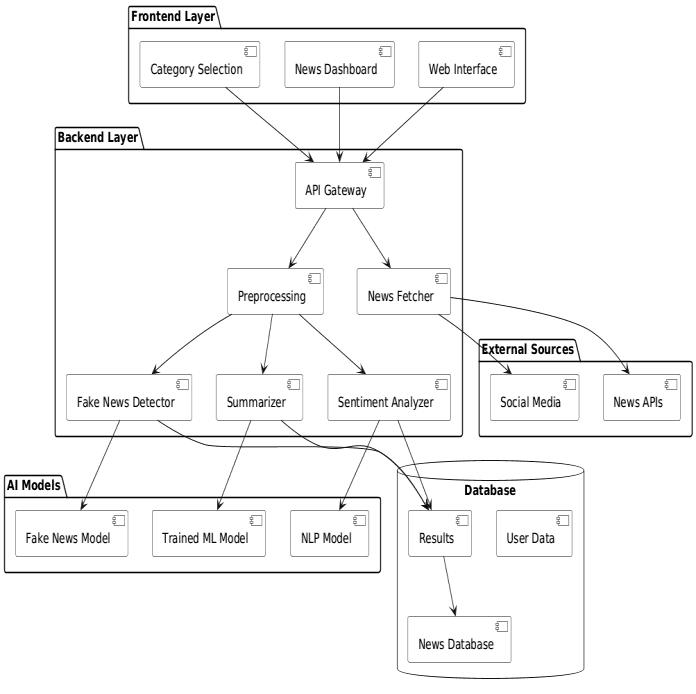
Fig-1: NewsMonkeySystemArchitecture
This figure illustrates the complete News Monkey system architecture.TheFrontendLayer(Angular)containsNews Card Display, Personalization Panel, Category Navigation, SearchComponent,andArticleModal.TheBackendLayer (Flask API) includes the REST API Gateway, Personalization Engine, News Aggregator, Text Preprocessor, Feature Extractor (TF-IDF), Random Forest Classifier, and AI Explanation Generator. The Data Layer stores the Trained Model, TF-IDF Vectorizer, User Preferences, and Article Cache. External Services include Fact-CheckDatabases,NewsAPI,andNewsSources.
The core machine learning algorithm is the Random Forest classifier an ensemble method constructing multiple decision trees and outputting the mode of their predictions. Random Forest was selected because it handles high-dimensional TF-IDF feature vectors effectively, provides feature importance scores enabling transparency, is robust to text data outliers, and achieveshighaccuracywithoutextensivehyperparameter tuning. TF-IDF vectorization converts preprocessed text into numerical features by balancing term frequency withinadocumentagainstitsfrequencyacrossthecorpus, capturing distinguishing terms that characterize fake versusrealnews.
The fake news detection process follows a structured eight-step workflow ensuring consistent and reliable predictions. Algorithm-1 outlines the complete
Volume: 13 Issue: 03 | Mar 2026 www.irjet.net
detection process from data collection through result displaytotheuser.
Input: Raw news article text (title + description)
Output: Credibility classification (Real/Fake) with confidence score
Step1:DataCollection-Gatherlabeleddatasetofverified andfakenewsarticles.
Step2:TextPreprocessing-Converttolowercase,remove punctuation,eliminatestopwords,applyPorterstemming.
Step3:FeatureExtraction-Convertpreprocessedtextto TF-IDFvectors(max5,000features).
Step4:ModelTraining-TrainRandomForestclassifier (n_estimators=100)on80%trainingsplit.
Step5:ModelSerialization-SavetrainedmodelandTF-IDF vectorizerusingjoblibfordeployment.
Step6:Prediction-Preprocessincomingarticle,transform withvectorizer,passtoRandomForestmodel.
Step7:CredibilityAssignment-Generatelabel(0=Fake, 1=Real)withconfidenceprobabilityscore.
Step8:ResultDisplay-Presentcredibilitybadge(Verified orAIDetectedFakeNews)withexplanation.
The News Aggregation Module interfaces with NewsAPI to fetch real-time headlines across Politics, Business, Technology, Sports, Health, and World Affairs categories. The module handles API authentication, rate limiting, error recovery, and fallback caching for uninterrupted service. The Personalization Module enables users to filter articles by selected categories withoutcomplexrecommendationalgorithms.TheSearch Module supports keyword matching across titles and descriptions, while the AI Credibility Score Module displays platform-wide detection statistics including percentage of verified articles and total fake articles detected.
The complete workflow begins when a user accesses the platform and the frontend requests news from the Flask backend. For each article, the preprocessing module cleans text, the TF-IDF vectorizer transforms it to numerical features, and the Random Forest classifier generates a prediction with probability scores.Thesystemassignsacredibilitybadgeandreturns results to the frontend for rendering. Figure 2 illustrates the detailed step-by-step workflow including all processing phases from user interaction through result display.
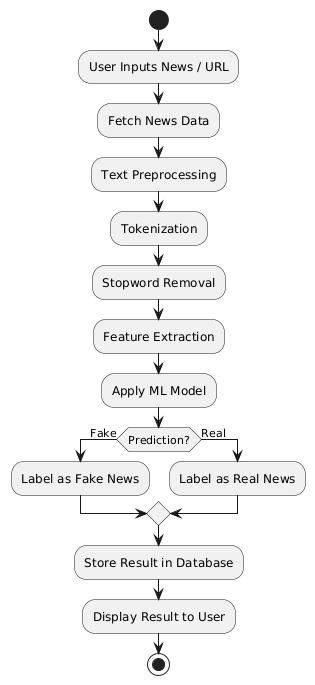
ThisfigurepresentsthecompleteNewsMonkeyfakenews detection workflow. The process flows from User Interaction (category selection/search/personalized feed) through News Aggregation (NewsAPI fetching and caching), Text Preprocessing (lowercase conversion, stopwordremoval,stemming),FeatureExtraction(TF-IDF vectorization), Machine Learning Prediction (Random Forest classification), AI Explanation Generation (VERIFIED or AI DETECTED FAKE NEWS badge assignment),ResultDisplay(newscardswithbadges),and ModalView(fullarticlewithdetailedAIanalysis).
News Monkey was implemented as a web-based platform integrating machine learning news detection, real-time aggregation, and user interface components. The system was developed using Python with Flask for backend services and Angular for the frontend. The machine learning model was trained on the labeled news dataset and deployed in the Flask backend for real-time article credibilityassessment.
Volume: 13 Issue: 03 | Mar 2026 www.irjet.net
The machine learning model was trained on a comprehensive dataset of 8,000 labeled news articles balancedacrossclasses,with4,000realarticlesand4,000 fakearticlesfrompubliclyavailablesources.Articlesspan politics, business, technology, health, and entertainment. Each article includes title, description, content text, and a binary label (1=Real, 0=Fake). Table 1 shows sample articlesfromthedatasetwiththeirgroundtruthlabels.
Table-1: SampleRepresentationoftheLabeledNews
"Governmentannouncesnewhealthcarepolicy coveringallcitizens"
"BREAKING:Miraclecurediscovered,doctors stunned"
"ISROsuccessfullylaunchesGSLV-F17navigation satellite"
"Celebrityrevealsshockingconspiracyabout government"
Table 1 shows sample articles from the training dataset. Real articles come from verified news sources, while fake articles exhibit sensational language, unverified claims, andlackcrediblesourceattribution.The balanceddataset ensures the model does not bias toward either class duringtraining.
The Random Forest classifier from Scikit-learn was trained with an 80/20 train-test split. The TF-IDF vectorizer retained 5,000 most significant features. The model used 100 estimators with cross-validation for hyperparametertuning.The trainedmodel andvectorizer wereserializedusingjoblibandloadedatFlaskstartupto minimize prediction latency. Each article is processed within milliseconds, enabling real-time credibility assessment.
2395-0056
ISSN: 2395-0072
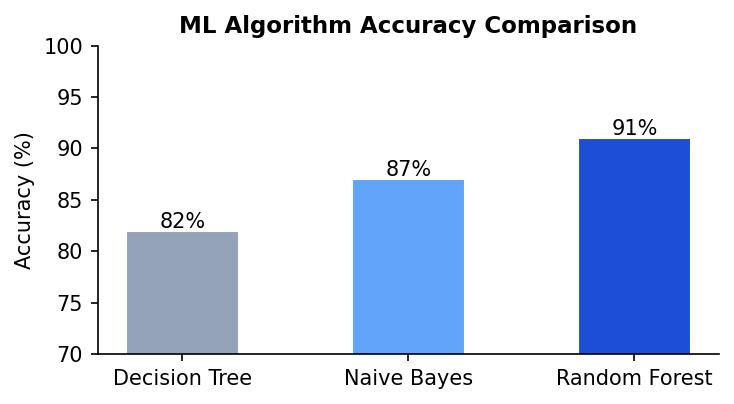
This figure compares the accuracy of three machine learning algorithms evaluated on the news credibility dataset. Random Forest achieved the highest accuracy of 91%, outperforming Logistic Regression (87%) and Decision Tree (82%). Random Forest was selected as the final model for News Monkey due to its ensemble approach that effectively reduces overfitting on highdimensionalTF-IDFfeaturevectors.
The News Monkey interface provides an intuitive user experience with clear visual indicators of article credibility. The homepage displays the platform header with tagline "AI-powered truth - Real-time news - No misinformation" and a "Fake News Detection Now Live!" banner. Category navigation (ALL NEWS, POLITICS, BUSINESS, TECHNOLOGY, SPORTS, HEALTH, WORLD, ENTERTAINMENT) allows content filtering. Each news card displays the article title, description, source, and a color-coded credibility badge. Figure 4 shows the News Monkeyhomepageinterface.
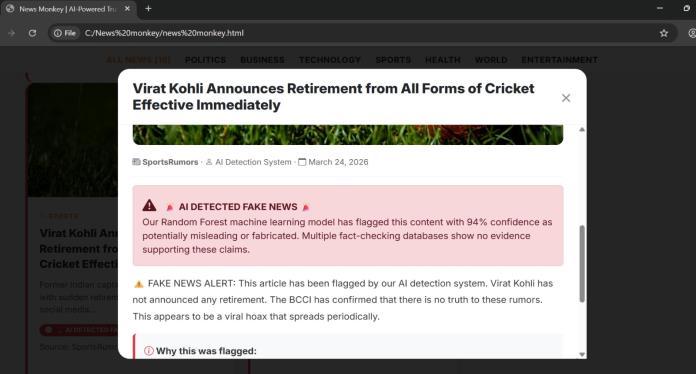
Fig-4: NewsMonkeyHomepageInterface
Figure 4 shows the News Monkey homepage. The dark headerdisplays theNEWS MONKEYlogowithtaglineand search bar. The navigation bar provides category filters. The hero banner announces "Fake News Detection Now Live!"withthenote"PoweredbyRandomForestClassifier - 94% Accuracy". News cards are displayed below with credibility badges indicating Verified or Fake status for eacharticle.
Clickinganyarticlecardopensadetailedmodalviewwith full content and AI analysis. For fake news articles, the modal displays a red "AI DETECTED FAKE NEWS" panel showing the detection confidence, explanation text, and thespecificreasonswhythecontentwas flagged.Figure5 shows the fake news detection modal for a sports article flaggedwith94%confidenceaspotentiallymisleading.
Volume: 13 Issue: 03 | Mar 2026 www.irjet.net p-ISSN: 2395-0072

Fig-5: AIDetectedFakeNewsModalwith94% Confidence
Figure 5 shows the fake news detection modal for the article"Virat KohliAnnouncesRetirementfrom All Forms ofCricketEffectiveImmediately"fromSportsRumors.The red AI DETECTED FAKE NEWS panel indicates the Random Forest model flagged this content with 94% confidence as potentially misleading or fabricated, noting that multiple fact-checking databases show no evidence supporting these claims. The "Why this was flagged" sectionprovidesdetaileddetectionreasoning.
For verified news articles, the modal displays a green "VERIFIED BY NEWS MONKEY AI" panel confirming the article has passed credibility checks and been crossreferencedwithtrustedsources.Figure6showsaverified ISRO news article with source attribution confirming the launchinformation.

Fig-6: VerifiedNewsArticlewithAICredibility Confirmation
Figure 6 shows the verified news modal for "ISRO Successfully Launches GSLV-F17 with Next-Gen Navigation Satellite" from ISRO Press Release. The green VERIFIED BY NEWS MONKEY AI panel confirms this article has passed credibility checks, with the ML model cross-referencing the content with trusted sources and
fact-checking databases. The article content shows the successful GSLV-F17 launch from Satish Dhawan Space CentreonMarch24,2026.
The Random Forest classifier was evaluated on the20% held-out testsplit andcomparedagainstLogistic Regression and Decision Tree classifiers under identical conditions.Table2presentsthecomparativeperformance metricsofallthreealgorithms.
Table-2: PerformanceComparisonofMachineLearning Algorithms
RandomForestachievedthehighestaccuracyof91%with precision 0.92, recall 0.90, and F1-score 0.91, demonstrating reliable performance for real-time fake news detection. Table 3 compares News Monkey against existingnewsplatforms.
Table-3: ComparisonBetweenExistingSystemsand NewsMonkey
Table 3 confirms that News Monkey uniquely combines real-time aggregation with AI-powered fake detection, personalized feeds, credibility badges, and transparent AI explanations capabilities absent in existing platforms likeGoogleNews,Inshorts,andFactCheck.org.
Volume: 13 Issue: 03 | Mar 2026 www.irjet.net
News Monkey successfully demonstrates the feasibility of integrating machine learning-based fake news detection with real-time news aggregation in a user-friendly platform. The system achieved 91% accuracy using a Random Forest classifier on a balanced dataset of 8,000 labelednewsarticles.TF-IDFvectorizationcombinedwith ensemble classification provides reliable detection with acceptable inference latency for real-time applications. Credibility badges with visual differentiation and detailed AIexplanationspromotedigitalliteracyamongusers.
The platform uniquely bridges the gap between news aggregationtoolsandfact-checkingservicesbycombining real-time aggregation, AI-powered fake detection, personalized feeds, and transparent AI explanations. Future work will focus on incorporating transformerbased models such as BERT for improved accuracy, expanding the dataset to include regional Indian languages, integrating user feedback mechanisms for active learning, and developing dedicated mobile applicationsforAndroidandiOSplatforms.
[1] S.Vosoughi,D.Roy,andS.Aral,"Thespreadoftrueandfalse news online," Science, vol. 359, no. 6380, pp. 1146-1151, 2018.
[2] I. Kononenko, "Machine learning for medical diagnosis: History, state of the art and perspective," Artificial IntelligenceinMedicine,vol.23,no.1,pp.89-109,2001.
[3] Z.Obermeyer and E.J.Emanuel,"Predicting the future - Big data,machinelearning,andclinicalmedicine,"NewEngland JournalofMedicine,vol.375,no.13,pp.1216-1219,2016.
[4] S. Bhatia and A. Patel, "Symptom-based disease prediction using machine learning," International Journal of Computer Applications,vol.180,no.45,pp.1-6,2018.
[5] H. Kaur and M. Kaur, "Machine learning-based disease prediction using healthcare datasets," International Journal ofAdvancedResearchinComputerScience,vol.10,no.2,pp. 45-50,2019.
[6] T.ShesagiriandL.NagenderKumar,"Lungcancerdetection using deep learning models," Journal of Informatics and CommunicationSystems,vol.11,no.3,pp.112-124,2024.
[7] World Health Organization, "Managing the COVID-19 infodemic: Promoting healthy behaviours and mitigating harmfrommisinformation,"WHOTechnicalReport,2020.
[8] M. T. Ribeiro, S. Singh, and C. Guestrin, "Why should I trust you?Explainingthepredictionsofanyclassifier,"Proc.22nd ACMSIGKDD,pp.1135-1144,2016.
[9] T. Chen and C. Guestrin, "XGBoost: A scalable tree boosting system,"Proc.22ndACMSIGKDD,pp.785-794,2016.
[10] L. Breiman, "Random forests," Machine Learning, vol. 45, no.1,pp.5-32,2001.
[11] J. Esteva et al., "A guide to deep learning in healthcare," NatureMedicine,vol.25,no.1,pp.24-29,2019.
[12] K. Shu, A. Sliva, S. Wang, J. Tang, and H. Liu, "Fake news detection on socialmedia: Adata mining perspective,"ACM SIGKDDExplorations,vol.19,no.1,pp.22-36,2017.
[13] S.J. Pan and Q.Yang,"A survey on transfer learning,"IEEE Transactions on Knowledge and Data Engineering, vol. 22, no.10,pp.1345-1359,2010.
[14] J. Devlin, M. W. Chang, K. Lee, and K. Toutanova, "BERT: Pre-trainingofdeepbidirectionaltransformersforlanguage understanding,"Proc.NAACL-HLT,pp.4171-4186,2019.
[15] A.Vaswani etal.,"Attention isallyouneed,"Advancesin Neural Information Processing Systems, vol. 30, pp. 59986008,2017.