
International Research Journal of Engineering and Technology (IRJET) e-ISSN: 2395-0056
Volume: 13 Issue: 03 | Mar 2026 www.irjet.net p-ISSN: 2395-0072
International Research Journal of Engineering and Technology (IRJET) e-ISSN: 2395-0056
Volume: 13 Issue: 03 | Mar 2026 www.irjet.net p-ISSN: 2395-0072
Aqsa S. Khan1, Alliza A. Siddique2, Fatima I. Shaikh3 , Azam N. Tak4, Ms. Noorusabah Sayed5
Project Guide & HOD I/C HOD AN, Lecturer IF, MHSSP Department of Artificial Intelligence & Machine
Learning M.H Saboo Siddik Polytechnic, Mumbai, India
Abstract - In modern educational institutions, managing academic and administrative activities manually can be inefficient, time-consuming, and prone to errors. The Nebula College Automation System is designed to provide a centralized digital platform that automates various college operations such as student registration, attendance management,coursemanagement,timetablescheduling,and result processing. The system allows students, teachers, and administrators to access and manage academic information through a user-friendly interface, improving communication and coordination between them. By integrating multiple modules into a single system, Nebula reduces paperwork, minimizeshumanerrors,andensuressecurestorageandquick retrieval of data through a structured database. Overall, the proposed system enhances efficiency, transparency, and productivity in managing college activities while supporting the digital transformation of educational institutions.
Nebula is an integrated digital solution designed to automate, manage, and streamline the academic and administrative processes of a college. It enables efficient handling of student information, admissions, attendance, examinations, fees, timetables, and communication by replacing traditional manual systems with a centralized, secure,anduser-friendlycomputerizedplatform.
The Nebula College Automation System is designed to provide a centralized platform that automates various college management processes. The system enables students,teachers,andadministratorstoaccessandmanage academic information through a secure and user-friendly interface.Itincludesmodulessuchasstudentmanagement, attendance tracking, course management, and result processing.Bydigitizingtheseprocesses,thesystemreduces paperwork, improves data accuracy, and enhances communicationamongdifferentstakeholders.
The main objective of the Nebula system is to improve efficiency, transparency, and accessibility in managing college activities. By integrating different academic and administrativefunctionsintoasingleplatform,thesystem supports better decision-making and contributes to the digitaltransformationofeducationalinstitutions.
Feedbackandcircularcausality
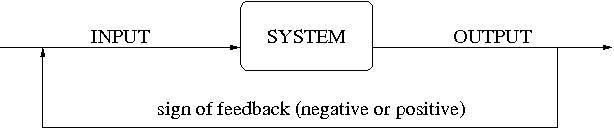
Feedback in a Nebula refers to the process where the outputofthesystemiscontinuouslymonitoredandusedas inputtoimprovefutureperformance.Thesystemcontains feedbackloopsthathelpinmaintainingaccuracy,efficiency, andcontroloveracademicandadministrativeprocesses.For example, when attendance data is entered by faculty, it is immediately reflected in the student portal. Students and administratorscanreviewthisdataandprovidefeedbackor corrections if required. This feedback helps the system maintainaccuraterecords
and ensures transparency. Negative feedback helps in reducing errors, such as correcting incorrect marks or attendanceentries,therebystabilizingthesystem. Positive feedback, on the other hand, may amplify system usage, suchasincreasedadoptionofonlineservicesaftersuccessful implementation.
Circularcausality inaCollegeAutomationSystemdescribes a continuous cause-and-effect cycle where system actions influenceuserbehavior,anduserbehaviorinturninfluences system actions. For instance, timely updates of exam schedulesencouragestudentstocheckthesystemregularly, whichincreasessystemusageandpromptsadministrators to keep the information updated. This continuous loop improvesoverallefficiencyandreliability.
Inessence,circularcausalityensuresthatimprovementsin one āpart of the system lead to positive changes in other parts, creating a self-regulating and adaptive system. Through feedback and circular causality, the College Automation System evolves into a stable, responsive, and effectivedigitalplatformformanagingcollegeoperations.
International Research Journal of Engineering and Technology (IRJET) e-ISSN: 2395-0056
Volume: 13 Issue: 03 | Mar 2026 www.irjet.net p-ISSN: 2395-0072
Theconceptofthe Nebula emergedwiththerapidgrowth ofcomputertechnologyandtheincreasingneedtomanage large volumes of academic and administrative data efficiently. During the late 20th and early 21st centuries, educational institutions began adopting computerized systemsto replacetraditional paper based processes.The integration of computers, databases, and networking technologies laid the foundation for automated college managementsystems.
These systems combined principles from information technology, management science, and education administration to create structured and goal-oriented solutions.
Earlyimplementationsfocusedonbasicrecordkeepingand result processing, but over time, the systems evolved to include real-time updates, role based access, feedback mechanisms,anddecisionsupportfeatures.Therelevanceof automationsoonextendedbeyondadministrativeefficiency toimprovingcommunication,transparency,andacademic planning.
Today, the College Automation System represents a convergence of technology and education, enabling institutions to operate as integrated, responsive, and digitallydrivenorganizationscapableofadaptingtomodern academicandadministrativedemands.
Manycollegesstillrelyonmanualprocessesordisconnected systemstomanageacademicandadministrativeactivities. Tasks such as student registration, attendance tracking, result management, timetable scheduling, and communication between students, teachers, and administrationoftenconsumesignificanttimeandareprone toerrors.Manual record-keepingalsomakesitdifficultto access,update,andmaintainaccurateinformation. Nebula – College Automation System aims to solve these problems by providing a centralized digital platform that automates and manages various college operations. The system will streamline processes such as student data management, course enrollment, attendance monitoring, assignmentsubmission,andcommunicationbetweenfaculty andstudents.Byautomatingthesetasks,Nebulawillreduce paperwork,minimizehumanerrors,improveefficiency,and providequickaccesstoimportantacademicinformationfor administrators,teachers,andstudents.
a) Lalit Mohan Joshi (2015)
In the paper “A Research Paper on College ManagementSystem,”LalitMohanJoshidiscussed
the need for a digital system to manage college activities such as admissions, student records, attendance, and examination management. The studyexplainsthatmanualsystemsconsumetime and are prone to errors, while computerized managementsystemsimproveefficiencyanddata accessibilityineducationalinstitutions.
b) Deepali S. Bhor, Vaibhav V. Bhosale, and Priyanka K. Kharatmal (2022)
The authors proposed a College Management Systemthatstoresstudentandinstitutionaldatain acentralizeddatabase.Theirsystemhelpsmanage admission processes, student details, attendance, andevents.Thestudyemphasizesthatweb-based systems reduce paperwork and allow administrators,faculty,andstudentstoaccessdata easilythroughadigitalinterface
c) Aditya Shelar, Sudarshan Sawant, Abhishek Pacharne, and Sahil Tike (2023)
Thisresearchpaperpresentsatechnicaloverview of web-based college management systems developedusingPHPanddatabasetechnologies. Thestudyanalyzesseveralexistingresearchpapers and concludes that automated systems help institutionsmanageacademicdataefficientlywhile improving communication between students, teachers,andadministration.
d) Rohit Jain, Aman Modi, and Ishan Kashyap (2023)
The authors reviewed different online intranetbased college management systems and discussed how such systems help institutions managemarks,assignments,academicrecords,and faculty activities through a centralized platform. Theresearchhighlightsthatautomationimproves transparency,reducesmanualwork,andprovides better information access for both students and faculty
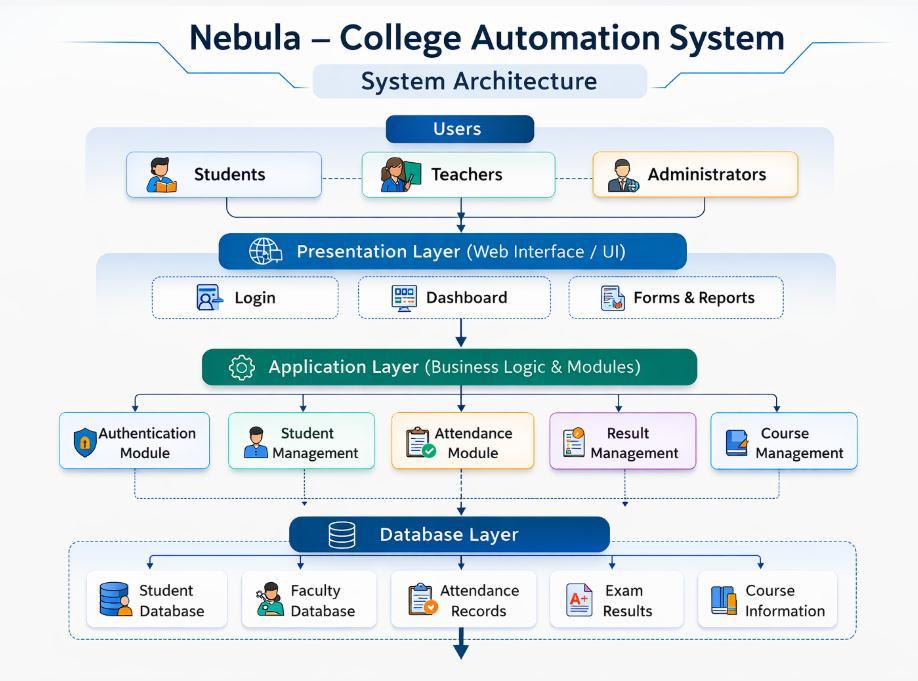
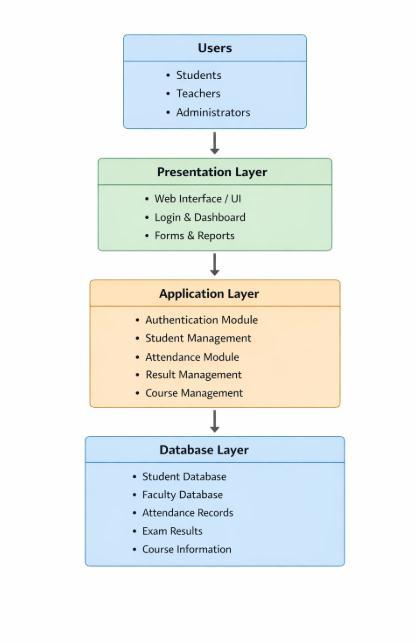
TheNebulaCollegeAutomationSystemfollowsathree-tier architecture consisting of the Presentation Layer, Application Layer, and Database Layer. This architecture ensures efficient communication between users and the systemwhilemaintainingsecuredatastorage.
1.PresentationLayer(UserInterface)
This layer interacts directly with users through a web interface. Different users such as students, teachers, and administratorsaccessthesystemthroughloginportals.The interface allows users to perform operations such as registration,attendancechecking,assignmentsubmission, timetableviewing,andresultchecking.
International Research Journal of Engineering and Technology (IRJET) e-ISSN: 2395-0056
Volume: 13 Issue: 03 | Mar 2026 www.irjet.net p-ISSN: 2395-0072
2.ApplicationLayer(Server/LogicLayer)
This layer processes user requests and implements the business logic of the system. It handles authentication, attendance processing, course management, result generation, and communication between modules. It also validatesuserinputsbeforestoringtheminthedatabase.
3.DatabaseLayer
This layer stores all the data required for the system. It includes student information, faculty details, attendance records, course data, exam results, and administrative information.Thedatabaseensuressecurestorageandquick retrievalofinformation.
a) Mobile Application Integration
Adedicatedmobileapplicationcanbedevelopedso that students and faculty can access attendance, assignments, notifications, and results easily throughsmartphones.
b) Cloud-Based System
Thesystemcanbemigratedtocloudplatformsto improve data storage, security, scalability, and remoteaccessibility.
c) Online Examination Module
Anonlineexaminationsystemcanbeintegratedto conduct quizzes, tests, and exams digitally with automaticevaluationandresultgeneration.
d) AI-Based Performance Analysis
Artificial Intelligence can be used to analyze student performance and provide insights or recommendationstoimproveacademicoutcomes.
e) Automated Notifications System
The system can send automatic notifications via email,SMS,ormobilealertsregardingattendance, examschedules,assignments,andresults.
f) Biometric Attendance Integration
Integration with biometric devices or facial recognitionsystemscanimprovetheaccuracyand reliabilityofattendancemanagement.
g) Learning Management System (LMS) Integration
ThesystemcanbeintegratedwithLMSplatformsto provideonlinestudymaterials,videolectures,and assignmentsubmissions.
The user-side interface of the College Automation System providesanintuitiveanduser-friendlyenvironmentwhere students, faculty, and staff can easily access various academicandadministrativeservices.
A. Login form
Login Form: Users can securely log in to the College Automation System by entering their registered username/email and password to access their dashboard andservices.
International Research Journal of Engineering and Technology (IRJET) e-ISSN: 2395-0056
Volume: 13 Issue: 03 | Mar 2026 www.irjet.net p-ISSN: 2395-0072
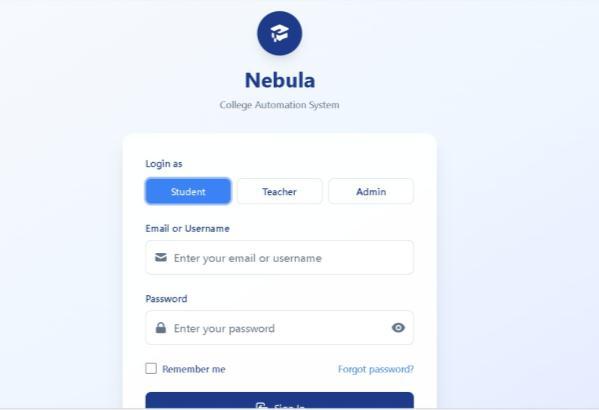
Fig4: loginformofstudent
AuthenticationandAccessControl:Thesystemverifiesuser credentialsandprovidesaccessbasedontheirrole(student, faculty,oradmin),ensuringsecureandauthorizeduseofthe system.
B. Student Dashboard Features
StudentDashboard:Afterloggingin,students canaccessa centralized dashboard that displays important academic informationsuchasattendance,timetable,announcements, andrecentupdates.
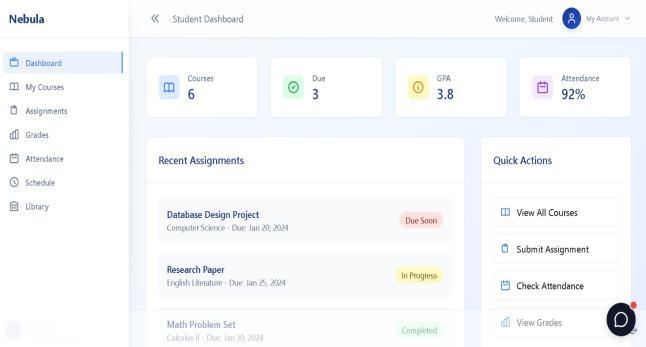
Fig5:StudentDashboard
Quick Access to Services: The dashboard provides easy navigation to key features like viewing marks, checking course details, submitting assignments, and accessing notices, allowing students to manage their academic activitiesefficiently.
C. Announcement
Announcements and Updates Section: The student dashboardincludesadedicatedsectionwherestudentscan view important announcements related to college events, academic updates, schedule changes, and other important noticesfromtheadministration.
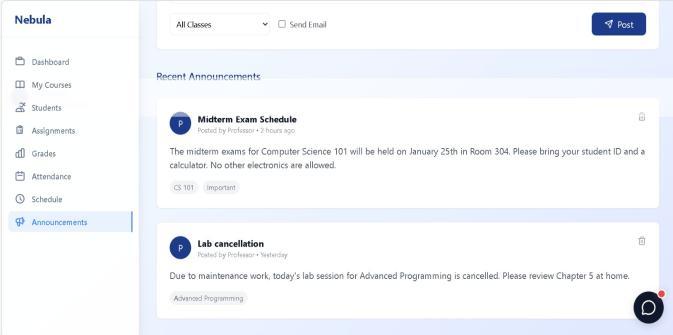
Fig6: Announcement
Real-Time Notifications: Students receive timely updates about upcoming events, holidays, examination schedules, and any changes in college activities, ensuring they stay informedaboutthelatestinformation.
D. Attendance tracker feature
Attendance Tracker: Students can view their subject-wise attendance records directly from the dashboard, allowing themtomonitortheirattendancepercentageforeachcourse
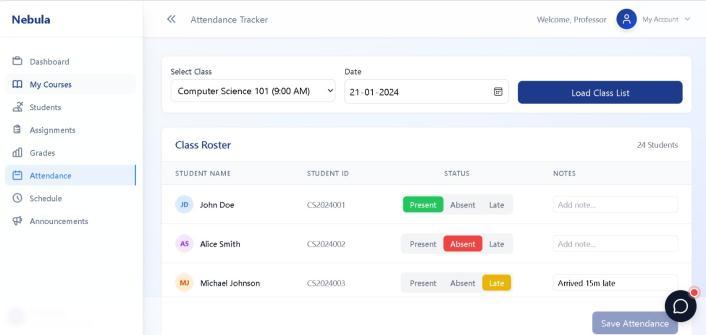
Fig7:AttendanceTracker
Attendance Updates: The system regularly updates attendancedatasostudentscanstayinformedabouttheir attendance status and ensure they meet the required attendancecriteria.
The Nebula College Automation System is designed to simplify and automate the various academic and administrative activities of a college. Traditional manual systems often lead to inefficiencies, data redundancy, and delays in accessing information. The proposed system provides a centralized platform that enables students, teachers,andadministratorstomanageacademicrecords, attendance,results,andcourseinformationefficiently. By implementing the Nebula system, institutions can significantlyreducepaperwork,minimizehumanerrors,and improve communication between different stakeholders. The system also ensures secure data storage and quick retrieval of information through a structured database.
International Research Journal of Engineering and Technology (IRJET) e-ISSN: 2395-0056
Volume: 13 Issue: 03 | Mar 2026 www.irjet.net p-ISSN: 2395-0072
Overall, the proposed system enhances productivity, transparency, and the overall management of college operations.
Wewouldliketoexpressoursinceregratitudetoourproject guide and faculty members for their valuable guidance, encouragement, and continuous support throughout the development of this research work. Their insights and suggestionshelpedusimprovethequalityofthisproject. We also thank our institution for providing the necessary resources and learning environment to successfully completethisresearch.Finally,wearegratefultoourfriends andfamilymembersfortheirmotivationandsupportduring thepreparationofthispaper.
[1] Lalit Mohan Joshi, “A Research Paper on College Management System,” International Journal of Computer Applications(IJCA),Vol.122,No.11,2015.
[2] Deepali S. Bhor, Vaibhav V. Bhosale, Priyanka K. Kharatmal, “College Management System,” International Journal for Research in Applied Science and Engineering Technology(IJRASET),Vol.10,Issue5,2022.
[3] Aditya Shelar, Sudarshan Sawant, Abhishek Pacharne, Sahil Tike, “College Management System: A Technical Review,” International Journal of Scientific Research in ScienceandTechnology(IJSRST),Vol.10,Issue3,2023.
[4] Rohit Jain, Aman Modi, Ishan Kashyap, “Review on College Management System,” International Journal of Advanced Research in Computer Science and Software Engineering,2023.
[5]K.C.LaudonandJ.P.Laudon,“ManagementInformation Systems: Managing the Digital Firm,” Pearson Education, 2018.
[6]IanSommerville,“SoftwareEngineering,”10thEdition, PearsonEducation,2016.
[7] Guidance and academic resources provided by project guideandfacultymembersofthedepartment