
International Research Journal of Engineering and Technology (IRJET) e-ISSN: 2395-0056
Volume: 13 Issue: 04 | Apr 2026 www.irjet.net p-ISSN: 2395-0072

International Research Journal of Engineering and Technology (IRJET) e-ISSN: 2395-0056
Volume: 13 Issue: 04 | Apr 2026 www.irjet.net p-ISSN: 2395-0072
R. Kiran Kumar1 , Dr K. Venkataramana2
1Student, Department of MCA, KMM Instiute of Post Graduate Studies, Tirupati, Andhra Pradesh, India
2Professor, Department of MCA, KMM Institue of Post Graduate Studies, Tirupati, Andhra Pradesh, India
Abstract - Rice leafdiseases significantlyaffectagricultural productivity, leadingto yieldloss andeconomicdamage.Early detection is essential for effective disease management. This project presents an enhanced deep learning-based system for detecting and classifying major rice leaf diseases such as Bacterial Leaf Blight, Brown Spot, Leaf Smut, Blast, and Tungro using a Convolutional Neural Network (CNN).
The system processes leaf images through preprocessing techniques like resizing and normalization, followed by classification usingthetrainedmodel.Auser-friendlyinterface is developed where users can upload images directly for prediction. The model provides accurate results along with confidence scores.Additionally, the system includes an automatedprecautionrecommendationfeaturethatsuggests preventive measures based on the detected disease. The proposedapproach achieves highaccuracyandimprovesrealtime applicability, making it a useful and efficient solutionfor smart agriculture and sustainable crop management.
Key Words: Rice leaf disease detection, Convolutional Neural Network (CNN), Deep learning, Image classification, Agricultural AI, Precision farming, Transfer learning, Explainability methods.
Riceisastaplecropformillionsofpeopleworldwide,butits productionissignificantlyimpactedbyvariousleafdiseases, leading to reduced yields and economic losses. Early and accuratedetectionofthesediseasesisessentialforeffective diseasemanagement.Thisprojectleveragesdeeplearning, specifically Convolutional Neural Networks (CNNs), to classify five major rice leaf diseases: Bacterial Leaf Blight, BrownSpot,LeafSmut,Blast,andTungro.
By preprocessing images, training a CNN model, and evaluatingitsperformanceusingvariousmetrics,thesystem aims to provide a reliable, automated solution for disease detection, improving agricultural productivity and sustainability.
2. Literature Survey
Sustainable Applications of Rice Feedstock in AgroEnvironmental and Construction Sectors Shaheen et al. (2022)exploredthepotentialapplicationsofricefeedstock beyonditsconventionalagriculturaluse.Theirstudyfocused onutilizingrice-basedmaterialsinconstructionandenergy
sectors, thereby promoting sustainability and reducing agricultural waste. The research identified key challenges such as material durability, processing costs, and environmentalimpacts.However,thefindingsindicatedthat rice feedstock can serve as an eco-friendly alternative in variousindustries.Thestudyemphasizedtheimportanceof policyinterventionsandtechnologicaladvancementstoscale upthesustainableapplicationsofrice-basedmaterials.
Rice Cultivation in Bangladesh: Present Scenario, Problems,andProspectsShelleyetal.(2016)examinedthe state of rice farming in Bangladesh, highlighting key challengessuchassoildegradation,waterscarcity,climate change, and pest infestations. The study analyzed the effectiveness of current farming techniques and identified potential improvements through advanced irrigation methods,pestcontrolstrategies,andhigh-yieldricevarieties. Additionally, the researchstressed the role of government policiesandtechnologicaladvancementsinovercomingthese challenges.Thefindingssuggestedthatintegratingmodern farming techniques with sustainable agricultural practices canenhancericeproductionandensurefoodsecurity.
Smart Farming Through Responsible Leadership in BangladeshHaqueetal.(2021)discussedtheroleofartificial intelligence, IoT, and automation in revolutionizing agriculturalpractices.Thestudyemphasizedtheadoptionof smartfarmingtechnologies,includingprecisionagriculture, automated irrigation, and remote sensing. The authors highlightedtheneedforstrongleadershipinimplementing these technologies, ensuring that farmers are well-trained and equipped with the necessary tools. The findings suggestedthatacombinationofresponsibleleadershipand technological innovation can significantly enhance agriculturalproductivitywhileminimizingresourcewastage.
UnderstandingtheInformationLandscapeinAgricultural Communities in Rural Bangladesh.Mazumdar et al. (2023) analysehowfarmersinruralBangladeshaccessagricultural informationandthechallengestheyfaceinobtainingreliable knowledge. The study identified a lack of digital infrastructure, language barriers, and low literacy rates as majorobstaclestoeffectiveinformationdissemination.The authors proposed digital platforms and mobile-based advisorysystemstobridgetheknowledgegapandimprove communication between farmers and agricultural experts. Their research highlighted the critical need for improved accesstoreal-timeinformationtosupportfarmersinmaking informed decisions about crop management and disease prevention.
International Research Journal of Engineering and Technology (IRJET) e-ISSN: 2395-0056
Volume: 13 Issue: 04 | Apr 2026 www.irjet.net p-ISSN: 2395-0072
DetectionofRiceLeafDiseasesUsingImageProcessing Pothen&Pai(2020)investigatedtheeffectivenessofimage processingtechniquesindetectingandclassifyingriceleaf diseases.Thestudyemployedtraditionalmachinelearning algorithmssuchasSupportVectorMachines(SVM)andKNearestNeighbour(KNN)toanalyzeleafimages.Theresults demonstratedthatimageprocessingmethodscouldidentify diseasepatterns,buttheylackedtherobustnessandaccuracy ofdeeplearningmodels.Theresearchlaidthefoundationfor integrating deep learning approaches, suggesting that advanced neural networks could significantly improve classification accuracy and real-time disease detection capabilities.
Webservicesaresoftwaresystemsdesignedforelectronic supplyanddemandthroughmachine-to-machineinteraction on a network . These systems have a machine-readable interface definition called Web Services Description Language(WSDL)anduseprotocolssuchasSimpleObject AccessProtocol(SOAP)totransmitmessages.Webservices followService-OrientedArchitecture(SOA)andadheretoits standards . SOA is an approach to producing distributed systemsthatprovidesoftwarefunctionsthroughservices. Theseservicescanbeusedtobuildnewservicesorcalledby other software. Service brokers provide an interface between service providers and clients, allowing users to compareandselectdifferenttypesofservices.Thebrokers are responsible for three tasks: ranking, selecting, and composingservices.Arankingsystemcalculatestherelative value of different services based on the quality of service requiredbytheassociateeditorcoordinatingthereviewof thismanuscriptandtheclientandthecharacteristicsofthe existing services. After comparing with other services, it offersthemostappropriateservicetotheuser.Duetothe increasingnumberofserviceproviders,webserviceswith similar functions have also increased. The only difference between these similar web services is their performance quality.Theservicequalityofwebservicesincludesaseries ofnon-operationalfeaturessuchasexecutioncostandtime, availability,executionsuccessrate,security,etc.
Therefore,selectingaservicethatcanmeetclients’quality standards from a range of services has become a crucial challenge.Eachwebserviceisdesignedtoperformaspecific task, and a user’s workflow may consist of multiple tasks. Foreachtask,providershaveasetofcandidateserviceswith varyinglevelsofservicequality.Hence,choosingthesuitable web service for each workflow task is essential to ensure maximumservicequality.
Nowadays,themostpopularwebservicesarerelatedto thefollowingtopics:Generativeartificialintelligence,Social media, E-commerce, Video Streaming, News, Messaging, Metaverse and Gaming, Financial Services, and Getting
accurateinformationaboutservicesinvolvesgatheringdata frommultipleserviceproviders.
Appleleafdiseasesseriouslyaffectthequalityofapplesand may lead to yield losses, detecting apple leaf diseases accuratelycanpreventdiseasesfromspreadingandpromote thehealthygrowthoftheindustry.However,recentstudies cannotachieveaccuratedetectionofleafdiseaseswithhigh accuracy because thelesions are of different sizes. So, this paperproposedanovelappleleafdiseasedetectionmethod called VMF-SSD (V-space-based Multiscale Feature-fusion SSD),whichisdesignedtoextractmorereliablemulti-scale featurerepresentationsforvariedsizesofdiseasedspotsand improvethefinaldetectionperformance.
Themulti-scalefeatureextractionisestablishedwithmultiscalefeaturerepresentationtofurtherimprovethedisease detectionperformance,especiallyforsmallspots.Afterthat,a Vspace-based location branch is presented to enhance the texturefeatureinformationandhelpfurtheridentifydisease spotlocation.Finally,attentionmechanismsareutilizedto automatically learn the importance of feature channels at differentscalesfordistinguishingdiseasedspotsofdifferent sizes.ExperimentalresultsshowedthattheVMF-SSDmethod achieves 83.19% map and obtains the detection speed of 27.53FPSonthetestset,whichindicatesthattheproposed VMF-SSDmethodcanachievecompetitiveperformanceon appleleafdiseasedetectiontaskandsatisfytherequirements ofagriculturalproductionapplications.
Thisdatasetcontainsalotoftrainandtestimagerecordsof featuresextractedfromplantleafdisease,whichwerethen classified into 10 classes.Our project dataset contains 8 different plant images.The plants are Apple, Cherry, Corn, Grape,Pepper,Potato,Strawberry,Tomato.
6.
Theexperimentalresultsprovideanin-depthanalysisofthe performance of the rice leaf disease detection model. The model was trained using a Convolutional Neural Network (CNN) and (FCDD) on a dataset containing images of five different rice leaf diseases. The dataset was split into training(70%),validation(15%),andtest(15%)sets.The modelwastrainedfor30epochswithanadaptivelearning rateusingtheAdamoptimizerandcategoricalcross-entropy loss function. The final model achieved high classification accuracy with optimal hyperparameter tuning and data augmentationtechniques.
Thetablebelowsummarizesthemodel'sperformanceonthe testdataset:
International Research Journal of Engineering and Technology (IRJET) e-ISSN: 2395-0056
Volume: 13 Issue: 04 | Apr 2026 www.irjet.net p-ISSN: 2395-0072
achieving high accuracy, precision, recall, and F1-score
The integration of preprocessing techniques, hyperparametertuning,anddataaugmentationsignificantly enhancedmodelperformance,ensuringrobustnessacross differentenvironmentalconditions.
Evaluation metrics, including confusion matrix analysis and AUC-ROC scores,demonstratedthemodel’sabilityto distinguishbetweenvisuallysimilardiseases.
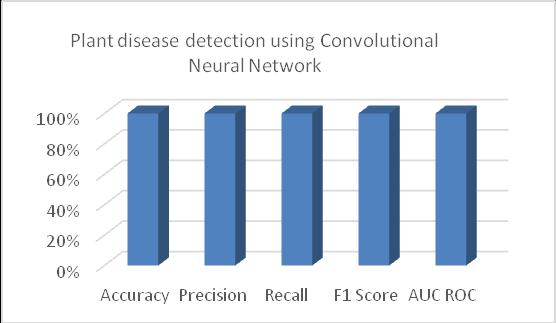
Theseresultsindicatethatthemodeleffectivelyclassifiesrice leaf diseases, demonstrating a high ability to distinguish betweensimilardiseasepatterns.
Line graph
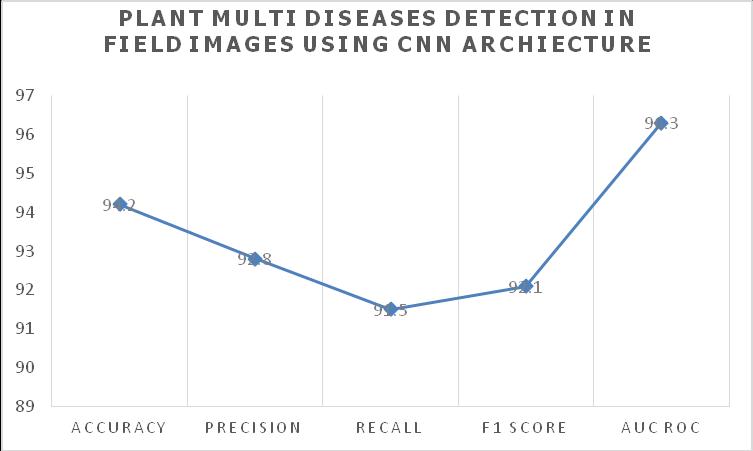
Theseresultsindicatethatthemodeleffectivelyclassifies riceleafdiseases,demonstratingahighabilitytodistinguish betweensimilardiseasepatterns.
7. CONCLUSIONS
The rice leaf disease detection system developed in this study successfully utilizes deep learning techniques to classify five common rice leaf diseases: Bacterial Leaf Blight, Brown Spot, Leaf Smut, Blast, and Tungro.
Byemployinga ConvolutionalNeuralNetwork(CNN),the model effectively extracts features from leaf images,
A real-time web-based application was also developed to facilitate easy disease identification for farmers and agriculturalprofessionals.Thesystemprovidesapractical and scalable solution, enabling early detection and preventivemeasures,ultimatelycontributingtoimproved crophealthandagriculturalproductivity.Futureworkwill focus on enhancing dataset diversity, incorporating attention-based architectures for improved feature extraction,andintegratingIoT-basedreal-timemonitoring systems. By advancing this AI-driven solution, the agricultural sector can benefit from more efficient, automateddiseasedetection,leadingtosustainablefarming practicesandbetterfoodsecurity.
Whilethecurrentmodelachieveshighaccuracyinriceleaf disease classification, several enhancements can further improve its performance and usability. Expanding the dataset with diverse and high-resolution images from different environmental conditions will enhance model generalization. Additionally, integrating attention-based architectures, such as Vision Transformers (ViTs), can improvefeatureextractionandclassificationaccuracy.
Anotherareaforimprovementisreal-timedeploymentusing IoT-enableddevicesthatautomaticallycaptureleafimages andsendthemforanalysis,providingfarmerswithinstant diseasediagnostics.Implementingexplainabilitytechniques likeGrad-CAMcanhelpvisualizemodeldecisions,increasing transparencyindiseaseclassification.
Furthermore,semi-supervisedandself-supervisedlearning approaches can be explored to leverage unlabeled data, improving the model’s robustness with minimal manual annotations.Futureadvancementswillfocusonmulti-modal analysis,combiningimage,weather,andsoildataformore accuratediseasepredictionandearlyinterventionstrategies.
[1] S. M. Shaheen, V. Antoniadis, M. Shahid, Y.Yang,H.Abdelrahman,T.Zhang,N.E.E.Hassan,I.Bibi,N.K.Niazi, S.A.Younis,M.Almazroui,Y.F.Tsang,A.K.Sarmah,K.-H.Kim, andJ.Rinklebe,‘‘SustainableapplicationsofRicefeedstockin agro-environmental and construction sectors: A global perspective,’’ Renew. Sustain. Energy Rev., vol. 153, Jan. 2022,Art.no.111791.
International Research Journal of Engineering and Technology (IRJET) e-ISSN: 2395-0056
Volume: 13 Issue: 04 | Apr 2026 www.irjet.net p-ISSN: 2395-0072
[2]I.J.Shelley,M.Takahashi-Nosaka,M.Kano-Nakata,M.S. Haque, and Y. Inukai, ‘‘Rice cultivation in bangladesh: Present scenario, problems, and prospects,’’ J. Int. Cooperation Agricult. Develop., vol. 14, no. 4, pp. 20–29, 2016.
[3] A. Haque, N. Islam, N. H. Samrat, S. Dey, and B. Ray, ‘‘Smart farming through responsible leadership in Bangladesh: Possibilities, opportunities, and beyond,’ Sustainability,vol.13,no.8,p.4511,Apr.2021.
[4]S.Mazumdar,S.Ehdeed,A.Jimenez,F.Ahmed,S.Momen, and M. Rasheduzzaman, ‘‘Understanding the information landscapeinagriculturalcommunitiesinruralBangladesh,’’ Electron.J.Inf.Syst.DevelopingCountries,vol.89,no.1,Jan. 2023,Art.no.e12245.
[5]M.E.PothenandM.L.Pai,‘‘DetectionofRiceleafdiseases using image processing,’’ in Proc. 4th Int. Conf. Comput. MethodologiesCommun.(ICCMC),Mar.2020,pp.424–430.
[6]N.ManoharandK.J.Gowda,‘‘Imageprocessingsystem basedidentificationandclassificationofleafdisease:Acase study on paddy leaf,’’ in Proc. Int. Conf. Electron. Sustain. Commun.Syst.(ICESC),Jul.2020,pp.451–457.
[7]K.Ahmed,T.R.Shahidi,S.M.IrfanulAlam,andS.Momen, ‘‘Rice leaf disease detection using machine learning techniques,’’ in Proc. Int. Conf. Sustain. Technol. Ind. 4.0 (STI),Dec.2019,pp.1–5.
[8] F.Zhao,Y.Chen,Y.Hou,andX.He, ‘‘Segmentation of blood vessel issusing rule-based and machine-learning-based methods:Areview,’’ MultimediaSyst.,vol.25,no.2,pp.109–118,Apr.2019.
[9] M. A. Khan, A. Alqahtani, A. Khan, S. Alsubai, A. Binbusayyis,M.M.I.Ch,H.-S.Yong,andJ.Cha,‘‘Cucumberleaf diseases recognition using multi level deep entropy-ELM featureselection,’’Appl.Sci.,vol.12,no.2,p.593,Jan.2022.
[10]S.M.M.Hossain,M.M.M.Tanjil,M.A.B.Ali,M.Z.Islam,M.S.Isla m,S.Mobassirin,I.H.Sarker,andS.R.Islam,‘‘Riceleafdiseases recognitionusingconvolutionalneuralnetworks,’’inProc. Int. Conf. Adv. Data Mining Appl. Switzerland: Springer, 2020,pp.299–314.
[11]P.MekhaandN.Teeyasuksaet,‘‘Imageclassificationof Riceleafdiseasesusingrandomforestalgorithm,’’inProc. Joint Int. Conf. Digit. Arts, Media Technol. ECTI Northern Sect.Conf.Electr.,Electron.,Comput.Telecommun.Eng.,Mar. 2021,pp.165–169.