
International Research Journal of Engineering and Technology (IRJET) e-ISSN: 2395-0056
Volume: 13 Issue: 04 | Apr 2026 www.irjet.net p-ISSN: 2395-0072
International Research Journal of Engineering and Technology (IRJET) e-ISSN: 2395-0056
Volume: 13 Issue: 04 | Apr 2026 www.irjet.net p-ISSN: 2395-0072
K Indu1, Dr K Venkataramana2
1Student, MCA 2nd year KMMIPS ,Tirupati, Affiliated to S.V.University, Tirupati, A.P, India
2Professor,Dept of MCA, KMMIPS ,Tirupati, Affiliated to S.V.University, Tirupati, A.P, India
Abstract - Crowd density estimation is a critical task in ensuring public safety, especially in highly crowded environments such as festivals, transportation hubs, and largepublicgatherings.Traditionalcrowdcountingmethods mainly focus onglobalestimation,whichoftenfails to detect localized high-riskzoneswhere stampedesare most likely to occur. This study proposes a hybrid machine learning approach that combines the spatial feature extraction capability ofConvolutional Neural Networks (CNN)withthe prediction strength of Random Forest (RF) Regression for effective multi-regional crowd density estimation. CNN is utilized to extract high-dimensional visual features from differentregionsofanimage,whiletheRandomForestmodel predicts region-wise crowd density based on these features. The proposedapproach focuses on identifying critical zones by applying region-specific safety thresholds, enabling early detectionofpotentialovercrowdingsituations.Experimental resultsdemonstratethatthehybridmodelachievesimproved accuracy compared to individual models and provides reliable localized predictions. The model also shows good scalability and computational efficiency for real-time applications. The findings confirm that integrating deep learning-based feature extractionwith ensemble regression techniques offers a robust and effective solution for crowd monitoring, stampede prevention, and intelligent surveillancesystems.
Key Words: ConvolutionalNeuralNetwork(CNN),Random Forest Regression, Crowd Density Estimation, Hybrid Model, Multi-Regional Analysis, Stampede Prevention, MachineLearning,ComputerVision
1.INTRODUCTION
Crowddensityestimation plays acrucial roleinensuring public safety in highly populated environments such as religious gatherings, transportation hubs, and large-scale events.Asdiscussedby[1],accuratemonitoringofcrowd distribution is essential for preventing accidents, managing crowd flow, and enabling timely emergency response. Traditional methods that rely on manual observationareofteninefficient, subjective, and prone to
delays, which has led to the growing adoption of automated crowd analysis techniques using machine learningandcomputervision.
Crowd datasets typically consist of images or video frames containing people distributed across different regions of a scene. According to [2], these datasets captureimportantspatialandvisualcharacteristicssuch as density patterns, movement flow, and structural variationsincrowdformations.Bydividinga sceneinto multipleregions(R1,R2, … Rn), it becomes possible to analyse localized crowd behaviour and identify high-risk zones more effectively. This region-based approach provides a more accurate evaluation of crowd density compared to traditional globalestimationmethods.
Crowd analysis is generally divided into two major aspects:crowdstatisticsandcrowdbehaviouranalysis.As explained by [3], crowd statistics focus on estimating density levels, while crowd behaviour analysis studies movement patternsandactivitieswithinthecrowd.They further highlight that crowd behaviour analysis can be subdividedintotrackingandactivityanalysis,whichare essentialforunderstandingdynamiccrowdscenariosand predictingpotentialrisks.
However, one of the major challenges in crowd density estimation is the uneven distribution and overlapping patterns of people across different regions. Traditional global counting methods often fail to detect localized congestion in critical areas such as exits, corridors, or narrow pathways. While deep learning models such as ConvolutionalNeuralNetworks(CNNs),asdemonstrated by [4], are highly effective in extracting complex visual features from images, they may not fully capture structured relationships between regions. On the other hand, machine learning models like Random Forest, introduced by [5], provide strong predictive capabilities for structured data but lack direct feature extraction
International Research Journal of Engineering and Technology (IRJET) e-ISSN: 2395-0056
Volume: 13 Issue: 04 | Apr 2026 www.irjet.net p-ISSN: 2395-0072
ability.
Theselimitationshighlighttheneedforahybridapproach that combines the strengths of both deep learning and traditional machine learning techniques. By integrating CNN-based feature extraction with Random Forest regression, it becomes possible to achieve more accurate and reliable multi-regional crowd density estimation. This hybrid approach enhances prediction accuracy and improves the detectionofcriticalzones,therebycontributingtosaferand moreefficientcrowdmanagementsystems.
Crowd density estimation and analysis have been widely studied using machine learning and computer vision techniques. Various benchmark datasets and surveillance systems have been used to evaluate crowd counting and density estimation algorithms under different real-world scenarios [6]. Researchershave exploredbothtraditional anddeeplearning-basedapproachestoimproveaccuracy, scalability, and robustness in crowded environments, especiallyforpublicsafetyandmonitoringapplications.
Oneofthemostwidelyusedapproachesincrowdanalysis isbasedonConvolutionalNeuralNetworks(CNN).Withthe advancement of deep learning, CNN-based models have shown significant improvement in extracting spatial features from images and estimating crowd density [7]. These models are capable of handling complex visual patterns and occlusions in dense crowds. However, their performance can be affected by variations in scale, perspective, and uneven distribution of people across differentregions,whichmakeslocalizeddensityestimation morechallenging.
Regression-based approaches have also been extensively used for crowd density prediction. Traditional regression modelsandensemblemethodssuchasRandomForesthave demonstrated strong performance in learning structured relationships between features and output variables. Random Forest, introduced by Leo Breiman, is known for its robustness and ability to handle non-linear data [8] However, these models depend heavily on the quality of inputfeaturesandlackthecapabilitytoextractmeaningful representationsdirectlyfromrawimages.
Recent research has focused on hybrid approaches that combinedeep learningwithmachinelearningtechniques. Studiesindicatethatusing CNN asa featureextractorand applying regression models on top of these features can significantlyimprovepredictionaccuracy[9] Suchhybrid models also help in capturing interdependenciesbetween differentregionsofascene,enablingbetterlocalizedcrowd analysis. These approaches are particularly useful in scenarioswherecrowddistributionisunevenanddynamic
Despite significant advancements in CNN and regression modelsindividually,limitedresearchhasbeenconductedon integrating CNN-based feature extraction with Random Forest regression for multi-regional crowd density estimation [10]. This gap motivates the development of a hybridCNN–RandomForestmodelthatleveragesbothdeep feature extraction and robust prediction capabilities to improve accuracy and enable early detection of critical crowdconditions.
Convolutional Neural Network (CNN) is a deep learning modelwidelyusedforimageprocessing,featureextraction, and pattern recognition in computer vision tasks. Unlike traditional machine learning methods, CNN automatically learns hierarchical feature representations directly from raw image data. This makes it highly effectivefor complex visual analysis such as crowd density estimation, where spatialpatternsandtexturesplayasignificantrole.
Mathematically, a CNN applies a series of convolution operations on the input image to extract meaningful features.Aconvolutionoperationcanberepresentedas:
F(x,y)=i=1∑m j=1∑nI(x+i,y+j)⋅K(i,j)
where:
•I(x,y)I(x, y)I(x,y) represents the input image,
• K(i,j)K(i, j)K(i,j) represents the convolution kernel (filter),
• F(x,y)F(x, y)F(x,y) is the resultingfeature map.
The CNN architecture typically consists of multiple layers includingconvolutionallayers,activationfunctions(suchas ReLU), pooling layers, and fully connected layers. These layers work together to progressively extract low-level to high-level features such as edges, textures, and complex patternsfromtheinputimage[11].
International Research Journal of Engineering and Technology (IRJET) e-ISSN: 2395-0056
Volume: 13 Issue: 04 | Apr 2026 www.irjet.net p-ISSN: 2395-0072
The training of CNN models is performed using backpropagation and gradient descent optimization techniques. During training, the network learns optimal filter weights that minimize theprediction error. In crowd analysis applications, CNN is often used as a feature extractor, converting image regions into high-dimensional feature vectors that capture important visual information relatedtocrowddensity.
OneofthemajoradvantagesofCNNisitsabilitytocapture spatial dependencies and handle variations in scale, lighting,andocclusion.Unliketraditionalmethodsthatrely onhandcraftedfeatures,CNNlearnsfeaturesautomatically, making it more adaptable to real-world crowd scenarios wheredensitypatternsarecomplexanddynamic.
In crowd density estimation, especially in multi-regional analysis,CNNcanprocessdifferentregionsofanimage(R1, R2, … Rn) and extract localized features for each region. This improves the accuracy of localized predictions compared to global estimation methods. However, CNN also has certain limitations. It requires a large amount of training data and computational resources for effective learning. Additionally, while CNN excels at feature extraction, it may not efficiently model structured relationships or decision boundaries for prediction tasks. Therefore, combining CNN with other machine learning models can enhance overall performance. Despite these limitations, CNN remains a powerful and widely used technique in image-based analysis and crowd monitoring applications.
Random Forest is a supervised, ensemble learning algorithm widely used for regression and classification tasksinmachinelearning. The method wasintroducedby Leo Breiman (2001) and is based on the principle of combining multiple decision trees to improve prediction accuracy and reduce overfitting. Each tree in the forest is trained on a random subset of the data, and the final prediction is obtained by aggregating the outputs of all trees.TheRandomForestalgorithmpredictsacontinuous outputbyaveragingthepredictionsfrommultipledecision trees. For a given input sample xxx, the prediction can be expressedas:
ŷ=(1/T)\sum_{t=1}^{T}f_t(x)
where:
• Tisthetotalnumberofdecisiontrees
• fₜ(x)representsthepredictionofthetᵗʰtree
• ŷisthefinal predictedoutput
RandomForestoperatesontheassumptionthatcombining multiple weak learners can produce a strong and more accurate model. Unlike single decision trees, it reduces variance by using techniques such as bootstrap sampling and feature randomness, which makes it robust to noise andoverfitting.
Given:TrainingdatasetD={(xᵢ,yᵢ)}fori=1ton
• Input featurevectorx(extractedfromCNN)
• NumberoftreesT
1. Thealgorithmperformsthefollowing:
2. Generate multiple bootstrap samples from the trainingdataset.
3. Train a decision tree on each sampled datasetusingrandomsubsetsoffeatures.
4. Predictoutputsforeachtreeindependently.
5. Computethefinalpredictionbyaveragingall treeoutputs.
Intheproposedsystem,RandomForestisusedtopredict region-wisecrowd density based on features extracted bytheCNN.Iteffectivelymodelsnon-linearrelationships betweenfeaturesandoutputvalues,makingitsuitablefor handling complex crowd distribution patterns. Additionally[12],itcancapturestructuredrelationships between different regions, improving the accuracy of localizedpredictions.
However, Random Forest also has certain limitations. It mayrequiremanytreestoachieveoptimalperformance, whichincreasescomputationalcost.Additionally,whileit provides strong predictive performance, it may lack interpretability compared to simpler models. Despite theselimitations,RandomForestremainsapowerfuland widely used method for regression tasks in real-world applications,includingcrowddensityestimation.
The crowd dataset consists of images or video frames containing people distributed across multiple regions within a scene. These regions (R1, R2, … Rn) represent differentspatial zonessuchasexits,corridors,andopen areas.Duetounevencrowddistributionandoverlapping densitypatternsamongtheseregions,ahybridapproach combining Convolutional Neural Network (CNN) and RandomForest(RF)Regressionisproposed.
International Research Journal of Engineering and Technology (IRJET) e-ISSN: 2395-0056
Volume: 13 Issue: 04 | Apr 2026 www.irjet.net p-ISSN: 2395-0072
Algorithm Steps:
Step 1: Data Preprocessing
• Divideinputimagesintomultipleregions(R1,R2, …Rn).
• Normalize image data and resize frames for consistentprocessing.
• Split dataset intotrainingandtestingsets.
Step 2: CNN Feature Extraction Phase
• InitializeCNNmodel(e.g.,pre-trainedmodellike VGGorResNet).
• PasseachregionoftheimagethroughtheCNN.
• Extract high-dimensional feature vectors from intermediatelayers.
• Obtain:
• Spatialfeaturerepresentationsforeachregion
• Featuremapscapturingcrowddensity patterns
Step 3: Feature Vector Construction
• CombineextractedCNNfeaturesintoastructured featurevector:
• Xenhanced=[XR1,XR2,…,XRn]X_{enhanced} = [X_{R1}, X_{R2}, \dots, X_{Rn}]Xenhanced=[XR1 ,XR2,…,XRn]
• Thisstepenhancestherepresentationoflocalized crowd information and preserves spatial relationshipsbetweenregions.
Step 4: Random Forest Regression Phase
• Initialize Random Forest with number of trees TTT.
• Train the model using CNN-extracted feature vectors.
• Foreachtestsample:
• Input feature vector into the Random Forest model
• Predictcrowddensity foreachregion
• Generateregion-wisedensity values
Step 5: Critical Zone Detection and Evaluation
• Apply predefined safety thresholds for each region:
• If predicted density in region RiR_iRi exceeds threshold→markas Critical Zone
• Computeperformancemetrics:
• Accuracy
• Precision
• Recall
• F1-score
• Confusion Matrix
The performance of the proposed Hybrid CNN–Random Forest model was evaluated using crowd image datasets obtainedfromsurveillancescenarios.Theanalysisfocuses on three primary aspects: regional density estimation accuracy,predictionreliability,andspatialinterpretability ofcrowddistribution.
Comparative Accuracy Analysis Algorithm
Proposed
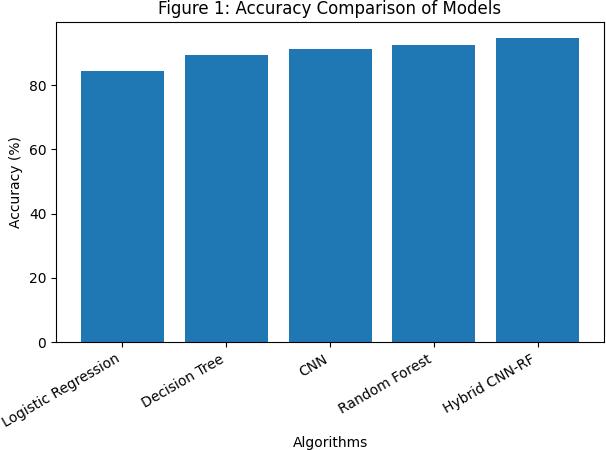
The hybrid model demonstrates superior performance comparedtostandalone methods.WhileCNNeffectively extracts spatial features, integrating Random Forest improves prediction accuracy andreduces errors in regionswithunevencrowddistributionandoverlapping densitypatterns.
International Research Journal of Engineering and Technology (IRJET) e-ISSN: 2395-0056
The bar chart illustrates that the proposed hybrid approach achieves the highest predictive performance amongallevaluatedmodels.
Prediction Reliability andConfusion Matrix
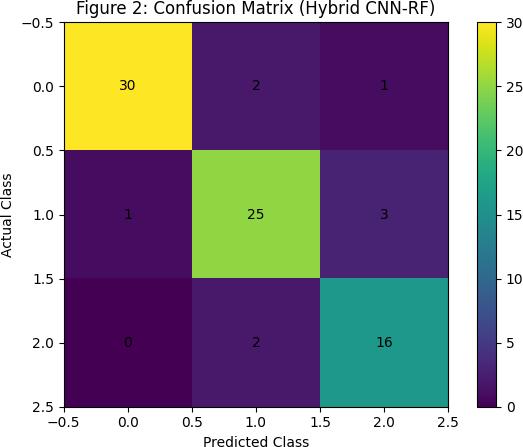
Fig.2– Multi-ClassConfusion Matrix
Theconfusionmatrixindicatesthatmostpredictionerrors occur in regions with moderate crowd density, where boundaries between safe and critical zonesoverlap. Highdensity regions are detected accurately due to distinct featurepatterns,confirmingtherobustnessoftheproposed model.
B. Regional Density Analysis(Model Interpretation)
The proposed Hybrid CNN–RF model effectively estimates crowd density across multiple regions withinascene.
Key Observations:
• Region-based analysis improves detection of localizedcrowdcongestion.
• The model captures complex spatial patterns
throughCNNfeatureextraction.
• Random Forest enhances predictionby learning non-linearrelationshipsbetweenregions.
• Critical zones are accurately identified using threshold-basedclassification.
Volume: 13 Issue: 04 | Apr 2026 www.irjet.net p-ISSN: 2395-0072 © 2026, IRJET | Impact Factor value: 8.315 | ISO 9001:2008
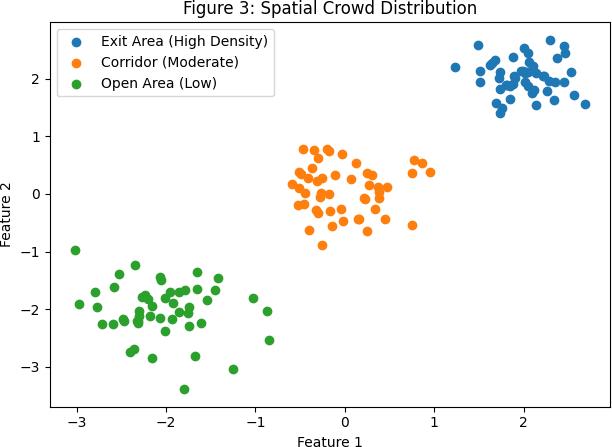
Fig.3– SpatialClusterMap
Thespatialplotdemonstrates:
• High densityin exit regions indicatespotential bottlenecks.
• Moderate density in corridors shows possible congestionbuildup.
• Low density in open areas ensuring safemovement.
Theregioncentersactasreferencepointsformonitoring crowd flow and identifyingpotential risk zones in realtime.
Thisstudyproposed ahybridCNN–RandomForestmodel for multi-regional crowd density estimation, which addresses the challenge of uneven and overlapping crowddistributionacrossdifferentregionsofascene.The
International Research Journal of Engineering and Technology (IRJET) e-ISSN: 2395-0056
ConvolutionalNeuralNetworkwasusedtoextractspatial andvisualfeaturesfromcrowdimages,whiletheRandom Forest model performed region-wise density prediction basedontheenhancedfeaturerepresentation.Theresults demonstrated high prediction accuracy (approximately 94%), indicating that the hybrid approach effectively improves localized density estimation and critical zone detection.
Overall, the integration of deep learning-based feature extractionwithensembleregressionenhancesrobustness incomplexcrowdscenariosandreducespredictionerrors inoverlappingregions.Theproposedmethodprovidesan efficient and reliable solution for crowd monitoring and stampede prevention.It can be furtherextended to realtime surveillance systems, smart city applications, and other computer vision tasks where spatial distribution andsafetyanalysisareessential
[1] Adam,A.,Rivlin,E.,Shimshoni,I.,&Reinitz,D.(2008). Robust real-time unusual event detection using multiplefixed-locationmonitors.
[2] Adelson,E.H.,&Bergen,J.R.(1985).Spatiotemporal energy models for the perception of motion. Journal oftheOpticalSocietyofAmericaA,2(2),284–299.
[3] Aggarwal,C.C.(2004).Ahuman-computerinteractive methodforprojectedclustering.
[4] Alahi,A.,Goel,K.,Ramanathan,V.,Robicquet,A., FeiFei, L., & Savarese, S. (2016). Social LSTM: Human trajectorypredictionincrowdedspaces.
[5] Alahi, A., Ramanathan, V., & Fei-Fei, L. (2017). Tracking millions of humans in crowded spaces. In Group and Crowd Behavior for Computer Vision,115–135.Elsevier.
[6] Alameda-Pineda, X., Staiano, J., Subramanian, R., Batrinca,L.,Ricci,E.,Lepri,B.,etal.(2016).SALSA:A noveldatasetformultimodalgroupbehavioranalysis.
[7] Bartoli,F.,Lisanti,G.,Seidenari,L.,Karaman,S.,&Del Bimbo, A. (2015). Museumvis itors: a dataset for pedestrianandgroupdetection,gazeestimationand behaviourunderstanding.
[8] Bartoli,F.,Seidenari,L.,Lisanti,G.,Karaman,S.,&Del Bimbo, A. (2015). Watts: a web annotation tool for surveillancescenarios.
[9] Bazzani, L., Cristani, M., & Murino, V. (2012). Decentralizedparticlefilterforjointindividual-group tracking.
[10] Benfold, B., & Reid, I. (2011). Stable multi-target trackinginreal-timesurveillancevideo.
[11] Bera, A., Kim, S., & Manocha, D. (2018). Modeling trajectory-level behaviors using time varying pedestrianmovementdynamics.
[12] Bewley, A., Ge, Z., Ott, L., Ramos, F., & Upcroft, B.
(2016).Simpleonlineandrealtimetracking.
Volume: 13 Issue: 04 | Apr 2026 www.irjet.net p-ISSN: 2395-0072 © 2026, IRJET | Impact Factor value: 8.315 | ISO 9001:2008