
International Research Journal of Engineering and Technology (IRJET) e-ISSN: 2395-0056
Volume: 13 Issue: 01 | Jan 2026 www.irjet.net p-ISSN: 2395-0072
International Research Journal of Engineering and Technology (IRJET) e-ISSN: 2395-0056
Volume: 13 Issue: 01 | Jan 2026 www.irjet.net p-ISSN: 2395-0072
Afif Prasetya Nugraha Putra1 , Agus Suprihanto1 , Sri Nugroho1
1 Department of Mechanical Engineering, Faculty of Engineering, Diponegoro University, Semarang 50275, Indonesia ***
Abstract - This study examines the Vickers hardness response of SKH9 high-speed steel (HSS) after hardening–tempering heat treatment using Response Surface Methodology(RSM)withatwo-factorinteraction(2FI)model. Hardening temperature (850–950 °C) and tempering temperature (450–550 °C) were selected as the primary process variables, while Vickers hardness (HVN) was used as the response. All specimens were hardened for 15 minutes, quenched in water, and tempered for 60 minutes to ensure consistent processing conditions. The experimental results showed that the hardness varied from 448 to 505 HVN within the investigated parameter range, demonstrating a strong dependenceontheappliedheattreatment.Statisticalanalysis confirmed that the 2FI model is significant at the 95% confidencelevel,withtemperingtemperatureidentifiedasthe dominantfactorcontrollinghardnessreduction.Theresponse surface analysis indicated that high hardness is achieved by combiningmoderate-to-highhardeningtemperaturewithlow tempering temperature, whereas lower hardness can be obtained by using high hardening temperature together with hightemperingtemperature.Thedevelopedresponsesurface model provides an effective and practical framework for selecting hardening–tempering conditions to tailor the hardness of SKH9 HSS for specific application requirements.
Key Words: High-Speed Steel (HSS); SKH9; Hardening–Tempering; Vickers Hardness; Response Surface Methodology
High-Speed Steel (HSS) remains a principal engineering material for cutting tools and wear-critical components because it can sustain high hardness while retaining adequate toughness under severe thermo-mechanical loading[1],[2].Inpracticalmanufacturing,theperformance ofHSSisnotdeterminedbychemicalcompositionalone;itis stronglygoverned bythe resultoftheappliedhardening–tempering heat treatment, which establishes a hardened matrix together with a characteristic distribution of alloy carbidesandacontrolledfractionofretainedaustenite[3], [4], [5]. Consequently, parameter selection in the heattreatmentcycleisadecisivestepinachievingtherequired hardnesslevelandensuringconsistentproductquality[6], [7]
Amongthevariouspropertymetricsusedtoqualifyheattreated HSS, hardness is one of the most widely adopted because it is closely associated with resistance to plastic deformationandedgeretentioninservice.Vickershardness (HV) is particularly suitable for laboratory-scale process developmentandmodelbuildingduetoitsrepeatabilityon smallspecimensandsensitivitytomicrostructuralvariations inducedbythermalprocessing[8],[9],[10],[11].However, optimizing hardness in HSS is not a simple monotonic “increase temperature to increase hardness” problem. During hardening (austenitizing), increasing temperature generally promotes dissolution of alloy carbides and enrichesaustenitewithcarbonandalloyingelements,which can increase the hardness of martensite after quenching. Beyond an optimum window, excessive hardening temperaturemayproduceadverseeffectssuchasaustenite graincoarseningandincreasedretainedaustenite,leadingto reduced hardness or higher scatter [12], [13], [14], [15]. Temperingintroducesadditionalcomplexitybecauseitcan either increase or decrease hardness depending on the competition between martensite decomposition and precipitation strengthening. Many HSS grades exhibit secondary hardening at appropriate tempering temperaturesduetoprecipitationoffinealloycarbides;at higher temperatures and/or prolonged exposure, overtemperingandprecipitatecoarseningreducestrengthening andhardness[16],[17],[18],[19]
Thecurrentstateoftheartreflectsthreecomplementary streams of work. First, metallurgical investigations have established the mechanisms linking heat-treatment parameterstomicrostructureevolutionparticularlycarbide precipitation behavior, retained austenite stability, and matrix transformations and haverelatedthesechanges to mechanical properties, including hardness. These studies provideessentialphysicalunderstandingofwhy hardness peaks can occur at intermediate conditions and why secondaryhardeningmaybefollowedbysofteningathigher temperingtemperatures.Second,industrialandhandbookbased guidance offers recommended hardening and tempering practices for specific grades and applications, providingbaselineparameterwindowsandemphasizingthe need for strict thermal control to reach target hardness levels. Third, within the broader materials-processing literature, statistical design-of-experiments approaches especially Response Surface Methodology (RSM) implemented using structured designs are widely used to
International Research Journal of Engineering and Technology (IRJET) e-ISSN: 2395-0056
Volume: 13 Issue: 01 | Jan 2026 www.irjet.net p-ISSN: 2395-0072
build empirical process–property models, quantify main effectsandinteractions,andidentifyoptimalregionswitha limitednumberofexperiments.RSMhasproveneffectivefor modeling hardness responses in heat-treatment-related studiesbecauseitcapturescurvature(quadraticbehavior) and interaction terms that are typical of thermally driven metallurgicalsystems[20],[21],[22]
Despitethisprogress,apracticalgapremainsinmanyHSS heat-treatment studies and in industrial parameter development: hardness is often reported at discrete combinations of hardening and tempering conditions without providing a compact, statistically validated response-surfacemodelthatmapstheparameterspaceto Vickers hardness within a clearly defined processing window [23], [24], [25], [26], [27]. This limitation is significant because the hardness response in HSS is frequentlynon-linearandinteraction-sensitive;abeneficial changeinhardeningtemperaturemaynotyieldimproved hardness if the tempering temperature shifts the system toward over-tempering, while tempering conditions that promote secondary hardening may be ineffective if the precedinghardeningstagedoesnotestablishtherequired soluteandcarbidestate[28].Withoutanexplicitpredictive surface,parameterselectiontendstorelyoniterativetrials orgeneralizedrecommendationsthatmaynotfullymatcha given process window, equipment capability, or hardness target[29],[30],[31],[32].
Accordingly, this study focuses on the heat-treatment outcomepost-processVickershardnessofHSSandapplies RSM to model and analyze the hardness response after hardening–tempering heat treatment. Hardening temperatureandtemperingtemperaturearetreatedasthe primary independent variables within a controlled experimentaldomain,andaquadraticregressionmodelis developed and assessed for adequacy. The resulting responsesurfaceisusedtoquantifytherelativeinfluenceof each parameter and their interaction, and to identify the parameter region that maximizes Vickers hardness. By presenting hardness as a predictive surface rather than isolateddatapoints,theworkprovidesanevidence-based basisforparameterselectionandsupports practical heattreatment tuning and process standardization for HSS applications.
ThematerialusedinthisstudywasHigh-SpeedSteel(HSS) type SKH9, which is a tungsten–molybdenum–based tool steelwidelyusedforcuttingandwear-resistantapplications duetoitshighhardnessandgoodthermalstabilityafterheat treatment[33].Allspecimenswerepreparedfromthesame batchofSKH9steel tominimizecompositional variability. Thesamplesweremachinedtoidenticaldimensionssuitable forhardnesstestingandweresurface-groundpriortoheat
treatment to ensure uniform thermal exposure and consistenthardnessmeasurements
ThisstudyemployedHigh-SpeedSteel(HSS)typeSKH9as the experimental material. All specimens were prepared from the same material batch to minimize compositional variability. The samples were machined to identical dimensionssuitableforhardnesstestingandsurface-ground priortoheattreatmenttoensureuniformthermalexposure and consistent indentation conditions during hardness measurements.
All specimens underwent a conventional hardening–temperingheattreatmentsequence.Duringthehardening stage,thesampleswereheatedinacontrolledfurnacetothe designatedtemperatureandheldfor15minutestoensure sufficient austenitisation and thermal homogenization Immediatelyafterthisperiod,thespecimenswerequenched inwater,whichwasusedasthequenchingmediumforall experimental runsin order tomaintainconsistentcooling severity. Tempering was subsequently carried out by reheating the quenched specimens to the specified tempering temperature and holding them for 60 minutes, followedbyaircoolingtoroomtemperature.Toisolatethe effectsoftheselectedvariablesonthehardnessresponse,all parameters other than the hardening and tempering temperatures, holding times, heating rate, quenching mediumandcoolingconditionswerekeptconstant.
Tomodeltheinfluenceofheattreatmentparameterson thehardnessresponseofSKH9HSS,atwo-factorinteraction (2FI)modelbasedonResponseSurfaceMethodology(RSM) wasemployed.Twoindependentvariableswereconsidered: hardeningtemperature(A)andtemperingtemperature(B). The experimental ranges were selected based on conventionalheattreatmentpracticesforSKH9:hardening temperaturewasvariedfrom850to950°C,andtempering temperaturefrom450to550°C.Theexperimentalmatrix consistedofafullcombinationoftheselectedfactorlevels, as summarized in Table 1. The response variable was defined as the Vickers hardness (HV) measured after the hardening–temperingcyclewascomplete.
Table -1: Experimentaldesignandheattreatment parametersforSKH9HSS
International Research Journal of Engineering and Technology (IRJET) e-ISSN: 2395-0056
Volume: 13 Issue: 01 | Jan 2026 www.irjet.net p-ISSN: 2395-0072
7
8
9
Vickers hardness testing was performed after heat treatment. Prior to testing, the specimen surfaces were lightlypolishedtoremovesurfaceoxidelayersandtoensure a smooth and flat indentation surface. Hardness measurements were conducted using a Vickers hardness tester under a constant test load and dwell time in accordance with standard testing procedures. For each experimentalcondition,multipleindentationsweremadeat differentlocationsonthespecimensurface,andtheaverage valuewasreportedastherepresentativeVickershardness to reduce the influence of local microstructural heterogeneity.
The experimental hardness data were analyzed using a two-factor interaction (2FI) regression model, which accountsforthemaineffectsofhardeningtemperatureand temperingtemperatureandtheirinteraction,expressedin thegeneralform[34]:
Where HV is the Vickers hardness, A is the hardening temperature,Bisthetemperingtemperature,andβ\betaβ terms are the regression coefficients. Analysis of variance (ANOVA) was employed to evaluate the statistical significanceofthemaineffectsandinteractionterm,aswell astheadequacyofthefittedmodel.Thevalidatedresponse surface was subsequently used to interpret the combined influenceofhardeningandtemperingtemperaturesandto identify the parameter region associated with maximum hardnessinSKH9high-speedsteel.
Table 2 summarizes the experimental matrix and the measuredVickershardness(HVN)ofSKH9high-speedsteel (HSS)afterthehardening–temperingheattreatment.Inall runs,thehardeningstagewasperformedwithaholdingtime of 15 minutes, followed by water quenching, and the temperingstagewascarriedoutwithaholdingtimeof 60 minutes. The investigated variables were hardening temperature(A)andtemperingtemperature(B),whileall otherprocessingparameterswerekeptconstanttoisolate theireffectsonhardness.
The hardness values ranged from 448 to 505 HVN, confirming that the selected heat treatment parameters significantly influence the hardness outcome within the investigateddomain.AcleartrendobservedfromTable2is the strong effect of tempering temperature. Increasing
tempering temperature generally reduced hardness, particularlyathardeningtemperaturesof900–950°C.For example,atA=900°C,hardnessdecreasedfrom505HVNat B=450°Cto483HVNatB=500°C,andfurtherto448HVN at B = 550 °C. This substantial reduction indicates that, within the tempering range of 450–550 °C, the hardness response is dominated by tempering-induced softening mechanisms,includingmartensitedecompositionandovertempering,whichreducethestrengtheningeffectachieved afterquenching.
Table -2: ExperimentalconditionsandVickershardness resultsforSKH9HSS
The influence of hardening temperature was more condition-dependent and suggests the presence of an interaction with tempering temperature. At the lowest temperingtemperature(B=450°C),increasinghardening temperaturefrom850°Cto900°Cincreasedhardnessfrom 485to505HVN,whileafurtherincreaseto950°Cresulted in a slight decrease to 503 HVN. This behavior implies an optimumnear900°C,whereenhancedcarbidedissolution and austenite enrichment can promote the formation of high-hardnessmartensiteafterwaterquenching.Theslight reduction at 950 °C may be associated with adverse austeniteconditionssuchasgraincoarseningorincreased retained austenite, which can reduce hardness despite higheraustenitizingtemperature
At higher tempering temperatures, the benefits of increasinghardeningtemperaturebecamelessconsistent. Notably,atB=550°C,thehardnessatA=850°Creached 495HVN,whereashardnessdroppedmarkedlyatA=900–950 °C (448–450 HVN). This pattern indicates that the hardnessresponsecannotbeexplainedbytheindependent main effects alone; rather, the influence of hardening temperature depends on the tempering condition that follows.Suchbehavioristypicalofheattreatmentsystems where the hardening stage establishes the as-quenched
International Research Journal of Engineering and Technology (IRJET) e-ISSN: 2395-0056
Volume: 13 Issue: 01 | Jan 2026 www.irjet.net p-ISSN: 2395-0072
microstructure (martensite/retained austenite and dissolved alloying content), while the tempering stage governs subsequent decomposition and precipitation processes.Inpracticalterms,ahardeningconditionthat is beneficialatlowertemperingtemperaturesmaynotremain beneficialathighertemperingtemperaturesifthetempering step drives the microstructure toward over-tempering or otherwise reduces the as-quenched strengthening advantage.
Toquantitativelycapturethiscoupledbehavior,Response SurfaceMethodology(RSM)wasappliedusingatwo-factor interaction(2FI)model,whichconsidersthemaineffectsof hardeningtemperatureandtemperingtemperatureaswell astheirinteraction.Theresultingresponsesurfacecontour plotinFigure1servesasaprocessingmapfortheVickers hardnessof SKH9HSSand clearlyshowsthat the contour linesarenotparalleltoeitheraxis,confirmingthepresence of interaction between the two thermal parameters. The contour map indicates that the highest hardness region (approximately500–505HVN)isachievedatacombination ofmoderate-to-highhardeningtemperatures(around890–930°C)andlowtemperingtemperature(approximately450 °C). This observation is consistent with the experimental results summarized in Table 2, where the maximum hardnessof505HVNwasobtainedatA=900°CandB=450 °C(Run2).
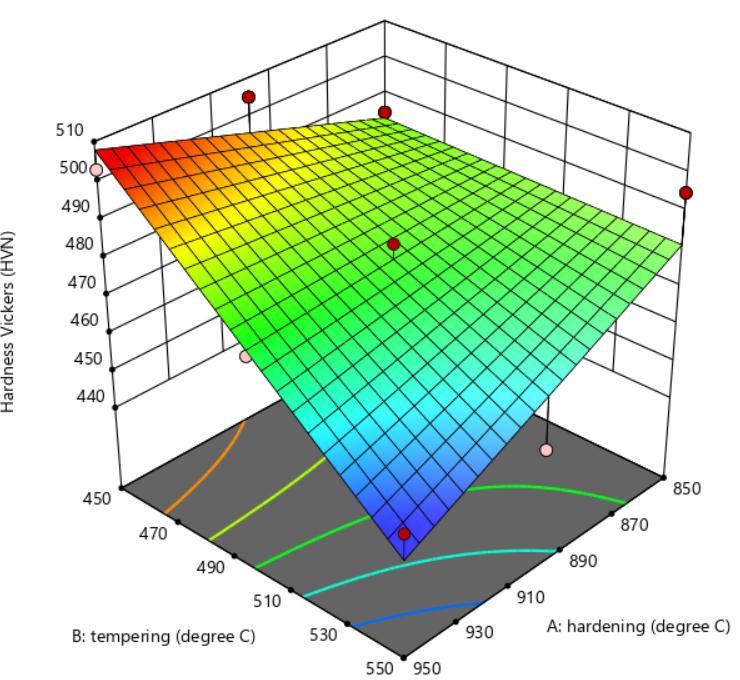
Beyond identifying the optimum region, the response surface also provides practical insight into how different combinationsofheattreatmentparameterscanbeselected totailorthehardnesslevel.Fromthecontourmap,itcanbe observedthathighhardnesscanbeobtainedbycombininga high hardening temperature with a low tempering
temperature,whichpromotessufficientcarbidedissolution during hardening while minimizing tempering-induced softening. Conversely, lower hardness levels can be deliberatelyachievedbyusingahighhardeningtemperature followed by a high tempering temperature, where the potential hardening benefit from elevated austenitizing is counteracted by enhanced martensite decomposition and over-tempering effects during tempering. This behavior highlightstheflexibilityofthehardening–temperingprocess in controlling the final hardness of SKH9 HSS through appropriateparametercombinations.
Previousstudieshavereportedthatincreasinghardening temperature tends to increase attained hardness under consistent tempering conditions, while higher tempering temperaturesleadtoreducedhardnesslevelsduetoovertemperingeffectsonmartensiteandcarbideevolution.For example, Mesquita et al. found that higher hardening temperatures result in higher hardness under the same temperingregime,andalsodiscussedapproachestotarget lower hardness through adjustment of heat treatment parameters[35] Liuetal.showedthattemperingabovethe secondaryhardeningpeakleadstoadeclineinhardnessas carbide distribution evolves [18] Barchukov et al. further discussed the effects of high-temperature tempering on hardness of high-speed steels, while Jovičević-Klug et al. highlightedtheoverallsensitivityofhardnesstotempering temperatureinhigh-speedsteelvariants[28].
The statistical validity of the 2FI model was evaluated usinganalysisofvariance(ANOVA).Theoverallmodelwas statisticallysignificantatthe95%confidencelevel,withan F-valueof5.87andap-valueof0.0429,indicatingthatthe selectedfactorsandtheirinteractionadequatelyexplainthe variationinhardnesswithintheinvestigateddomain.Among theindividualterms,temperingtemperature(B)exhibiteda statistically significant effect (F = 10.74, p = 0.0220), confirming it as the dominant factor controlling hardness reduction.Incontrast,thehardeningtemperature(A)main effectwasnotstatisticallysignificant(F=0.47,p=0.5219), suggesting that its influence on hardness is primarily
International Research Journal of Engineering and Technology (IRJET) e-ISSN: 2395-0056
Volume: 13 Issue: 01 | Jan 2026 www.irjet.net p-ISSN: 2395-0072
expressed through its interaction with tempering temperatureratherthanasanindependentlinearfactor.The interaction term A×B yielded a marginal p-value (p = 0.0526), which, although slightly above the conventional 0.05threshold,remainspracticallymeaningfulinthecontext of heat treatment processes where physical coupling betweenhardeningandtemperingstagesisexpectedandis further supported by the observed non-parallel trends in Table3andthecontourstructureinFigure1
Overall, the combined experimental results, response surfacecontouranalysis,andANOVAdemonstratethatjoint control of hardening and tempering temperatures is essential for tailoring the hardness of SKH9 HSS. When maximum hardness is required, the response surface recommends a processing window characterized by high hardening temperature and low tempering temperature Conversely, whena reduced hardness level is desired,the contour map indicates that high hardening temperature combined with high tempering temperature provides an effectiveroutetoachievelowerhardnessthroughcontrolled over-tempering. These findings provide a clear, evidencebasedframework forselectingheattreatmentparameters basedonthetargetedhardnesslevel.
This study investigated the Vickers hardness response of SKH9 high-speed steel (HSS) after hardening–tempering heattreatmentusingResponseSurfaceMethodology(RSM) withatwo-factorinteraction(2FI)model.Theexperimental results demonstrated that the applied heat treatment parameterssignificantlyinfluencethefinalhardness,with measuredvaluesrangingfrom448to505HVNwithinthe investigated temperature domain. Statistical analysis confirmedthatthedeveloped2FImodelissignificantatthe 95%confidencelevel,indicatingthatthecombinedeffectsof hardeningtemperature,temperingtemperature,andtheir interaction adequately describe the hardness variation of SKH9HSS.
Among the investigated parameters, tempering temperaturewasidentifiedasthedominantfactorgoverning hardness reduction, whereas the effect of hardening temperature was primarily dependent on the selected temperingconditionratherthanactingasanindependent linearfactor.Theresponsesurfaceanalysisshowedthathigh hardnesslevelscanbeachievedbycombiningmoderate-tohigh hardening temperatures with low tempering temperature, with the maximum hardness of 505 HVN obtained at a hardening temperature of 900 °C and a tempering temperature of 450 °C. Conversely, lower hardnesslevelscanbeintentionallyproducedbyemploying high hardening temperature followed by high tempering temperature, where tempering-induced softening counteracts the hardening benefit from elevated austenitizing.Overall,theresponsesurfacemodelprovidesa
practical and evidence-based framework for selecting hardening–temperingparameterstotailorthehardnessof SKH9HSSaccordingtospecificapplicationrequirements.
[1] S. Shaojun, Z. Xianping, and S. Chengtong, “Heattreatmentandpropertiesofhigh-speedsteelcutting tools,”IOPConf.Ser.Mater.Sci.Eng.,vol.423,no.1, 2018,doi:10.1088/1757-899X/423/1/012031.
[2] Y. Wang et al., “Advanced manufacturing of highspeedsteels:Acriticalreviewoftheprocessdesign, microstructural evolution, and engineering performance,” J. Mater. Res. Technol., vol. 24, pp. 8198–8240, May 2023, doi: 10.1016/j.jmrt.2023.04.269.
[3] Z. Wu et al., “Effect of microstructure on wear resistance during high temperature carburization heat treatment of heavy-duty gear steel,” Mater. TodayCommun.,vol.40,p.109486,Jun.2024,doi: 10.1016/j.mtcomm.2024.109486.
[4] A.Saastamoinen,A.Kaijalainen,J.Heikkala,D.Porter, and P. Suikkanen, “The effect of tempering temperature on microstructure, mechanical propertiesandbendabilityofdirect-quenchedlowalloystripsteel,”Mater.Sci.Eng.A,vol.730,pp.284–294,2018,doi:10.1016/j.msea.2018.06.014.
[5] Z.Daietal.,“Fundamentalsandapplicationofsolidstate phase transformations for advanced high strength steels containing metastable retained austenite,”Mater.Sci.Eng.RReports,vol.143,pp.1–39,Jan.2021,doi:10.1016/j.mser.2020.100590.
[6] S.Omarand K. P. Plucknett, “Theinfluence ofDED processparametersandheat-treatmentcycleonthe microstructureandhardnessofAISID2toolsteel,”J. Manuf.Process.,vol.81,pp.655–671,Sep.2022,doi: 10.1016/j.jmapro.2022.06.069.
[7] M.Lindič,D.Klobčar,A.Nagode,N.Mole,B. Žužek, andT.Vuherer,“Heattreatmentoptimisationof18 % Ni maraging steel produced by DED-ARC for enhancing mechanical properties,” J. Adv. Join. Process., vol. 11, p. 100312, 2025, doi: https://doi.org/10.1016/j.jajp.2025.100312.
[8] Q.LuoandM.Kitchen,“Microhardness,Indentation SizeEffectandRealHardnessofPlasticallyDeformed AusteniticHadfieldSteel,”Materials(Basel).,vol.16, no.3,2023,doi:10.3390/ma16031117.
[9] A.D.BagulandD.KumarDubey,“Effectsonhardness by various heat treatments processes on HSS tool bit,”Mater.TodayProc.,vol.43,pp.694–699,2020,
International Research Journal of Engineering and Technology (IRJET) e-ISSN: 2395-0056
Volume: 13 Issue: 01 | Jan 2026 www.irjet.net p-ISSN: 2395-0072
doi:10.1016/j.matpr.2020.12.619.
[10] K.Karolewska,M.Wirwicki,andB.Ligaj,“Evaluation ofaMethodforDeterminingMaterialStrengthBased on Hardness Measurements: A Case Study of the Ti6Al4VAlloy.,”Mater.(Basel,Switzerland),vol.18, no.16,Aug.2025,doi:10.3390/ma18163726.
[11] M.FujitaandK.Kuki,“AnEvaluationofMechanical Properties with the Hardness of Building Steel Structural Members for Reuse by NDT,” Metals (Basel)., vol. 6, no. 10, 2016, doi: 10.3390/met6100247.
[12] M. Gebril, M. Aldlemy, and A. F.Khblan, “Effect of AustenizationTemperaturesandTimesonHardness, MicrostructureandCorrosionRateofHighCarbon Steel,”Springer,Des.Comput.Mod.Eng.Mater.Adv. Struct. Mater., vol. Volume 54, p. pp 421-428, Jul. 2014,doi:10.1007/978-3-319-07383-5_30.
[13] R.Hossain,F.Pahlevani,andV.Sahajwalla,“Effectof smalladditionofCronstabilityofretainedaustenite inhighcarbonsteel,”Mater.Charact.,vol.125,Feb. 2017,doi:10.1016/j.matchar.2017.02.001.
[14] S.-W.Youngetal.,“EffectofAlloyingElementsonthe High-Temperature Tempering of Fe-0.3N Martensite,”ActaMater.,vol.206,p.116612,2021, doi: https://doi.org/10.1016/j.actamat.2020.116612.
[15] W. Liu, X. Wang, F. Guo, and C. Shang, “Carbides Dissolutionin5Cr15MoVMartensiticStainlessSteel and New Insights into Its Effect on Microstructure and Hardness,” Materials (Basel)., vol. 15, no. 24, 2022,doi:10.3390/ma15248742.
[16] G.Krauss,“TemperingofLathMartensiteinLowand MediumCarbonSteels:AssessmentandChallenges,” steel Res. Int., vol. 88, p. 1700038, May 2017, doi: 10.1002/srin.201700038.
[17] Y. Liu et al., “Evolution of Microstructures and MechanicalPropertieswithTemperingTemperature in a Novel Synergistic Precipitation Strengthening Ultra-High Strength Steel.,” Mater. (Basel, Switzerland), vol. 17, no. 21, Oct. 2024, doi: 10.3390/ma17215314.
[18] B. Liu et al., “Effect of Tempering Conditions on Secondary Hardening of Carbides and Retained AusteniteinSpray-FormedM42High-SpeedSteel,” Materials (Basel)., vol. 12, p. 3714, Nov. 2019, doi: 10.3390/ma12223714.
[19] D.Delagnes, P.Lamesle,M.-H.Mathon, N.Mebarki, andL.Christophe,“Influenceofsiliconcontentonthe precipitation of secondary carbides and fatigue
properties of a 5%Cr tempered martensitic steel,” Mater.Sci.Eng.A,vol.394,pp.435–444,Mar.2005, doi:10.1016/j.msea.2004.11.050.
[20] A.Megalingam,A.Ahmad,T.D.Alang,J.Alias,andN. Razak, “Application of Response Surface Methodology for Parameter Optimization of Aluminum 7075 Thixoforming Feedstock Billet Production,”J.Mater.Eng.Perform.,Nov.2022,doi: 10.1007/s11665-022-07535-4.
[21] V.Prabakaran,R.Palani,P.Saran,andS.Jenef,“Study ofthetribologicalperformanceofpre-andpost-heat treatmentofAISID2steelwithAlCrNcoatingunder wetconditions,”Aust.J.Multi-DisciplinaryEng.,vol. 19, no. 1, pp. 18–29, Dec. 2023, doi: 10.1080/14488388.2023.2193377.
[22] V. Yarasu, B. Podgornik, B. S. Batic, M. Sedlacek, Č Donik, and F. Ruiz-Zepeda, “Microstructure and mechanical performanceofAISI D2toolsteel after standard and modified deep cryogenic treatment,” Materialia, vol. 41, p. 102433, 2025, doi: https://doi.org/10.1016/j.mtla.2025.102433.
[23] Y.Wang,X.Ren,Z.Hou,A.Jiang,J.Zhao,andZ.Liu, “Optimization of Heat Treatment Process and Strengthening–TougheningandMechanismforH13 Steel,” Metals (Basel)., vol. 15, no. 10, 2025, doi: 10.3390/met15101101.
[24] S.Mudda,A.Hegde,S.Sharma,B.M.Gurumurthy,M. Shettar,andM. C.Gowrishankar, “Effect of various heat treatment methods and optimization of their parameterson mechanicalpropertiesofAISI4140 steel.,”Sci.Rep.,vol.15,no.1,p.31854,Aug.2025, doi:10.1038/s41598-025-17299-1.
[25] P. Biswas, A. Kundu, D. Mondal, and P. Bardhan, “Effectofheattreatmentonmicrostructurebehavior andhardnessofEN8steel,”IOPConf.Ser.Mater.Sci. Eng., vol. 377, Jul. 2018, doi: 10.1088/1757899X/377/1/012065.
[26] T.Pasang,Z.Chen,M.Ramezani,T.Neitzert,andD. Au, “The Effect of Heat Treatment Atmosphere on Hardening of Surface Region of H13 Tool Steel,” J. Mater.Sci.Chem.Eng.,vol.1,pp.20–29,Nov.2013, doi:10.4236/msce.2013.16004.
[27] A.Fortini,E.Bertarelli,M.Cassola,andM.Merlin,“An Industrial-Scale Study of the Hardness and MicrostructuralEffectsofIsothermalHeatTreatment Parameters on EN 100CrMo7 Bearing Steel,” Appl. Sci.,vol.14,no.2,2024,doi:10.3390/app14020737.
[28] A.U.Lavrentiev,D.A.Barchukov,A.U.Lavrentiev,E. F. Romanenko, and A. V Filonovich, “HIGH-
International Research Journal of Engineering and Technology (IRJET) e-ISSN: 2395-0056
Volume: 13 Issue: 01 | Jan 2026 www.irjet.net p-ISSN: 2395-0072
TEMPERATURE TEMPERING OF HIGH-SPEED STEELS WITH MINIMUM CONTENT OF RETAINED AUSTENITE,”pp.621–625,2017.
[29] Y.JiangandJ.MohammadpourVelni,“ASoftRobotic GripperforCropHarvesting:Prototyping,Imaging, andModel-BasedControl,” AgriEngineering,vol. 7, no.11,2025,doi:10.3390/agriengineering7110378.
[30] B. Lu et al., “When Machine Learning Meets 2D Materials: A Review,” Adv. Sci., vol. 11, no. 13, p. 2305277, Apr. 2024, doi: https://doi.org/10.1002/advs.202305277.
[31] M. Kulichenko et al., “Data Generation for Machine LearningInteratomicPotentialsandBeyond,”Chem. Rev.,vol.124,no.24,pp.13681–13714,Dec.2024, doi:10.1021/acs.chemrev.4c00572.
[32] A. K. Kausik, A. Bin Rashid, R. F. Baki, and M. M. Jannat Maktum, “Machine learning algorithms for manufacturing quality assurance: A systematic review of performance metrics and applications,” Array, vol. 26, p. 100393, 2025, doi: https://doi.org/10.1016/j.array.2025.100393.
[33] Y.Zhang,C.L.Hu,Z.Zhao,A.P.Li,X.L.Xu,andW.B. Shi, “Low cycle fatigue behaviour of a Cr–Mo–V matrix-typehigh-speedsteelusedforcoldforging,” Mater. Des., vol. 44, pp. 612–621, 2013, doi: https://doi.org/10.1016/j.matdes.2012.08.052.
[34] Y. Zhang, J. Pan, and L. Shi, “Construction of 2fioptimalrow–columndesigns,”J.Stat.Plan.Inference, vol. 234, p. 106192, 2025, doi: https://doi.org/10.1016/j.jspi.2024.106192.
[35] R.Mesquita,C.Barbosa,C.Gonçalves,andA.Slaviero, “Effect of hardening conditions on mechanical propertiesofhighspeedsteels,”Int.HeatTreat.Surf. Eng., vol. 5, pp. 36–40, Mar. 2011, doi: 10.1179/174951411X12956208225221.