
International Research Journal of Engineering and Technology (IRJET) e-ISSN: 2395-0056
Volume: 13 Issue: 05 | May 2026 www.irjet.net p-ISSN: 2395-0072
International Research Journal of Engineering and Technology (IRJET) e-ISSN: 2395-0056
Volume: 13 Issue: 05 | May 2026 www.irjet.net p-ISSN: 2395-0072
Asst. Prof. Dr. G. Arunachalam, M.E., Ph.D., 123UG Student Ms. P. Nandhini, Ms. S. Nagadharshini, Ms. N. J. Dharshini
Electronics and Comm Engg. The Gnanamani College of Technology (Autonomous), Pachal, Namakkal – 637018
Abstract: The “Low Cost Smart Flight Controller Using Drone” project is developed to provide an affordable, reliable, and intelligent flight control solution for small drone applications. This system is designed using the powerful Espressif Systems ESP32 microcontroller, which offers fast processing capability, low power consumption, and built-in wireless communication features such as Wi-Fi and Bluetooth. The TDK InvenSense MPU6050 sensor plays an important role in monitoring the drone’s movement, acceleration, and orientation to achieve stable and balanced flight control. By continuously collecting motion data and processing it in real time, the controller helps the drone maintain smooth navigation and improved flight stability. The project mainly focuses on reducing the overall cost of drone flight controllers while maintaining good performance and efficiency. This low-cost smart flight controller can be widely used for educational purposes, research activities, surveillance systems, and beginner-level drone development projects, making advanced drone technology more accessible and practical for students and developers.
Keywords: Smart Flight Controller, Drone Technology, ESP32 Microcontroller, MPU6050 Sensor, Flight Stabilization, Embedded System, Wireless Communication, Low-Cost Drone System, Real-Time Motion Control and IoT-Based Drone Applications
The rapid advancement of unmanned aerial vehicles (UAVs) has created a growing demand for reliable and cost-effective flight control systems. Drones are now widely used in applications such as aerial photography, agriculture, surveillance, disaster monitoring, and delivery services. However, many commercial flight controllers are expensive and difficult for students and beginnerstounderstandormodify.
Toovercometheselimitations,the“LowCostSmartFlight Controller Using Drone” project aims to develop an affordable and intelligent flight control system using modern embedded technologies and easily available electronic components. The proposed system is designed around the powerful Espressif Systems ESP32 microcontroller, which provides high-speed processing capability, built-in Wi-Fi and Bluetooth communication, andlowpowerconsumption.TheESP32actsasthebrain of the drone by collecting sensor data, processing flight information, and generating control signals for stable
droneoperation.Toachieveaccuratemotionsensingand balancing,thesystemusestheTDKInvenSenseMPU6050 sensor,whichcombinesagyroscopeandaccelerometerin a single module. This sensor continuously measures the drone’sorientation,tiltangle,andmovement,helpingthe controller maintains stability during flight. The main objective of this project is to create a smart and budgetfriendly flight controller that can perform stable drone navigationwhilereducingoverallsystemcost.
TheintegrationoftheESP32andMPU6050 enablesrealtime monitoring and fast response to flight disturbances, improving the drone’s balance and performance. In addition, the wireless communication capability of the ESP32 allows future enhancements such as mobile app control, IoT-based monitoring, and autonomous navigation features. This project not only provides a practical solution for low-cost drone development but alsoservesasanexcellentlearningplatformforstudents and researchers interested in embedded systems, robotics,andUAVtechnology.
The literature survey on the “Low Cost Smart Flight Controller Using Drone” project highlights the growing importanceofaffordableandintelligentdronesystemsin modern applications such as surveillance, agriculture, delivery services, and environmental monitoring. Earlier drone flight controllers mainly relied on expensive hardware and complex processing units, making them difficult for students and small-scale developers to implement. Recent studies show that compact microcontrollers like the Espressif Systems ESP32 have become popular due to their low cost, high-speed processing capability, built-in Wi-Fi and Bluetooth features, and energy-efficient operation. Researchers have also widely used the TDK InvenSense MPU6050 sensor for motion sensing and drone stabilization because it combines both accelerometer and gyroscope functionalities in a single module, providing accurate orientation and movement detection. Various existing systems focus on improving flight stability, balancing, navigation, and wireless communication, but many still involve higher implementation costs or complicated architectures.Thisprojectaddressesthoselimitations by developing a simple, cost-effective, and reliable smart flight controller system that can provide stable drone operation while reducing overall hardware expenses and improving accessibility for educational and research purposes.
International Research Journal of Engineering and Technology (IRJET) e-ISSN: 2395-0056
Volume: 13 Issue: 05 | May 2026 www.irjet.net p-ISSN: 2395-0072
[1] A. Kumar and R. Singh, “Development of a LowCost Drone Flight Controller Using ESP32 and MEMS Sensors,” International Journal of Innovative TechnologyandExploringEngineering(IJITEE), vol. 9, no. 6, pp. 1450–1455, Apr. 2020.
This paper presents the design of a compact and economical drone flight controller based on the ESP32 microcontroller and MPU6050 motion sensor. The authors focused on improving flight stability while reducing the overall hardware cost of the drone system. The ESP32 was selected because of its high-speed processing capability and built-in wireless communication support. The MPU6050 sensor was used to monitor acceleration and angular velocity for maintaining drone balance during flight. Experimental results showed that the proposed controller achieved stable hovering and smooth directional movement with low power consumption. The study highlighted that lowcost embedded platforms can effectively support realtime drone stabilization and autonomous control applications.
[2] S. Prakash, M. Reddy, and P. Verma, “Design and Implementation of an Affordable Quadcopter Flight Control System,” IEEE International Conference on Communication and Electronics Systems (ICCES), Coimbatore, India, 2021, pp. 1123–1128.
The authors developed a budget-friendly quad copter system using embedded sensors and microcontrollerbased flight algorithms. The research mainly concentrated on attitude estimation and stabilization using the MPU6050 gyroscope and accelerometer module. The flight controller processed sensor data continuously to maintain balance during takeoff, landing, and directional movement. The proposed system demonstrated reliable flight performance while minimizinghardwarecomplexityandmanufacturingcost. The study concluded that low-cost flight controllers can be effectively used for educational, surveillance, and lightweightaerialmonitoringapplications.
[3] R. Karthik and V. Balaji, “Smart Drone Stabilization System Using ESP32 and MPU6050 Sensor,” InternationalJournalofScientificResearchin Computer Science, Engineering and Information Technology(IJSRCSEIT), vol. 8, no. 3, pp. 320–326, May 2022.
This research introduced a smart drone stabilization technique using the ESP32 microcontroller integrated withtheMPU6050motiontrackingsensor.
The system collected real-time motion data and applied stabilization logic to improve the drone’s flight accuracy and response time. The ESP32 enabled faster data processing and wireless communication for remote monitoring purposes. The authors emphasized the
importance of lightweightandlow-powercomponentsin improvingdroneefficiencyandreducingoperationalcost. The experimental analysis confirmed that the proposed controller provided better motion stability, reduced drift errors, and improved flight control reliability in low-cost droneapplications.
Proposed Block Diagram
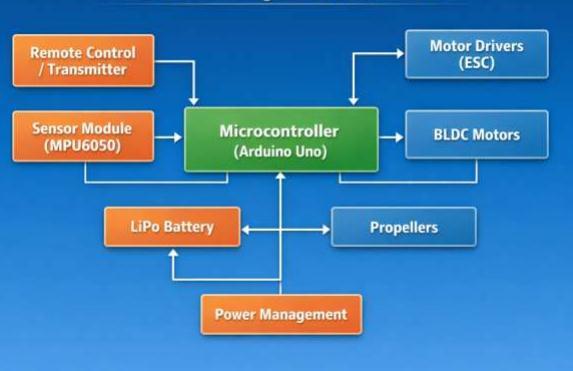
The proposed system of the “Low Cost Smart Flight Controller Using Drone” is designed to provide a simple, affordable, and efficient solution for stable drone operation using modern embedded technology. In this system,theESP32actsasthemaincontroller,handlingall flight control operations with fast processing speed and low power consumption. The MPU6050 sensor continuously monitors the drone’s movement, tilt, and orientation by measuring acceleration and gyroscopic values in real time. Based on these sensor readings, the controller automatically adjusts the drone’s motion to maintainbalanceandstabilityduringflight.Thesystemis developed with a low-cost approach so that students, researchers, and hobbyists can easily build and experiment with drone technology without expensive flight control hardware. In addition, the wireless communication capability of the ESP32 supports future improvements such as remote monitoring, mobile control, and IoT-based drone applications, making the project flexible, scalable, and suitable for educational as wellaspracticalapplications.
The “Low Cost Smart Flight Controller Using Drone” works by continuously monitoring and controlling the movement of the drone in real time using an intelligent embedded system. The Espressif Systems ESP32 microcontrolleractsasthemainprocessingunit,whereit receives motion and orientation data from the MPU6050
International Research Journal of Engineering and Technology (IRJET) e-ISSN: 2395-0056
Volume: 13 Issue: 05 | May 2026 www.irjet.net p-ISSN: 2395-0072
sensor. The MPU6050 contains both an accelerometer and a gyroscope, which help detect the drone’s tilt, rotation, speed, and direction during flight. Based on these sensor readings, the ESP32 quickly analyzes the drone’s position and sends corrective control signals to the motors to maintain balance and stable movement. If the drone tilts or becomes unstable due to wind or sudden motion, the controller automatically adjusts the motor speed to bring the drone back to a balanced position. The integrated wireless capability of the ESP32 also allows easy communication for remote monitoring andcontrol.Thissmartcoordinationbetweenthesensor, controller, and motors enables smooth flight operation, improved stability, and efficient drone performance at a lowdevelopmentcost.
TheESP32 microcontroller actsasthebrain of the smart drone flight controller system. It is widely preferred in modern embedded and IoT applications because of its high-speed dual-core processor, built-in Wi-Fi and Bluetooth connectivity, low power consumption, and compact design. In this drone project, the ESP32 continuously receives data from sensors, processes flight stabilization algorithms, and sends control signals to the motors through the ESCs. Its fast processing capability helps maintain smooth and stable flight performance whilealsosupportingadditionalfeaturessuchaswireless monitoring, telemetry, and future AI-based flight enhancements. Due to its affordability and powerful performance, the ESP32 is an excellent choice for developingalow-costsmartdronecontrollersystem.
TheMPU6050sensorisanimportantcomponentusedfor drone stabilization and motion sensing. It combines a 3axis gyroscope and a 3-axis accelerometer in a single compact module, allowing the drone to measure angular rotation, tilt, acceleration, and orientation in real time. During flight, the sensor continuously monitors the movement and balance of the drone and sends this information to the ESP32 controller for correction and stabilization. This helps the drone maintain proper alignment, reduce unwanted vibrations, and improve overallflightaccuracy.Becauseofitssmallsize,lowcost, and reliable performance, the MPU6050 is commonly used in quad copters, robotics, and motion-controlled systems.
The 1800 KV Brushless DC (BLDC) motor provides the thrust required for the drone to lift and maneuver in the air. BLDC motors are highly efficient, lightweight, and capable of delivering high rotational speed with minimal
energy loss, making them ideal for drone applications. The “1800 KV” rating indicates the motor’s speed constant, meaning it can rotate at approximately 1800 RPM per volt supplied without load. In this project, the motorsrespondquicklytospeedcontrolcommandsfrom the ESP32 through the ESCs, allowing smooth takeoff, landing, hovering, and directional movement. Their durabilityandlowmaintenancerequirementsmakethem suitableforstableandlong-durationdroneoperation.
The Electronic Speed Controller,commonlycalledESC, is responsibleforcontrollingthespeedanddirectionofthe BLDCmotorsinthedrone.Itactsasaninterfacebetween the ESP32 flight controller and the motors by converting control signals into precise electrical pulses. The ESC adjusts motor speed according to the flight conditions, enabling stable hovering, turning, climbing, and landing operations. It also ensures smooth acceleration and protects the motors from excessive current and overheating.Indronesystems,ESCsplayacriticalrolein maintaining balance and synchronized motor performanceduringflight.
TheLithiumPolymer(LiPo)batteryservesastheprimary power source for the drone system. LiPo batteries are widely used in drones because they are lightweight, rechargeable, and capable of delivering high current outputrequiredforrapidmotoroperation.Inthisproject, the battery supplies power to the ESP32 controller, sensors, ESCs, and motors, ensuring continuous drone operation during flight. Their compact size and high energy density help improve flight duration while minimizing overall drone weight. Proper voltage management and safe charging practices are essential to ensurereliablebatteryperformanceandlongerlifespan.
The drone frame forms the structural body of the quad copter and supports all major components, including motors, propellers, sensors, battery, and controller circuits.Itisdesignedtobelightweightyetstrongenough to withstand vibrations, minor impacts, and flight stress. A well-balanced frame improves drone stability, aerodynamics, and maneuverability during operation. In this project, the frame provides proper alignment for the motors and helps distribute the weight evenly, resulting in smoother flight performance and better control accuracy.
Propellersareessentialcomponentsthatgeneratethelift required for the drone to fly. They rotate at high speed usingtheBLDCmotorsandcreateairflowthatpushesthe
International Research Journal of Engineering and Technology (IRJET) e-ISSN: 2395-0056
Volume: 13 Issue: 05 | May 2026 www.irjet.net p-ISSN: 2395-0072
drone upward and controls its movement in different directions.Thesize,shape,andmaterialofthepropellers directly influence flight efficiency, stability, and speed. In this smart drone system, the propellers work together withthemotorsandESCstomaintainbalancedflightand enable smooth directional control such as forward, backward,left,right,androtationalmovement.
Thecamera and gimbals systemisusedtocapturestable aerial images and videos during drone operation. The gimbals helps reduce unwanted vibrations and sudden movementsbystabilizingthecameraalongdifferentaxes, ensuring smooth and clear footage even when the drone is in motion. In this project, the camera can be used for surveillance, live monitoring, photography, mapping, or inspection applications. The integration of a stabilized camera system enhances the drone’s functionality and allows it to perform advanced smart monitoring tasks efficiently.
The power supply system is responsible for distributing electrical power to all components of the drone in a safe and controlled manner. It ensures that the ESP32 controller, MPU6050 sensor, ESCs, motors, and other modules receive the required operating voltage and current. A properly designed power system improves flight reliability, prevents voltage fluctuations, and enhances overall system efficiency. In this project, the power supply arrangement helps maintain stable operation of the drone while supporting continuous communicationandsensormonitoringduringflight.
10. Voltage Regulator
Voltage regulators are used to provide stable and constantvoltagelevelstosensitiveelectroniccomponents in the drone system. Since the LiPo battery voltage may varyduringoperation,regulatorshelpprotecttheESP32, sensors, and communication modules from voltage fluctuations and electrical damage. They ensure smooth functioning of the embedded circuitry by converting higher or unstable voltage into safe operating levels. In thisproject,voltageregulatorsimprovesystemreliability, reduce electrical noise, and enhance the overall safety of thedronecontrollerdesign.
11. RC Transmitter and Receiver
The transmitter and receiver module enables wireless communication between the user and the drone. The transmitter sends control commands such as throttle, direction, altitude adjustment, and movement instructions, while the receiver installed on the drone receives these signals and forwards them to the ESP32 controller. This wireless communication system allows
real-time remote operation and improves flight responsiveness.
In this project, the transmitter and receiver ensure reliable command transmission over a suitable range, making the drone easy to control and operate safelyduringflight.
1. Power Supply Calculation
TheflightcontrollerusesanESP32andMPU6050sensor, whichoperateat3.3V.
OperatingVoltage=3.3V
AverageCurrent=240mA
Usingthepowerformula:P=V\timesI
Substitutingthevalues:P=3.3\times0.24
PowerConsumption:P=0.792W
Therefore,theESP32consumesapproximately 0.8 Watts
2. MPU6050 Sensor Power Calculation
OperatingVoltage=3.3V
CurrentConsumption=3.9mA
Using:P=V\timesI
Substitutingthevalues:P=3.3\times0.0039
P=0.01287W
TheMPU6050consumesapproximately 0.013 Watts
3. Total Flight Controller Power
TotalPower:0.8+0.013=0.813W
Hence, the complete flight controller consumes nearly 0.81 Watts
4. Battery Backup Calculation
Assume:
BatteryCapacity=2200mAh
BatteryVoltage=3.7V
Batterybackupformula:
TotalLoadCurrent:
ESP32=240mA
MPU6050=3.9mA
International Research Journal of Engineering and Technology (IRJET) e-ISSN: 2395-0056
Volume: 13 Issue: 05 | May 2026 www.irjet.net p-ISSN: 2395-0072
TotalCurrent=243.9mA
Substituting:
So, the flight controller can work for approximately 9 hours withoutmotorsconnected.
5. Drone Tilt Angle Measurement
The MPU6050 measures the tilt angle using accelerometerdata.
Tiltangleequation:
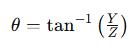
Where:
(Y)=Y-axisacceleration
(Z)=Z-axisacceleration
(theta)=Tiltangle
This calculation helps the drone maintain balance and stableflight.
6. PWM Signal Calculation for Motor Control
The ESP32 generates PWM signals to control motor speed.
PWMDutyCycleFormula:
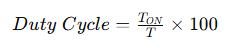
ONTime=1.5ms
TotalPeriod=20ms
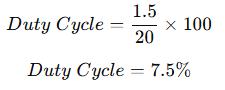
This PWM signal controls the speed of the drone motors formovementandstabilization.
VII APPLICATIONS
1. Agricultural Field Monitoring:Thesmartdronecan beusedbyfarmerstomonitorcrophealth,irrigation conditions, and field activities. It helps in identifying damaged crops, water shortages, and pest-affected areas quickly, reducing manual effort and improving agriculturalproductivity.
2. Disaster Management and Rescue Operations: During floods, earthquakes, or fire accidents, the dronecancapturereal-timeaerialimagesandvideos of affected areas. This helps rescue teams locate
victims, assess damage, and plan emergency operationsmoreefficientlyandsafely.
3. Security and Surveillance Systems: The low-cost flight controller can be integrated into surveillance drones for monitoring public areas, industries, campuses, and border regions. The drone provides continuousaerialobservationandimprovessafetyby detectingsuspiciousactivitiesfromremotelocations.
4. Environmental and Wildlife Monitoring: The drone system can be used for monitoring forests, rivers, wildlife habitats, and pollution levels. Researchers and environmental agencies can collect aerial data without disturbing natural ecosystems, making the monitoring process faster and more accurate.
5. Educational and Research Purposes: Since the project is designed using affordable components like the ESP32 and MPU6050, it is highly suitable for engineering students and researchers. It provides practical knowledge in embedded systems, drone technology, wireless communication, and flight stabilizationtechniques.
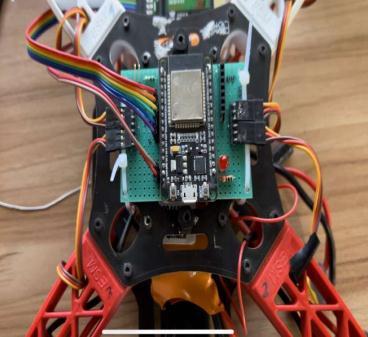
An ESP32 microcontroller mounted on a custom drone frame prototype with servo and sensor wiring connections for flight control, wireless communication, andembeddedsystemexperimentation.
Theexperimentaloutcomesofthe“LowCostSmartFlight Controller Using Drone” project demonstrated that the developed system can achieve stable and reliable drone flight at a significantly lower cost compared to conventional flight controllers. By integrating the Espressif Systems ESP32 microcontroller with the TDK InvenSense MPU6050 motion sensor, the drone was able to continuously monitor orientation, balance, and movement in real time, resulting in improved flight stability and smoother navigation. During testing, the controller responded effectively to changes in tilt, vibration,andmotion,allowingaccuratecorrectionofthe drone’spositionduringoperation.
International Research Journal of Engineering and Technology (IRJET) e-ISSN: 2395-0056
Volume: 13 Issue: 05 | May 2026 www.irjet.net p-ISSN: 2395-0072
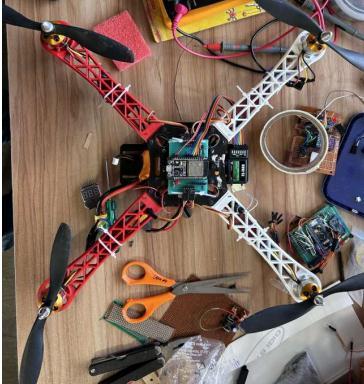
A DIY quad copter drone prototype featuring an ESP32-based flight controller mounted on an X-frame chassis with brushless motors, propellers, ESC connections, and embedded electronics for wireless dronecontrolandstabilizationtesting.
The wireless communication capability of the ESP32 also enhanced flexibility for future IoT-based monitoring and remote-control applications. Overall, the project proved that a compact, energy-efficient, and budget-friendly smart flight controller can successfully supportdronestabilization,controlaccuracy,andreliable performance for educational, research, and small-scale aerialapplications.
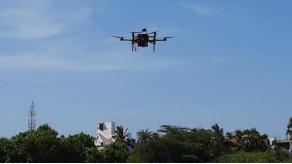
An ESP32-based quad copter drone performing a test flightinanoutdoorenvironment,demonstratingwireless flight control, aerial stability, and real-time embedded systemoperationforsmartdroneapplications.
The “Low Cost Smart Flight Controller Using Drone” project successfully demonstrates the development of an affordable, reliable, and intelligent flight control system using modern embedded technology. By integrating the powerful Espressif Systems ESP32 microcontroller with theMPU6050motionsensor,thesystemisabletoachieve
real-time flight stabilization, motion sensing, and responsive drone control with reduced hardware cost. Theprojectprovesthatefficientdronetechnologycanbe developed using low-cost components without compromisingessentialflightperformanceandstability.
In addition, the compact design, wireless communication capability, and low power consumption make the system suitable for educational, research, surveillance, and beginner-level drone applications. Overall, this project provides a practical foundation for future smart drone innovations and encourages the development of budgetfriendly unmanned aerial systems for real-world applications.
[1] S. Madani and A. Benallegue, “Backstepping Control for a Quadrotor Helicopter,” in Proceedings of the 2006 IEEE/RSJ International Conference on Intelligent Robots andSystems,Beijing,China,Oct.2006,pp.3255–3260.
[2] M. W. Mueller, M. Hehn and R. D’Andrea, “A Computationally Efficient Motion Primitive for Quadrocopter Trajectory Generation,” IEEE Transactions onRobotics,vol.31,no.6,pp.1294–1310,Dec.2015.
[3] P. Pounds, R. Mahony and P. Corke, “Modelling and Control of a Quad-Rotor Robot,” in Proceedings of the Australasian Conference on Robotics and Automation, Auckland,NewZealand,Dec.2006,pp.1–6.
[4] A. Kendoul, I. Fantoni and R. Lozano, “Modeling and Control of a Small Autonomous Aircraft Having Two TiltingRotors,”IEEETransactionsonRobotics,vol.22,no. 6,pp.1297–1302,Dec.2006.
[5] J. Borenstein and Y. Koren, “The Vector Field Histogram Fast Obstacle Avoidance for Mobile Robots,” IEEETransactionsonRoboticsandAutomation,vol.7,no. 3,pp.278–288,Jun.1991.