
International Research Journal of Engineering and Technology (IRJET) e-ISSN:2395-0056
Volume:13Issue:03|Mar2026 www.irjet.net p-ISSN:2395-0072
International Research Journal of Engineering and Technology (IRJET) e-ISSN:2395-0056
Volume:13Issue:03|Mar2026 www.irjet.net p-ISSN:2395-0072
Prof.
Vikas Pawar1, Aditya Sunil Oswal2, Aditya Sunil Gawali3, Aditya Sanjay Lasurkar4 , Samiksha Nitin Thorat5
Dept. of Civil Engineering, MET BKC college, Maharashtra, India
Abstract - Structural Health Monitoring (SHM) of Reinforced Cement Concrete (RCC) infrastructure is critical, as members are perpetually subjected to cyclic loading, environmental degradation, and material aging. These factors induce stochastic variations in structural response that,ifundetected,compromiseglobalstabilityandescalate life-cycle maintenance costs. Traditional inspection protocols primarily rely on qualitative visual assessments, which are labor-intensive and lack the precision required forproactivefailuremitigation.
This research presents a high-fidelity, cost-effective IoTbased strain monitoring and early warning system designed for real-time autonomous observation. The hardware architecture integrates foil-type resistance strain gaugeswithahigh-resolutionsignal conditioningstageand an ESP32microcontroller foredge-baseddataacquisition. Toensure dataintegrity,thesystemestablishesacalibrated baselineunderambientconditions.
A primary challenge in SHM is the presence of signal interference; therefore, this system implements a confidence-based algorithmic approach rather than deterministic thresholding. By analyzing temporal strain patterns and statistical consistency, the framework effectively filters transient noise and environmental fluctuations, significantly reducing the False Alarm Rate (FAR)
Experimental validation was executed on an RCC beam specimen to characterize the load-strain hysteresis and verify the sensitivity of the proposed monitoring logic. The results demonstrate that the integrated system provides a scalable, low-latency, and economically viable solution for the preliminary identification of structural anomalies, offering a robust alternative to conventional intermittent inspections.
Key Words: Structural Health Monitoring (SHM), Internet of Things (IoT), ESP32, Reinforced Concrete, Strain Gauges, Anomaly Detection, Real-time Data Acquisition, Signal Conditioning, Predictive Maintenance, Structural Integrity, Load-Strain Hysteresis, False Alarm Rate (FAR) Reduction, BaselineCalibration,In-situCharacterization.
The global construction landscape is fundamentally anchored by Reinforced Cement Concrete (RCC), particularly in the form of flexural members like beams and slabs that bear the primary structural load. While these systems are designed for durability, they exist in a state of continuous flux. From the moment of commissioning, RCC elements are subjected to a complex interplay of cyclic loading, thermal expansion, and chemical degradation (such as carbonation or chloride ingress). Over time, these factors lead to material fatigue and a gradual reduction in the section’s moment of resistance,oftenmanifestingasmicro-crackingbeforeany visiblesignsofdistressappear.
The primary challenge in maintaining such infrastructure lies in the diagnostic gap. Traditional maintenance protocolsareinherently reactive and qualitative,relying heavily on periodic visual inspections. However, visual observation is subjective and limited to surface-level defects; it cannot quantify the internal stress-strain distributionor identifylatentstructural instability.Bythe time a crack becomes visible to the human eye, the internal reinforcement may have already surpassed its yield point, leading to expensive or even impossible repairs.
The emergence of the Internet of Things (IoT) has introduced a paradigm shift in civil engineering through Structural Health Monitoring (SHM). By embedding high-precisionsensorsdirectlyontocriticalmembers,itis nowpossibletotransitionfromperiodicmanualchecksto continuous,real-timedataacquisition
This project explores the development of a low-cost, automated SHM framework utilizing strain-gauge technology and ESP32-based edge computing. Unlike standard monitoring systems that often trigger false alarmsduetoenvironmentalnoise,thisresearchproposes a confidence-based logic to filter transient disturbances. By establishing a digital baseline of structural response, the system aims to provide a reliable, high-fidelity early warning mechanism, ensuring that structural anomalies areflaggedlong beforethey compromisethesafetyof the occupants.
International Research Journal of Engineering and Technology (IRJET) e-ISSN:2395-0056
Volume:13Issue:03|Mar2026 www.irjet.net p-ISSN:2395-0072
The structural integrity of Reinforced Cement Concrete (RCC)infrastructure,specificallyflexuralcomponentssuch as beams and slabs, is subject to continuous degradation driven by cyclic loading, environmental stressors, and material aging. These factors often lead to subtle variations in structural response that are frequently overlooked until significant, visible damage manifests, compromisingsafetyandescalatinglife-cyclemaintenance costs. Current diagnostic protocols rely heavily on qualitative visual inspections and manual testing, which are inherently reactive, labor-intensive, and incapable of detecting latent internal defects at an incipient stage. Furthermore, while modern Structural Health Monitoring (SHM) systems offer data-driven insights, their widespread implementation is hindered by prohibitive costs forsmall-scaleapplicationsanda highsusceptibility to false alarms triggered by stochastic environmental noise. Consequently, there is a distinct requirement for a high-fidelity, economically viable IoT-based monitoring framework that utilizes intelligent data processing to provide reliable, real-time early warnings before structuralanomaliesescalateintocatastrophicfailure.
The primary goal of this research is to develop an autonomous, cost-effective monitoring framework for infrastructure safety. To achieve this, the project is directedtowardthefollowingtechnicalobjectives:
[1] To investigate the mechanical response and strain distribution profiles of Reinforced Cement Concrete (RCC) flexural members under various loading scenarios.
[2] To architect an economically viable sensing framework utilizing high-sensitivity resistive foiltype strain gauges for the precise quantification of micro-strains.
[3] To engineer a robust, IoT-integrated Data Acquisition (DAQ) node leveraging the ESP32 microcontroller for real-time edge processing and wirelesstelemetry.
[4] To implement analytical algorithms for characterizing temporal strain signatures and identifying stochastic deviations from established structuralbaselines.
[5] To develop a confidence-based Early Warning System (EWS) designed to provide proactive alerts for incipient structural anomalies while minimizing theFalseAlarmRate(FAR).
[6] To formulate a comprehensive experimental protocol for validating the system's sensitivity
throughcontrolledloadingofinstrumentedRCCbeam specimens.
The Proposed Methodology for this research is structured into a systematic engineering workflow, transitioning from hardware architecture design to the implementation of the analytical warning logic. The processisdividedintothefollowingtechnicalphases:
[1] SensorIntegrationandSignalConditioning
Theinitialphaseinvolvesacomprehensiveevaluation of strain measurement techniques to select highsensitivity, foil-type resistive strain gauges. To translate minute mechanical deformations into measurable electrical signals, a precision signal conditioning circuit is designed using a Wheatstone Bridge configuration. This analog output is then interfaced with a 24-bit HX711 analog-to-digital converter (ADC), which provides the high-resolution amplification required to capture micro-strain variations.
[2] IoT Data Acquisition (DAQ) and Firmware Development
The hardware core utilizes an ESP32 microcontroller,selectedforitsdual-coreprocessing capabilities and integrated Wi-Fi stack. Firmware is developed to establish a robust Data Acquisition (DAQ)pipelinethat samples sensordata at calibrated intervals. This system is programmed to establish a digital structural baseline by recording strain signatures under ambient, "zero-load" conditions, providingareferenceforfutureanomalydetection.
[3] AnalyticalFrameworkandWarningLogic
A primary focus of the methodology is the development of a confidence-based detection algorithm. Unlike conventional systems that use simple thresholding, this framework continuously analyzes temporal strain trends and statistical consistency. The logic evaluates four critical parameters: Trend (T), Sudden Jumps (J), Baseline Shifts (B), and Persistence (P). A warning signal is onlydispatchedoncethecumulativeconfidencescore exceeds a predefined limit, effectively filtering out stochastic environmental noise and transient loading disturbances.
[4] ExperimentalValidationProtocol
To verify system efficacy, a controlled experimental plan is formulated using an instrumented RCC beam specimen. The specimen is subjected to incremental flexural loading in a Universal Testing Machine
International Research Journal of Engineering and Technology (IRJET) e-ISSN:2395-0056
Volume:13Issue:03|Mar2026 www.irjet.net p-ISSN:2395-0072
(UTM) to characterize the load-strain hysteresis and observespecificfailuremodes,suchascrackinitiation and steel yielding. The data collected during these tests serves to calibrate the warning thresholds and validatethereal-timeresponseoftheIoTnode.
The operational framework of the proposed system is engineered to provide continuous, real-time telemetry of structural deformation through a multi-stage data processingpipeline.
[1] SignalAcquisitionandProcessing
The system initiates with the detection of microstrains in flexural members using high-sensitivity resistance strain gauges. These analog signals are routed through a bridge circuit to a 24-bit HX711 signal conditioning unit, which amplifies and digitizes the data for processing by the ESP32 microcontroller. A digital reference baseline is establishedunderambientloadingconditionstoserve asthestructural"signature"fornormalbehavior.
[2] Confidence-BasedDetectionFramework
To mitigate the high False Alarm Rate (FAR) typical ofsingle-thresholdsystems,thisresearchimplements a multi-parameter evaluation logic. The system calculates a cumulative Confidence Score ($C$) by monitoringfourdistinctstructuralindicators:
● Trend Variation (T): Quantifies a progressive increaseinthestrain-to-loadratio,signalingaloss ofsectionalstiffness.
● Sudden Jump (J): Identifiesinstantaneousspikes in strain values without corresponding load increments, typically associated with micro-crack initiation.
● Baseline Shift (B): Detects permanent residual deformation or "creep" that persists even after theremovaloftransientloads.
● Persistence (P): Evaluates the temporal stability and repetition of abnormal readings to ensure theyarenotcausedbystochasticsensornoise. Thetotalscoreisderivedusingthefollowingrelation:
[3] C.AlertThresholdsandSystemResponse
Table1: Systemresponsesarecategorizedbasedonthe severityofthecalculatedconfidencescore:
Confidence Score Structural Condition System Action
0–3 Safe Ambientmonitoringanddata logging.
4–7 Warning Generationofproactive alertsindicatingpotential distress.
7–10 Danger Emergencytrigger; immediatestructural assessmentrequired.
This hierarchical approach ensures that temporary noise or transient environmental disturbances do not trigger unnecessary alarms, focusing instead on stable, repeated deviationsthatsignifygenuinestructuralanomalies
6. ADVANTAGES AND DISADVANTAGES
[1] Advantages
● Economic Scalability: The use of off-the-shelf IoT components provides an affordable alternative to industrial-gradeSHMhardware.
● HighSignal-to-NoiseRatio(SNR):Theconfidencebased logic effectively filters environmental interferenceandelectricalnoise.
● Autonomous Monitoring: Enables 24/7 real-time structural observation without manual intervention.
[2] ConstraintsandLimitations
● Laboratory Scale: The current prototype is validated under controlled experimental conditions.
● Maintenance Requirements: Periodic calibration ofthestraingaugesisnecessarytomaintainlongtermaccuracy.
● Installation Precision: The system’s sensitivity is highly dependent on the quality of the sensor adhesiveandplacement
Toevaluate the efficacyoftheproposed Structural Health Monitoring (SHM) framework, a controlled flexural test was conducted on an instrumented Reinforced Cement Concrete (RCC) specimen. The objective was to correlate real-time strain acquisition with physical failure modes andvalidatetheconfidence-basedwarninglogic.
International Research Journal of Engineering and Technology (IRJET) e-ISSN:2395-0056
Volume:13Issue:03|Mar2026 www.irjet.net p-ISSN:2395-0072
To evaluate the system's efficacy, a simply supported Reinforced Cement Concrete (RCC) beam was subjected to a central point load using a Universal TestingMachine(UTM).
● Specimen Dimensions: The beam featured a spanlengthof0.6mwithacross-sectionalareaof 150mmx150mm.
● Material Grades: Concrete of grade M25 and steel of grade Fe500 were utilized for the specimen.
● Sensing Architecture: A foil-type resistance straingaugewasbondedtothetensionfaceofthe beam and interfaced with a signal conditioning unit and an ESP32 microcontroller for real-time dataacquisition.
The experimental results identified several distinct phasesinthestructuralresponseofthebeam:
● Linear Elastic Region: Initially, the strain increased proportionally with the applied load, indicating that the beam was operating within its elastic limits. At a load of 14.1 kN, the system recordedastrainof148micro-strain
● Crack Initiation (The "Jump" Event): At approximately 16.1 kN, a sudden and significant increaseinstrainwasdetected,jumpingfrom166 to 242 micro-strain. This indicated the onset of micro-cracking in the tension zone and the subsequent transfer of stress to the reinforcement.
● SteelYielding: Asloadingcontinued,thestiffness of the section reduced, leading to rapid strain growth. Yielding of the steel reinforcement was observed at 44.5 kN, where the strain reached 2483micro-strain.
● Ultimate Capacity and Failure: The beam reached its ultimate load capacity of 53.2 kN at 6893 micro-strain. Beyond this peak, the beam exhibited softening behavior, eventually leading to catastrophic structural failure at a maximum strainof13,193micro-strain.
Table-2: KeyLoad-StrainMilestones
Load (kN)
Strain (με) behavior
0.0 0 Initialcondition 3.8 32 Linearelastic behaviour 8.8 93 Elasticbending continuous 14.1 148 Pre-crackingstage 15.8 166 Micro-crackingstage 16.1 242 Suddentransferto steel 19.5 469 Crackelasticbehaviour
25.5 854 Crackpropagation 29.9 1153 Highstrainunderload 30 1185 Baselineshiftduring load
39.5 1963 Rapidstraingrowth
44.5 2483 Steelyieldingbegins 46.8 4013 Strainhardeningphase
51.5 5993 Plastichingeformation
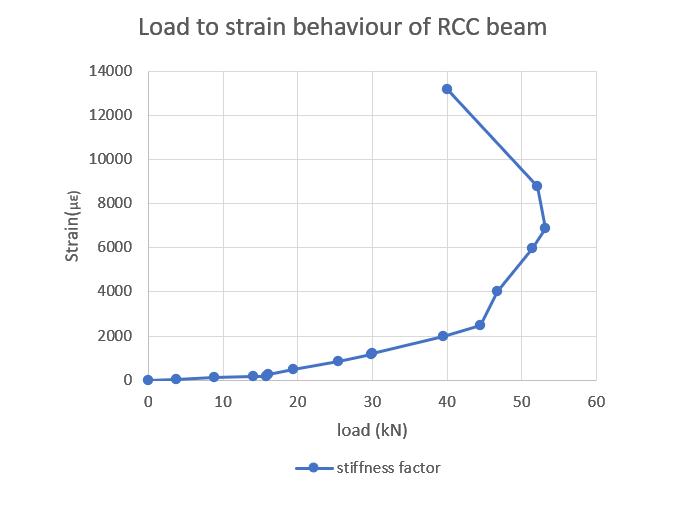
Chart-1:lossofstiffnessfactor.
C.ValidationofConfidence-BasedWarningLogic
A critical test of the system was conducted by holding a constant load of 30 kN to observe "Baseline Shift," which representspermanentresidualdeformation.
International Research Journal of Engineering and Technology (IRJET) e-ISSN:2395-0056
Volume:13Issue:03|Mar2026 www.irjet.net p-ISSN:2395-0072
Table3: BaselineShiftObservationatConstantLoad(30 kN)
53.2 6893
52.1 8793
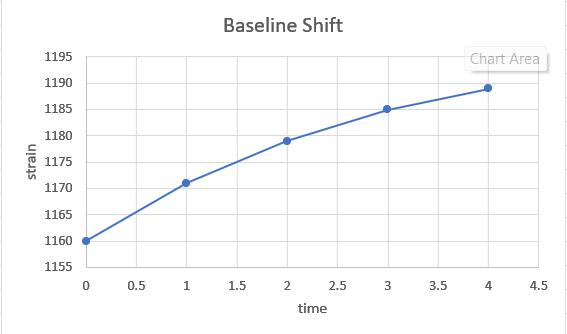
Chart-2:BaselineShift
During this phase, the system checked four parameters Trend (T), Jump (J), Baseline (B), and Repetition (P). By scoring each parameter as two based on the observed severity, the system generated a cumulative confidence score. For this specific case, a confidence index score of 5 wascalculated,correctlytriggeringa"Warning"levelalert toindicatepossiblestructural damagewithoutgenerating afalsealarmfromtemporarynoise.
The current research serves as a foundational framework for low-cost structural monitoring, with several avenues forfuturetechnicalexpansion:
[1] Network Scalability: Future iterations aim to transition from a single-sensor prototype to a distributed wireless sensor network (WSN) to facilitate comprehensive monitoring of large-scale infrastructure such as bridges and multi-story buildings.
[2] Cloud-Integrated Telemetry: Integrating the ESP32 node with cloud-based IoT platforms would enable centralized data management, allowing engineers to access structural health metrics remotely from any location.
[3] Mobile Interface Development: The developmentof dedicated mobile applications can provide real-time push notifications and dashboard visualizations for immediatestakeholderalertsduringcriticalstructural events.
[4] Advanced Analytics: Incorporatingmachinelearning algorithms and advanced data analysis techniques could improve the system’s ability to perform longterm predictive maintenance and fatigue life estimation.
[5] Long-Term Durability Studies: Future work will focus on the performance and calibration stability of the sensing nodes over extended periods in diverse environmentalconditions
This research successfully demonstrates the development and validation of a cost-effective, IoT-based Structural HealthMonitoring(SHM)systemdesignedforRCCflexural members. Unlike traditional inspection methods that are qualitative and reactive, the proposed framework providesaquantitative,real-timeassessmentofstructural response.
The integration of confidence-based warning logic represents a significant technical improvement over standard thresholding systems, as it effectively filters stochasticenvironmentalnoiseandtransientdisturbances to minimize the False Alarm Rate (FAR). Experimental testing on an RCC beam specimen confirmed the system's high sensitivity to critical mechanical transitions, includingmicro-crackinitiationat16.1kNandtheonsetof steel yielding at 44.5 kN. Furthermore, the system accurately identified permanent residual deformation through baseline shift analysis, triggering proactive alerts asintended.
Ultimately, the developed system offers a reliable, simple, and economically viable solution for preliminary structural assessment, providing a robust tool for enhancing the safety and longevity of modern civil infrastructure.
International Research Journal of Engineering and Technology (IRJET) e-ISSN:2395-0056
Volume:13Issue:03|Mar2026 www.irjet.net p-ISSN:2395-0072
[1] Anjuna, S., Radhakrishnan, N., & George, G. (2025). Internet of Things (IoT)-based strain monitoring system for large engineering structures. Innovative Infrastructure Solutions, 10, Article 40. SpringerNature.
[2] Ferreira,R.,Silva,P.,&Rocha,J.(2022).UseofIoTfor structural health monitoring of civil engineering structures.Sensors,22(23),8320.MDPI.
[3] Rahita, A. C., Zaki, A., Nugroho, G., & Yadi, S. (2024). Internet of Things (IoT) in Structural Health Monitoring: A decade of research trends. InstrumentationMesureMetrologie,23(2),123-139.
[4] Shukla, M. D., & Joshi, S. (2025). Structural health monitoring of RCC structure by Internet of Things. International Journal of Environmental Sciences, 11(22),581-588.
[5] Zhang, B., Ren, Y., He, S., Gao, Z., Li, B., & Song, J. (2025). A review of methods and applications in structural health monitoring (SHM) for bridges. Measurement,245,116575.Elsevier.
2026, IRJET | Impact Factor value: 8.315 | ISO 9001:2008 Certified Journal | Page 1572