
International Research Journal of Engineering and Technology (IRJET) e-ISSN: 2395-0056
Volume: 13 Issue: 05 | May 2026 www.irjet.net p-ISSN: 23950072
International Research Journal of Engineering and Technology (IRJET) e-ISSN: 2395-0056
Volume: 13 Issue: 05 | May 2026 www.irjet.net p-ISSN: 23950072
Dr. Radhika M N¹, Akshay Kumar K S², Chandana T D³, Chirag D⁴, Dhanush D S⁵
Department of Electronics and Communication Engineering P.E.S College of Engineering, Mandya, Karnataka, India
Abstract - This project presents a real-time structural condition monitoring system using a Kalman Filter to enhancetheaccuracyofsensordata.Thesystemutilizesan ESP32 microcontroller integrated with MPU6050 (accelerometer and gyroscope), strain gauge, and temperaturesensortomeasurestructuralparameters.Due to noise and environmental disturbances, sensor readings are filtered using the Kalman Filter for accurate estimation. The ESP32’s Wi-Ficapabilityenables real-time data transmission for monitoring. The proposed system ensures continuous observation, early fault detection, and improved reliability, providing an efficient and costeffective solution for structural health-monitoringapplications.
Key Words: Structural Health Monitoring, Kalman Filter, ESP32, IoT, MPU6050, Strain Gauge, Real-Time Monitoring
Structuralhealthmonitoringisessentialforensuringthe safety and durability of structures such as bridges and buildings. Traditional methods are manual and may fail todetect earlydamage. This project presentsa real-time monitoring system using an ESP32 microcontroller integratedwithMPU6050,straingauge,andtemperature sensor to measure structural parameters. Sensor data is oftenaffectedbynoise,whichisreducedusinga Kalman Filter for accurate estimation. The ESP32 enables wireless data transmission through Wi-Fi. The system provides continuous monitoring, early fault detection, and a cost-effective solution for maintaining structural integrity.
Structural failures in infrastructures such as bridges and buildingsoccurduetoundetectedcracks,vibrations,and materialdegradation.Traditionalinspectionmethodsare manual, time consuming, and lack real-time monitoring, leadingtodelayeddetectionandincreasedrisks.Existing systemsalsogeneratelargeamountsofrawdatawithout properanalysis.
This project proposes an IoT-based structural health monitoringsystemusingESP32,MPU6050,straingauges, and temperature sensors. Sensor data is analyzed to detect anomalies, while a Kalman filter improves accuracy. A web dashboard provides real-time visualization and alert
Notifications, enabling early damage detection, efficient maintenance,andimprovedstructuralsafety.
3.OBJECTIVES
• To develop an IoT-based structural health monitoring system using ESP32, MPU6050, strain gauges, and temperaturesensorsforcontinuousreal-timedatacollection.
• To enhance data accuracy using a Kalman filters for reliablemonitoringanddecisionmaking.
• Todesignaweb-baseddashboardthatvisualizesreal-time data and provides instant alerts for abnormal conditions, enablingtimelymaintenanceandimprovedstructuralsafety.
4.1 ESP32 Development Board
TheESP32isa powerful microcontrollerwithbuilt-in WiFi and Bluetooth capabilities. It acts as the central controller for data acquisition, processing, and wireless communication.
4.2 MPU6050 Sensor
TheMPU6050combinesa3-axisaccelerometerand3-axis gyroscope for measuring vibration, acceleration, and orientationparameters.
4.3 Power Supply
A rechargeable Li-ion battery is used to provide stable powertothemonitoringsystem.
4.4 Jumper Wires and Breadboard
These components are used for establishing circuit connectionsandprototyping.
The proposedStructural HealthMonitoring (SHM) system operates by continuously collecting structural data using multiplesensorsintegratedwiththeESP32microcontroller. The collected raw sensor data often contains noise and fluctuations caused by environmental disturbances and sensor inaccuracies. To improve measurement reliability, the ESP32 processes the sensor readings using a Kalman filter algorithm. The Kalman filter estimates accurate values by reducing unwanted noise and smoothing the sensoroutput.
International Research Journal of Engineering and Technology (IRJET) e-ISSN: 2395-0056
Volume: 13 Issue: 05 | May 2026 www.irjet.net p-ISSN: 23950072
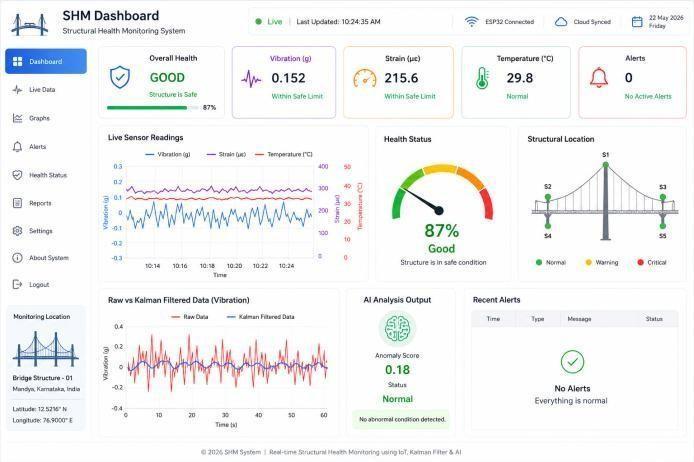
Fig -1:KalmanSHMDashboard
The MPU6050 sensor measures vibration and acceleration parameters, the strain gauge detects structural deformation, and the DHT11 sensor monitors environmentalconditionssuchastemperature.
The ESP32 acquires raw sensor readings and processes them using a Kalman Filter algorithm to reduce measurementnoiseandimprovedataaccuracy.Thefiltered sensor information is transmitted wirelessly through the ESP32 Wi-Fi module to a cloud platform or web dashboardforreal-timemonitoring.
When sensor values exceed predefined threshold limits, the system generates warning alerts for early fault detection and preventive maintenance. The entire process operates continuously, ensuring reliable real-time structural condition monitoring and improved infrastructuresafety.
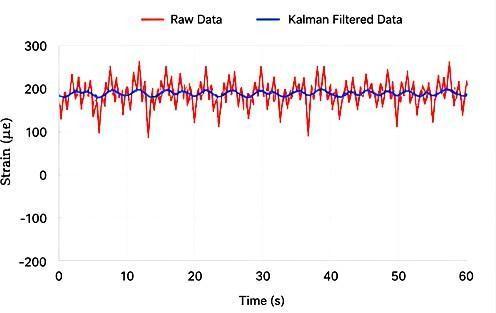
Fig -2:RawvsKalmanfilter
The proposed Structural HealthMonitoring(SHM) system wassuccessfullyimplementedusingESP32,MPU6050,strain gauge,andDHT11sensors.Thesensorscollectedreal-time structuraldata,andtheKalmanFilterwasappliedtoreduce noise and improve measurement accuracy. The processed data was transmitted through Wi-Fi and displayed on the SHMdashboardformonitoring
ThecomparisonbetweenRawDataandKalmanFilteredData showed that the Kalman Filter reduced fluctuations and providedsmootherandmorereliablesensorreadings.The system successfully monitored vibration, strain, and temperature values while providing real-time alerts for abnormal conditions. The developed system offers an efficient and low-cost solution for structural safety monitoring.
This project developed a Kalman Filter-Based Real-Time Structural Health Monitoring System using IoT and AI technologies.Thesystemcontinuouslymonitoredstructural parametersandimprovedsensoraccuracythroughKalman Filtering.Real-timemonitoringandalertgenerationhelpedin earlyfaultdetectionandpreventivemaintenance.
Theproposedsolutionisreliable,cost-effective,andsuitable formonitoringbridges,buildings,andotherinfrastructure systemstoimprovesafetyandmaintenanceefficiency.
[1] Rahita, A. C., et al., "Internet of Things (IoT) in Structural Health Monitoring: A Decade of Research Trends,"IIETAJournal,2024,DOI:10.18280/i2m.230205.
[2]Mardanshahi,A.,etal.,"SensingTechniquesforStructural HealthMonitoring:AState-of-the-ArtReview,"Sensors,2025, DOI:10.3390/s25051424.
[3]Negi,V.,etal.,"StructuralHealthMonitoringinAerospace: Integrating Sensor Technologies," ICST Conference, 2025, DOI:10.2991/978-94-6463-772-4_23.
[4]Shao,S.,etal.,"ResearchStatusandProspectsofHealth MonitoringMethodsforLargeStructures,"Springer,2025, DOI:10.1007/s42452-025-07679-7.
[5] Mahbubi, K., et al., "Fiber-Optic Sensors in Structural HealthMonitoring,"JournalofCivilEngineering,2024,DOI: 10.56578/jche020104.
[6] Saravanan, T. J., et al., "IoT-Based Structural Health Monitoring of Civil Structures," Springer, 2024, DOI: 10.1007/s41062-024-01413-9.