International Research Journal of Engineering and Technology (IRJET) e-ISSN: 2395-0056

Volume: 09 Issue: 09 | Sep 2022 www.irjet.net p-ISSN: 2395-0072
International Research Journal of Engineering and Technology (IRJET) e-ISSN: 2395-0056
Volume: 09 Issue: 09 | Sep 2022 www.irjet.net p-ISSN: 2395-0072
1 Assistant Professor, Chitkara School of Planning and Architecture, Chitkara University, India
2 Associate Professor, Division of Architecture and Civil Engineering, Ashikaga University, Japan ***
Abstract - This paper is one of the research outcomes of the "Study of the Impact of Water Management Systems on Evolution and Structuring of Urban Settlements in India". Cities that have been targetedas case example are 'Narnaul' (Haryana) and 'Jhunjhunu' (Rajasthan). Despite the fact that boththese cities havesimilar geographicaland climatic conditions, the typology of traditional water here have regional differences based on social structure and resource optimization etc. Narnaul has more vivid typologies with five different categories of water structures namelyStepwells, Kunds, Talabs, Johads and wells. On the contrary, Jhunjhunu only consists of three typologies- Stepwells, Johads and wells. Hence, this paper explains the conventional wisdom of water structures describing typology, material and usage based on background of both the cities, and finally presenting the current state of these structures. Before losing built heritage of water structures, we must find out value and re-assessment for tuning into the sustainable component of the city. This paper reviews possibility to revive documented water structures and propose sustainable approach in future by acknowledging cultural andspiritual values ofabandoned water structures.
Key Words: Water Structure, Urban Settlement, Sustainable,Documentation,Stepwells,Builtheritage
Theresearchpaperistoclarifyandunderstandvariations andactualstatus ofwaterstructuresinpresentthrougha comparative study between cities of Narnaul and Jhunjhunu.
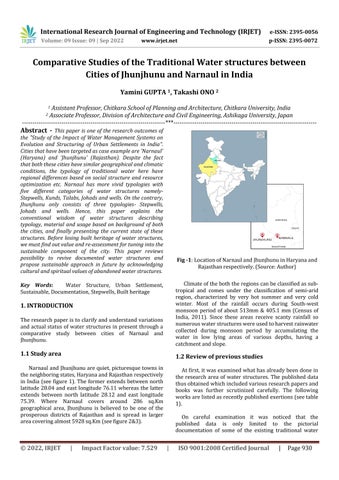
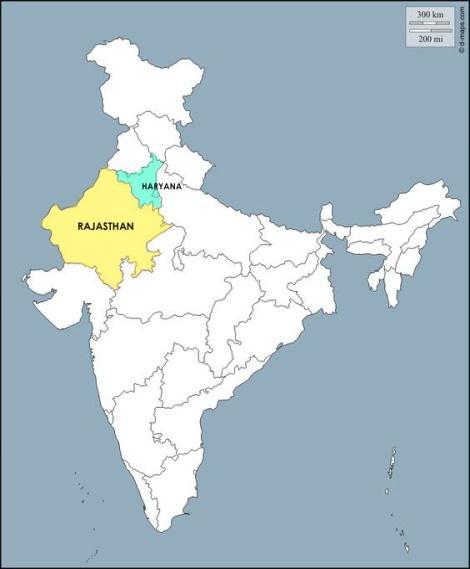
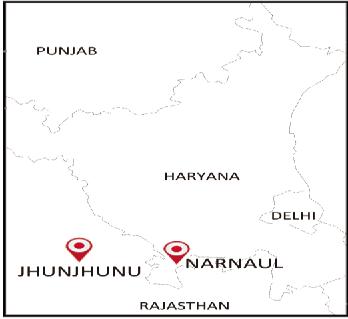
NarnaulandJhunjhunuarequiet,picturesquetownsin theneighboringstates,HaryanaandRajasthanrespectively in India (see figure 1). The former extends between north latitude 28.04 and eastlongitude 76.11 whereas the latter extends between north latitude 28.12 and east longitude 75.39. Where Narnaul covers around 286 sq.Km geographical area, Jhunjhunu is believed to be one of the prosperous districts of Rajasthan and is spread in larger areacoveringalmost5928sq.Km(seefigure2&3).
Fig -1:LocationofNarnaulandJhunjhunuinHaryanaand Rajasthanrespectively.(Source:Author)
Climateoftheboththeregionscanbeclassifiedassubtropical and comes under the classification of semi-arid region, characterized by very hot summer and very cold winter. Most of the rainfall occurs during South-west monsoon period of about 513mm & 405.1 mm (Census of India, 2011). Since these areas receive scanty rainfall so numerouswaterstructureswereusedtoharvestrainwater collected during monsoon period by accumulating the water in low lying areas of various depths, having a catchmentandslope.
Atfirst,itwasexaminedwhathasalreadybeendonein the research area of water structures. The published data thusobtainedwhichincludedvariousresearchpapersand books was further scrutinized carefully. The following worksarelistedasrecentlypublishedexertions(seetable 1).
On careful examination it was noticed that the published data is only limited to the pictorial documentation of some of the existing traditional water
International Research Journal of Engineering and Technology (IRJET) e-ISSN: 2395-0056
Volume: 09 Issue: 09 | Sep 2022 www.irjet.net p-ISSN: 2395-0072
structures in India right from 4th century to late 1990’s narrating the history associated with them along with their architectural attributes or depicts the famous stepwells within well known cities. Since time, India prospers because of its efficient water management systems which included essential rain harvesting, groundwater recharging and storage systems. But it was noticed that the already published data focuses on only onetypologymajorlystepwells.
Hence the research focus was established on targeting all the typologies of traditional water structures. To maintainprecisiontheresearchwasfurthercarriedouton regional level which ensuredcoveringall thesystemsand structurespresent in a particulararea.To understandthe mechanisms in depth detailed documentation was done which involved understanding the area of study through primaryfieldstudies,observation,GroundedTheory(Data Collection, Coding and Memoing), Ethnographic Approach andfinallymakingonscaledrawingsofplansandsections ofwaterstructuresthroughtriangulationmethodsetc.
Table -1: Bookspublishedonwaterstructures (Source:Reference[1],[4],[5],[6],[7],[8],[10])
Title Author Date
The Stepwells of Gujarat: In ArtHistorical Perspective Jutta JainNeubauer 1981
Steps to water Morna Livingston 2002
Water Architecture in South Asia Julia Hegewald 2002
Baolis of Bundi INTACH 2015
Her Story: Exploring the Stepwells of Gujarat Purnima Mehta Bhatt 2015
The Vanishing Stepwells of India Victoria Lautman 2017
Delhi Heritage: Top 10 Baolis Vikramjit Rooprai 2019
The originality of this paper is not only limited to understand unknown water structures located in particular regions of Narnaul and Jhunjhunu but also to understand in depth the architecture features and diversityofthewaterstructuresscatteredthroughoutthe town/districtcomprehensively.
a)Todrawcomparativeanalysisofthevividtypologies ofwaterstructurespresentinboththeregionstomanifest howevenafterhavingregionalsimilaritiesstillthereisso much alteration in the shape and size of every structure.
Moreover,eveninsamestructuresofoneregionthereisa presenceofdiversityasperthebackgroundofthecity.
b) To make it conspicuous through detailed documentation that how these 250-500 old but scintillatingstructuresare sostructurallysound that they canstillbeusedtogarnerrainwaterfordryseasons.
c) To spread awareness about these priceless inheritance in people by creating ownership and civic sense.
This paper is based on two field surveys that have been conducted by authors and collaborators in Narnaul from 12th to 18th February 2018 as primary survey and in Jhunjhunu from 2nd to 8th March 2019 as secondary survey. The field survey has been conducted with the followingmethodology:-
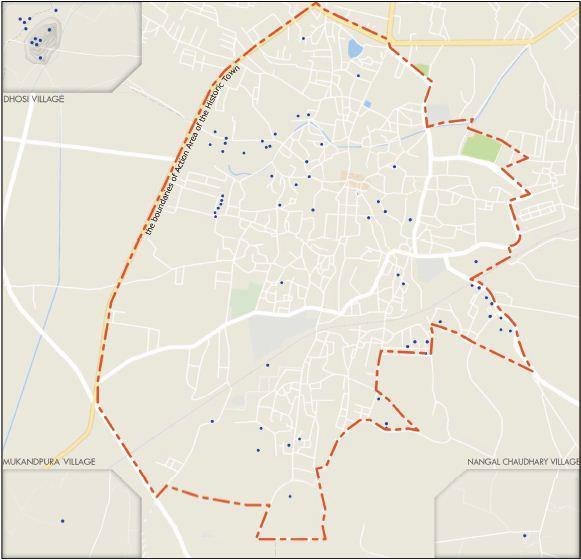
a) The research methodology was adopted on module which begins with identification of the action area within historic core boundary of the districts of Narnaul and Jhunjhunu which is shownwithreddottedlines(Figure2&3).
Fig -2:HistoriccoreboundaryofNarnaulwithexisting waterstructures(Source:Author)
International Research Journal of Engineering and Technology (IRJET) e-ISSN: 2395-0056
Volume: 09 Issue: 09 | Sep 2022 www.irjet.net p-ISSN: 2395-0072
Unlike Narnaul, Jhunjhunu has only three typologies of water structures which are shown with red and blue dots (seefigure3),namelya) Bawdi b) Johad c) Well
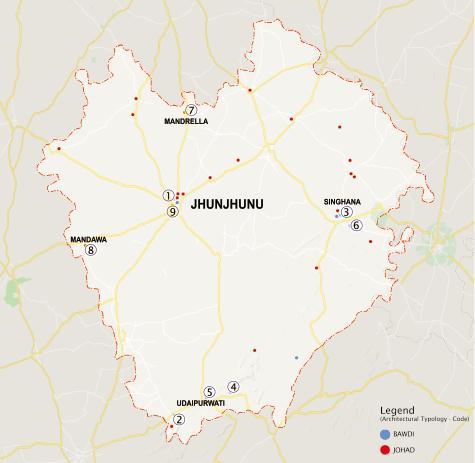
Fig -3:BoundaryofJhunjhunudistrictwithexistingwater structures(Source:Author)
b) Primary and secondary survey then mainly attributes to the database of the research of water structures that comprehends the traditional wisdom. Main source of information is based on the questionnaires and personal interviews of local people bytheauthor.Inadditiontoit,theresearchisbasedon thedatacollectedfromthelocalofficialsandNGOs.
b) The collected information has thus been perspicuously examined, anatomized and explicatedininventoryforms.
d) The final and the most crucial step then adopted wasdocumenting the water structures identifiedin the markedboundary.
In addition to this, majorcriteria forselection of water structures for detailed documentation were varied typology, structural stability and mean of access to the particularwaterstructure.
The water resources available within the physical boundaryofthevillageNarnaularemarkedwithbluedots withinreddottedlineofhistoriccoreboundary(seefigure 2). There are five varied typologies of water structures present in Narnaul and in local dialect they are regarded as:-
a) Baoli b) Johad c) Kund
d) Talab/Sagar
e) Well
Fig -4:Differenceofdialectofwaterstructureineach areaandclassificationofeachstructures (Source:Author)
According to the survey, typologies of water structure in Narnaul and Jhunjhunu can be classified as figure 4. Although each name in dialect of typologies varies, water structures in Narnaul can be divided into 5 typologies on thebasisofdifferenceofstructureandusage.
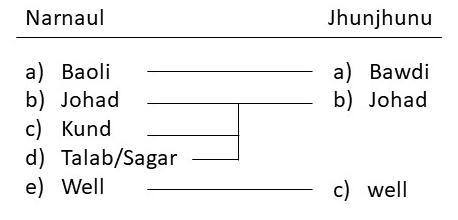
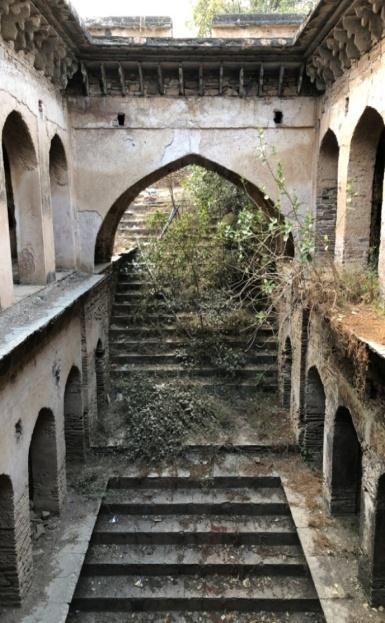
Fig -5:MukundpuraBaoli,Narnaul(Source:Author)
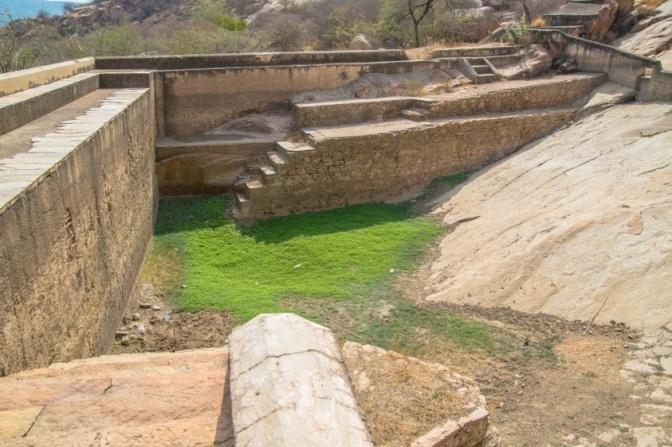
Fig -6:Johad,Narnaul(Source:Author)
International Research Journal of Engineering and Technology (IRJET) e-ISSN: 2395-0056
Volume: 09 Issue: 09 | Sep 2022 www.irjet.net p-ISSN: 2395-0072
Allfivetypologiescanbebrieflyexplainedasbelow.
Baoli (see figure 5):
It is called Bawdi in Jhunjhunu but “Stepwell” in general. It has two main components- ‘well’ and ‘enclosed underground corridors along with steps’ to approach the well(Michell&Davies,1990).
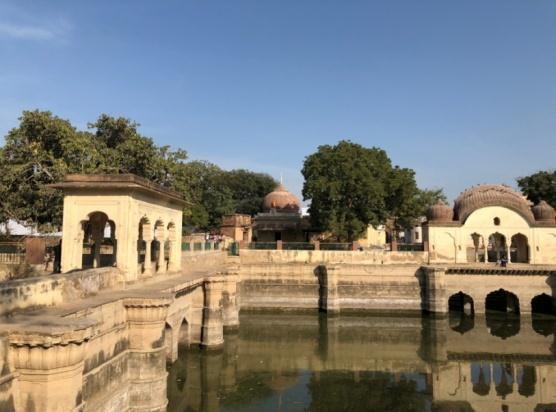
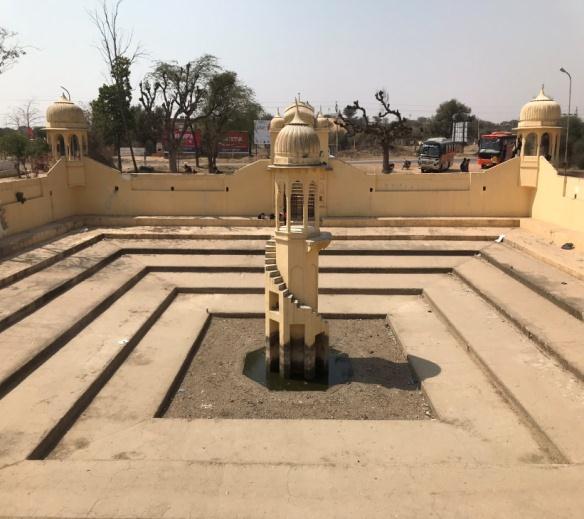
As in addition to meet water demands of local inhabitants in specific cases they performed various other necessary societal functions like social, gatherings, religious ceremonies and leisure purposes (Shekhawat, 2015).
Johad (see figure 6&7):
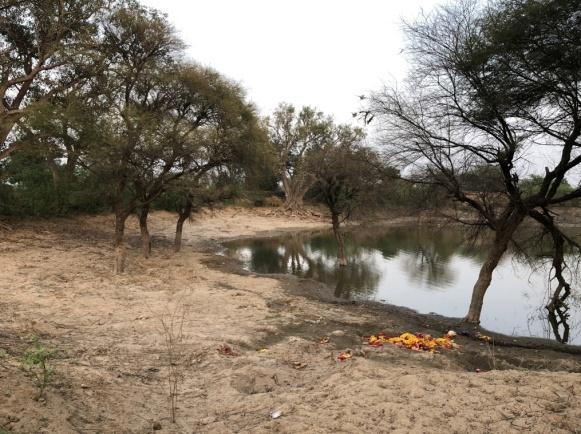
Pre-eminent traditional rain water harvesting structures built in natural depressions. In the course of heavy rains these structures avert irrepressible flooding (Bhattacharya,2015)
Talab/Sagar (see figure 8):
These are basic stone and mud catchments erected acrosscounter’sslopetoharvestrainwater(Bhattacharya, 2015).Principally,thesearemaintainedbycommunity.
Kund (see figure 9):
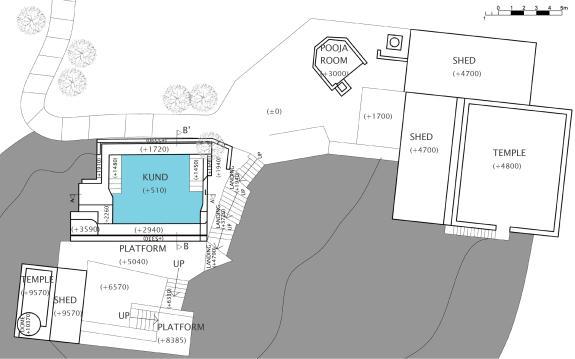
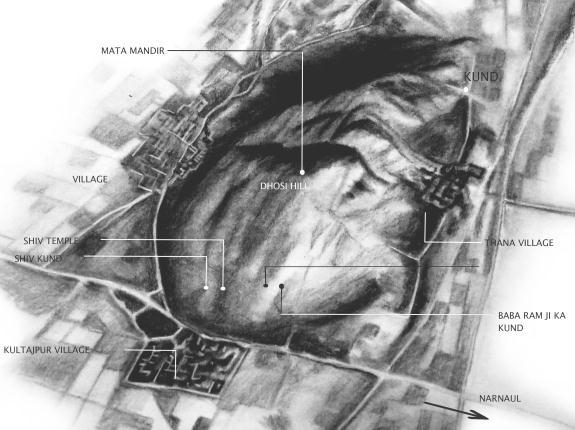
Autochthonous water harvesting structures constructedbylocalmaterials.Accordingtothesurvey,itis relevant with religious site which locates temples and shrinesetc.
Well:
Traditional water management system having cylindricalundergroundpittoaccessgroundwater.
Table 2 describes water structures which were documented in primary and secondary survey i.e.Narnaul andJhunjhunu(seetable2).
International Research Journal of Engineering and Technology (IRJET) e-ISSN: 2395-0056
Volume: 09 Issue: 09 | Sep 2022 www.irjet.net p-ISSN: 2395-0072
Typology/ Name
no
Co-ordinates Capacity (in metres)
1 Johad/ Unknown 28°01'19"N 76°05'36"E 100 x 90m
2 Kund/ Baba Ram Ji Kund 28°03'16"N 76°01'51"E 8.0 x 8.0m
3 Talab;Sagar/ Gopal Sagar 28°02'50"N 76°05'52"E 40 x 45m
4 Talab;Sagar/ Tilu Ali ka Talab 28°02'20"N 76°05'49"E 49 x 48m
Structur al stability
Abandoned
Present condition of structure N arn au l
Excellent The water is covered with the layer of algae.
Good Adaptive reuse of leisure purpose.
Good Abandoned. Vegetation growth at walls and the ground area.
5 Stepwell/ Nangal Chaudhary Ki Baoli 28°11'34"N 76°07'29"E 21 x 15m Excellent Abandoned. Well has filled up with soil due to erosion.
6 Stepwell/ Mukundpura Baoli 27°59'11"N 76°04'42"E 37 x 13m
Good Abandoned. Plaster worn off with blemished carvings.
7 Stepwell/ Mirza Ali Jan Ki Baoli 28°02'48"N 76°05'56"E 30.6 x 13.4m Good Abandoned
8 Stepwell/ Nagpuria Ki Baoli 28°02'50"N 76°06'01"E 7 x 30m
Good Abandoned. A layer of algae has formed over the water
9 Stepwell/ Sher Shah Suri Baoli 28°01'51"N 76°05'59"E 15.6m in diameter (Hexagonal) Good Abandoned. Vegetation growth can be seen.
1 Bawdi/ Mertaniji ki Bawdi 28°08'01"N 75°23'42"E 46.7 x 14.9m Excellent Abandoned
2 Bawdi/ Chetan Das Ji ki Bawdi 27°41'30"N 75°23'35"E 57.8 x 16.3m Excellent Abandoned
3 Bawdi/ Ganga Mandir Kund 28°05'49"N 75°50'20"E 19.3 x 16.8m Good Maintenance under supervision of private trust.
4 Bawdi/ Chapoli ki Bawdi 27°44'20"N 75°33'00."E 43.9 x 11.7m Good Abandoned.
10 Stepwell/ Raja ki Baoli 30°15'08"N 76°52'35"E 20 x 4.6m Poor Abandoned. J h u n jh u n u
5 Bawdi/ Udaipurwati ki Bawdi 27°43'52"N 75°28'28"E 34.6 X 11.4m Excellent Maintenance under supervision of private trust.
6 Bawdi/ Dhana ki Bawdi 28°05'27"N 75°51'11"E 18.7 x 8m Poor Abandoned. Vegetation growth.
7 Johad/ Mandrella Johad 28°19'10"N 75°25'35"E 34.1 x 34.7m Good Abandoned
8 Johad/ Mandawa Johad 28°02'31"N 75°09'09"E 42.7 x 45m Excellent Abandoned.
9 Johad/ Samas Talab 28°07'43"N 75°23'24"E 41.5 x 40.7m Excellent Abandoned.
Note: Structural stability has been categorized into 3 categories. Excellent- When the structure is intact and there is no risk accessing it. Good- When the structure is not in dilapidated condition but requires maintenance and repair. Poor- When the structure is in ruins.
As already discussed, the first and foremost difference thatispresentinthewaterstructuresofboththeregionsis the variety of typologies present. Narnaul has more diversity with five typologies of water structures, Jhunjhunuhasonlythreetypologies-Stepwells,Johadsand wells.
Analyzingthedifferenceintypology,incaseofNarnaul the typology is subdivided into Kund, Talab/ Sagar due to ruler’s influence or possessing sacred values like `Dhosi hill`. For instance, Baba ram Ji Kund located in middle of hill holds religious value as is located with temple and pooja room etc. together (figure 10&11). Further, Johad is not only catchment but it also possesses additional functionandrole.
International Research Journal of Engineering and Technology (IRJET) e-ISSN: 2395-0056
Volume: 09 Issue: 09 | Sep 2022 www.irjet.net p-ISSN: 2395-0072
Typologies present in Jhunjhunu purely represents social structure to be based on whole community involvement, the water structures present in Narnaul reflects bothcommunityaswell as privateownership.For an instance, there are more than 100 traditional wells presentinthehistoriccoreboundaryofNarnaulwhichare believed to be built by then king’s order on local people’s pleadforwater.
takht
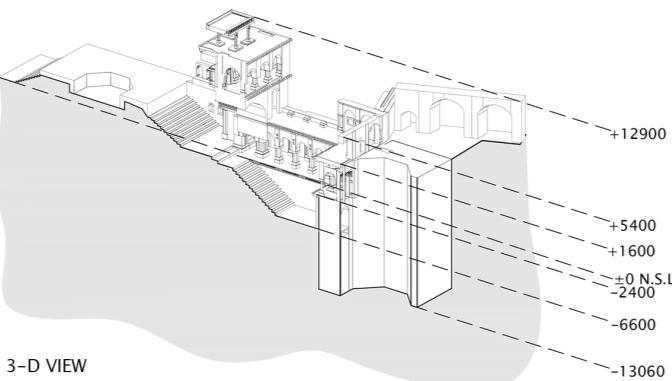
Fig -12:3DviewofsectionandphotographofMirzaAliJan KiBaoli(Source:Author)
Table -4: ComparativeanalysisofStepwellsinNarnaul andJhunjhunu(Source:Author)
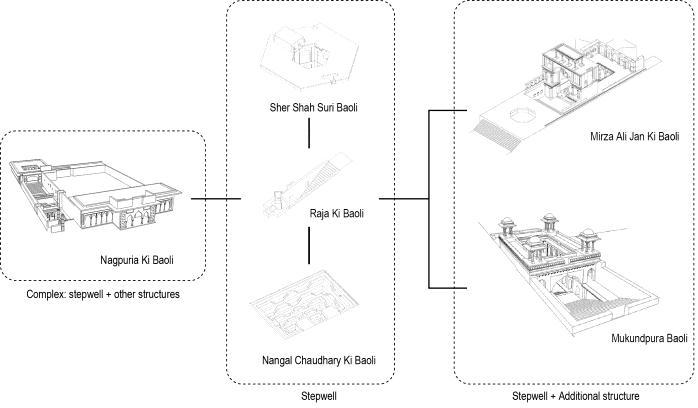
Fig -13:3CategoriesofstepwellsinNarnaul(Source:Author)
Diversity in Shapes Diverse variety of shapes are presenta) Linear b) Rectangular c) Hexagonal
Except Mertaniji ki Bawdi which holds associative value all the stepwells of Jhunjhunu holds Sacred value.
All the stepwells are rectangular in shape Values Stepwells in Narnaul have these values associated with them. a) Sacred b) Associative c) Narrative
Level of awarenes s
Low to negligible as mostly structures are left abandoned with no maintenance
c) VariationbasedonLandform:-
Good Majorly stepwells are being looked after by private trusts of associated temples
DhosihillslieintheclosevicinitytotheNarnaul.Hence presence of diverse landform in form of both plain and hills gives the area diversity of both Kunds as well as Talabs/ Sagars. On the contrary, due to presence of only plainlandform,Jhunjhunulacksthesemechanisms.
d) Variationbasedonruler/people’sbelief:-
Due to close proximity to Delhi, Narnaul was the main centre of kings/ invaders and their gems/ sub-rulers. Therefore, Narnaul’s stepwells mark royalty and ruler’s symbols of possession whereas stepwells in Jhunjhunu representstotallydifferentscenariowithhavingnoruler’s influencebutbuiltonspiritualorassociativeaspect.
As shown in Mirza Ali Jan Ki Baoli the gateway of the structure is crowned by a flat-roofed pillared pavilion above,known as ‘Takht’. The takht was used by ruler and symbolizesroyalty(seefigure12).
e) VariationinStepwellsofboththeregions:-
StepwellsinNarnaulcanbeclassifiedinto3categories (seefigure13)a) Complex:stepwell+otherstructures b) Stepwell c) Stepwell+additionalstructure
Unlike Narnaul, Stepwells in Jhunjhunu can be classifiedintoonlytwocategoriesa) Complex:stepwell+otherstructures
International Research Journal of Engineering and Technology (IRJET) e-ISSN: 2395-0056
Volume: 09 Issue: 09 | Sep 2022 www.irjet.net p-ISSN: 2395-0072
This variation can be seen in shape and approaches of stepwell(seetable4).
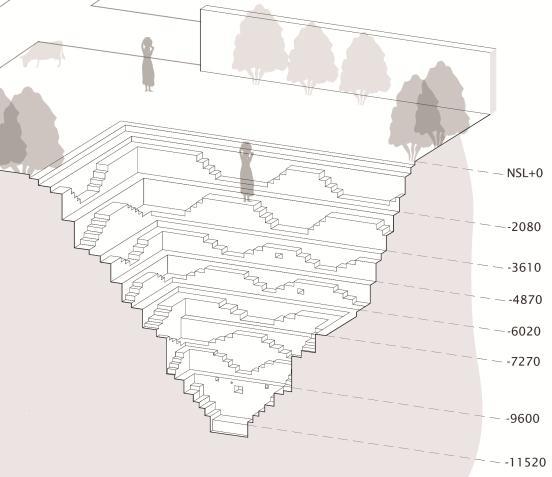
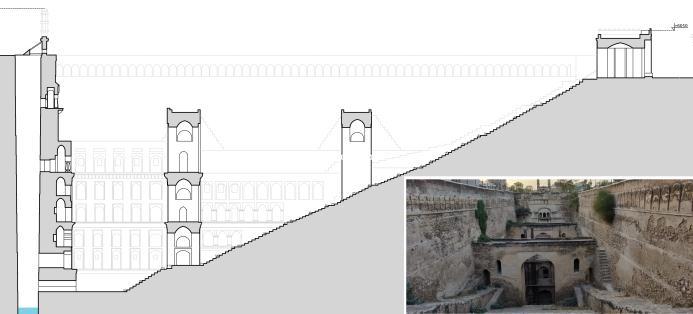
For example, in Sher Shah Suri Baoli and Nangal Chaudhary Baoli, there is variation of the shape and approaches (see figure 14&15). Former is an octagonal shape having approach along the arc, latter is almost square with approach from three sides. In contrast, the biggestand mostcomplexstructure in Jhunjhunu,Mertani JiKiBawdiisrectangularhavinglonglengthandnarrower width.Itcanbeapproachedfromonlyoneway(seefigure 16).Almostallstepwellsarerecognizedassimilartype.
f) VariationinJohadsofbothregions:-
Johads in Narnaul are catchment areas with only ‘Kacha’ construction whereas in Jhunjhunu both Kacha as well as ‘Pakka’ Johads are there (see table 5). As mentioned in Table 5, Johads in Jhunjunu are especially associated withsacred value through temples in order to be used to perform rituals. Johad in Jhunjhunu, therefore, broadlyincludesSagarandKundinNarnaul.‘Pakka’Johads aretheone which are constructed with a strong and durable construction material like brick whereas ‘Kacha’ Johads are the one which are made up of mud or are formed through the natural depression and does not involve any specificconstructionmaterial.
Fig -16:sectionandphotographofMertaniJiKiBawdi (Source:Author)
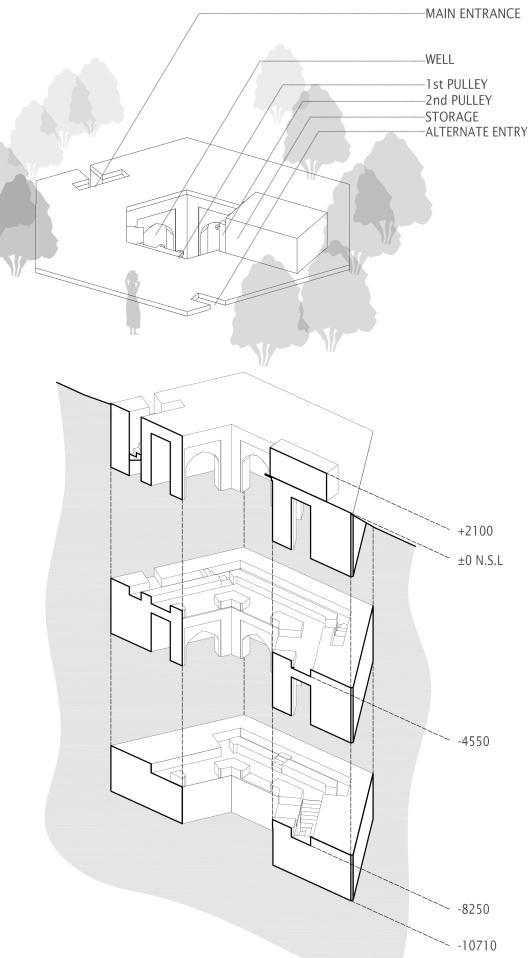
Table -5: ComparativeanalysisofJohadsinNarnaul andJhunjhunu(Source:Author)
Narnaul Jhunjhunu Johads
Construction type Kacha Pakka Values No values associated Johads are majorly accompanied with temples, hence water in Johads was used to perform rituals therefore, Sacred Values are associated.
Architectural feature No such feature present as it was just the natural depression to collect excess water.
Various architectural elements are present like chhatris, minarets, ramps, arches etc.
International Research Journal of Engineering and Technology (IRJET) e-ISSN: 2395-0056
Volume: 09 Issue: 09 | Sep 2022 www.irjet.net p-ISSN: 2395-0072
Theauthorsconfirmthatthedatasupporting thefindings of this study are available within the article [and/or] its supplementarymaterials.
[1] Bhatt, P. M., & Solar, D. del. (2014). Her space, her story: exploring the stepwells of Gujarat. New Delhi: Zubaan.
[2] Bhattacharya,S.(2015).TraditionalWaterHarvesting Structures and Sustainable Water Management in India: A Socio-Hydrological Review. International Letters of Natural Sciences,37, 30-38. doi:10.18052/www.scipress.com/ilns.37.30
This paper clarified the followings through comparative studyonneighboringdistricts-NarnaulandJhunjhunu.
1. Based on social structure and land form, Johad is not only reservoir and was subdivided into Kund talab/Sagarwithadditionalfunctionsandroles.
2. ShapeandapproachofstepwellsinNarnaulcanbe seeninvarietyincomparisontothecommontypeofshape and approach in Jhunjhunu. Because Narnaul’s stepwells mark royalty and ruler’s symbols of possession whereas stepwellsinJhunjhunurepresentstotallydifferentscenario with having no ruler’s influence but built on spiritual or associativeaspect.
Above all, even if water structures are located nearby with similar geographical and cultural conditions, huge differences are observed based on social background of respectiveareas.
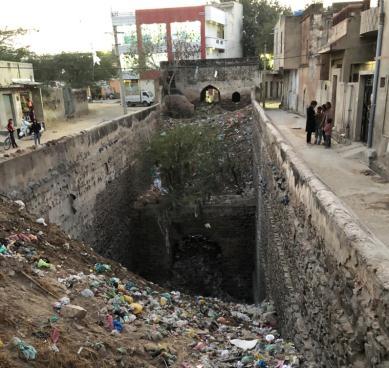
Conventionally, in addition to conclusion, we must notify the present situation of water structure between Narnaul and Jhunjhunu. It is found that unlike Narnaul, various stepwells have become dumping yard gradually in Jhunjhunu(Seefigure17).
Water structures including stepwells must be recognizedascrucialheritageofwatercultureinIndia.To enhance the cultural value the findings of the research shouldwidelydisseminated.
This work was financially supported by Chitkara UniversityandJSPSKAKENHIGrantNumberJP20K04909.
[3] Census of India 2011 Rajasthan District Census Handbook Jhunjhunun. (2011). Retrieved from http://censusindia.gov.in/2011census/dchb/DCHB_A /08/0805_PART_A_DCHB_JHUNJHUNUN.pdf
[4] Gupta, D. (2015). Baolis of Bundi: the ancient stepwells.NewDelhi:INTACH.
[5] Hegewald,J.A.B.(2002). WaterarchitectureinSouth Asia: a study of types, developments and meanings. Leiden:Brill.
[6] Jain-Neubauer, J. (1981). The stepwells of Gujarat: in art-historicalperspective.NewDelhi:AbhinavPubl.
[7] Lautmann, V. (2017). Vanishing stepwells of India. Merrell.
[8] Livingston, M. (2002). Steps to water: The Ancient stepwells of India. New York: Princeton Architectural Press
[9] Michell, G., & Davies, P. (1990). The Penguin guide to themonumentsofIndia.London:Penguin.
[10] Rooprai, V. S. (2019). Delhi heritage: top 10 baolis. NewDelhi:NiyogiBooks.
[11] Shekhawat,A.Stepwellsof Gujarat -Alistofbeautiful StepwellsinGujarat.(2015).Retrieved June10,2019, from http://www.indiasinvitation.com/stepwells_of_gujara t/