International Research Journal of Engineering and Technology (IRJET) e-ISSN: 2395-0056

Volume: 09 Issue: 08 | Aug 2022 www.irjet.net p-ISSN: 2395-0072
International Research Journal of Engineering and Technology (IRJET) e-ISSN: 2395-0056
Volume: 09 Issue: 08 | Aug 2022 www.irjet.net p-ISSN: 2395-0072
Abstract - Several factors influence a country's preparedness index. Technology is an important factor in increasing productivity and improving job function. In the modern era, IT is being usedto improve organizations' ability to employ resources. This article examines various readiness indices to determine how industry 5.0 is evolving and how to quantify the IT readiness index for overall development.These organizational indices improvedserviceprovideraccess,work allocation effectiveness, process efficiency, and transparency. It is critical to determine what factors influence an organization's readiness (where IT readiness acts as an indicator to measure the IT-related facilities). The readiness index for each government organization must be determined based on these characteristics, which will help analysts rate the organization's readiness for AI-based automation.
KeyWords: e-governance,Industry5.0,ReadinessIndex, BigData
Overthelastfewdecades,technologicaladvancementshave advanced rapidly, and they now permeate all aspects of Business and society, providing new opportunities and benefits to many (Bag et al., 2021). As technological disruptionsbecomemorecommon,globalleadersfocuson combiningmechanicalopportunitiesandhumanprosperity. Assume we can't use innovation to bring out the best in people (Chauhan et al., 2021). In that case, society may becomefractured,andsomeofourcoreauthorityprinciples, such as majority rule government, may be jeopardized. Furthermore, if the benefits of innovation are not fully realized, new gaps may form, or existing ones will be exacerbated. In this perspective, the two co-editors of the NetworkReadinessIndex(NRI),oneofthemostimportant global databasesontheapplicationandutilizationofdata and communication technology, decided to update the databaseincollaborationwithselectedICTexperts(Bruschi et al., 2021; Esmaeilian et al., 2020; Gupta et al., 2021; N. Kumar & Dadhich, 2014). As a result, an updated, futureready file will continue the NRI tradition of providing policymakers,businessleaders,academics,andthegeneral public with a reliable and significant tool for assessing progress and planning activities for increasingly comprehensiveandfeasibledevelopmentinthedigitalage.
As outages in big data, computerized reasoning, finance, wellness tech, and expanded and augmented reality gain
traction, global pioneers focus on combining new opportunities with human concerns (Industry & What, 2016). The realization has grown that if we do not use innovationtobringoutthebestinpeople,wemayendup withasocietythatisbroken.Ourfundamentalauthoritative principles, such as the majority rule system, have been corrupted.Furthermore,ifthebenefitsofongoingandfuture improvements are not distributed evenly, they will create new gaps or exacerbate existing ones. In the literature, (Dadhich, Rao, et al., 2021; Kannan, 2021; Rao, S S, 2017) established the technology readiness index of AsianenterprisesregardingITserviceadoptionandoverall efficiencies.(Dadhich,2017;Dadhichetal.,2022; Kannan, 2021; Kiraz et al., 2020) discovered that professional businessstudentsinMalaysiaaretechnologicallyprepared to assess their level of acceptance of new technologies. (Dadhich,Manish,ShalendraSinghRao,RenuSharma,2021; KumarNaresh,DadhichManish,2014)discoveredapositive correlationbetweentechnologyreadinessandself-service technologyadoptioninTaiwan. (Dadhich, 2016; Kiraz et al., 2020) assessed final users' technologyreadinessbyusingvirtualinterfacesofwebsites toidentifybettercontextualelements,sitetype,andonline accessmethods,whichcouldbe beneficial toindustry5.0. Furthermore, (Kiss et al., 2019) calculated the TRI of customers in Turkey who prefer short-life-cycle products/services and rapidly diminishing technology for business sustainability and survival. Furthermore, (ShashankKumaretal.,2021)haveidentifiedITreadiness as a critical success factor in adopting e-procurement by governmententerprises.
Thepresentprojectisatheoreticalmodalbasedonextensive research that relied solely on secondary sources of information.Thesourcesarebooks,journals,annualreports, white papers, and newspapers. The primary methodology usedinthisworkisthestudyofliterature.
The research looks at numerous readiness indexes for Industry 5.0 promotion and development. Analyzing multiple readiness indices might help firms make better informed, and thus faster, decisions about which areas of Industry5.0toprioritize.Theresearchmustincludethatno
International Research Journal of Engineering and Technology (IRJET) e-ISSN: 2395-0056
availablereadinessassessmentsforIndustry5.0canindicate itsimpactonfutureindustrygrowthwhencomposingthem.
The readiness assessments are based on the following methodologies, which involve gathering substantial data fromtheexaminedentities.
Index Abbreviation IndexName Evaluating Authority No. of Individual Indicators
NRI Networked Readiness Index
GII Global Innovation Index
GCI Global Competitiveness Index
OECD scoreboard Science, industry, and technology Scoreboard
World Economic Forum
Cornell University, INSEAD, WIPO
World Economic Forum
No. of nations Evaluated
53 139
81 127
110 variables 141
OECD 200 31
RBI RBIndustry5.0 ReadinessIndex Rolland Berger 6 dimension s
120
The 2019 Network Readiness Index ranks 121 economies basedonfourpillars(technology,people,governance,and effect). Sweden leads the ranking this year, just ahead of SingaporeinsecondandtheNetherlandsinthird(Table1). Inreality,asevidencedbytheiroverallresults,theleading countriesintheNRIhavenothingincommon.Forexample, thetop fivecountries(including fourth-placeNorwayand fifth-placeSwitzerland)areseparatedbyonlyafewpoints. Similarly,thetoptencountries Denmark,Finland,theUS, Germany,andtheUK areallwithin5pointsofSweden's highestscore(Sartaletal.,2020).
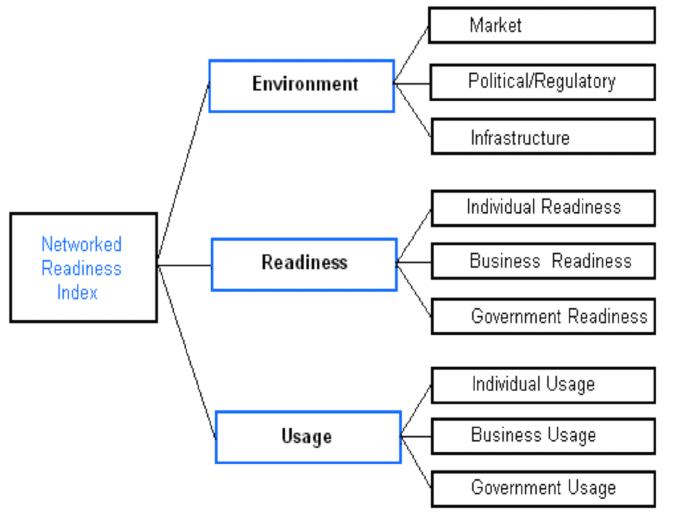
TheNetworkedReadinessIndexassessesacountry'sability tocapitalizeonICTnetworkstoincreasecompetitiveness.It hasbecomeanimportantindicatorofhowgovernmentsuse technologyinatrulydigitalsociety(Dadhich,2016;Mogale etal.,2020).Thisindex'ssignificanceisbasedonanumber ofcriticalinfrastructurefacilities,proceduralframeworks, and other elements that must be developed to reap the benefitsofthedigitalrevolution.Theframeworkismadeup of four primary sub-indices, ten subcategories, and 53 specific indicators spread across the different characteristics.Theprimarycategoriesareasfollows:
a. Environment Sub Index: Political and regulatory environment&Businessandinnovationenvironment
b.ReadinessSubIndex:Infrastructure,Affordability,Skills
c. Usage Sub Index: Individual usage, Business usage, Governmentusage
d.ImpactSubIndex:Economicimpacts,socialimpacts
India has made significant progress in political and regulatory environments and the economic and modernization environments. Inadequate digital infrastructure and a low-skilled population are significant roadblocks to ICT adoption. Several economies have also improvedtheirperformancequickly(Dadhichetal.,2020). As a result, India's rating dropped two from the previous year. The report cites areas for development, such as that 30%ofIndiansareilliterateandthatyoutharenotenrolled insecondaryeducation.Only15%ofpeoplehaveaccessto the internet, and broadband is only available in high-end homes.India'soveralldevelopmentishamperedbyalackof basic infrastructure in rural and remote areas. The governmentlaunchedtheDigitalIndiaprogramtoaddress theissue,enhancedigitalinfrastructure,raisedigitalliteracy, andequipresidentswithonlinegovernanceservices.
Further, the Global Innovation Index 2019 outlined the measuresfor129countries'innovationperformance,with 80 indicators covering various topics such as political condition, education, infrastructure, and business sophistication. The GII 2019 also examines the future of medical innovation, examining how technical and nontechnologicalmedicalinnovationwilltransformthedelivery ofhealthcareservicesaroundtheworld.Italsolooksatthe significanceanddynamicsofmedicalinnovationinshaping
Volume: 09 Issue: 08 | Aug 2022 www.irjet.net p-ISSN: 2395-0072 © 2022, IRJET | Impact Factor value: 7.529 | ISO 9001:2008 Certified Journal | Page739
International Research Journal of Engineering and Technology (IRJET) e-ISSN: 2395-0056
Volume: 09 Issue: 08 | Aug 2022 www.irjet.net p-ISSN: 2395-0072
thefutureofhealthcareandahealthyeconomy(Birda,2019; Dadhich,Purohit,etal.,2021)
Switzerlandisthemostadvancedandinnovativecountryin the world, according to the 2019 edition of the Global InnovationIndex,followedbySweden,theUnitedStates,and theNetherlands,amongothers,withregionalleaderssuchas India,Chile,Israel,Singapore,Rwanda,Vietnam,andChina dominating. India was ranked first in the Central and SouthernAsiaregion(52nd).Becauseofitsexcellentlogical distributions and colleges, India ranks second in the magnitudeofadvancementamongmiddle-incomecountries. Itmaintainshighlevelsinafewkeyindicators,forexample, profitabilitygrowthandadministrationcostsrelatedtodata and correspondence improvements. In terms of R&D spending,Indiaranksfifteenthamongglobalorganizations this year (Saurabh Kumar & Singh, 2021; Naresh Kumar, 2016).
Thisisoneofthreeindicesusedtoevaluatesocialpressure andresilience.TheGlobalCompetitivenessIndex(GCI)isa World Economic Forum initiative aimed at better understandingallcountries'economicfoundationsinorder to assess their competitiveness in achieving long-term economic productivity, growth, and opulence. Instead of short-termandreactionarymetrics,theindexservesasan annual benchmark for policymakers to measure their success against the productivity standard. The 12 instruments are Infrastructure, Innovation Capacity, ICT Selection,MacroeconomicReliability,FinancialFramework, Product Showcase, Labor Market, Market Size, Health, BusinessDynamism,andInstitutions(Muoz-Pascualetal., 2019). India climbed eight places to 68th place in the rankingin2019,upfrom58thin2018.Switzerlandisranked one,followedbytheUnitedStatesandSingapore.Thisindex measures a country's capacity to advance globally, retain, and attract talent. In the Global Talent Competitive Index, India is ranked 68th, up from 80th last year, with Kazakhstan, India, and Sri Lanka occupying the top three slotsintheCentralandSouthAsiaarea.Furthermore,India's vocational and technical skill score is 76th, while its MidLevelSkillslevelis113th.
From2009to2020,thisScoreboardcontainsinformationon small and medium-sized businesses that can obtain financing.Datafromdemand-sidesurveysweregatheredfor thecountryprofiles, whichincludedvariousindicatorson debt funds, asset-based finance, equity, and recent public andprivatesectorfinancingstructureconditionstopromote SMEaccesstofinance.Conversely,Indiaisnotamemberof theOECDScorecard(Mashelkar,2018).
Thisindexiscreatedusingtwotypesofindicators.Tobegin, industrial excellence is an important factor, including production process sophistication, automation, labour readiness, and innovation intensity. The second factor is sectoropenness,anewnetwork,andInternetsophistication. These indicators are scored on a five-point scale to determineyourreadinessforIndustry5.0.Allcategoriesare evaluated using the averages of the indicator scores. Furthermore,theConfederationofIndianIndustryseeksto create and maintain an environment favourable to the development ofpartneredindustry, government,andcivil society through consultation processes. It is a non-profit, industry-managedorganizationthatisactivelyinvolvedin India'sgrowth.
The readiness indices of an organization resulted in increasedaccessibilitytoserviceproviders,effectivework allocation, improved process efficiency, and improved transparency. Experts have discovered that government institutions lag far behind the private sector's readiness. Possiblecausesincludealackofappropriatehardwareand softwareresources,ascarcityoftrainedpersonnel,efficient training programmes to improve staff skills, and a lack of financialsupportfromdepartments.Asaresult,itiscritical to identify the criteria that determine an organization's readiness. Considering these factors, each government organization'sreadinessindexmustbedevelopedtoassist policymakers in ranking the organization's readiness to implemente-procurement Severaltypesofreadinessscores areappropriateandeffectiveforhandlingthequalitativeand quantitative competency of the industry and its future advancement using a fuzzy multi-attribute ranking technique.Readinessmodelsareusedtoassessthestateof implementationofIndustry5.0technologies.Thisenables the quantification and qualification of its readiness level, takingintoaccountavarietyofparameters.Monitoringthe status of Industry 5.0 necessitates the use of readiness models. The ease and speed with which these emerging technologies can be used vary greatly. Certain businesses cannotincorporateIndustry5.0intotheirexistingbusiness models, resulting in an inaccurate self-assessment of the levelofpreparedness.Toaccomplishthisgoal,itiscriticalto understandhowbusinessesareaddressingthechallengesof digitaltransformation,whatcompaniesbelievetheenabling technologiesforIndustry5.0are,howfaralongIndustry5.0 is in its readiness, and how companies see the barriers to adoptionofthesetechnologies.Thepurposeofthisarticleis toevaluateReadinessIndicesforAdoptionforIndustry5.0, which can be used by policymakers, administrators, and experts to develop a specific policy to achieve the overall goals.
International Research Journal of Engineering and Technology (IRJET) e-ISSN: 2395-0056
Volume: 09 Issue: 08 | Aug 2022 www.irjet.net p-ISSN: 2395-0072
[1] Bag, S., Gupta, S., & Kumar, S. (2021). Industry 4.0 adoptionand10R advancemanufacturingcapabilities for sustainable development. International Journal of Production Economics, 231, 107844. https://doi.org/10.1016/j.ijpe.2020.107844
[2] Birda, R. K. (2019). Study of ICT and E-Governance FacilitiesinTribalDistrictofRajasthan.Kamal,9(7),39–49.
[3] Bruschi,R.,Pajo,J.F.,Davoli,F.,&Lombardo,C.(2021). Managing5Gnetworkslicingandedgecomputingwith the MATILDA telecom layer platform. Computer Networks, 194(January), 108090. https://doi.org/10.1016/j.comnet.2021.108090
[4] Chauhan, C., Singh, A., & Luthra, S. (2021). Barriers to industry4.0adoptionanditsperformanceimplications: An empirical investigation of emerging economy. Journal of Cleaner Production, 285, 1–15. https://doi.org/10.1016/j.jclepro.2020.124809
[5] Dadhich,M.(2016).AComparativeStudyofInvestment PortfolioofLifefundofLICofIndiaandICICIPrudential Life Insurers. International Journal of Research in EconomicsandSocialSciences,6(10),229–238.
[6] Dadhich, M., Chouhan, V., Gautam, S. K., & Mwinga, R. (2020).ProfitabilityandCapitalAdequacyApproachfor Measuring Impact of Global Financial Crisis Vis-À-Vis IndianBanks.InternationalJournalofAdvancedScience andTechnology,29(4),2344–2365.
[7] Esmaeilian,B.,Sarkis,J.,Lewis,K.,&Behdad,S.(2020). Resources,Conservation&RecyclingBlockchainforthe future of sustainable supply chain management in Industry 4.0. Resources, Conservation & Recycling, 163(December 2019), 105064. https://doi.org/10.1016/j.resconrec.2020.105064
[8] Dadhich,M.,Hiran,K.K.,Rao,S.S.,&Sharma,R.(2022). ImpactofCovid-19onTeaching-LearningPerceptionof Faculties and Students of Higher Education in Indian Purview.JournalofMobileMultimedia,18(4),957–980. https://doi.org/10.13052/jmm1550-4646.1841
[9] Dadhich, M., Purohit, H., & Bhasker, A. A. (2021). Determinants of green initiatives and operational performanceformanufacturingSMEs.MaterialsToday: Proceedings, 46(20), 10870–10874. https://doi.org/10.1016/j.matpr.2021.01.889
[10] Dadhich, M., Rao, S. S., Sethy, S., & Sharma, R. (2021). DeterminingtheFactorsInfluencingCloudComputing ImplementationinLibraryManagementSystem(LMS): A High Order PLS-ANN Approach. Library Philosophy
and Practice, 6281. https://doi.org/https://digitalcommons.unl.edu/libphil prac/6281
[11] Gupta,H.,Kumar,A.,&Wasan,P.(2021).Industry4.0, cleanerproductionandcirculareconomy:Anintegrative framework for evaluating ethical and sustainable businessperformanceofmanufacturingorganizations. Journal of Cleaner Production, 295, 1–18. https://doi.org/10.1016/j.jclepro.2021.126253
[12] Kannan, K. S. P. N. (2021). Competencies of quality professionalsintheeraofindustry4.0:acasestudyof electronicsmanufacturerfromMalaysia.International Journal of Quality & Reliability Management, Emerald Publishing Limited, 38(3), 839–871. https://doi.org/10.1108/IJQRM-04-2019-0124
[13] Dadhich,M.(2017).ImpactofDemonetizationonIndian Economy. International Journal of Research in Social Sciences,7(8),208–215.
[14] Kiraz, A., Canpolat, O., Ozkurt, C., & Tas, H. (2020). Computers & Industrial Engineering Analysis of the factors affecting the industry 4.0 tendency with the structural equation model and an application. Computers & Industrial Engineering, 150(10), 1–10. https://doi.org/10.1016/j.cie.2020.106911
[15] Dadhich,Manish,ShalendraSinghRao,RenuSharma,R. M.(2021).AnalyticalStudyofStochasticTrendsofNonPerforming Assets of Public and Private Commercial Banks in India. 2021 3rd International Conference on Advances in Computing, Communication Control and Networking (ICACCCN) Analytical, 71–76. https://doi.org/10.1109/ICAC3N53548.2021.9725463
[16] Kiss, M., Breda, G., & Muha, L. (2019). Information security aspects of Industry 4.0. Procedia Manufacturing, 32, 848–855. https://doi.org/10.1016/j.promfg.2019.02.293
[17] Kumar,N.,&Dadhich,M.(2014).RiskManagementfor InvestorsinStockMarket.EXCELInternationalJournal of Multidisciplinary Management Studies, 4(3), 103–108.
[18] Kumar Naresh, Dadhich Manish, R. S. S. (2014). Determinant of Customers' Perception towards RTGS andNEFTServices.AsianJournalofResearchinBanking and Finance, 4(9), 253–260. https://doi.org/10.5958/2249-7323.2014.00960.2
[19] Kumar, Saurabh, & Singh, M. (2021). Environmental dynamism, industry 4.0 and performance: Mediating role of organizational and technological factors. Industrial Marketing Management, 95, 54–64. https://doi.org/10.1016/j.indmarman.2021.03.010
© 2022, IRJET | Impact Factor value: 7.529 | ISO 9001:2008 Certified Journal | Page741
International Research Journal of Engineering and Technology (IRJET) e-ISSN: 2395-0056
Volume: 09 Issue: 08 | Aug 2022 www.irjet.net p-ISSN: 2395-0072
[20] Kumar, Shashank, Raut, R. D., Nayal, K., Kraus, S., Surendra, V., & Narkhede, B. E. (2021). To identify industry4.0andcirculareconomyadoptionbarriersin theagriculturesupplychainbyusingISM-ANP.Journal of Cleaner Production, 293, 126023. https://doi.org/10.1016/j.jclepro.2021.126023
[21] Mashelkar, R. A. (2018). Exponential Technology, Industry 4.0, and Future of Jobs in India. Review of Market Integration, 10(2), 138–157. https://doi.org/10.1177/0974929218774408
[22] Mogale,D.G.,Cheikhrouhou,N.,&Tiwari,M.K.(2020). Modelling of sustainable food grain supply chain distribution system: a bi-objective approach. International Journal of Production Research, 58(18), 5521–5544. https://doi.org/10.1080/00207543.2019.1669840
[23] Muñoz-Pascual,L.,Curado,C.,&Galende,J.(2019).The triple bottom line on sustainable product innovation performance in SMEs: A mixed-methods approach. Sustainability, 11, 1–22. https://doi.org/10.3390/su11061689
[24] NareshKumar,M.D.(2016).Ananalyticalstudyoflife insurance facilities provided by life insurance companies. SAARJ Journal on Banking & Insurance Research,5(1),82–92.
[25] Rao, S S, M. D. (2017). Impact of Foreign Direct Investment in Indian Capital Market. International Journal of Research in Economics and Social Sciences (IJRESS),7(6),172–178.
[26] Sartal, A., Bellas, R., Mej, A. M., & Garc, A. (2020). The sustainable manufacturing concept, evolution, and opportunitieswithinIndustry4.0:Aliteraturereview. Advances in Mechanical Engineering, 12(5), 1–17. https://doi.org/10.1177/1687814020925232
[27] Dadhich,M.,&Kant,K.(2022).Empiricalinvestigationof extended TOE model on Corporate Environment Sustainabilityanddimensionsofoperatingperformance of SMEs: A high order PLS-ANN approach. Journal of Cleaner Production, 363, 1–16. https://doi.org/10.1016/j.jclepro.2022.132309
[28] Dadhich,M.,Poddar,S.,&Kant,K.(2022).Antecedents andconsequencesofpatients'adoptionoftheIoT4.0for e-health management system: A novel PLS-SEM approach. Smart Health, 25(5), 1–14. https://doi.org/10.1016/j.smhl.2022.100300
2022, IRJET | Impact Factor value: 7.529 | ISO 9001:2008 Certified Journal |