Performance Analysis of Resource Allocation in 5G & Beyond 5G using AI
Engineering, K. J. Somaiya Institute of
Maharashtra, India
Telecommunication Engineering, K. J. Somaiya Institute of Engineering

Department of Electronics
Information Technology, Mumbai, Maharashtra, India.
Abstract In the foreseeable future, the increase in the number of devices and the Internet of Things (IoT) can make it troublesome for the latest cellular networks to make sure adequate network resources are allocated. Future network technologies have attracted increasing attention, by delivering new style ideas with dynamic resource allocation. Device resource requirements are typically variable, so a dynamic resource allocation methodology is adapted to ensure the efficient execution of any task. In this project, Performance Analysis of Resource Allocation in Future Cellular Networks with AI an attempt has been made to replicate a modern cellular data structure that supports dynamic resource allocation. Therefore, we will be designing a modern cellular data structure that supports dynamic resource allocation. Then, a dynamic nested neural network is built, which adjusts the nested learning model structure online to meet the training necessities of dynamic resource allocation. An AI driven dynamic resource allocation algorithm (ADRA) is used that supports the nested neural network combined with the Markov decision process for training a Modern cellular data structure. The results will thus validate that the algorithm improves the average resource hit rate and reduces the averagedelay time.
Key Words: Artificial intelligence, Edge Computing, Resource Allocation, 5G, Reinforcement Learning, Neural Network, Beyond 5G.
1. INTRODUCTION
Cellular communication structures have progressed from rudimentary designs to cutting edge machines during the last many decades. For the past few decades, the wi fi communicationsindustryhasbeenoneofthefewthathas maintainedafast growingtrendwithuniquefeatures.
Mobile communication systems have progressed from their beginnings to the fifth generation. Increased user demand and advancements in IP technology are driving the evolution of cellular structures from first to fourth technology. Only simple and basic voice services are provided by the first generation analog system. With the
advancement of digital technology, the widely used GSM system is able to provide significantly increased capacity and facilitate international roaming. The emergence of smartphoneshasresultedinasignificantchangeinthe3G network structure, both in terms of circuit switching and packet switching. The 3G system changed the way we connected dramatically. It has faster data speeds than 2G and can handle a wide range of services, including online surfing, e mail, video conferencing, and navigation maps. However, there are three major standards in use around theworld,andinteroperabilitybetweenthemisdifficultto achieve.
The fourth generation of cellular wireless technologies, known as 4G, has replaced the previous generation of broadband mobile communications. The 4G service offering'spremiseistoprovideacomprehensiveIP based solution that allows multimedia applications and services tobesuppliedtousersatanytimeandfromanylocation, with a high data rate, the superior quality of service, and high security. The functionality of 4G communications depends on seamless mobility and interoperability with existingwirelessstandards.
LTE is the fourth generation of mobile communication technology, commonly known as "4G." The "Universal Mobile Telecommunications System" (UMTS) the third generation of mobile communications has been enhancedwithLTE.Accordingly,5Gismadeupofaseries ofimprovementstoLTE.Asaresult,5Gclearlyrepresents thenextstepintheevolutionofcellulartechnology.AnIP networkarchitectureisattheheartoftheLTEnetwork.As a result, Deutsche Telekom's fixed line network has also beenconvertedtoInternetProtocol(IP).
5G will not only support communication, but also processing, management, and content delivery (4C) functions, as compared to earlier generations. With the introductionof5G,severalnewapplicationsandusecases arepredicted,suchasvirtual/augmentedreality(VR/AR), unmanned cars, Interactive Net, and IoT applications. These applications are expected to result in significant growth for both communication and computational resources.
International Research Journal of Engineering and Technology (IRJET)
Volume: 09 Issue: 04 | Apr 2022 www.irjet.net
Wireless network systems rely heavily on resource allocation. To meet different network requirements in a 5G communication network, the system must be smarter and more dynamic in nature. The system allocates resources for power control, bandwidth allocation, deployment techniques, and association allocation. In any cellular network architecture, resource allocation is critical. It is crucial in ensuring that end users, business partners, and customers of cellular based applications have easy access. The cellular network environment benefits greatly from resource allocation. The level of fairness of the network's resource allocation determines network performance. The level of fairness has a strong linktothenetwork'sperformance.Theresourceallocation fairness levels are fair, ideal, unfair, and unbalanced. The performance levels of the network are poor, less good, good,andperfect.
Our main aim is to design a dynamic resource allocation model forthelatestcellularnetworkwherethedensity of users is bigger than the density of available resources by considering both the average resource hit rate and the averagedelaytimeofthenetwork.
On the other hand, running distributed machine learning model training at the edge of the network is valuable for solving resource allocation problems under different optimization goals. We established a resource allocation neural network model for a modern cellular structure to achieve the high real time performance of dynamic resource allocation, which is also in line with the inevitable trend of the development of large scale IoT applications. Finally, an AI driven dynamic resource allocation algorithm is designed to realize appropriate resource allocation optimization in the latest cellular networks.
2. RELATED WORKS
Researchcarefullyassociatedwiththistextisinparticular dividedintothesubsequent3
1)
2)
2.1 FUTURE CELLULAR NETWORK
The communication industry is anticipated to grow at an incredible rate, encouraging innovation and productivity in all other economic sectors like transportation, health care, agriculture, finance, services, consumer electronics, and so on.[11] According to Zhang et. al., the Internet of Things (IoT), vehicle to everything (V2X), distance learning, (advanced) virtual and augmented reality, unmanned aerial vehicles(UAVs),androbotization are all newconceptsthatcansignificantlyimpactourlifestylesin the coming years.[11] So the need for AI in 5G/B5G
ISSN:2395 0056
ISSN:2395 0072
development needs domain specific knowledge in communication technology, proficiency in Machine learning and artificial intelligence, and hardware design experience.[11]
2.2 INTELLIGENT EDGE COMPUTING
Traditional cloud computing is not the same as edge computing. It's a modern computing paradigm in which computation takes place at the network's edge.[5] Its primary concept is to bring computational processing closer to the data source.[5] Edge computing is defined differently by different researchers. Shi et al. [12] introduced the emergence of the concept of edge computing:‘‘Edgecomputingisa newcomputingmode of network edge execution. The downlink data of edge computing represents cloud service, the uplink data representstheInternetofEverything,andtheedgeofedge computingrefers tothearbitrarycomputingand network resources between the data source and the path of cloud computingcenter.’’[12]Edgecomputing,inotherwords,is the provision of services and computations at the network's and data generation's edge.[12] Edge computing refers to the migration of the cloud's network, computing, storage, and resource capabilities to the network'sedge,aswellasthesupplyofintelligentservices at the edge to satisfy the necessities of the IT industry in agile linking, real time business, data optimization, application intelligence, security, and privacy, as well as the network's low latency and high bandwidth requirements.
2.3 RESOURCE ALLOCATION
To make complete use of side and terminal gadgets, deep gaining knowledge of fashions tends to be allotted on a couple of gadgets.[9] However, adjustments in undertaking necessities and variations in gadgets have introduced top notch challenges, mainly to a pressing want for cheap aid allocation strategies as a prerequisite for making sure undertaking performance.[13] A large number of edge devices, such as sensors and actuators, has led to an enormous increase in data processing, storage, and communication requirements. A cloud platform has been proposed for connecting a massive number of IoT devices, with a huge amount of data generated by such devices being offloaded to a cloud server for processing. Edge devices, as opposed to cloud servers,canprovidelatency criticalservicesandavariety of IoT applications. End devices are resource constrained ingeneral;forinstance, batterycapacityandinternal CPU computation capacity are both limited [13]. Offloading computational activities to relatively resource rich edge devices can satisfy application quality of service (QoS) needs while also improving end device capabilities for resource intensiveapplications.[13]
2022, IRJET | Impact Factor value: 7.529 | ISO 9001:2008
3410
Engineering and Technology (IRJET)
3. SYSTEM ARCHITECTURE
3.1 PROBLEM FORMULATION
In 5G, high throughput and ultra low communication latency are proposed to be achieved, to improve users’ quality of experience (QoE). For this, 5G targets three evolution axes to cope with the new applications fields; such as autonomous cars/driving, industrial automation, virtual reality, e health, etc. To achieve this in a highly dense populated area where the available resources are comparatively lower than the need of required resources bytheusers.
Thus, in a massive IoT architecture, it is necessary to implement a machine learning algorithm for better performance for the task of resource allocation. Since the taskrequestandusercasesmayvarywithrespecttotime we need to implement a real time based simulation environmentandareal time basedAIalgorithmforbetter performance. Thus, we have implemented a dynamic neuralnetworkframeworkinthisproject.
3.2 IMPLEMENTATION
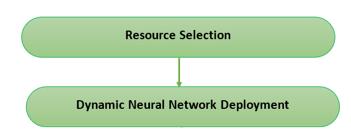
Adynamicresourceallocationmodelforthelatestcellular network where the density of users is bigger than the density of available resources is designed and then its performance is analyzed in terms of hit rate and delay time.Inthisproject,wehavedividedworkintotwoblocks namely, the resource selection block, and the neural networkblock.
A. RESOURCE SELECTION STAGE
Inthefirstblock,i.e.resourceselectionblockissubdivided into three layers 1) the processing layer; 2) the object layer; and 3) the distance layer. In the processing layer, the process or a given task is simulated. Here, we have used a single task to simplify the process of simulation. This task type is of “Objection detection: VOC SSD300” with a processing size of 300 * 300 * 3 * 1 bytes, loading size of 300 * 300 * 3 * 4 bytes and transmission data size of4*4+20*4bytes.
Figure 1 Dynamic allocation process
Then, in the object layer, we simulate the user data, the usercanbemobileorastationarydevice.Here,amassive
ISSN:2395
2395
IoT architecture is simulated i.e. the Edge Server is responsible for offering computational resources (5.04 * 108bits/sec)andtheprocessrequeststatesaregenerated formultipleuse cases.Forsimplificationoftheproject,six statesaredefinednamelystateone offloadingofataskto the edgeserver, state two sending oftask request tothe edge server (2.16 * 105 bits), state three processing of the requested task (8.64 * 106 bits), state four the processed task results are sent back to the user device (768 bits are required), state five disconnect state (default), state six migration of task to another edge server.
In the distance layer, the mobility data of the user is simulatedusingthedatai.eKAISTDatasetprovided
by CRAWDAD. The mobile devices of a subway station in Korea from the city of Seoul are collected to form the KAISTdataset.
B. DYNAMIC NEURAL NETWORK DEPLOYMENT STAGE
Let’s first understand the problem in allocating computer resources and migration bandwidth, while selecting the offloading server for each user is a discrete variable challenge. As a result, for continuous and discrete problems a non policy, non model, and actor critic network structure based Deep Deterministic Policy Gradient(DDPG)methodisused.DDPGupdatesthemodel weights at every step, thus, allowing the model to immediatelyadapttochangesintheenvironment.
International Research Journal of Engineering and Technology (IRJET)
2395
Figure 2:
Here, in this structure, two dynamic neural networks are implemented.
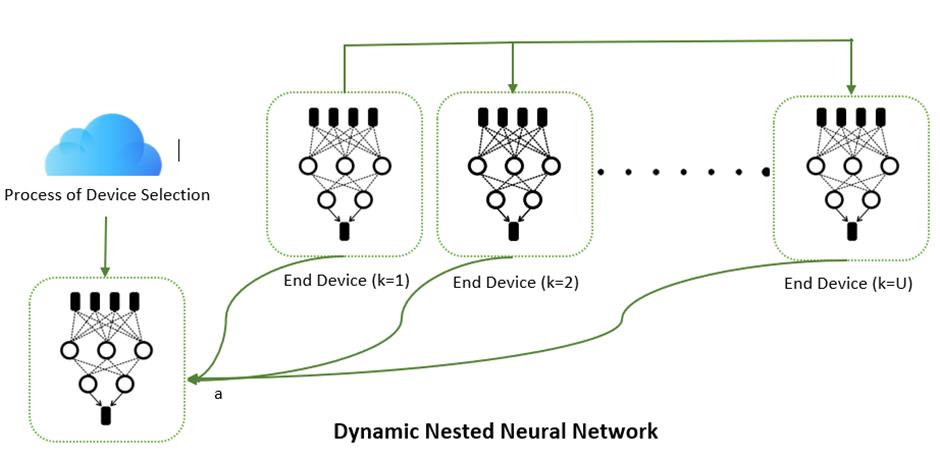

● Actor Itproposesanactiongivenastate.
● Critic It predicts if the action is good (positive value)orbad(negativevalue)givenastateandan action.
In the actor network, a four layer neural network is implementedforeachuser.Here,userstatesaresimulated and their required resources are calculated. Then, using MDPtheresultsofthisnetworkareforwardedtotheEdge Serverandontheserequiredresourcesanothertwofour layerneuralnetworksaretrainedfortheprocessinglayer firstfortheresourcesselectionandsecondfortheuseof bandwidth.Here,theresourcesaredeployedtotheuseras per their requirements, and its efficiency is tried to increasebyusingneuralnetworksofthesimulatedaction space.
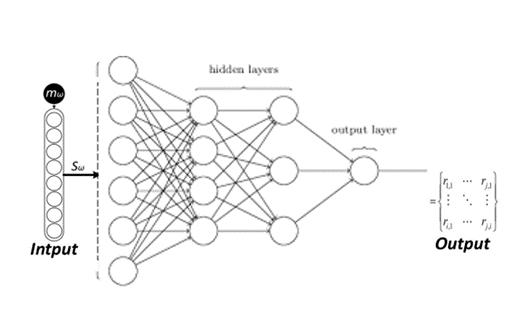
Inthecriticnetwork,theactionspaceanditsefficiencyare used as input to form a backtracking network structure, thus helping in predicting whether the action is a good actionorabadactionforagivenstate.
This, critic network output is in turn used in the action network as input for the next training episode thus, successfully helping the real time model to update and trainitselfforbetterefficiency.
Figure 3 Resource allocation training process of Algorithms.
4. PERFORMANCE ANALYSIS AND RESULTS
4.1 PERFORMANCE ANALYSIS
In this section, the proposed algorithm is evaluated for varioususersnamely(15,20,25,30,35,40,and45users) and 3 edges in the distance of 3.5 km having a resource limit of up to 5.04 * 108 bits/sec. In addition, the user neuralnetworkisrandomlydeployedoneachdevice.The key objective of the simulation is to see if the proposed algorithm can make real time resource allocation decisions to ensure that task executing devices have the resources when they need to complete the task smoothly. Since it is performed under 5G the communication rate is setto5GHz/sandthedelayissetto0.1ms.Thehitrateis definedasthemeasureoftheaccuracyofthefinaldecision
Journal of Engineering and Technology (IRJET)
2395
2395
result,i.eitistheratiooftheresourceactuallyallocatedto the device and the resource demand. The delay time is defined as the time required to successfully execute the given task i.e. it is the measure of the difference between the time at which the task process is requested by the device and the task process is completed and is transmittedtothedevice.
For the nested neural network, its number of dimensions is the same as the number of devices selected to nest. Therefore,onlythedeviceswithlocalneuralnetworksare selected. The threshold of these local neural networks is an important factor that determines the performance of thenestedneuralnetwork,
4.2 RESULTS OBTAINED
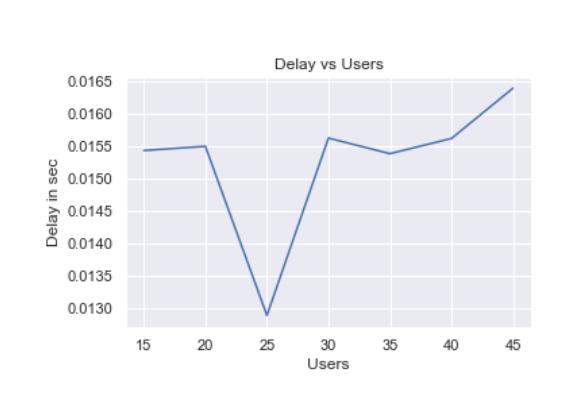
Thefigureshowstheaveragedecisiondelaytime,whichis the average waiting time of the device from initiating the requesttoobtainingthedecisionresult.Itshouldbenoted that this online decision delay is based on previous training results instead of a complete training process from scratch. The comparison is done by changing the device distribution density. The devices with resource requests are randomly selected. It can be found that with theincreasedscaleofdevicedistributiondensity,although the training time of all algorithms increases, the decision timeofthealgorithmismoreorlessintherangeof0.013 to0.017secs.
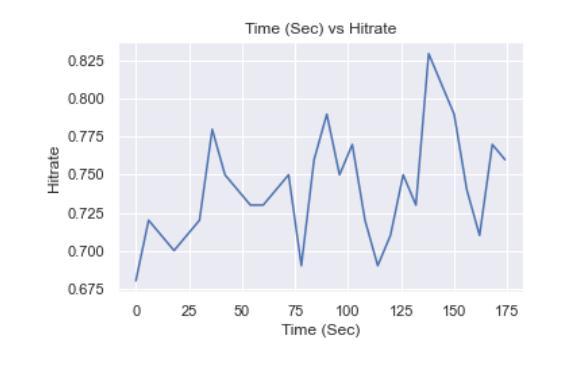
TheaverageresourcehitratesareshowninFigure,where thetimeperiodissetas0.25mintoobservethereal time performanceamongthem.Wecanseethatateachpointin time the average resource hit rate seems to be gradually increasing.
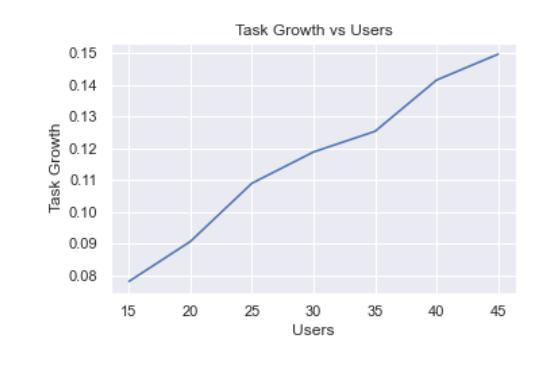
Thefigureshowstheaveragetaskgrowthpercentagewith respect to the number of users, it can be seen that as we increase the number of users the percentage of tasks completed increases. It should be noted that it is not the differenceintheaveragetaskbeforeandaftertrainingbut itspercentage.Thusitcanbescaledonthesamegraph.
15450.534 0.6504
20438.867 0.665
25611.2 0.741
30550.7 0.594
35289.9 0.745
40546.934 0.626 0.016
45439.0 0.584
International Research Journal of Engineering and Technology (IRJET) e ISSN:2395 0056
Volume: 09 Issue: 04 | Apr 2022 www.irjet.net p ISSN:2395 0072
5. CONCLUSIONS AND FUTURE SCOPE
In this model, we haven't taken into consideration the uncertainty in the channel state information. This work can be extended by incorporating the uncertainty in the wirelesspropagationenvironment.
Our project only focuses on maximizing the total network throughput. This work can be extended by incorporating fairness or users’ QoS requirements (e.g. minimum rate guaranteeforeachuser)in theresourceallocationmodel. Unfortunately, these networks will be interference limited, since orthogonal transmission schemes and/or linear interference neutralization techniques are not practicalduetothemassiveamountofnodestobeserved.
We can consider other parameters, such as energy consumptionandmobility,toimprovethemechanism.
6. REFERENCES
[1] H.Ye,G.YeLi,andB. H.F.Juang,“Deepreinforcement learning based resource allocation for V2V communications,”IEEETrans.Veh.Technol.,vol.68,no.4, pp.3163 3173,Apr.2019.
[2] “K. B. Letaief, W. Chen, Y. Shi, J. Zhang, and Y. J. A. Zhang, “The roadmap to 6G: AI empowered the wireless networks,” IEEE Commun. Mag., vol. 57, no. 8, pp. 84 90, Aug.2019.
[3] M. Chen, Y. Miao, H. Gharavi, L. Hu, and I. Humar, “Intelligent traffic adaptive resource allocation for edge computing based 5G networks,” IEEE Trans. Cognitive Commun.Netw.,vol.6,no.2,pp.499 508,Jun.2020.
[4] S. Wang, T. Sun, H. Yang, X. Duan, and L. Lu, “6G network:Towardsadistributedandautonomoussystem,” 2020,pp.1 5.
5] Zhiyong Liu∗, Xin Chen∗, Ying Chen∗, Zhuo Li, “Deep Reinforcement Learning Based Dynamic Resource Allocationin5GUltra DenseNetworks”,2019pp.
[6] Kai Lin , Senior Member, IEEE, Yihui Li, Qiang Zhang , and Giancarlo Fortino , Senior Member, IEEE, “AI Driven Collaborative Resource Allocation for Task Execution in 6G EnabledMassiveIoT”,2021pp.
[7] Y. Dai, K. Zhang, S. Maharjan, and Y. Zhang, “Edge intelligence for energy efficient computation offloading and resource allocation in 5G beyond,” IEEE Trans. Veh. Technol.,vol.69,no.10,pp.12175 12186,Oct.2020.
[8] K. Lin, C. Li, Y. Li, C. Savaglio, and G. Fortino, “Distributed learning for vehicle routing decision in software defined Internet of vehicles,” IEEE Trans. Intell. Transp.Syst.,earlyaccess,Sep.28,2020
[9]X.Wang,Y.Han,C.Wang,Q.Zhao,X.Chen,andM.Chen, “In edge AI: Intelligentization mobile edge computing, caching and communication by federated learning,” IEEE Netw.,vol.33,no.5,pp.156 165,Sep./Oct.2019.
[10] Chen, Z. Li, K. Wang, and L. Xing, “MDP Based Network Selection withRewardOptimizationinHetNets,” Chinese Journal of Electronics, Vol.27, No.1, pp. 183 190, Jan.2018.
[11]C.Zhang,Y. L.Ueng,C.StuderandA.Burg,"Artificial Intelligence for 5G and Beyond 5G: Implementations, Algorithms, and Optimizations," in IEEE Journal on EmergingandSelectedTopicsinCircuitsandSystems,vol. 10, no. 2, pp. 149 163, June 2020, doi: 10.1109/JETCAS.2020.3000103.
[12] K. Cao, Y. Liu, G. Meng and Q. Sun, "An Overview on Edge Computing Research," in IEEE Access, vol. 8, pp. 85714 85728,2020,doi:10.1109/ACCESS.2020.2991734
© 2022, IRJET | Impact Factor value: 7.529 | ISO 9001:2008
Page 3414