Self Driving Car
Abstract The evolution of Internet ofThingshasserved up the catalyst in the field of technology Automobile manufacturers such as Ford, Audi, Hyundai, Tesla, and other companies are investing billions of dollars in autonomous vehicle driving research. According to the new information, in the next 30 years, this fast developing industry will be worth $ 7 trillion. This will create a shift on the way cities are planned, as less parking spots will be needed, and secondly, in a developed city with most of its vehicles being connected and autonomous, traffic optimization will be able to be strongly applied by coordinating movement of the vehicles.
1. INTRODUCTION
Overthelastyearstheautomotiveindustryhasadvanced significantly towards a future without human drivers. Researchers are currently trying to overcome the technological, political and social challenges involved in making autonomous vehicles mainstream. These vehicles needtobesafe,reliableandcost efficient.Connectingthem and creating coordination mechanisms could help achieve these goals. This project proposes a self driving Radio Control car.This carrunsinanartificial environment.The environment consists of various real life obstacles, traffic signals, speed boards, etc. The car has to run and adjust accordingtotheenvironment.Thisprojectfocuses onlane driving, obstacle detection and road signs. This is a small scale representation of the self driving car using various Deep Learning, Computer Vision techniques. With the increaseinthesizeofthemodelthecomplexitiesincreaseas well. The project focuses on basic driving features consideringthesafetyandcostofthemodel.
2. LITERATURE REVIEW

Mohammed A.A. Babiker et al.[1] made use of the Unity platformtobuildthesimulatorofthecaranditsenvironment. Themodeluses2NeuralNetworksvizConvolutionalNeural Network and VGG16 model. CNN algorithm was used to predict the output of the steering angle and VGG16 model was used to detect the traffic lights. Initially the data was collectedbydrivingthecarmanuallyandthedataobtained wasusedtotraintheneuralnetworks.Thecameracollects the image which in turn acts as an input to the CNN algorithm. The predicted values help the car to move accordingly.Themodelhadanaccuracyof86%andwasable todetectdifferentroadfeatures.
Uvais Karni et al.[2] used Image processing, Deep learning,RaspberryPi,Arduinotobuildasmall scaleversion of an autonomous RC car. CNN was chosen by the author becauseofitshighefficiencyandlowtimetakentobuildthe model.NeuralnetworkandRandomForestweresothatthe modelcarwouldrunwithoutanyerrorsafterbeingtrained onallsets.RaspberryPicameracapturestheimageandthe neural network is loaded on the same Raspberry Pi Microcontroller. The model is trained several times using CNN.Sigmoidandcostfunctionswereusedtominimizethe errorsinthemodelforsmoothfunctioningofthecar.Since they loaded the model on the Micro controller itself, The future scopeof this projectwill be loading the model on a Laptop/PCforfasteroutputs.
JaychandUpadhyayetal.[3]hasbuiltasimulationof Autonomousdrivingcarusingaunitygamingmodule.DeepQ learning instead ofDeep learning wasused, Deep learning usingCNNgivesoutputasaclassificationwhereasDeepQ learninggivestheoutputasQpoints.Qpointsaregivenwhen themodelisbuiltandtestedsuccessfully,ifitthrowssome error then we get Q points in negative. The model always triestoattainahighnumberofQpoints.Thefuturescopeof thismodelisimplementingthesamemodelinarealsmall scaledRCcarsothatitcanbeusedinthefuture.
3. PROPOSED BLOCK DIAGRAM
Negi
Kunj Patel
Janhavi Satam
Student, Department of Information and Technology Engineering, Atharva College Of Engineering, Maharashtra, India
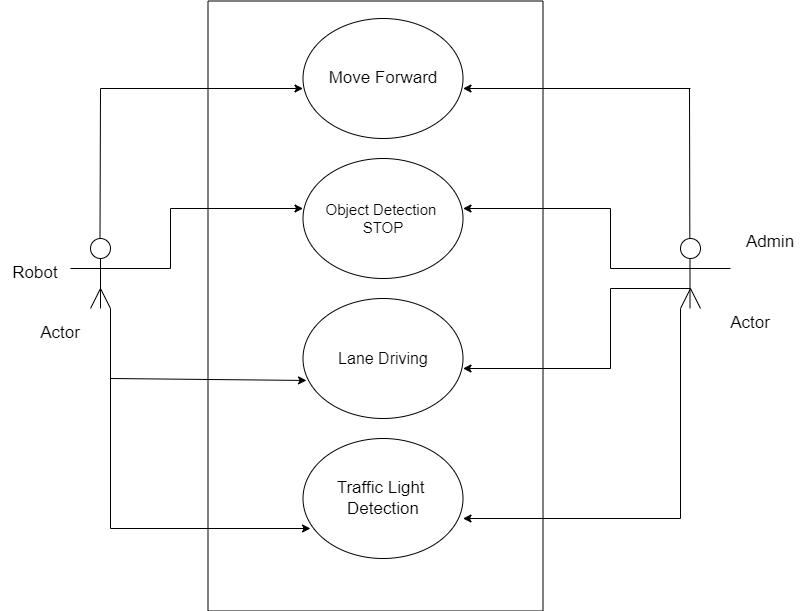
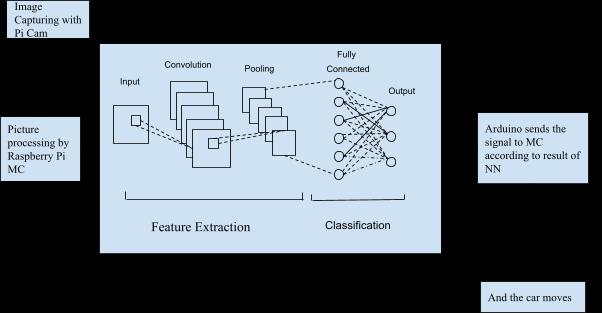
The RC Car is trained in a virtual environment. The environmentiscreatedbytakingintoconsiderationthereal lifesituations. Thecaris trained many times togethigher accuracy.ThePiCameraattachedontopofthecarcaptures the images. The images are processed by Raspberry Pi Microcontroller.
Imagepre processingisdoneusingOpenCV.Theimageinput isthentakenandfeatureextractiontakesplaceusingCNN algorithm.Theimagesarepooledpixelbypixelmanner.This giveshigheraccuracytothemodel.
After pooling the images are classified and divided into classes,thefinaloutputisobtained.Theoutputisthensentto theArduinoMicrocontroller.Themicrocontrollerreadsthe NNoutputandsimultaneouslytriggersthecaraccordingto theoutput.Thecarmovesaccording tothesignalreceived fromArduiono.
4.2 Working of the Project
● Firststepofourprojectwastoloadthetraining data. The dataset consists of 67 images of the environment that was created artificially. It has severalimagesofroadsthatgostraight,towards theleftandtowardstheright.
● Thetrainingdataisstoredasannpzfile(Numpy arrayzip)andisgivenasaninputtotheModel.
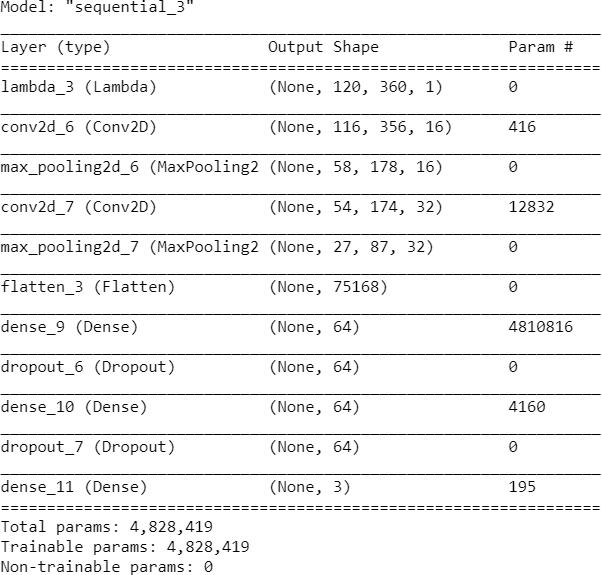
● We have used the sequentialmodelthatCNN provides.‘Relu’and‘Softmax’activation functionswereused.
4.1 Algorithms
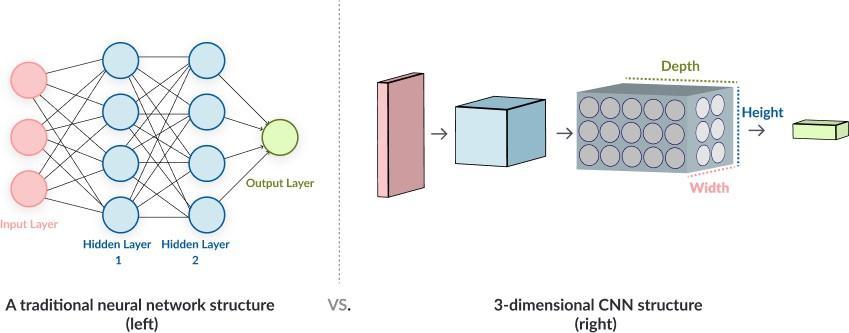
A Convolutional Neural Network (ConvNet/CNN) is a DeepLearningalgorithmwhichcantakeinaninputimage, assignimportance(learnableweightsandbiases)tovarious aspects/objects in the image and be able to differentiate one from the other. The pre processing required in a ConvNetismuchlowerascomparedtootherclassification algorithms. While in primitive methods filters are hand engineered,withenoughtraining,ConvNetshavetheability to learn these filters/characteristics. . The architecture performs a better fitting to the image dataset due to the reduction in the number of parameters involved and reusabilityofweights.Inotherwords,thenetworkcanbe trained to understand the sophistication of the image better.
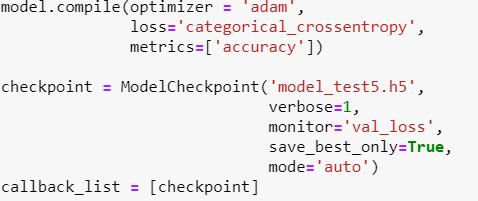
Totrainthemodelweused‘adam’optimizer.
● After50epochsourmodelwasreadytobetested.
●
○
the
sent
the
the
actsas
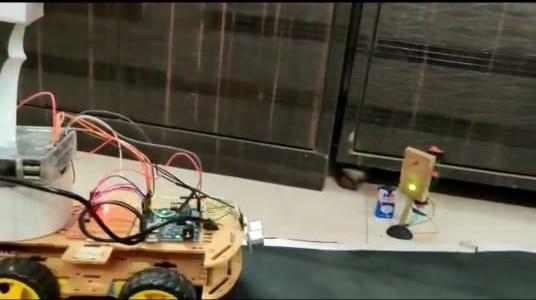
● Traffic Signals & Road Sign Detection: In order todetectthesignalswehaveapre trainedcascade classifier model in OpenCV. A cascading classifier detects a frame as positive or negative so each classifierwillcheckeachframeforpositivesamples, ifthesampleisnotfoundtheslidingwindowmoves tothenextframe.Thenextframeischeckedagain foraparticularclassifier.Thisgoesontilltheentire frameofthevideoiscovered.
the
model
have made (shown above).
sent
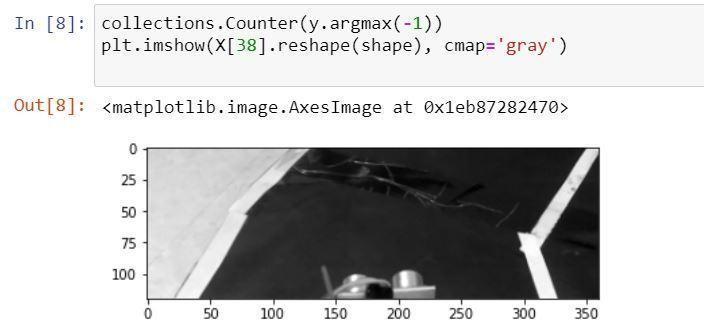
● Lane Detection: A trained Convolutional Neural Networkmodelisusedtopredictthenextmoveof thecar.Iftheroadismovingtowardstheleft,the predictiongivenbyCNNwillbealeftturn.Duringa leftturn,theModelseeswhitespaceoftheflooron the right and black chart paper on the left, which triggersaLeftturnprediction.
acts as
the
5. RESULTS
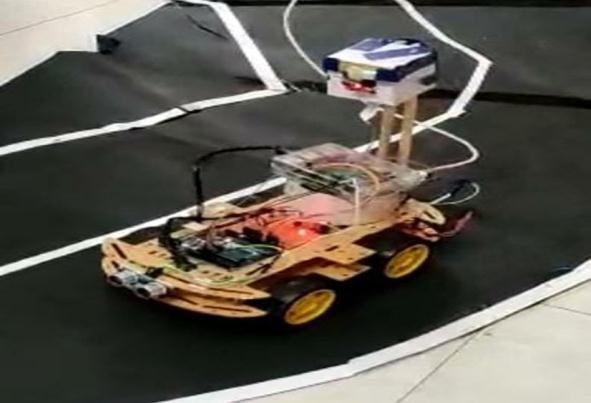
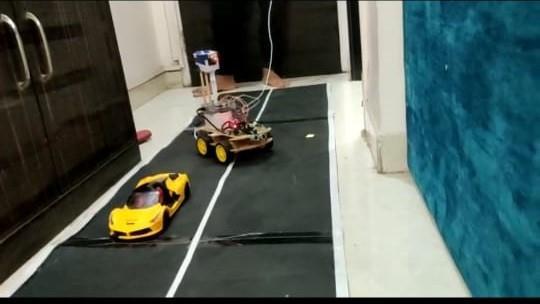
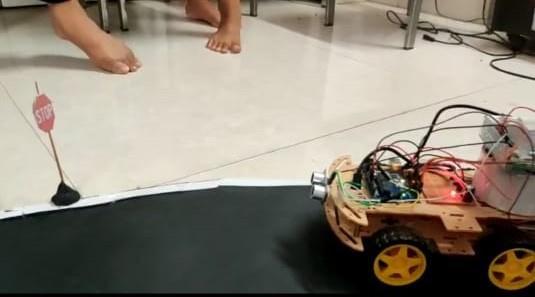
Thepicturedepictsthehardwareprototypeofourself driving car model made using CNN and IOT devices. The blackchartpaperhereactsasanartificialenvironmenton whichtheprototypewillworkabidingbyrulesthatwehave stated.
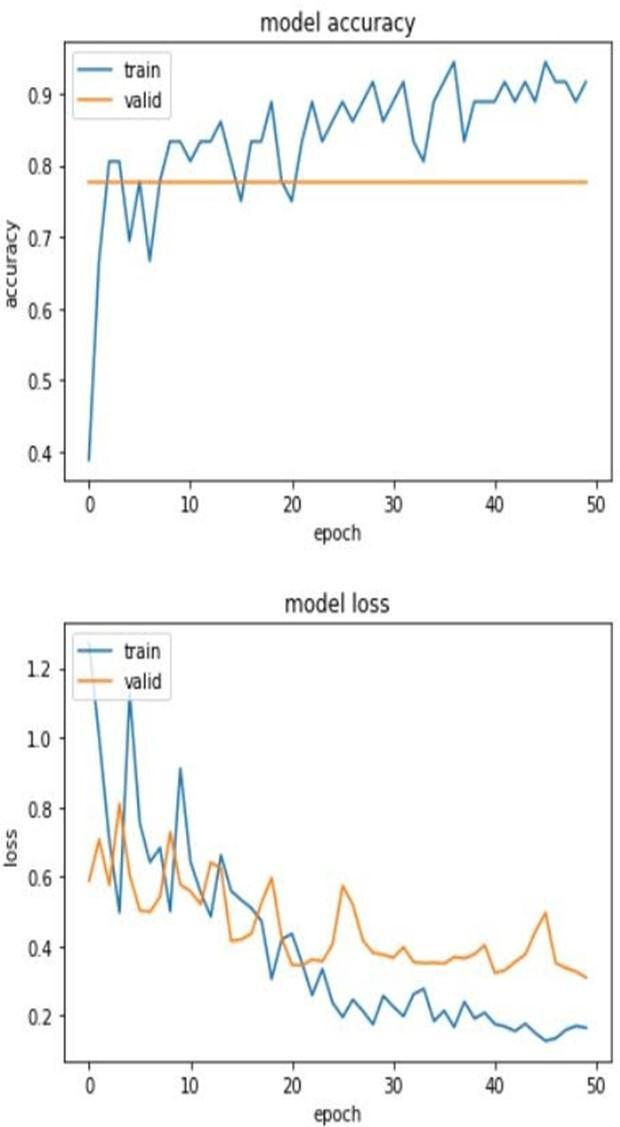
ValidationAccuracy
which consisted of
tothe
model.The
increasedovertimei.e.themodelkepton
itselfinthe50steps.Validationdatawaspassed
accuracy was acquired.In
dataset and the
secondimageboththetrainingand
errors were less than 0.4 which proves that the model is accurateinpredictingthedirectionsinwhichthecarshould travel.
2395
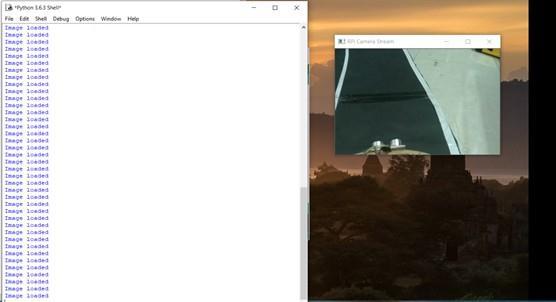
Thisfigurehastwocomponents,theoneontheleftisthe Imagebeingtransmittedfromtheraspberrypicamtothe
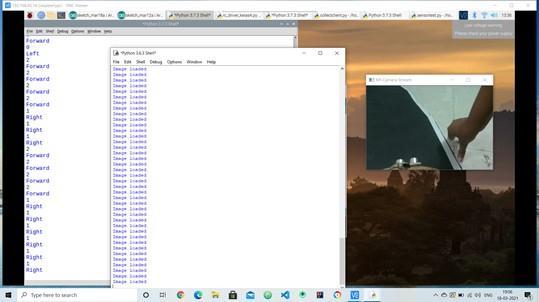
andhencetheimageloadednotificationpop
therightisthenormalimagestream thatthecamerahasrecorded.
inevery second.
Figure_isthemainimplementationofthecodesthatwe have used. Server Sockets are used to transmit data betweentheRaspberryPiandtheHostcomputeroverthe samenetwork.
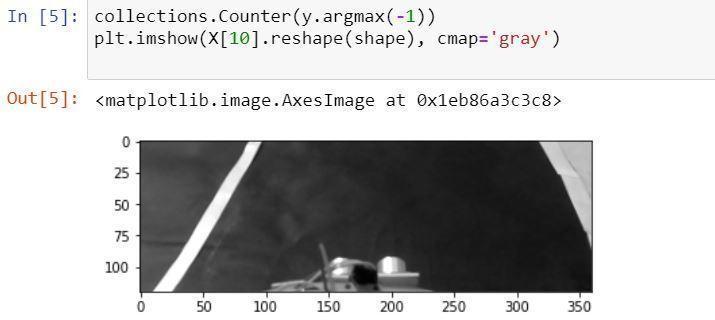
Asyoucansee,thepictureontherightshowstheroad goingstraightandthenturningleft.Inthesamewaywecan seethemodelpredictingforwardfirstandthenaleft.(on thetopleftoftheimage).
6. CONCLUSION
Self drivingcarsarethefutureoftheautomobileindustry.In ourproposedmodel,implementationofselfdrivingcarscan becostefficientandstillgivehigheraccuracyrates.Thecaris trainedtomoveinavirtualenvironmentwhichissimilarto thereallifeenvironmentandfunctionsjustlikethehuman minddoeswhiledriving.Lanedriving,lanechanging,traffic rules,etcarethemajorfactorsthismodelisfocusingupon. Thismodelcanbeimplementedonalargescalethoughthe complexitieswillincreasewiththeincreaseinthesizeofthe project.Hence,acostefficientmodelwithhighaccuracyrates is whattheproposedmodelisallabout.
7. REFERENCES
[1] MohammedA.A.Babiker,MohammedA.O.Elawad, AzzaH.M.Ahmed,”ConvolutionalNeuralNetwork for Self Driving Car in a virtual Environment”, 2019 International Conference on Computer, Control, Electrical, and Electronics Engineering (ICCCEEE19).
[2]Uvais Karni, Shreyas Ramachandran, K Sivaraman,”Development Of Autonomous DownscaledModelCarUsingNeuralNetworksAnd Machine Learning”, 2019.3rd International Conference on Computing Methodologies and Communication(ICCMC)
[3] JaychandUpadhyay,Takafumiokayama, “AutonomousDrivingSystembasedonDeepQ Learning”,2018.InternationalConferenceon IntelligentAutonomousSystems(ICoIAS)
[4]Nischal Sanil, Pasumarthy Ankith Naga venkat, Rakesh V, Rishab Mallapur, Mohammed Riyaz Ahmed,“Deep Learning Techniques for Obstacle DetectionandAvoidancein DriverlessCars”,2020 International Conference on Artificial Intelligence andSignalProcessing(AISP).
[5] Bhaskar Barua, Clarence Gomes, Shubham Baghe, JigneshSisodia,”ASelf DrivingCarImplementation using Computer Vision for Detection and Navigation”,Proceedings of the International Conference on Intelligent Computing and Control Systems(ICICCS2019)
[6]Dong Dong 1 , Xiao Yang Li2 , XiaoTong Sun3,”A Vision Based Method For Improvingthe Safety Of Self Driving”,School of Reliability and Systems Engineering, Beihang University Science and Technology on Reliability and Environmental EngineeringLaboratoryBeijing,China
[7] Gowdham Prabhakar, Binsu Kailath,Sudha Natarajan, Rajesh Kumar,”Obstacle detection and classification using Deep learning for tracking in high speed Autonomous driving”, IEEERegion 10 Symposium(TENSYMP)
[8] Mohammad Rubaiyat Tanvir Hossain, Md. Asif Shahjalal, Nowroz Farhan Nur,”Design of an IOT basedAutonomousvehiclewiththeaidofcomputer vision”,International Conference on Electrical, ComputerandCommunicationEngineering(ECCE), February16 18,2017,Cox’sBazar,Bangladesh