
DESIGN AND FABRICATION OF ATTACHABLE WHEELCHAIR AUTOMATOR
Today,in the twenty first century, technological advancements have proven to be a boon for all civilian populations and have assisted the globe in becoming independent, but, as with any coin, there are two sides to every coin; similarly, these advancements and progress have left the disabled dependent on others for their mobility, and the same is true for paraplegia patients. According to 2011 surveys, 2.21 percent (2.76 million) of India's population is disabled. The number of people living with paraplegia has surpassed 20,000, and it is growing at a rate of about 10,000 each year. Our initiative intends to provide disabled (paraplegia patients) with an autonomous lifestyle, a clean environment, and an easy form of transportation in order to make their lives easier. Patients with paraplegia have difficulties pushing wheelchairs on uneven surfaces; also, pushing the wheelchair puts effort on their upper body, which can lead to tiredness over time. The typical wheelchair on the market does not make the patient independent, and the electrical version is prohibitively expensive. However, the issue is that it gets caught in minor potholes and does not satisfy the requirements when used on uneven terrain since the front wheel is smaller. Attachments manufactured from a cycle electric conversion kit are used in this project to bring electronics to a wheelchair. Because the trike is three wheeled, the difficulty of balancing is eliminated because it is a self balanced vehicle, and the crippled can ride electrically. The addition will lift the smaller front wheels, and the front wheel will be significantly larger in diameter than the front wheel, making it easier to ride on uneven terrain. We have also attached a disc brake and a 4 point safety harness for added safety.The concepts of the wheelchair and the electric conversion kit were thoroughly researched, and the many components that would be employed were created accordingly. The vehicle would next be evaluated and modifications made based on the results in order to optimise it for everyday usage and meet all of the parameters that allow us to have a comfortable and safe ride. We can automate the vehicle and provide the rider with the best comfort by usinga hub motor.
KeyWords: Wheelchair, Battery, Motor Hub, 4- Point Safety, paraplegia patients.

1. INTRODUCTION
Itiswellknownthat,inthetwenty firstcentury,allofthe inventions, discoveries, and advances accomplished throughout the centuries have made civilian life nothing short of a paradise. Transportation vehicles have progressedfromasinglewheeltobicyclestocarstosteam enginestoshipstoaeroplanes,makinghumantravelfrom one location to another far more convenient than before. Thesetransportationvehicleshavemadehumanexistence considerably easier and have aided in accelerating progress in order to provide a brighter future for future generations.But,aswitheverycoin,therearetwosidesto everystory,andthisroadofprogressforabrighterfuture for the majority has left disabled people as a burden on their families. People with lower body disabilities, often known as paraplegia patients, have trouble pushing wheelchairsonunevenand ruggedterrain bythemselves. Additionally, pushing wheelchairs puts stress on their upper body and can lead to weariness over time. The usage of an electrical wheelchair is the most practicable choice to meet the above mentioned requirements, but given the economic situation of the majority of the country's civilian population, the electrical wheelchair is too expensive, and the cost increases exponentially with the big brands. The electronic wheelchair is simple to operate and does not place undue strain on the patient's body.
1.1. Background
There has already been far too much research into the electrical wheelchair. Although the traditional electrical wheelchair may be a potential substitute for non electricalwheelchairs,thehighcostandridercomfort makeitdifficultfortheridertogolongdistancessincethe rider's posture places too much stress on the back, shoulder, and neck. This causes the rider to take pauses while riding and makes them reliant on others, which is undesirable because city life is too fast paced. After doing some study on electrical cycle conversion kits, we discoveredthatwecanturnaregulartrikeintoanelectric trike without the requirement for the rider to balance it. Now, in order to provide the highest comfort to the rider, and to ensure that the rider's posture does not cause any stresstothehumanbodywhenridingthevehicle.
HISTORY OF WHEELCHAIRS:
In the 6th and 5th centuries BCE, an engraving unearthed on a stone tablet in China and a child's bed depictedinanornamentonaGreekdecorativehandleless container are the first documented examples of wheeled furniture chairs. (Ability Tools, 2013; Koerth Baker et al., 2017; Joseph Flaherty, 2012; Maggie et al., 2012; Joseph Flaherty,2012; Maggie et al.,2012). The earliest evidence ofwheelchairsbeingusedtotransportcrippledpeoplecan be found in China three centuries later. As depicted in Figure 1, the Chinese used wheelbarrows to transport people and large things. A distinction between the two purposes was not made for another many years, until around525CE,whenChineseartbegantodepictwheeled chairs constructed explicitly and categorically to carry people. For a long time, wheelchairs have been used to carry physically weak patients in hospitals, as well as the elderly, crippled, and physically challenged. Wheelchairs aredrivenbymanualefforts,andthecrippledoperateand control them withtheirhandswhilesomeone elsepushes the patient's wheelchair. This study offers a simple automaton that may be attached to or connected to a traditionalhand operatedwheelchairtoconvertitinto an E wheelchair. This does not necessitate any human effort on the part of the user (self propelled) or an attendant pushingfrombehind(attendantpropelled).

an alternative that best matches the basic parameters of an electrical wheelchair while also being cost effective, non hazardoustotheenvironment(specificallyintermsof batteries, as lithium ion batteries have disposal issues) and keeping the factor of ergonomics as a primary consideration. In addition, we kept people who already havewheelchairsandhoistsinmind.
2.1.Objective
2.1.1. Design Objective
Disabled individuals should have access to a sustainable mode of transportation that does not jeopardize their safety, allowing them to travel independently,inanenvironmentallyresponsible,socially acceptable, and economically viable manner. The transportation system should be built and operated in such a way that it protects people's health, ensures everyone'ssafety,andimprovescommunityqualityoflife. Therichandthepoorhavedifferentinterpretationsofthe term "sustainability." For the wealthy, sustainability can beachievedbytechnologicalfixessuchascleanerengines and fuels, but for the poor, it is a way of life and they are limited to using public transportation. The goal should be to provide accessible, cost effective, and environmentally responsible transportation for disabled individuals. The electrical tricycle attachment is the ideal answer for this. The objectives due to which electrical tricycle attachment arepreferredovertraditionalwheelchairareasfollows:
1. To virtually design a wheelchair according to the anthropometricdata,ensuringmaximumcomfort, safety and efficiency keeping Design for Manufacturing and Assembly [DFMA] guidelines in consideration and making it a success model when it comes to actual implementation of conceptontheshopfloor.
2. Problem Definition
According to 2011 polls, 2.21 percent (2.76 million) of India's population has a disability, and the number of paraplegia (those with a lower body handicap) is over 20,00,000, with an annual increase of about 10,000.Patients with paraplegia have difficulties pushing wheelchairs on uneven surfaces; also, pushing the wheelchairputseffortontheirupperbody,whichcanlead to tiredness over time. The standard wheelchair on the market does not make the patient independent, and the electrical version is prohibitively expensive. However, the issueisthatitgetscaughtinminorpotholesanddoesnot satisfy the requirements when used on uneven terrain because the front wheel is too narrow. The majority of electric wheelchairs on the market today use Lithium ion rechargeable batteries, which are both damaging to the environment and expensive. To address the aforementioned issues, we reasoned that why not create
2. Theclampswouldbeinsuchawaythatitcanbe fitted in any of the traditional pre existing wheelchairs.
3. Develop an aesthetically appealing wheel chair whichiseconomicallyaffordableatthesametime torenderitmarketable.
4. It can also manage on rough terrain as it has the largerfrontwheelwhichwon'tgetstuckinrough anduneventerrain.
5. As the rider (patient) do not have to push it manually so there is no stress generation in the body.
6. Thediscbrakesand3 pointsafetyharnesswitha properheadsupportaddonfeatureswhichmake itmoresafeandErgonomic.
International
Volume:
7.
8.
create a revolutionary
adhere to
Design Specification
Governments
everyphase.
TEAMS DESIGN CONSTRAINT TEAMS PERSPECTIVE
Factor of safety (Minimum1.5)
Greater the factor of safety lesser wouldbethechancesoffailureof thewheelchairensuring thesafety.
Weight Lesser the weight less would be theefforttakenbythepatient.
Braking Safety Requirement
SafetyHarness (Seatbelt)
Material (M.S. Pipe, GRADE: ANSI 1020)
Brakingdistance (Less than 6m at the speed of 25km/h)
Battery (Lithium sulphur battery)
Disc brakes have been used to ensure greater efficiency and low maintenance.
Useof4 or5 pointsafetyharness toensurethesafety.
M.S. has high machinability, high strength,high ductility and good weldability.
Thebrakingdistanceislaid down by theASME and we decided to stickwithit.
We decided to opt for the battery whichis cheapandecofriendly
3. Methodology
3.1 Planning & Flow of Working
The production of these vehicles is divided into following phases:
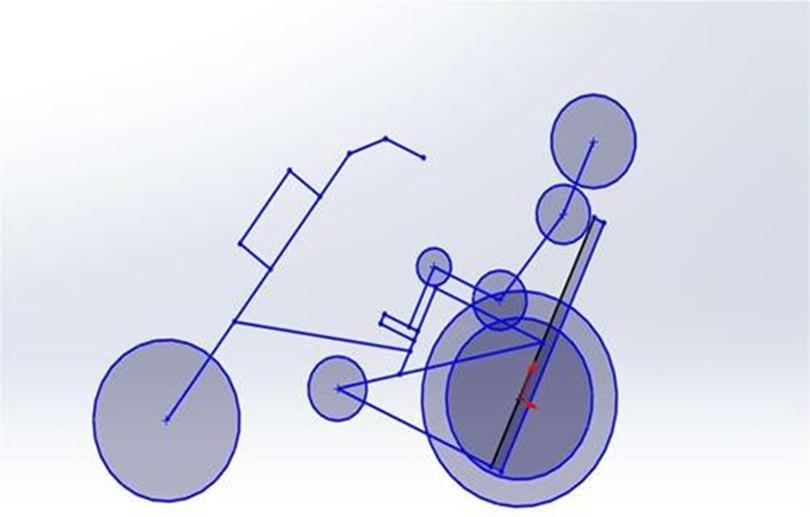
1. Phase of design: The attachment was designed by amassing anthropometric data and using that data to compute measurements for the attachment, which were then calculated and designed in Solidworks software, whereallofthepieceswerecreatedandassembled.Itisa chassis with a single frame. We iterated our car frame aftercollectingallofthedata.
2. Market research phase: All of the parts and tools needed to make the attachment were researched in order to get the greatest quality products at the best pricing. During the procedure, the optimal materials, pipe shape, pipe size, and parts for the job were discovered. More attention was placed on the usage of more conventional products, ensuring that the product's availability and maintainabilityareoptimal forthegeneralpublic.Despite the factthat production is notviableowingtotheCOVID 19pandemic.
3.Testingandmodification phase: We will testall ofthe components on the software during the testing phase becauseactual fabricationoftheprototypeisnotpossible duetothelockdown,sowewillonlydoanalysisonANSYS Software. Based on the results of the analysis, we will surely modify our design and make it more competitive whenitenterstheworldmarket.
4. Literature Survey
1. Design and Fabrication of Drivable Wheelchair AttachmentInternationalJournalofInnovative
Minimum product Weight
Manufacture the attachment within a budget of ₹20,000
Maintaining minimum weight of the entire assembly in order to achieve maximum speed and propervehiclestability.
Tomakethevehicleanaffordable alternativefortheconsumer
Typeofhandlebar This type of handlebar possesses greater
We all know that wheelchairs are used to transport patientsorpersonswhoaredisabled.Handicappedpeople canmaneuvertheirwheelchairsusingtheirupperlimbsor with the assistance of others. So, here we are building a detachable handle that is connected to the wheelchair so that a person may simply operate their wheelchair withouttheassistanceofothersandwithoutexperiencing anystresswhiledoingso.Sowe'reemployingabatteryin that handle, which can be simply recharged or removed. We intend to use a 300W, 12V brushless motor and 48V, 24Ahbatteriesinourproject,whichcanbechargedin4 5 hoursandhavearangeof30kmataspeedof25km/hr.
2. Prototype of Wheel chair attachable E hand bike International Journal of Advance In Science And Engineering(IJITEE).
In this work, the focus is on building a wheelchair attached hand bike that may be operated manually for
of Engineering and Technology (IRJET)
2395
improved road mobility. To control it, a hand bike has a battery as well as mechanical brakes. They are made in such a way that they are inexpensive to those in the middleclass.Handbikesaredesignedtobesafe,light,and attractive. Recycled aluminium and steel bicycle parts are usedtomakehandbikes.Theinitialintentionwastobuild a composite wheelchair that could be converted into an electric wheelchair attachment. Ability to adapt a high performancetricyclefordisabledpeoplewithouthavingto leave the chair. It's simple to convert to a tricycle. It's simple to engage and withdraw. We chose the subject of wheel chair attachment E hand bike because it is necessary for disabled persons who are unable to go long distances and require an additional person to push the wheelchair.
3.DesignandImplementationofelectricwheelchair
A smart wheelchair is made up of a regular power wheelchair with a computer and a collection of sensors attached, or a mobile robot base with a seat attached. Geared hub motors make up the majority of 250 watt motors. Planetary gears are used to boost efficiency and speed.This allows us to lower both the weight of the engineandtheoverallweightofthewheelchair.
4.Studyonsmartwheelchairsystems2016
Accidents lead people to suffer from lower impairments. They benefit from the use of an electrical wheelchairbecauseitallowsthemtomeettheirneedsfor independence and mobility. Air pressure is employed whensipping(inhaling)and puffing(exhaling)ona straw tube that delivers a signal to a wheelchair. Another strategy is to use the direction in which the impaired person is gazing or turning his or her head. In such technology,acameraisemployed,andtheusermuststare inthedirectioninwhichhewishestomove.
5. Solar Powered Wheelchair Mobility for Physically Challenged'
People who are physically challenged have limited mobility. The project intends to improve the mobility of physically challenged people. With the help of a mobile application, power is provided by rechargeable lead batteries,whicharecombinedwithaGPSandGMSsystem for position. For indirect drive transfer, the motor is attached to the drive wheel shaft. When the drive wheels arestruckorunderasevereload,thisreducestorqueand alsoactsasashockabsorber.
6. Electrical Attachment of Wheelchair for Handicapped Person National Conference on Information, CommunicationandEnergySystemsandTechnologies.
In this project, weare using a pre made wheelchair andconvertingitintoatricyclewithanelectricbikehand
using an electric conversion cycle kit. We're putting the battery in the hand so that it can charge quickly and be used for a long time. This hand bike is simple to disassemble. It is simple to use for patients with mobility issues.
7. Lithium Sulfur Battery Technology Readiness and Applications.
WeareusingLiSbatteryinsteadofLi ionbecauseall weknowisthatitisbetterascomparedtoit.AlthoughLiS batteries have tremendous advantages over Li ion batteries, Performance and capacity of the batteries are best.ThemajordisadvantageoftheLi ionbatteriesisthat theyarenotasrobustasotherrechargeabletechnologies. It requires protection to be overcharged and discharged too. Also it suffers from aging which is not good for the electronic consumers. For air travelers, lithium ion batteries need to be carry in luggage so that we require security position, this may change from time to time .We have to take it with the cover and with protection. Li S batteries offer a number of advantages in comparison to current battery technology including (1) an improved gravimetricenergydensity,(2)asignificantlyreducedraw materialscost,(3)improvedsafetycharacteristicsand(4) a reduced environmental burden associated with the cell materials.Lithium sulphurtechnologyhasthepotentialto offer cheaper, lighter weight batteries that also offer safety advantages. After initially finding use in niche markets such as satellites, drones and military vehicles, the technology has the potential to transform aviation in thelong term.
5. CAD Models
6. Results and Discussion
1. A wheelchair attachment is being developed to address a dependability and safety issue for a disabledperson'smovement(paraplegiapatient).
2. The electric Tricycle attachment is designed to eliminate the strains that the paraplegia patient's upperbodyhasbeensubjectedto.
International Research Journal of Engineering and Technology (IRJET) e ISSN:2395 0056
Volume: 09 Issue: 04 | April 2022 www.irjet.net p ISSN:2395 0072
3. Furthermore, having a mode of transportation providesindividualsasenseoffreedom.
4. The existing system is substantially more expensiveandhassomeshortcomings, whichour projecthasaddressed.
5. The project's price, as well as its modular nature, makingitaviableoptionfordisabledpeoplewho cannotaffordconventionalalternatives.
6. Front wheel drive and a low centre of gravity Driving and braking make it easier to navigate uneventerrainwhilemaintainingstability.
7. Conclusion
1. We leveraged current technologies to produce a cost effective and efficient solution to a problem that has plagued disabled persons who cannot affordpriceymobilitysolutions.
2. The expected mass manufacturing cost is roughly $15,000/ , which is around a fourth of the least expensive electric wheelchairs with good safety andqualityratings.
3. This document details the whole design of an electric trike attachment for wheelchairs. The usage of solid modelling aided in the production of high quality designs. Finally, the trike's chassis was examined to determine its capabilities and endurance, with the results being tracked for future improvement. To make driving an electric trikeassafeaspossible,extraordinaryprocedures weretaken.
4. Anear perfectsafetyrecordanddrivertrusthave resulted from experience and smart engineering. This electric trike concept can be considered for mass manufacturing by industries in order to replace conventional electric wheelchairs and contributetoenvironmentalsustainability.
8. Reference
[1] S.D. Kumar, Avinash Jangir, Nishant Saraswat, Anadi Nema, Bhargav Patel “Design and Fabrication of Drivable Wheelchair Attachment” International Journal of Innovative Technology and Exploring Engineering(IJITEE)ISSN:2278 3075, Volume 8 Issue 8, June,2019.
[2]AnupamS.Bhojkar,Hrishikes D.Gaikwad,ShubhamA. Jankar,AkashP.Salokhe,VishwajeetR.Salokhe“Prototype of Wheel chair attachable E hand bike” International Journal of Advance In Science And Engineering (IJITEE) ISSN:2319 8354,,Volume 7Issue 1,March,2018.
[3] Prof. S. S. Kumbar, , Mr Sandeep Mudakannavar, Mr Vinayak patil, “Design and Implementation of electric wheelchair with Controlling the speed & movement of wheelchair”.
[4] Electrical Departmant,SGI Antigre,ShivajiUniversity “Studyonsmartwheelchairsystems2016”.
[5] P. Swapna , Dr. B. Sharmila, Y. Dharshan Arun Manohar Gurram, P.S,V Ramana Rao , Raghuveer Dontikurti “Solar Powered Wheelchair Mobility for Physically Challenged” International Journal of Current Volume 3,Issue 5May 2016.
[6] Robotics and Autonomous Systems. Volume 58, pp. 1148 1158 Lockton D., (2004) Wheelchair, Drive 241 (1) 5 68Lucas,H.V.,WoudeV.,DeGroot,S.andJanssen,T.W.J., (2005). Manual wheelchairs: Research and innovation in rehabilitation, sports, daily life with health, Medical Engineering&Physics,volume28,pp.905 915.
[7] Murray, John Lawn (2003) “Study of Stair Climbing AssistiveMechanismsfortheDisabled”,IEEETransactions on Neural Systems and Rehabilitation Engineering, Volume11,No.3,pp.323 332.
© 2021, IRJET | Impact Factor value: 7.529 | ISO 9001:2008
Journal | Page 2994