
Grievance Reporting System
- During current times when people are more connected and indulging in technology, our project uses this as the base to solve modern problems of grievance registration. The project modules are developed in such a way that it facilitates and ease the overall process of grievance registration to a minimum in order to save users time. Using this android application, users can capture images which will be then run through a machine learning model to calculate the severity of the image, for instance, high, medium, and low. During the image capturing process users, spatial location will also be registered to know the overall location of the issue one can then post the captured images with relevant descriptions, where they will be sent to a government body while also generating a grievance post that can be viewed and up voted by fellow citizens. This can create a healthy pressure on the officials while simultaneously showing the citizens how efficiently the government officials are working on it, hence maintaining equilibrium.
Key Words: Grievance, Registration, Android, Severity, Up vote, Spatial Location
1. INTRODUCTION
With times technology has updated almost all practices and applications around us, making them more efficient, effective, and affordable but government systems like the grievance registration systems still stand a bit primitive duetothefactthatwestillhavetomanuallyaddourown locations, lack of ways to analyze the grievances, etc. to name a few. For instance, the Wrong insertion of spatial location can cause misunderstandings and unwanted delays for the officials. Even when the solutions of these problemsarealreadypresentlikeGPSlocationtotrackthe spatial location and Machine learning algorithms for analysis. The power of officials in certain terms is limited so we addressed it and tried to solve issues of user participation in our application using a portal where fellowuserscanposttheir grievancesbutinsteadofthem beingviewedjustbytheofficialsitwouldbeaddedintoa portalwherefellowuserscanseeitandup voteitorlikeit if they are facing the same issue. Resulting in a reduction of redundancy and an increase in the number of issues posted, as such portals keep the public engaged and also helpthemfinda senseofbelongingnessand fulfillmentof contributingtowardsthebettermentofsociety.
2. LITERATURE SURVEY

A. GPS based complaint redressal system
Vishesh K. Kandhari et.al created an android application that locates the spatial location of the user when he registers a complaint, it locates the spatial location of the user using Google Maps API. The other addition of the authoristhesub system whichforwardsthe grievance to theuppermanagementifacertainamountoftimepasses. [1]
B. Architecture of a GPS-Based Road Management System
Yoon Yeh Tan, Yin Ping Ng, Kim Nee Goh, Yoke Yie Chen, and Kamaruzaman Jusoff et.al developed a system that sends the location of the user along with the description when one registers a grievance to server and stores it inside a database. The application can then retrieve the locationandplotitonamap.[2]
C. A Survey of Image Classification Methods and Techniques
Siddhartha Sankar Nath, Jajnyaseni Kar, Girish Mishra, Sayan Chakraborty published a research paper that explains the concept of Image classification, its prospects, and also the various techniques one can use to execute it alongwiththeirrespectiveprosandcons.[3]
D. Convolutional Neural Networks for Image Classification and Captioning
Sachin Padmanabhan published a paper that explains the useofCNNanditsimplementationofCNNarchitecture in Image classification along with its neural network layers. Italsocomparestheperformanceofotheralgorithmsand thencomparesittothatofCNN.[4]
E. Implementation of Location based Services in Android using GPS and Web Services
Manav Singhal and A. Shukla published a paper that proposes the implementation of GPS and web services throughWalkScoretransit APIsandGoogleWebServices on Android devices, additionally it also discusses the variousservicesprovidedtotheuserthroughit.[5]
Table 1: Summary of the Literature survey
SR No. Paper Advantages and Disadvantages
1 Vishesh K. Kandhari[1]
Advantages:
The automatic tracking of spatial location removes the issue of humanerror.
The sending of grievances to the upper management after a fixed interval of time creates a proper accountability factor for each complaint.
Disadvantages:
1. In terms of innovation it is limited to spatial location no other important functionality is providedbytheapplicationhence making the overall scope quite limited.
5 Manav
Singhal and A.Shukla[5]
boxsystems.
Disadvantages:
1. Only the concept of the image classification was discussed, but no implementation of a real applicationwasshown.
Advantages:
1. A GPS utilized has pinpoint accuracy in regards to spatial locationdetection.
Disadvantages:
1. GPS satellite signals do not penetratebuildinginteriorswell.
3. PROPOSED SYSTEM
3.1 Grievance Registration Application
2 Yoon Yeh Tan, Yin Ping Ng, Kim Nee Goh,YokeYie Chen and Kamaruzama nJusoff[2]
Advantages:
1.Thespatiallocationsare stored into a database that is easy to manageandkeepatrackof.
2. Android application in the paper retrieves the spatial location, which is in a string of numbers format and then convertsitintoagraphicalformat through a Map which makes it easierfortheusertounderstand.
Disadvantages:
1. Similarly other than spatial detection and registration system related to road systems no other domainsarecovered.
3 Siddhartha
Sankar Nath, Jajnyaseni Kar, Girish Mishra, Sayan Chakraborty [3]
Advantages:
1. The categorization of the scene will help in efficient and rapid analysisofthesurroundings.
2.Numerousimagesareclassified in a much quicker way so that accessibilityiseasierandfaster.
Disadvantages:
1.Wecannotestimateormapthe resultsofanewsample. 2. Varying results are obtained duetooutliers.
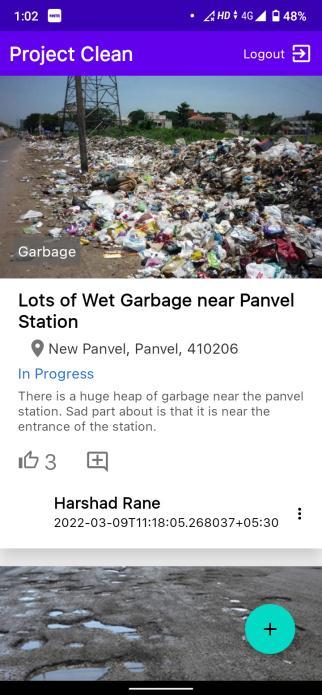
Grievance registration App was developed using (programming languages). In this App once the user has successfully created an account and logged in, they will come across a portal that will display a summary of grievances posted by users like them; here the user has the privilege to comment on it or up vote it to show his support, in case he faces the same issues. Whenever the user first logs in and opens the home page its spatial locationwillgetregisteredandthatwillbedynamicasitis subjected to changes, whenever the user opens the home pageagainafterafixedintervaloftime.Grievanceswillbe displayed in a card layout format so that the user can glancethroughtheminrapidsuccession,clickingonthem formoreinformation onthe grievance will leadthem to a new tab where additional details about the grievance will beshown,forinstance,itsimage,thespatiallocationofthe problem, the description, number of up votes, its status, Score and other miscellaneous details like date of its registering, etc. The spatial location taken allowed us to display the location of the problem on the Map using an API, it makes the task of tracking and getting the estimation of the place where the grievance is situated easier for the human mind (i.e., Government officials) to interpret, due to its graphical format. The Navigation bar provided, holds 3 functions namely, the home button which holds all the grievances posted by fellow users whichwerementionedbefore.Secondly,theaddgrievance button,andfinallytheUserProfilebutton.
4 Sachin Padmanabha n[4]
Advantages:
1.Bettercaptioningisachievedas the image captioning uses Black
HomeScreen
3.1.2grievance registration
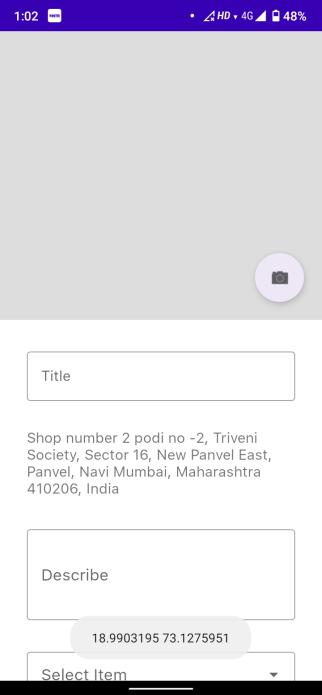
Theaddgrievancebuttonallowsthemtoclicktheimageof theencounteredissues,forexample,aheapofgarbage. He then has to Click the image of it using his phone camera, add the title, description and category of it from thedrop downlist,thespatiallocationoftheplacewhere, the image was captured would also be recorded automatically helping the user avoid the tedious task of manually typing it while also preventing inaccuracies due to human error. After filling the necessary fields, the user needs to submit it to successfully register it in the Governmentdatabase,fromwheretheneededactionswill beperformedonit.Incasetheuserdoesnotwanttoclick animageofthegrievanceforsomereasonthenhehasthe freedom to do so as well. After performing the action, users registered grievance will be displayed on the home page and be ready to be up voted or be commented on. Lastly, the User profile button, it’s the place where user can perform editing actions on his personal details or simplyLogoutofhisaccount.
3.2 Government Web Application
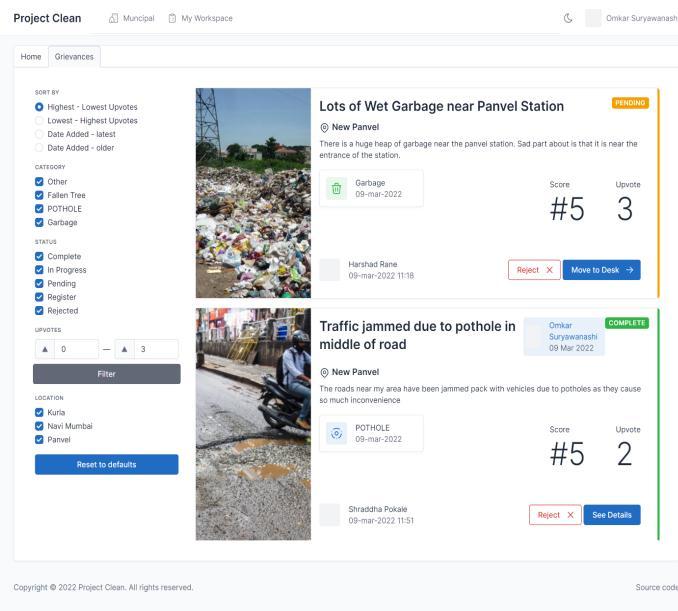
On the government’s side, every employee will be providedcredentialsofhisregisteredaccountusingwhich theycanlogintotheWebApplication.Theseaccountswill hold different privileges, for instance the landing page (Home)willconsistofadashboardthatwilldisplayallthe statisticsofthegrievances,likenumberofissuesresolved, still pending, their total numbers etc. Using these figures, the officials can track their progress and can gain some
insight into the data to facilitate decisions regarding it (Example: the analysis of data can help in budget estimation). The website can be roughly divided into 2 sectors;oneispublicsector(Municipal)whereallofficials can look at the cumulative progress and statistics of all grievances. The other is personalized section, which an officialcanenterafterclickingonmyworkspacebutton. In Municipal section other than statistics one can view registered Grievances that come from the Android application and perform various actions on it. There are multiple Filters put in place to filter the grievances on different parameters like Number of Up votes, Category, status, location etc. There are 4 statuses that could be assigned to a grievance, first one is registered, and this status is given after the successful registration of the grievance by the user through the android application. SecondisPendingstatus,whichsignifiesthatnopersonas of yet has been assigned to your grievance. Thirdly, In Progressthisstatus depicts thata governmentofficialhas undertaken your grievance and is working on it. Finally, therejectedstatus,thisstatussignifiesthatforsomevalid reason your grievance has been rejected by the officials and they won’t be working on it, the reason will also be providedbythem.Theprivilegeofassigningthesestatues is given to officials when they move the grievance from publicsectiontotheirpersonalworkspace.
Fig3.1.3WebApplicationdashboard
3.1.4Grievancedetailpage
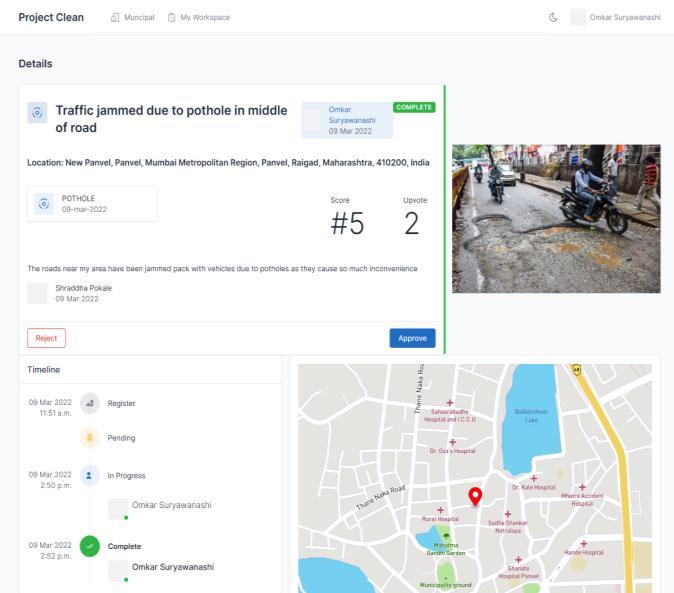
MyWorkspacehasaDesksectionthatactslikeapersonal virtual desk for the user where he can create or manage fileswithease.Insidethesefileswillbethegrievancethat were selected by him from public area and brought here so he can work on it. As soon as the official does so his nameisregisteredwiththegrievance,displayingtheexact time and date when he started working on it along with his name. This eases the job of upper echelons as the overallprogressofeachemployeegetstrackedandpeople couldbeheldaccountablefortheirwork.
3.3 Scoring Criteria
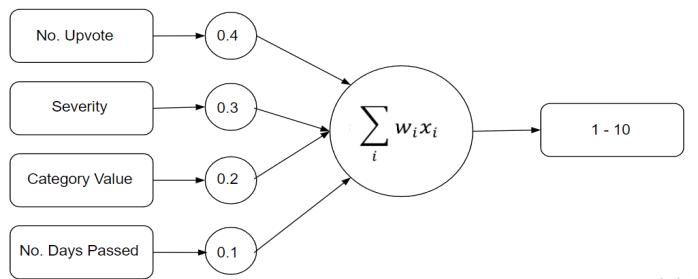
The Score which is displayed on each grievance plays a vital role in helping the officials Prioritize the grievances, intotalthereare4distinctfunctionsusedtocalculatethis score.WhichareNumberofdays(Theolderthegrievance, higher the weightage), Category (Some categories are considered more important than the rest, for instance, Garbage will have more weight than Fallen Tress), Severity,thisparameteriscalculatedbyaCNNmodelthat calculates the severity of a grievance through the image which is provided by the user Between 0 to 1, where 0 is lowest 0.5 is medium and 1 is highest (Example: a small heap of garbage could have a severity of 0.1, on the other hand, a large heap of garbage could have the severity of 0.9),thefinalfunctionusedtocalculatescoreisNumberof Upvotes(highertheupvoteshigherthepriority).TheScore roughlydividesallthegrievancesintocategoriesof#1 all thewayto#10,#1beingtheoneswiththehighestpriority and succeeding ones having lower, all the way to #10 whichisthelowest.
3.4 Image Classification for Grievance Severity
In TensorFlow Keras library, layer and model were used. After pre processing, we used sequential models with 2 CNNlayersandadensenetworkof2layers.
3.4.1 Pre Processing
TheRGBtypeimageisconvertedtoagrayscaleimageand Re Sized into a 200 X 200 pixel image. Then the provided image is flattened into a NumPy array of float values. Following this, the values are divided by 255 in order to reduce the computation power required to process it. Labels are assigned with 0 as low, 1 as medium, and 2 as high respectively. The datasets are randomly Split with 20% of them being utilized as test Datasets and the other 80%astrainingDatasets.
3.4.2 CNN Layers
HeretheCNNlayerconsistedoftheConvolutionlayerand Max pooling layer. In the first convolution layer we considered 32 filters having a size of 3x3 with activation function being relu, input shape was 200 X 200 X 1, and MaxPoolingwithpoolsize2X2. For the second Convolution layer, we selected 64 filters with size being 3 X 3, its activation function as relu, and MaxPoolingwithpoolsize2X2.
3.4.3 Dense Network
In the Dense network for the first layer we selected 64 neurons and activation function as relu and in the second layer we considered 3 neurons while activation function being softmax. To compile the model we used the ‘adam’ optimizer and ‘sparse_categorical_crossentropy’ for loss. TheCNNmodelwastrainedupto10epochs.
3.5 Normalization
TheRangeofInputValues
Number of votes ideally is infinite but in real life applicationswehavetoconvertitintofinite,soinorderto dosoweconsideredtheTotalnumberofusersregistered in that particular area as the upper limit. Similarly in the criterionNo.of days passed, ifthestatus ofany grievance does not change after 30 days it will be assigned special statusdirectly.
TheRangeofInputValues(Realistically):
Criterions Range
No.ofupvotes
Severity
CategoryValue
No.ofdayspassed
N
3
30
WhereN=Totalnumberofusersinthatcity. In regards to the Category value, Certain categories hold moreimportancethanothersandhenceshouldholdmore weight. We have assigned the following weights to the Categories.
Category Value Garbage 1 Pothole 2 FallenTrees
allthescoreswillbeconvertedintoarangeof0 10
3.6 Weighted Scoring Model
Weight is assigned to each criterion based on its relative importance.TheformulaofWeightedScoringModel:
Weig ht Raw Input Value Normalize Input Value
Weighted Value
Post 1 Post 2 Post 1 Post 2 Post 1 Post 2
No. Upvote 40% 168 37 8.40 1.85 3.36 0.74
Severity 30% 1 0 5.0 0.0 1.5 0
Category Value 20% 3 1 10.0 0.0 2 0
No. Days Passed 10% 22 10 7.24 13 3.10 34 0.72 413 0.31 034 7.58
3.7 Requirement Analysis
A. Software
ForthebelowinstanceNo.ofupvotesrangefrom0to200
Input Value Normalised Value
No. Upvotes 168 8.40
Severity 1 5.0 Category Value 3
No. Days Passed 22
System
B. Hardware
7/MacOSandabove
Android5.0+
8 1.05
2
3.8 Datasets
the fallen tree category,
have
the dataset. They are further divided into three sub
medium,
Category
high.
4. RESULT ANALYSIS
Here we display data that has gone through data visualization, which helps workers get a better real time understanding of the overall operation in terms of the grievance statuses. Some of the graphs utilized to display dataarelinegraphs,piecharts,etc.
We have created a dashboard for all these graphs, which will help government officials understand and track the total number of grievances, their statuses, amount of increases or decreases within different time periods, etc. This will help in the planning of a number of things like Budget estimation, appropriate delegation of duties, and suitable distribution of human resources among the task force.
5. CONCLUSION
Thisprojectisourapproachtomakingtheexistingsystem more efficient, robust and detailed which was done with the help of different modules that we implemented and arethus illustrated in thereport. Theapplicationalsohas unique functions like the scoring function, a unique priority function that will calculate the grievance ranking using different parameters and will thus help in ranking thegrievancesinturnhelpingtheofficialstosortoutmore importantonesfromtherest.Nowadays,whentechnology isconstantly evolving, even a little innovation can make a huge social impact which we tried to do through the meansofourproject.
6. ACKNOWLEDGEMENT
All the team members who participated in this project wouldlike to extend our heartfelt gratitude to theProject Guide of our group, Prof Amol Kharat, who mentored us and offered us vital expertise and advice on this project,
allowing us to develop it beyond our wildest dreams. We would also want to thank Dr. Sharvari Govilkar, our head ofdepartment
(Computer Engineering), for providing us with a platform on which we could work, develop projects, and demonstrate the practical applications of our academic curriculum. We would like to thank our Principal, Dr. SandeepJoshi,forbestowingsuchagoldenopportunityon us.Theopportunitytoworkonthisfantasticprojectabout grievance registration application has aided us in conducting extensive study and learning more about the subjectthroughImplementation.
7. REFERENCES
1.VisheshK.Kandhari,publishedaresearchpapernamed, “GPS based complaint redressal system”, Conference: 2014 IEEE Global Humanitarian Technology Conference SouthAsiaSatellite.
2.YoonYehTan,YinPingNg,KimNeeGoh,YokeYieChen, and Kamaruzaman Jusoff published a research paper named “Architecture of a GPS Based Road Management System” World Applied Sciences Journal 12 (Special Issue on Computer Applications & Knowledge Management): 26 31,2011ISSN1818 4952.
3. Siddhartha Sankar Nath, Jajnyaseni Kar, Girish Mishra, Sayan Chakraborty published a research paper named “A Survey of Image Classification Methods and Techniques”, IEEEXplore:22December2014.
4. Sachin Padmanabhan published a paper named “Convolutional Neural Networks for Image Classification andCaptioning”,web.stanford,eu.
5. Manav Singhal and A. Shukla published a paper named “Implementation of Location based Services in Android using GPS and Web Services.” International Journal of ComputerScienceIssues9(1):237 242(January2012).
6. Viral Patel, anyaal Kapadia, Deval Ghevariya, and Shiburaj Pappu, “All India Grievance Redressal App”, Journal of Information Technology and Digital World (2020).