
ATTENDANCE BY FACE RECOGNITION USING AI
SHAKYA AYUSH RAJESH1 , ACHAREKAR OJAS SHIVADATTA
(Students of VPPCOEVA, Mumbai)
, GAIGOLE DIGVIJAY DILIP
Under Guidance of Prof. MAHENDRA PAWAR Dept. Computer of Engineering, VPPCOEVA, Mumbai, India
Abstract Students' attendance used to be manually recorded on an attendance sheet handed out by the teacher in class, which took a long time. A large classroom environment with distributed branches makes it difficult to verify whether the authenticated students are responding or not. Compared to other biometric options, FACE RECOGNITATION technology is gradually becoming a universal biometric solution. It is accurate and allows for a high rate of enrollment and validation. A face recognition based student attendance system has been proposed here. As a demonstrationtool for educational institutions, the project aims to demonstrate Face Recognition in real time. In any environment, the system will mark and record attendance. When a student steps in front of the camera, the system will automatically identify, recognise, and record their attendance. Students will be notified via email when an attendance reporthas beengenerated
Key Words: Automated Attendance, Face Recognition, Face Detection.
1.INTRODUCTION
A major issue in today's information system era is authentication. Human face recognition (HFR) is a well knowntechniquethatcanbeusedtoverifytheidentityof a particular user. Face detection is the process of determining whether or not an already detected object is a recognised face. When it comes to identifying human facesindigitalimagesorvideo,facedetectioncanbeused in many different ways. Face detection and recognition are two different issues that are frequently conflated. To determineifa"face"issomeoneknownorunknown,Face Recognitionusesadatabaseofknownfacestovalidatethe input face. An example of biometric software is Face Recognition, which creates a digital faceprint by mathematicallymappinganindividual'sfacialfeatures(or expressions). In order to verify an individual's identity, thesoftwareusesDeepLearningalgorithmstocomparea live capture or a digital image to the stored face print. Faizan Ahmad et al (2012), Rabia Jafri et al(2009), E.Prathibha etal(2012),andPalabiSaikiaetal(2012)all studiedtheeffectsofacupunctureonmentalhealth.
1.1 Aim and Objectives
With face recognition technology in mind, the goal is to create a hassle free system for keeping track of attendance records. Marking attendance is a common practise in many workplaces, including schools, workplacesforbothemployeesandstudents,andevenin many businesses. Automating an existing manual system using computerised equipment and a full fledged computer system fulfils their needs so that valuable data information can be stored for a longer period with easy access and manipulation of the same. The necessary hardwareandsoftwarecanbefoundeasilyandaresimple to work with. Face recognition based automated student attendance is the goal of this project. As a result of these goalsbeingmet,thefollowingoutcomesareexpected:
Use3Dmappingtofindthefacesegment.
Find out what information you can use from a faceyou'vejustseen.
Theprocessoforganisingthefeaturesinorderto identifythepersonwhosefacehasbeendetected.
The attendance of a specific student is being tracked.
Send a letter to each of your students to inform themofthechange.
Reduce the amount of labour that is done by hand.
2. Literature Review

Domain Explanation
Amethodforperformingoperationsonanimageinorder to produce an improved image or extract useful informationfromitisknownas"imageprocessing."Itisa form of image processing in which an image is used as input and the output can be an image or the characteristics or features of that image. Today, image processing is one of the fastest developing technologies. Engineering and computer science departments both use itasaprimaryresearchfocus.
Thethreemainstepsinimageprocessingareasfollows:
Acquiringtheimageandimportingitusingimage acquisitionsoftware.
processofdissectingandmodifyinganimage
Image analysis based output,
as
Scope
modified
Detection of Faces: Face detection is the process of determining only the face portion of an image. It is possibleforfacedetectionandfacerecognitiontofailfora number of reasons. It has been found that (Faizan Ahmad etal,2012;JawadNagietal,2008)
Variationsintheimage'sbackgroundandtheenvironment inwhichpeopleappearhaveanimpactontheaccuracyof facerecognitionalgorithms.
Facial feature detection is hampered by illumination variationscausedbydifferentlightingenvironments.
Variationintheangleatwhichthefacialimageisacquired candistortfacerecognition,particularlyforEigenfaceand Fisherfacemethods.
Various facial expressions convey feelings and emotions through the use of facial expressions. Changes in facial feature shape and spatial relation are caused by the expressionvariation.
Occlusion: When a portion of the human face is obscured, the term "occlusion" is used. Face recognition algorithms willperformworsebecauseofthelackofinformation.
Imagesmay be rotated, scaled, or translatedina waythat distortstheiroriginalinformation.
In terms of biometrics, face recognition is one of the few that has both high accuracy and low intrusiveness at the same time. Even though a physiological approach is more precise, it is also more intrusive. A person's face image is entered into the database using a variety of methods. Automatic face recognition must be able to deal with a widevarietyofimagesofthesamefacebecauseofchanges in the following parameters: Pose, Illumination, Expression,Motion,Facialhair,Glasses,andBackgroundof the image. Personal identification, security system, image processing, psychology, computer interactivity, entertainmentsystem,smartcardandsooncanallbenefit from advanced face recognition technology. Face recognition, which has its roots in still image face recognition, can be performed in both a still image and a videosequence.
Compared to other biometric options, FACE RECOGNITATION technology is gradually becoming a universalbiometricsolution.Itisaccurateandallowsfora highrateofenrollmentandvalidation.Attendancesystems like this one aren't just for educational institutions. It can beusedinavarietyofotherfieldsaswell.Asimilarsystem for tracking faculty absences can be implemented. All studentsinschoolsandcollegesshouldhaveaccesstothe system.
3. Existing System
Many engineering schools and businesses have devised sophisticated attendance tracking systems. There are some issues with the performance and stability of the systemsthathavebeendeveloped.Includedinthecurrent systemsare:
What is the subject of this article?
The Biometric based systems use a unique part of the human body, such as the iris, nostrils, retina, palm, fingerprints,etc.,forattendancemanagementpurposes.As the data grows, so does the need for the system to be maintained, refreshed, and updated on a regular basis. Biometric based systems are more expensive, but a computer or Android based attendance system is more cost effective. The main disadvantage of the iris recognition system is that it has the potential to cause damagetotheeye.
System based on RFID
In addition to their ID cards, students in high schools and collegesreceiveRFIDcards.Beforeenteringtheclassroom, students insert their cards into the RFID reader. These systems necessitate constant monitoring due to the possibility of students inserting two cards into the RFID reader, creating a proxy, as well as the risk of damage to theRFIDreaderduetoimproperusage.RFIDreadersalso needtobeservicedonaregularbasis.
4. Proposed System
Facts are collected, interpreted, and problems are identified through system analysis. An investigation is carried out to determine the goals of a system or its components. Using this technique, you can improve the system and ensure that all of its components work togethertoachievetheirgoals.
you provide us with the images and 3D scans we need, wecanproducetheoutputyouwant.
Ifyoushowaphoto,the2Dmappingfeaturewillnotwork.
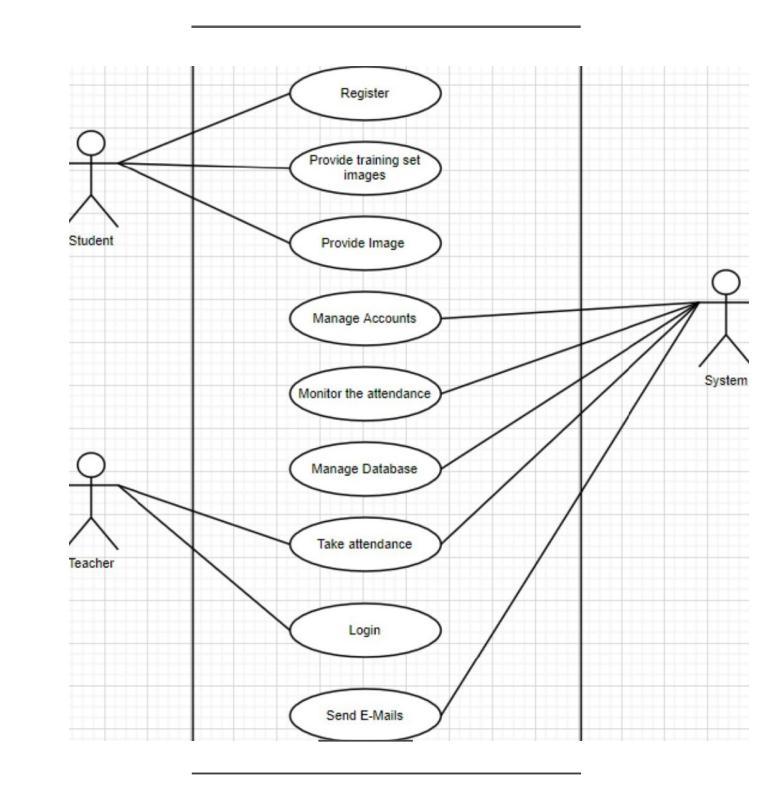
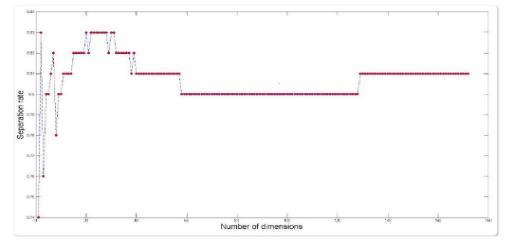
confined to his own computer. 3D mapping techniques have been employed. 2D Face recognition is not possible with this software. Creating digital 3D models of objects within a machine, like a computer, and then manipulating themodelforanyoneofanumberofdifferentpurposesis thegoalof3DMachineVisiontechnology.
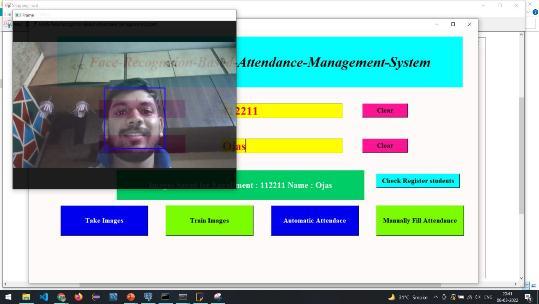
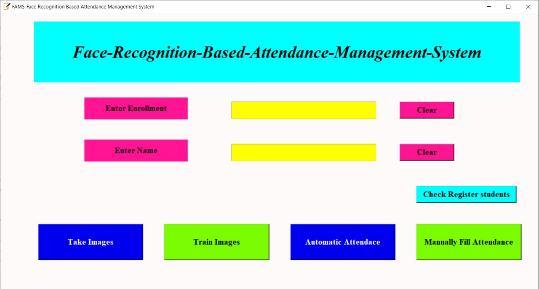
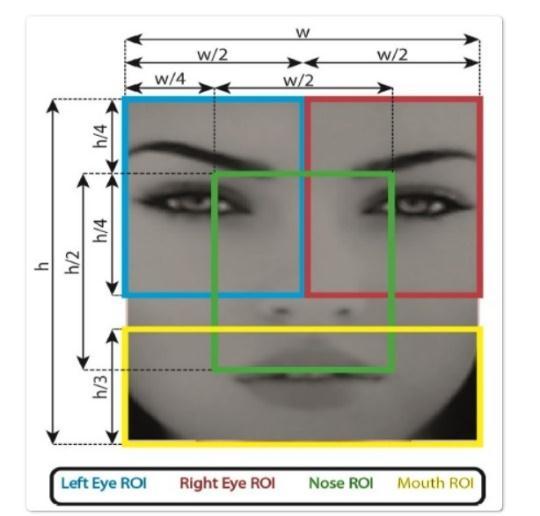
We'vedesignedanautomatedattendance trackingsystem that uses face recognition to verify its accuracy. The frontal image of the students is captured by a camera situated at a distance from the school's main entrance. Step3:Findoutwhatitlookslike.Itisalwaysbeneficialto use a face detection algorithm that is accurate and efficient. Algorithms called classifiers are used to identify whether an image contains a face or not. Face detection classifiers have been trained on tens of thousands to tens ofmillionsofimagestoimprovetheirprecision.
5. CONCLUSION
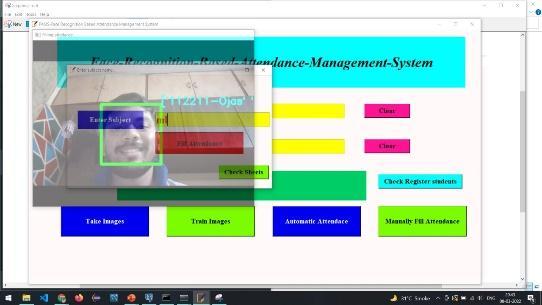
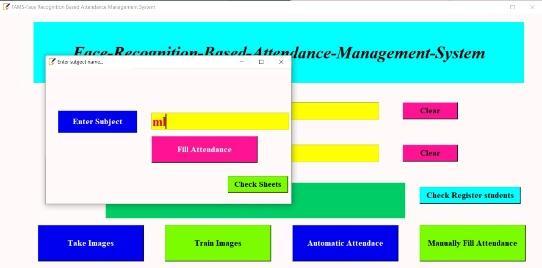
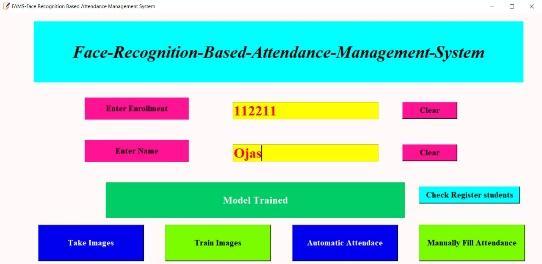
Deepfacialrecognitiontechniqueswereemployedhereto addresstheissue offaceattendancechecking.Thesystem has a user friendly interface that is accessible to both teachers and students. It is more efficient and less time consumingthanthemoretraditionalmethodsofrecording attendance. Despitethelow resolution webcamontypical laptops,theapplicationperformsaccuratelyonourprivate dataset. We can see from this that our underlying algorithm is effective in dealing with the problem of low qualityinputdata input.Ourgoalistoexpandourdataset so that it is asymptotically related to real world applications in the near future. The algorithm's ability to distinguishfeaturedistributionsofoutputclasseswillalso be improved by considering additional algorithms. The project's accuracy and security could be improved in the futurewiththeadditionofirisscannersoftware.Basedon real time usage and scale, database changes can be made inreal time. Insteadofa laptop,thesystemcan berun on RaspberryPi compatiblehardware.
6.REFERENCES
1. Pedersoli, and L. Van Gool, "Face detection without bellsand whistles", EuropeanConference onComputerVision,pp.720 735,2014.9
2. J. Yan, Z. Lei, L. Wen, and S. Li, "The fastest deformablepartmodelforobjectdetection'',IEEE Conference on Computer Vision and Pattern Recognition,pp.2497 2504,2014.
3. X. P. Burgos Artizzu, P. Perona, and P. Dollar, "Robust face landmark estimation under occlusion'', IEEE International Conference on ComputerVision,pp.1513 1520,2013.
4. X.Cao,Y.Wei,F.Wen,andJ.Sun,''Facealignment by explicit shape regression'', International Journal of Computer Vision, vol 107, no. 2, pp. 177 190,2012.
5. T. Barbu, "Gabor filter based face recognition techniquet", http://www. acad.ro/sectii2002/proceedings/doc2010 3/12 Barbu.pdf,2008.
6. Opencv library, Haar Like Cascade, https://docs.opencv.org/3.4.1/d7/ d8b/tutorial pyfacedetection.html
7. Casasent, David P. "Experiments with two industrial problems using texture classification based on feature distributions." Proc Spie 2354(1994).
8. P. N. Belhumeur, J. P. Hespanha, and D. J. Kriegman. Eigenfaces vs. fisherfaces: recognition using class specific linear projection. IEEE Transactions on Pattern Analysis and Machine Intelligence,19(7):711 720,Jul1997
9. Ahonen, T, A. Hadid, and M. Pietikäinen. "Face descriptionwithlocalbinarypatterns:application tofacerecognition."IEEETransactionsonPattern Analysis & Machine Intelligence 28.12(2006):2037 2041
10. Takeo Kanade. Computer recognition of human faces,volume47.Birkh¨auserBasel,1977.