International Research Journal of Engineering and Technology (IRJET)

Volume: 09 Issue: 04 | Apr 2022 www.irjet.net

International Research Journal of Engineering and Technology (IRJET)
Volume: 09 Issue: 04 | Apr 2022 www.irjet.net
Afziya Waknis1, Shubham Yadav2, Tejashree Bahikar3
e ISSN:2395 0056
p ISSN:2395 0072
1Electronics and Electrical Engineering, New Horizon Institute of Technology and Management, Thane, India. 2,3 University of Mumbai, Mahatma Gandhi Road, Kala Ghoda Fort Mumbai, Maharashtra 400032, India.
***
Abstract This paper describes the development of a system to monitor sound decibels in the environment as well as enable real time data visualization using an interface through Node MCU and multiple devices. A sound sensor is used for the measurement of sound intensity. The best kind of transducer for sound level meter is condenser microphone, which combines precision with reliability. The diaphragm of the sensor responds to changes in air strain brought on through sound waves. That is why the instrument is sometimes referred to as a sound pressure level meter.
Sound level meters are generally used in noise air pollution research for the quantification of extraordinary sorts of noise, particularly for industrial environmental, mining and plane noise. We are making a system which measures the sound intensity and shows the real time data on cloud graph as well as on the notice board along with it we can display the required message on the notice board through the app on the cellphone through any desired location. This will help in controlling and monitoring the noise factor mainly in industrial areas. The components used in this system are Node MCU, sound sensor, LCD display along with I2C module, connecting wires, PCB/breadboard.
Key Words: Sound sensor, noise monitoring , decibel values , NodeMCU,LCD display.
In general, a sound level metre is used to measure the intensity of the surrounding sound. Condenser microphones combine precision with stability and reliability,makingthemidealforusewithadecibelmetre.
Because the diaphragm of the microphone responds to changes in air pressure caused by sound waves, this device is also known as an SPL (Sound Pressure Level) Meter.
Decibel metres are commonly used in studies to identify various types of noise pollution, particularly industrial, environmental, mining, and aircraft noise. This do it yourself project is useful for measuring loudness in decibels(dB)
In this IoT project, we will create a simple Decibel Meter with an ESP8266 and a Sound Sensor. We will also use a
small 0.96" I2C OLED Display to visualise the noise intensity locally. The Sound Sensor will detect sound and convert it into an analogue signal that the Nodemcu ESP8266 will read. The Node MCU then connects to the WiFi network and uploads the data to the Arduino IoT Cloud. As a result, you can monitor those parameters remotelyfromanywhereintheworld.
The entire system can be divided into three parts: hardware (Nodedevices), database, and webapp. Figure 1 showsablockdiagramofthesystemoverview.





The ADC will obtain an analogue reading from the microphone.Afterthesignalhasbeenprocessed,itissent to the NodeMCU, which uses Wi Fi to send the processed data
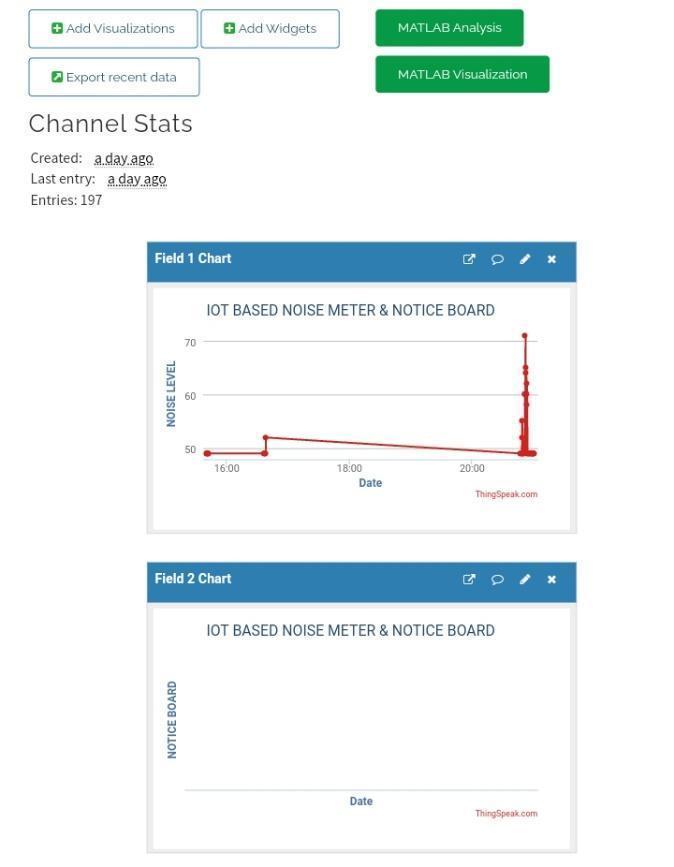
to the database, ThingSpeak, via the internet[9]. ThingSpeak is essentially a database that handles real time data memory and serving. The webapp then pulls real timedataanddisplaysitintheformofagraphinthe Thingspeakfieldchannel.
In this project, we are using a sound sensor module. This sensor consists of an in built capacitive microphone, which uses the vibration and converts it into current or
© 2022, IRJET | Impact Factor value: 7.529 | ISO 9001:2008 Certified Journal | Page 2387
Research Journal of Engineering and Technology (IRJET)
Volume: 09 Issue: 04 | Apr 2022 www.irjet.net
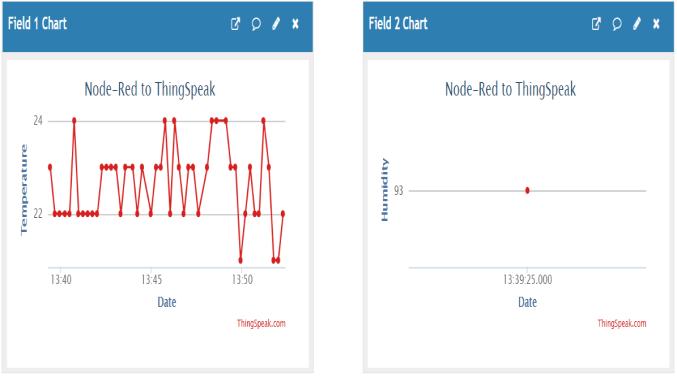
voltage signals. This sensor is further connected to the Node MCUESP8266 .ThisESP8266 actsa theheart of the system. It sends the data to LCD display via I2C module where serial communication can take place. Also it sends the real time data to the IoT cloud database at the specified location.So, basically the transducer i.e. the sound sensor detects the noise in 3 different levels assigned such as low , moderate, high .When the code in loaded in node MCU it will connect to the wifi. Once the wifi is connected the lcd display will start displaying the decibel values of the amount of noise detected by the sound sensor. The decibel values changes according to noise detected by sensor. Also when the noise is at low level green LEDturns ON, whenthe noiselevel increases and goes to moderate level the green LED turns OFF and the yellow LED turns ON , as soon as the noise level reaches the highest level the yellow LED turns OFF and red LED turns ON along with the buzzer alarm. Also we have access to display the required message on the LCD display through the app in our phones.The real time data will be shown in the cloud data channel through a field graph. Also we can download the records in the excel sheet of the recorded decibel values .Also we have made anapp which will beconnected to the displayso that any specifiedmessagecanbedisplayedonitbytheauthority.
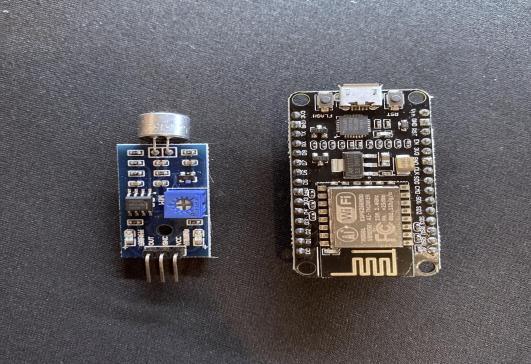
Each node device is made up ofa loudness/sound sensor, and a NodeMCU (ESP8266) module, all powered by a single 5V smartphone DC wall adapter or a smartphone powerbank.Figure2depictsoneofthethreenode device prototypescreatedforthisproject.
Sound Sensor: The Sound Sensor detects the intensity of the environment's sound and feeds it to the Arduino's ADC. The module's main component is a simple microphonebasedontheLM386amplifierandanelectret microphone. This module is a three pin sensor with power, ground, and an analogue output that can be easily interfacedandsampledbyamicrocontroller.
2022,
e ISSN:2395 0056
p ISSN:2395 0072
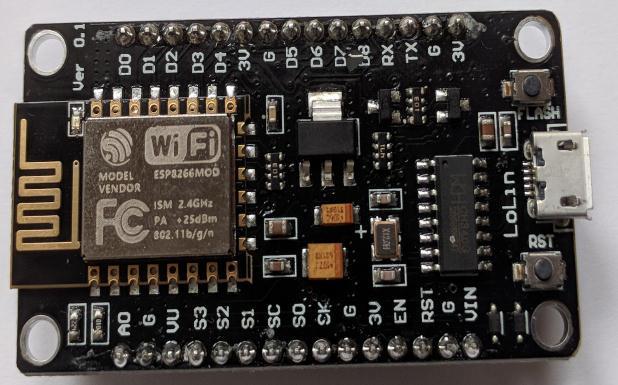
NodeMCU (ESP8266): This is the node device's brain. It serves as an IoT platform. It's a Wi Fi module with esp8266 firmware.Ituploadsprocessedsensor data from the Arduino to the database. The ESP8266 Open source Community created this board. It operates on the NodeMCU operating system, which is based on the LUA scriptinglanguage. TheprocessorisanESP8266(LX106). It has 128 Kbytes of internal memory and a storage capacity of 4 Mbytes. With a physical size of 49 x 24.5 x 13mm and a USB port for connecting to a computer, this chip consumes approximately 0.00026W0.56W of power. Having met all of the criteria, this chip is currently the most advanced hardware available and represents the future of IoT. This device is programmed using the Arduino wrapper/interpreter library, which allows programminginC++.
Factor value:
|
LCD with I2C module:GND is a ground pin and should be connectedtothegroundofNodeMCU.VCCsuppliespower tothe moduleandtheLCD.Connectittothe5Voutput of the NodeMCU or a separate power supply. SDA is a Serial Data pin. This line is used for both transmit and receive. SCLisaSerialClockpin.Thisisatimingsignalsuppliedby theBusMasterdevice.
9001:2008
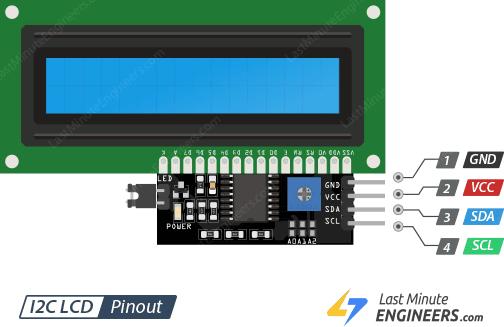 Fig -3PinsshownofNodeMCU
Fig 4LCDdisplaywithI2Cmodule
Fig -3PinsshownofNodeMCU
Fig 4LCDdisplaywithI2Cmodule
This app is being used to send the message/notice over thedisplayforemergencypurposes.
Using a web browser and either a connected phone or an emulator,AppInventorallowsyoutocreateAndroidapps. The App Inventor servers maintain track of your projects andstoreyourwork.
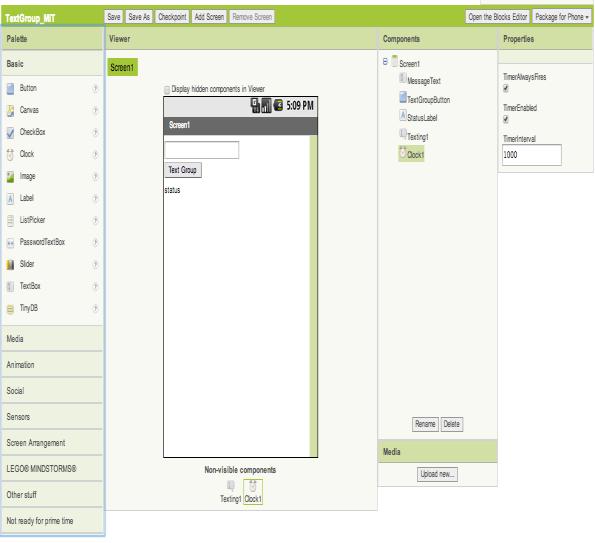
MIT App Inventor is a web based platform that uses mobile app creation to teach computational thinking topics. Students build apps by dragging and dropping components within a design view and programming application behaviour with a visual blocks language. In this chapter, we look at (1) the history of MIT App Inventor's development, (2) the project's project objectivesandhowtheyinfluencethesystem'sdesign,and (3) the procedures MIT utilises to develop the platform and how they are influenced by computational thinking literature. The benefits of quick, iterative design on learning include using components as abstractions, aligning blocks with student mental models, and using componentsasabstractions
ThingSpeak is an open source Ruby software that allows userstocommunicatewithinternet connecteddevices.[2] Itsimplifiesdataaccess,retrieval,andloggingbyexposing an API to both devices and social network websites. ThingSpeak was originally launched in 2010 by ioBridge asaservicetosupportIoTapplications.[3]
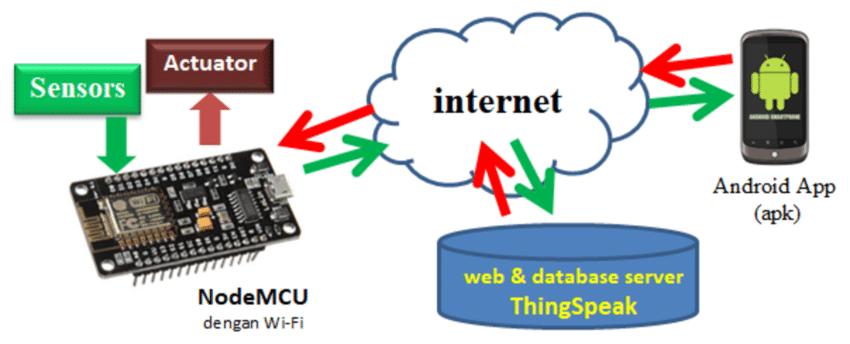
ThingSpeak has integrated support from MathWorks' numerical computing software MATLAB,[4] allowing ThingSpeak users to analyse and visualise uploaded data usingMATLABwithouttheneedtopurchaseaMathWorks MATLABlicence.
ISSN:2395
Fig
Fig
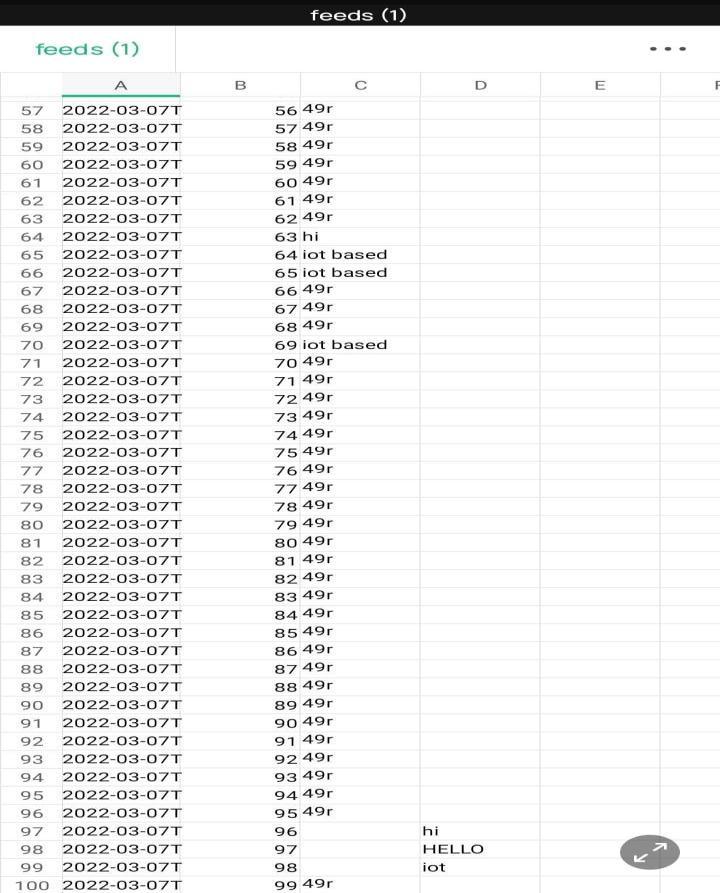
:Realtimemonitoringofdecibelvaluesshownin exceldatafile
NoisepollutionhasbecomeoneofIndia'smostimportant problems, affecting inhabitants' strength. As a result, the framework should be designed to significantly reduce the degree of noise, and adjustments should be made as needed. One method for IoT based noise pollution monitoringispresentedinthisstudy.
The clamour contamination checking framework utilises an Arduino regulator to record and measure data, as well as a sound sensor to detect a considerable amount of clamour. This approach can also be used to check for commotion pollution in modern zones and urban settlements. The use of this model can provide a cost effective and low effort solution for monitoring natural noiseonacontinuousbasis.
This compact system has a small scale as well as large scale applications. Major use of it can be in the industrial sector as noise pollution is the main issue in industries nowadays. It can also be used in educational institutes to monitor noise in libraries and classrooms. Can be used in traffic areas to monitor noise pollution in theenvironment.ThisdeviceismainlyusingNodeMCUfor
Technology (IRJET)
e ISSN:2395 0056
ISSN:2395 0072
sending and showing the data on website for keeping a pastrecordofthechangesinnoisedecibels.Aswell aswe can get a real time graph using IoT using the interface. Implementation of this device will give a cost effective and well systemized solution for keeping a track on environmental noise at real time monitoring.
[1] Botteldooren D., De Coensel B., Oldoni D., Van RenterghemT.,DauweS.Soundmonitoringnetworksnew style. Breaking New Ground: Annual Conference of the AustralianAcousticalSociety,2011
[2] Velásquez P., Vásquez L., Correa C., Rivera D. A low cost IoT based environmental monitoring system. A citizen approach to pollution awareness. Conference on Electrical, Electronics Engineering, Information and CommunicationTechnologies,2017.
[3] Kalengkongan, T. S, Dringhuzen J. Mamahit, SherwinRUASompie,2018.DesignofArduinoUno Based Noise Detection Tool, Journal of Electrical and Computer EngineeringVol:7(2)183 186.
[4] Dhole,R.N.,Undre, V.S.,Pawale,S.:Arduinobased noise detection and image capturing using MATLAB. In: National Conferences in Computing, Networking and Security,pp.143 146(2013)
[5] Roseline,R.A.,Devapriya,M.,Sumanthi,P.:Pollution monitoringusingsensorsandwirelesssensornetworks:a survey. Int. J. Appl. Innov. Eng. Manag. 2(7), 119 124 (2013)
[6] Abdur Rahim, M., Arafatur Rahman, M., Rahman M.M., et al.: Evolution of IoT enabled connectivity and applications in automotive industry: a review. Veh. Commun. 100285 (2020).https://doi.org/10.1016/j.vehcom.2020.100285
[7] T.K.GannavaramV,R.Bejgam,S.B.Keshipeddi,S. Sunkari and V. K. Aluvala, "Conversion of Sound Energy into Electrical Energy in Highly Populated Areas," 2021 6th International Conference on Communication and Electronics Systems (ICCES), 2021, pp. 32 36, doi: 10.1109/ICCES51350.2021.9489219
[8] E. Murphy and E. A. King, ‘‘Principles of environmental noise,’’ in Environmental Noise Pollution. Amsterdam,TheNetherlands:Elsevier,2014,pp.
Research Journal of Engineering and Technology (IRJET)
Volume: 09 Issue: 04 | Apr 2022 www.irjet.net
Afziya Waknis, B.E. in Electrical andElectronicsEngineering from New horizon institute of technology and management Thane.1st classdistinction passin diploma from VPM’s Polytechnic Thane in the field of industrial electronics.

Shubham Yadav , B.E. in Electrical and Electronics Engineering from New horizon institute of technology and managementThane.1st classfrom PravinPatilcollegeofdiploma.
Tejashree Bahikar, Total6years experience as a Assistant Professor in BE & Diploma College, ME 1st class from MatoshricollegeofEngineering& Research Center; Pune university & 1st class B.E. from S.V.I.T. Chincholi;PuneUniversity


9001:2008



e ISSN:2395 0056
p ISSN:2395 0072