Tanu Rizvi1, S. P.Dubey2, Nagendra Tripathi3
1. INTRODUCTION
3Professor, Department of Electrical Engineering, Bhilai Institute of Technology, Durg, Chhattisgarh, India. *** Abstract-This paper aims to focus upon the applications of renewable energy sources in industries. Till current scenario not much attention is diverted towards their potential for industrial applications. Researchers have shown that up till 2050 majority of processing will be done by harnessing renewable energy sources. They are likely to provide nearly 50% share at favorable cost as compared to other sources till 2050.Solar energy sources will be emerging as a dominant source above all renewable due to their compatibility with all kind of systems. In this paper a detailed review for technological updation to explore the potential of renewable energy sources in industries has been proposed and the key findings and methods needed to be elaborated for such frameworks has been discussed.
Key Words Renewable Energy, Industry, Solar, Wind,Biomass.
Assistant Profesor, Department of Electrical Engineering, Shri Shankaracharya Technical Campus, Bhilai, Chhattisgarh, India.
Reconceptualizing the Application of Renewable Energy Sources in Industry: A Review
2Vice Chancellor, ICFAI University, Raipur, Chhattisgarh, India.
Industries today are intensive in energy. This industries uses a chain of various chemical, electrical and mechanical complex processes, moreover they all includes high temperature and pressure requirement which should be continuous in nature. For the same, the supply of energy should be intermittent. The cost ofenergyisaseriousoffenceintheseindustrieswhich can take over the overall cost therefore the energy system to be used should be highly compatible and stable with overall working conditions[3]. Indian government has now started imposing penalties on industries regarding various pollution issues which is again a important factor to consider and also it requires additional investments for various pollutant emission control processes such as carbon capture, sequestration etc. This pressure to diversify supply energysourcesforindustriesisovercomebyincluding the imminent and inevitable renewable sources of energy[1]. Their advantages include inexhaustible sources,nonpolluting,lowoperationandmaintenance cost, no refueling cost, employment to rural areas etc as well as they have many cons too such as their output is site specific with varying speed of wind and solar irradiance, high installation cost etc. A systematic operation methodology is required to successfullyframetherenewablesourcesinindustries since industries are based on heavy equipments of large scale and also their demand is of large volume. Firstly,onestraightforwardwayistoemploythemat certain part only so that it matches the demand of a particular section and the whole system won’t get hampered. Secondly they can be remotely operated aroundplantsorcanbetransferredbywayofexternal energysuppliers[2].Iftheentiredemandsidecan’tbe met then it should be designed to meet some specific area of plant. All the above statement should be justified with systematic investment evaluation. However the history of large scale employment of renewable in industries is very short and thus there seems a clear gap betweenthe two. To bridge the gap between renewable and industries some novel framework are discussed here in this article which includes various techniques for employability of renewableenergysourcesinindustries.
2. METHODOLOGY
1
This section deals with methodologies adopted by various author to integrate renewable or Hybrid renewable energy sources (HRES) with industries. we have quoted two examples and have reviewed many others too. The author presents a detailed development to explore the use of renewable in industry. The author investigates a simulation framework and has computed capacity of hybrid renewable energy sources such as solar, wind power, diesel and batteries. Here the matching of actual supply and demand side supply has been involved to emerge as a new system. A total of eight frameworks have been proposed here to evaluate the applicability of renewable with industries[3]. It is technically possible to shift half of industrial demand to renewable in which the dominating source will be
International Research Journal of Engineering and Technology (IRJET) e-ISSN: 2395-0056 Volume: 09 Issue: 01 | Jan 2022 www.irjet.net p-ISSN: 2395-0072 © 2022, IRJET | Impact Factor value: 7.529 | ISO 9001:2008 Certified Journal | Page514

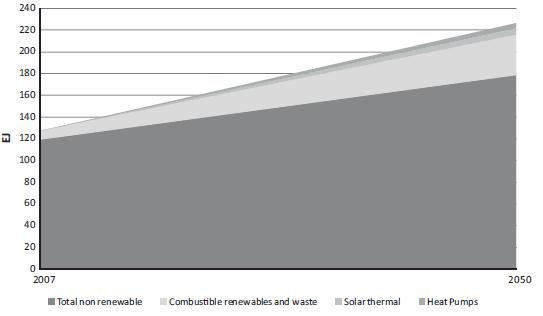
Table 3 shows the total consumption of final energy and the dominance of biomass and solar energyinindustriesuptill2050
industries.SolarincludingthatBiomasswithashareof75%.Fig.1showsthepotentialcanbeharnessedfromrenewableby2050finalenergyandfeedstockasdonebyUNIDOapplicationsarealsoasecondlargeoptionforFromthetotalenergyuseinmanufacturing
reductions of GHG in industrial sector. The pattern of consumption can be summarized approximately and Table 1 shows the same pattern from 2006 to 2030 estimatedgloballywhereastheuseofvariousformsof energy in industrial sector for developing and developedcountriesissummarizedandcategorizedas per their recent upliftments towards industrial applications.
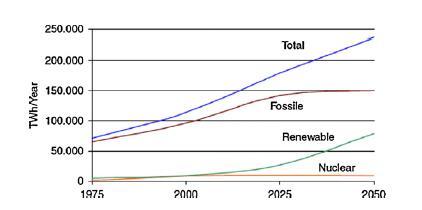
Table 2 shows the energy used in industrial sector currently. According to the researchers the global energy consumption will raise upto75,000TWhtill2050asshowninFig.2whereas Table 3shows Key Findings with various renewable options for industrial applications.
Table-1:consumptionEstimatedGlobalindustrialenergyfuelpatternfrom2006to2030
industries 21% will be contributed by renewable up till 2050 which accounts a potential of 50 Exajoules/year of energy. The use of direct and indirectrenewableenergywilladdupto10%till2050 whichisabout25%oftotalenergygeneration.
Fig 2:Global Energy Consumption
Table-3:- PotentialinBiomass&Solarenergyforindustrialapplications.
Fig-1: Renewable Potential in Industry by 2050, Final Energy & Feedstock. (UNIDO Analysis)
Table-2:- EstimatedGlobalindustrialenergy Similarly,anotherauthorestimatedtherenewable for a load such as a cement plant. A load of a cement technology institute is selected and comparedwithanexistingsystemandasystemis IndustrialSector EnergyFinal (2050)Biomass (2050)Solar Chemical Petrochemical& 40.6 22 0 Construction 2.5 6 0 Food&Tobacco 10 9 26 Iron&Steel 30.5 2 0 Machinery 7.2 0 16 Minning&Quarrying 4.1 0 20 NonMetallicMinerals 17.1 29 0 Paper,Pulp&Printing 11.9 54 0 Textile&Leather 3.6 3 14 TransportEquipment 2.3 0 14 Wood&WoodProduct 3.5 67 0 Feedstocks 49.8 14 0 NonSpecified 32.5 18 0 Total 226.2 16 2 Sources of Energy 2006 2030 Liquid 34.6 28.6 NaturalGas 24.1 25.6 Coal 24.8 24.3 Electricity 14.9 19.7 Renewable 1.5 1.8 Country Industrial Sector Energy Use (%) China 70 Malaysia 48 Turkey 35 USA 33 India 38.5 International Research Journal of Engineering and Technology (IRJET) e-ISSN: 2395-0056 Volume: 09 Issue: 01 | Jan 2022 www.irjet.net p-ISSN: 2395-0072 © 2022, IRJET | Impact Factor value: 7.529 | ISO 9001:2008 Certified Journal | Page515
Step 3- Uses the model to run various “what if” scenarios to calculate energy savings associated someTowithidentifiedenergyconservationmeasures.implementvariousindustrialpowersystemssoftwareareusedforbriefanalysis:
The economy of any country depends upon its industrial growth and these industries can’t rely completely on renewable energy sources due to excessdemand;alsotheglobalwarmingsituations together with energy crisis can be overcome experimenting other options with industries. Therefore the researchers have preferably suggested upgrading the systems with grid. Large PV systems, wind, biomass, small hydro can be integrated for system competency and growing energy crisis owing to consumption of fossil fuels in coming years. The operating cost and maintenancecostislowwiththerenewableandis a long time and single time investment. On the otherhandindustriespersonnelarealsowillingto pay a low and reliable per unit cost for their processes and production. Other techniques like a solartrackingsystem,commerciallyandlowcutin speedwindturbinesetc.canalsobeemployedfor enhancing the industrial system with overall low carbon products emissions and for saving the penaltiesimposedbygovernments.
Step 1 Collects data at the site enough to fully definethebuildingandenergyconsumingfeatures o Inputs that are unknown should be highlighted andusedascalibrationparameters
International Research Journal of Engineering and Technology (IRJET) e-ISSN: 2395-0056 Volume: 09 Issue: 01 | Jan 2022 www.irjet.net p-ISSN: 2395-0072 © 2022, IRJET | Impact Factor value: 7.529 | ISO 9001:2008 Certified Journal | Page516
HOMER Hybrid optimization of multiple electric renewable (HOMER) software simulates favorable optimization cases in many of research. A Grid system together with renewable can be easily simulated using this software developed by National Renewable Energy Laboratory (NREL), US. For designing any system the temperature resources, wind power etc data for location is extracted from solar energy database, national solar mission by Indian government for Indian specific origins and from National Aeronautics & SpaceAdministration(NASA)surfacemeteorology datacentre. SAM-System Advisor Model (SAM) can be other optionformodelingpowersystemofanyindustry. It provides a techno economic modeling which facilitatesdecisionmaking.PVsystemsfromsmall to large scale integration, concentrating solar power system including MPPT system, industrial process heat, wind power, tidal systems, biomass etccanbemodeledusingSAM.
proposedsoastofindthemostfeasiblesystemto improve reliability and lower emissions with coal saving.Theexistingsystemisagridsupplysystem whereas the proposed method is a PV bio diesel hybrid energy system. The proposed system comprising 25kW PV array, 28kW bio diesel generator, 10kW inverter and 10kW rectifier suppliespowertothecementtechnologyinstitute. It saves 55.080kg of coal and preserves the atmospherefromadditionof27.744tonesofyear. The proposed system also improves reliability from 93.18%to 100%. [10]Various researchers have investigated the employment of renewable energysourcesforindustrialapplications,someof whicharesummarizedinTable4.
Step 2 Fillsoutthemodelandrunthesimulation
Opportunity exists for project to utilize energy modeling software to help evaluate design decisions in terms of life cycle cost impacts in order to maximize performance. Building energy performance is a function of numerous, interdependentinternalandexternalfactors, such as material selection, mechanical and electrical systems, solar orientation, climate, and occupant usage. Modification of various design components canproducecomplexinteractionsthataredifficult to analyze in isolation. For that only the energy simulation softwares provide tools for evaluating energy impacts across dynamic interrelated systems. These are the overall steps followed to createanenergymodel
3. CONCLUSIONS & FUTURE SCOPE
2.1 Modeling Softwares
Chain Monte distribution.distributionthatonprobabilityalgorithmsCarlo(MCMC)methoddenotingforsamplingfromadistributionbasedconstructingaMarkovchainhasthedesiredasitsequilibrium Source7 S.P.Makhijaetal.2016 Feasibility analysis of distributed solar penetrationelectricity in plantsmanufacturingcement To find most feasible system for cementmanufacturingplant. Syatem designed to reduced pollutant emissions considerably by 23% with slight Increase in NPC and COE by productionwithsystem3.075%and0.6436%,respectively.Thesaves7,09,139kgcoalperyear0.6437%increaseincementcost
The results show that diesel price systemincremeincreasesbeyondenergy.presentaffectincrementfrom$1.01to$1.09doesnotoptimalsystemsizebutonlynetcostandlevelisedcostofWhendieselpriceincreases$1.09,theoptimalsystemsizeresultingincapitalcostnt.Itattainsanewoptimalsizeatadieselpriceof$1.13.
Hybrid
Designed optimal sized system for the areas showing diesel pricehikes. Source9 MuhammadBilaletal.2016 EnergyWheelingHybridSystem for Industries consideration.Pakistan.GadoonconnectedwheelingFindingalowcostsystemfor36MWgridhybridsystemsforindustrialloadinFivecasesunder System with 66% renewable fraction is derived also advantageous in long run by decreasing grid consumption to 33.98% with lowestCOEascomparedwithexistingsystemAgrid system with solar PV, industrialtowindandhydalsystemsisusedovercomeenergycrisisinsector. International Research Journal of Engineering and Technology (IRJET) e-ISSN: 2395-0056 Volume: 09 Issue: 01 | Jan 2022 www.irjet.net p-ISSN: 2395-0072 © 2022, IRJET | Impact Factor value: 7.529 | ISO 9001:2008 Certified Journal | Page517
withreducewhichgridPVDesignedasysteminwhichpowerfromwillbeavailableduringdaytimeandpowerwillbeutilizedatnighttimecanhelptothegriddemandbyindustriesabackupfromdieselgenerator. oversystemDesignedalowcarbonemissionwithalowcostsystemitslifespan. Source6 RyuJunHyungetal. 2016 RenewableEmployingPreparationApproachSimulationTechnoeconomicinofEnergies for
Source5 S. M. SiddiqueeShahnewazetal.2015 Optimized Hybrid Renewable Energy ElectrificationEfficientSystemForIndustrial Analysis
Source4 R.P.Martinsetal.2015 Renewable Energy Sources Insertionin Timbera Industry CaseStudy A PV/wind/grid following distributed generation concept for
Source8 MakhijaPrakashSatyaetal.2016 Optimally
hybrid
industrialAtotalofeightconfigurationsisproposedforimplementation.ITuses
Table-4 SummaryofRenewablesforIndustrialApplications S. No. Authors Year Title Proposed Method Findings Uniqueness Source1 TaibiEmanueleetal. 2012 renewableThepotentialforenergy in industrialapplications AnalysisofpotentialforRenewableinindustries. If the renewable shares are 50% then definitely the share of direct and indirectrenewableenergyuserise. Method to contribute about 10 % GHG emission reduction in industries. Source2 etRMekhilefal. 2012 A review on solar energy use in industries Integration of solar energy systemsinindustry. Solar PV systems are feasible for industries whose overall efficiency can be improved by proper system integration and design of solar collectors. System comprises many other andmodulecosts,andtechnicalvariablessuchasweartear,initialandrunningeconomicincentives,PVdiminishingpricerateoilpriceraisesetc. Source3 Md.MehediHasanetal.2015 Efficient Hybrid Renewable Energy withIndustrialSystemforSectorOnGrid Time Management area,systemgenerator,coenergyAnalysisofhybridrenewablesourcestogetherwithproductionofdieselsolarPVandgridinTongiindustrialBangladesh.
Grid pressure is reduced by implementing on grid solar diesel hybridsysteminindustry. Proposed combination of energy system for compensating regular grid failure and minimizing electricity demand ’s pressure thus minimizing system life cyclecost. economic viabilityinatimberindustry. Case studies to facilate application of renewableenergyinindustries. Renewable sources in timber industrialapplications. of the PV based energy system in Chittagong, the industrial capital of Bangladesh with the existing system containing diesel set and grid. ProcessIndustry A simulation framework to analyze the application of multiple energy sources (solar, wind and diesel batteries) for process industry. Markov Distributed generation system without battery and with renewable to analyze NPC, LCOE,emissions. sized hybrid energy auxiliariessystemfor of a manufacturingcement unit dieselwith fuel price sensitivityanalysis system containing solar PV, wind,batteries and Chhattisgarh,inmanufacturingloadadieselforrunningauxiliaryofacementunitlocatedDurgdistrictofIndia.
[2.] S. Mekhilefa, R. Saidur, and A. Safari, “A Review on SolarEnergyuseinIndustries,”2011, Elsevier,Renewable andSustainableEnergyReviews,15: 1777 1790.
BIOGRAPHIES
[1.] J. P. Paskaetal, “Hybrid power systems An effective wayofutilizingprimaryenergysources”,2009,Renewable Energy,Vol.34,pp.2414 2421.
REFERENCES
Tanu Rizvi hasdoneherB.EinEEEin 2008 from SSTC (Pt. R.S.S.U) followed by M.Tech (PSE) in 2012(CSVTU). She bagged 2nd position in University Toppers List in her graduation followed by honors in M.Tech. Presently she is pursuing her PhD in EEfromCSVTU,Bhilai.SheisWorking as Assistant Professor in EE Dept., SSTC, Bhilaifrom 2008 onwardsto till tutorialdate.SheisalsocoordinatorofspokenIITBombay.
Dr. Nagendra Tripathi has done his
Machines,includesmonthsteachingEngineering,Professor2015.andEngineeringInstrumyear1998B.TechinElectricalfromBIT,DurgrinfollowedbyM.Techinentation&ControlfromBIT,Durgin2008PhDfromC.V.RamanUniversityinPresentlyheisworkingasaindepartmentofElectricalBIT,Durgwithatotalexperienceof20yearsand7tilldate.HisresearchareaRenewableEnergy,ElectricalDigitalElectronicsetc. International Research Journal of Engineering and Technology (IRJET) e-ISSN: 2395-0056 Volume: 09 Issue: 01 | Jan 2022 www.irjet.net p-ISSN: 2395-0072 © 2022, IRJET | Impact Factor value: 7.529 | ISO 9001:2008 Certified Journal | Page518
[13]A. B.Awan.”Performance Analysis and Optimization of A Hybrid Renewable Energy System for Sustainable.”2018,NEOM City in Saudi Arabia, Journal of RenewableSustainableEnergy11(2):11 17. [14]J.D.Navamani,A.Lavanya,C.M.PrahadheeshwarandS. M. Riyazudeen.” Hybrid Power System Design Using Homer Pro.”2019, International Journal of Recent TechnologyandEngineering,8(IS4):605 609. [15]T. Rizvi, N. Tripathi and S. P. Dubey.”Feasibility Analysisofa GridIntegratedRenewableEnergySystemin HeavyIndustries.”2020, Journal ofAdvanceResearch and DynamicsinControlSystems,12(6):2289 2302.
timeauthoredFundedBasedInverters,PowerincludesBhilaiR&DProfessor&Head,EEDeptandasDeanfrom2012onwardsinRCETtotilldate.HisresearchareaRenewableEnergyandalsoElectronicsConverters,Powerqualityissuesetc.uponhisinteresthebagged7Projects,3Patentsand2BookChapters.HeislifefellowmemberinIETE&IEEE.
Dr. S.P. Dubey has done his B.Tech in Electrical from GEC Raipur in Year1995 followed by M. Tech from IIT Roorkee in 2000 and PhD from BITS Pilani in 2006. He served as AssistantProfessorfor7yearsinBITS Pilaniandthen3yearsinIITRoorkee. From 2010 onwards he is serving as
[3.] E. Taibia, D. Gielenb and M. Bazilianc, “The Potential For Renewable Energy in Industrial Applications Renewable and Sustainable Energy Reviews,”2012, Elsevier, Renewable and Sustainable Energy Reviews, Sci verseSciencedirect,16:735 744.
[4.] Md. M. Hasan, A. A. Tanvir, S.M.S Siddiquee and A. Zubair , “Efficient Hybrid Renewable Energy System for Industrial Sector with On Grid Time Management,”2015, Green Energy and Technology, 3rd International [5Conference.]S.M.ShahnewazSiddiquee,Md.S.Alam,Md.K.Islam, Mortuza, H. Reza and M. Al Arafat , “Optimized Hybrid Renewable Energy System for Efficient Industrial Electrification,”2015, IEEE 2nd International Conference on Electrical Engineering and Information & CommunicationTechnology,Dhaka,Bangladesh:1 5. [6.] M. Bilal, Rizwan Ullah, A. Ali, M. Hilal Khan, and Z. Ullah,“Wheeling Hybrid Energy System for Industries”,2015 IEEE International Conference on Computing, Electronic and Electrical Engineering, Quetta, Pakistan,:169 174. [7.] R.P. Martins, A.M. Schetinger, B.M. Biaz, M.Z. Fortes, B.S.M.C Borba and D.H.N. Dias and M. C. Borba , “Renewable Energy Sources Insertion in A Timber Industry CaseStudy,”2016,IEEECHILEANconferenceon Electrical, Electronics Engineering, Information and CommunicationTechnology,Santiago,Chile.555 560. [8.] J. H. Ryu, S. B. Lee and B.M. Hodge and I.B. Lee ,”Techno EmployingEconomicSimulationApproachinPreparationofRenewableEnergiesforProcess Industry,”2016, IEEE 43rd Conference on Photovoltaic Specialist,Portland,OR,USA,1862 1864. [9.] S.P. Makhija and S. P. Dubey, “Optimally Sized Hybrid EnergySystemforAuxiliariesofACementManufacturing Unit with Diesel Fuel Price Sensitivity Analysis,”2016, [101Taylor&Francis,InternationalJournalofAmbientEnergy,6..] S.P. Makhija and S. P. Dubey, “Feasibility analysis of distributed solar electricity penetration in cement manufacturing plants,”2017, Taylor & Francis, [11]InternationalJournalofAmbientEnergyS.Ghose,A.E. Shahat and R. J. Haddad”Wind Solar Hybrid Power System Cost Analysisusing HOMER for Statesboro,Georgia.”2017, IEEE Conference, Concord, USA,1 3. [12.]Rohit Sen and Subhes C. Bhattacharyya.“Off grid Electricity Generation with Renewable Energy Technologies in India: An Application of HOMER.”2018, RenewableEnergy62:388 398.