not diagnosed because people with diabetes have no knowledge of the disease or have no symptoms; about a third of people with diabetes do not know their status. Diabetes causes serious long term damage to many organs and systems, including the kidneys, heart, nerves, blood vessels, and eyes, if not properly controlled. As a result, early detection of the disease allows vulnerable people to take preventive measurestoreducethecourseofthediseaseandimprove theirqualityoflife.
InYEAR:2020thispaper six ways to categorize machine learning were available was applied and the results were compared. The trained database was then processed taken online and offline questions with 18 different questions these are the algorithms used on the PIMA website. Forest Algorithm provided accuracy which was 94.10%whichwasthehighestamongotheralgorithms.
In2010,itwas projected that 285 million individuals globally had diabetes(6.4percentofadults).Thatnumberispredicted to climb to 552 million by 2030. Based on the present paceofdiseaseprogression,oneout of everytenpersons is anticipated to have diabetes by 2040. In South Korea, the prevalence of diabetes has risen substantially; according to current studies, 13.7 percent of all individuals have diabetes, and over a quarter have Diabetesprediabetes.isusually
AUTHORS:NehaPrernaTigga,ShrutiGarg ProcediaComputerScience,Volume167
Researchhasbeendoneinmanydifferentfields,including machine learning (ML) and artificial intelligence (AI), in order to reduce the effects of diabetes and improve the qualityofpatientcare.ManyresearchershaveshownML based methods of predicting the incidence of diabetes.
II. ALGORTHMS
Diabetes mellitus, commonly referred to as chronic illness, is a group of diseases caused by high blood sugar. If early predictions are met, the risk and severity of diabetes can be greatly reduced. Reliable and accurate diabetes is extremely difficult due to the small amount of labelled data and the presence of suppliers of non essential items other than the deficit in sugar based data sets. We have developed a strong diabetes prediction framework for this paper, which mainly includes external rejection, data suspension, feature selection, various Machine Learning (ML) categories, Decision Trees, Random Forest, SVM, code integration, and retrospective), and Multilayer Perceptron (MLP). In this study, weighted integration of a few ML models was also proposed to improve diabetes prognosis, where weights were calculated using the ML model corresponding to the Area Under ROC Curve (AUC), F1 score, accuracy, and memory based on report classification.
Using the Pima Indian Diabetes Dataset, all the studies in this book were conducted under the same screening settings
Current status (testing, diagnosis) and forecasting techniquesaretwotypesofthesestrategies.Currentdata classification is processed by current status recognition techniques; pre screening methods are concerned with the classification of future data models. The aim of this activity is to create a machine learning model (ML) that can predict the onset of type 2 diabetes (T2D) in the following year (Y + 1) using the values of the current year (Y). Predictability models classify data entry conditions as normal (non diabetic), prediabetes, or diabetes,dependingonthecondition.Theperformanceof thepredictivemodels,whichincludedobjectrotation(LR), support vector support (SVM), descending order and resolution tree algorithms, were compared. We also evaluated the effectiveness of integration strategies such asthevotingphase.
Diabetesisachronicmetabolicconditioncharacterizedby elevated blood glucose levels caused by inadequate insulinuseorinsufficientinsulinsynthesis.
[1]. TITLE: Predicting Type 2 Diabetes Using Mechanical SeparationMethods
Keywords . Diabetes Prediction, SVM, Decision Tree, Ensembling Classifier, Machine Learning, Pima Indian Diabetic Dataset I. INTRODUCTION
International Research Journal of Engineering and Technology (IRJET) e-ISSN: 2395-0056 Volume: 09 Issue: 01 | Jan 2022 www.irjet.net p-ISSN: 2395-0072 © 2022, IRJET | Impact Factor value: 7.529 | ISO 9001:2008 Certified Journal | Page292 DIABETES PREDICTOR USING ENSEMBLE TECHNIQUE Prof. Pavitha N1 , Tanmay Patil2, Mahalakshmi Phaldesai3, Ritesh Pokarne4, Prachi Kumar5 , Tanushri Bhuruk6 1 6Department of Artificial Intelligence and Data Science, Vishwakarma Institute of Technology, Pune, Maharashtra, India. *** Abstract
III.
The algorithms which have been used in this project are SVM (Support Vector Machine), MLP (Multilayer Perceptron),DecisionTree andtheEnsembleclassifier to integratethesealgorithms. LITERATURE REVIEW

YEAR: AUTHORS:2021HenockM.DebernehandIntaekKim
This paper was about the project description of Diabetic Predicting Models using the best classifications, factors usedforglucose,BMI,age,insulin,etc.Intheirmodel,they used a single algorithm that combines various ML methods/modifications such as e Support Vector Classifier, Random Forest Classifier, Decision Tree Classifier, Extra Tree Classifier, Ada Boost algorithm, Perceptron, Linear Discriminant algorithm, Logistic Regression, K Nearest Neighbor, Gaussian Naïve Bayes, Baggingalgorithm,GradientBoostClassifier.
International Research Journal of Engineering and Technology (IRJET) e-ISSN: 2395-0056 Volume: 09 Issue: 01 | Jan 2022 www.irjet.net p-ISSN: 2395-0072 © 2022, IRJET | Impact Factor value: 7.529 | ISO 9001:2008 Certified Journal | Page293 [2].TITLE:“Predictabilitymodelfortype2diabetesbased ondatamining.” AUTHORS:Wu,H.,YangS.,Huang,Z.,He,J.,Wang,X. ThisYEAR:2018paper focuses on the advanced type of KNN and retrospective algorithms that have helped predict% of a person's risk of developing type 2 diabetes and found a 95.42% accuracy. the conversion and this value were collected by performing approximately 100 tests and the selected minimum number was 'within the total number ofsquareerrors'. [3]. TITLE: "Diagnosis of Diabetes Using Classification MiningTechniques",IJDKP,vol.5,no.1,pp.01 14 YEAR: AUTHORS:2015.A.Iyer,J.S,andR.Sumbaly, This paper focuses on identifying solutions helpful for detectingdiabetes.Mainlytheclassificationanalysisofthe data is done by two algorithms are Naive Bayes and DecisionTree.Cross validationapproachandbyusingthe PIMA dataset we got an accuracy of 74.8% for Decision TreewhileNaiveBayesgave79.5%butuseda70:30split. [4]. TITLE: Current Methods of Predicting Diabetes: A ReviewandCaseStudy
YEAR: AUTHORS:2019Souad Larabi Marie Sainte, Linah Aburahmah, RanaAlmohaini,TanzilaSaba Thisarticleisaboutmultidisciplinaryresearchconducted onadiabetesforecastingarticlethatusedalgorithmssuch as tree cutting, Vector support (SVM), and foundation. They aimed to use dividers with rarely used categories and to evaluate their effectiveness. This article explores and evaluates diabetes guessing projects over the past 6 years using DL and ML techniques. Projects are based on the Pima Indian data set and tested using Wefa software Tool. The types of divisions used were Trees, Laziness, Laws, Jobs, and Bayes. Throughout the following categories accuracy, precision, recall, F rating, and ROC location were recorded. The highest accuracy obtained from the above dividers was 74.48% given by the REP tree(ReduceErrorPruning).Heisafast pacedandmulti treedecision maker.Hisstudytimeisshortbecauseheis a fast learner. It works on the basis of computer literacy using entropy. This process is also used to reduce the numberoferrorsbetweenactualoutputandexpectations, whichhelpsachieveahigherlevelofaccuracy.
In this article, characteristics from the present year were used where they created a machine learning (ML) model topredictT2Doccurrenceinthefollowingyear(Y+1)in the current year(Y). The resultant features used were g plasma glucose (FPG), HbA1c, triglycerides, etc. On the basis of the data, logistic regression, random forest, support vector machine, XGBoost,and ensemble machine learning algorithms were used to predict whether the patient was normal (non diabetic), prediabetic, or had diabetes.Theresultsofcross validation(CV)showedthat the ensemble models outperformed the single models. The differences in performance between the single models (LR, RF, SVM, and XGBoost methods) were insignificant. On the test dataset, the best accuracy for predicting the occurrence of diabetes was 73 percent, whiletheLRmodelhadthelowestaccuracyat71percent.
[7] TITLE: Diabetes Mellitus Predictability using Machine LearningAlgorithms
YEAR: AUTHORS:2019AishwaryaMujumdara,Dr.VaidehiVb
[5]. TITLE: Prediction of Type 2 Diabetes Based on MachineLearningAlgorithm
Another algorithm used was piping. Pipes work by allowing the line sequence of data conversion to be tied together, leading to a measurable modeling process. The goal is to ensure that all the steps along the way, such as the training database or each wrap of the various validationmethods,areinlinewithavailabletestingdata. They came out with 96 percent accuracy, Logistic Regression became the top model, while AdaBoost classifierwasthebestmodelwith98.8%accuracy.
[6]. TITLE: Diabetes Predictability using Machine LearningAlgorithms
YEAR: AUTHORS:2019Hansen&Schnell
AUTHORS:YEAR:ensemble2008Grudzinski,Husain&Khan
YEAR: AUTHORS:2014Vijayan&Ravikumar
IV. METHODOLOGY
[11]TITLE:VotingclassifierDiabetesPrediction
This project's machine learning classifiers are trained on the publicly available PIMA Indian Diabetes dataset, which contains information about768 females. As shown in table 1.1, the data set contains 268 diabetic patients and 500 non diabetic patients with eight different attributes.
A WHO study of pregnant women revealed that 2 to 17.8% had diabetes during pregnancy. Diabetes mellitus is one of the major concerns in medical science research due to the extreme social effect of a particular disease, whichproduceslargeamountsofdata.Therefore,without a doubt, when it comes to diagnostics, management and other related clinical management aspects, machine learning and data mining techniques in diabetes mellitus are of great concern. . Various methods have been developed based on the context of this study and therefore, a combination of machine learning and data mining has been proposed to differentiate diabetes. Obesity and gestational diabetes are complications that occur during pregnancy and ultimately affect the baby’s generation during childbirth and fatal health (World HealthOrganization,2013). PredictionofDiabetes
In 2014, Vijayan et al. used a variety of diabetes data mining techniques in 2017, the author shared the importance ofAdaBoostandhowto incorporatemachine learningbagsusingJ48asabasisforforecastingdiabetes. It surprisingly puts patients with diabetes and non diabetics based on risk factors for diabetes. It was noted thattheAdaBoostlearningalgorithmexceedsthepackage aswellastheJ48algorithm.
This section of the literature provides a detailed descriptionoftheproject'sflowinthefollowingsections: 1,2,3,4,5, which are Data set description, Data prepossessing, machine learning model withhyper parameter, Ensemble voting classifier, and project framework.i)Datasetdescription ii) DataPreprocessing iii) Modelsused iv) Projectframework
[10]TITLE:EnsembleDiabetesPrediction
YEAR: AUTHORS2017SmithEverhart,Dickson&Johannes
YEAR: AUTHORS:2020(Goyal, Malik, Kumar, Rathore & Arora, 2020; Kumaretal.,Mittal,Arora,Pandey&Goyal
International Research Journal of Engineering and Technology (IRJET) e-ISSN: 2395-0056 Volume: 09 Issue: 01 | Jan 2022 www.irjet.net p-ISSN: 2395-0072 © 2022, IRJET | Impact Factor value: 7.529 | ISO 9001:2008 Certified Journal | Page294
[9] TITLE: Accuracy in Diabetes Prediction using
Itisanimportantwayoftransformingbiologicaldatasets into useful information, advanced clinical research, and improving health care. The need for segregation of diabetic patients as mentioned above has led to many improvements in ML strategies. The National Centre for Diabetes and Digestive and Kidney Diseases originally provided this Pima Indian diabetes data. It contains 769 datapointsofwhich500arediabeticand268arediabetic (data on Pima Indians Diabetes May 2008). Research history in this database shows that various machine learningalgorithmsandmethodsofintegrationhavebeen usedtoclassifydiseasesbutnoneofthemhavebeenable toachievemorethan76%accuracy.
The proposed neural network algorithm ADAP algorithm to create an integrated model where they randomly selecteddatafortrainingandachievedaccuracywas76%. Quinlan used the C4.5 learning model and the model performed well with 71.1% accuracy. Naive Bayes, J48, Radial basis function, Artificial neural network used for diagnosisoftype2diabetes.76.52%,74.34%respectively.
A. Data set description
Muchresearchhasbeendoneonpredictingdiseasessuch as diagnosis, prognosis, isolation, treatment etc. Recent research shows that various ML (Machine Learning) algorithms have been used to diagnose and predict disease. They have resulted in spectacular performance anddevelopmentin deep and familiarML routes. ML has demonstrated its efficiency and effectiveness with high flexibilitynumberswhilemakingsolidspeculationmodels. Monitored ML methods focus on word dependent verification in the form of standalone / variable names. Predictable modelling is widely used in many areas of data mining and health care such as brain tumour detection and detection of significant, usually 85% of thoseidentifiedbysupervisedlearningmethodsand15% byunsupervised,andespecially,organizationalrules.
[8]TITLE:
No.S (F)Attributes Description Mean +_ Std 1 Pregnant numberTotal of times got pregnant 3.85 ± 3.37 2 Glucose glucoseFastinglevel 120.9 0±31.97 3 Pressure (mmBloodDiastolicPressureHg) 69.11 ±19.36 4 Triceps thicknessSkin in triceps area (mm) 20.54 ±15.95 5 Insulin InsulinSerum 79.81 ±115.24 6 BMI Body mass index 32.00 ±7.88 7 Pedigree functionPedigreDiabetese 0.47 ± 0.33 8 Age Age of patient 33.24 ±11.76
The accuracy of the classifiers increases with the increment of the attribute’s dimension. However, the performance of the classifiers will tend to reduce when theattribute’sdimensionincreaseswithoutincreasingthe samples. C. Model used in this project
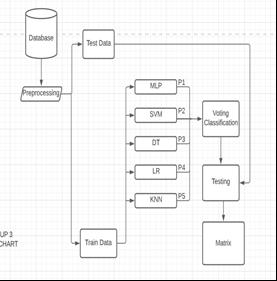
Theframeworkforthisprojectisshownindiagramfig: X where the first step is collecting raw data and pre processing the data so that the data is used efficiently by themachinelearningclassifierforbetterresults.
In the proposed framework, the pre processing step includes outlier rejection (P), filling missing values (Q), standardization(R),and featureselection of the attribute whicharebrieflydescribedasfollows:
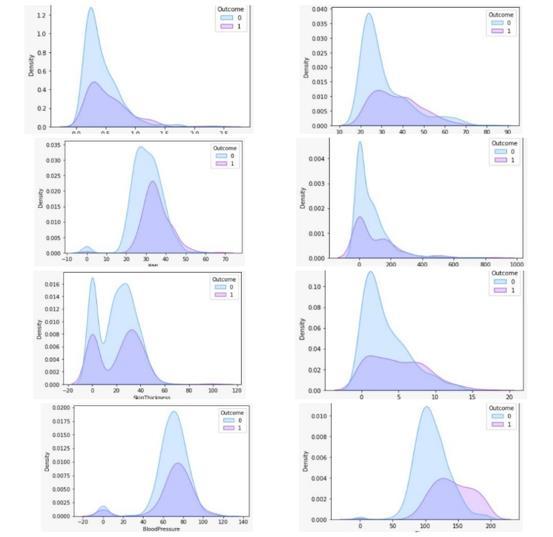
Figure a: The population distribution of all attributes in the data set, where the blue and violet colours denote non diabeticanddiabeticclasses,respectively.
TheOutlierrejection(Q):outlier[23]isa markedly deviated observation from other observations. It requires to be rejected from datadistributionastheclassifiersareverymuchsensitive to the data range and distribution of the attributes The mathematical formulation for the outlier rejection in this literaturecanbewrittenasin(2) P(x)=(x,ifQ1−1.5×IQR≤x≤Q3+1.5×IQR (2) reject,otherwise hear, x is the instance of feature vector that lies in n dimensional space, x ∈ Rn. Q1, Q3, and IQR is the first quartile, third quartile, and interquartile range of the attributesrespectively,whereQ1,Q3,IQR∈Rn
To carry out the task of classification we have used different machine learning models like K nearest neighbour (KNN), Support vector machine (SVM), Decision tree (DT)and multi layer perceptron (MLP) a briefdescriptionaboutthemodelisgivenintheTable1.2. Ensembling of machine learning model is an approach to boost performance recall and the precision of the prediction.
International Research Journal of Engineering and Technology (IRJET) e-ISSN: 2395-0056 Volume: 09 Issue: 01 | Jan 2022 www.irjet.net p-ISSN: 2395-0072 © 2022, IRJET | Impact Factor value: 7.529 | ISO 9001:2008 Certified Journal | Page295 Table1.1
Fillingthemissingvalue(Q): The missing or null value in dataset can lead to false prediction by the classifier. In this type of data pre processingthemissingornullvaluesaresubstitutedwith mean value of the attribute, rather than dropping it this can be represented by mathematical formulation as writtenin(3):Q(x)=(mean(x)ifx=null/missed x,otherwise (3) here x is the instances of the feature vector that lies inn dimensionalspace,x∈Rn Standardization(R): Standardizationisatechniquetorescaletheattributesfor the for achieving standard normal distribution with zero mean and unit variance and can be represented by mathematicalformulationaswrittenin(4) R(x)=x−x¯/σ(4) where x is the n dimensional instances of the feature vector, x ∈ Rn. x¯ ∈ Rn and σ ∈ Rn are the mean and standard deviation of the attributes. However, in many ML models such as tree based models are probably the models, where feature standardization can’t provide a guaranteeforsignificantimprovement.
B. Data preprocessing
(SVM) is a set of related monitoring methods that are often used in medical diagnostics to differentiate and reverse. Simultaneously SVM reduces the error of empirical separation and enlarges geometric margins. SVMs can therefore be also called Maximum Margin Classifiers. SVM is a standard algorithm based on the proven responsibility for the study of mathematical learning theory, called the structural risk reduction principle. SVMs can optimize non linear partitions using a so calledkernel trick,which clearly lays out their input into high resolution feature areas. The kernel trick allows you to create a separator withoutclearlyknowingthefeaturespace.
International Research Journal of Engineering and Technology (IRJET) e-ISSN: 2395-0056 Volume: 09 Issue: 01 | Jan 2022 www.irjet.net p-ISSN: 2395-0072 © 2022, IRJET | Impact Factor value: 7.529 | ISO 9001:2008 Certified Journal | Page296 Table1.2
Diabetes mellitus is a disease that affects many persons nowadays. As a result, early detection of this disease is critical. The major goal of this study is to find the most accurate and efficient algorithm for predicting diabetes patients. The accuracy of machine learning algorithms that were used in the preceding five years was investigated. As a result, the authors developed a soft voting classifier model based on a combination of four machine learning algorithms: decision tree, logistic regression, SVM, and MLP. The proposed model was first tested on the Pima Indians diabetes dataset, following which it was used to the breast cancer dataset. On the Pima Indians diabetes dataset, the ensemble soft voting classifier produced 79.08 percent accurate results and 97.02 percent accurate results on the breast cancer modellearningMachine Hyperparameter K nn Nnumberofneighbour Algorithms used for finding nearest neighbour Ball Tree (BT): Node definesa D hyperspheredimensionalorball KD Tree (KDT): Leaf nodeisaD dimensional point Brute: Based on the brute forcesearch Leaf size for BT or KDT which depends on the natureofproblem Metric (Manhattan distance (L1 norm) or Euclidean distance (L2 norm)) Measuring function: Entropy Thestrategyusedforsplitting ateachnode Minimum sample for an internal node and leaf node
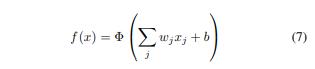
TMultilayerperceptron:heneuralnetwork consists of neuron as small processing unit connected by unidirectional weighted connection. The D dimensional input vector is converted in n dimensional by the MLP. The output of each processingunitcanbeexpressedasin(7). wherethexj,wj,bandΦaretheinputs,weights,biasto the neuron and the non linear activation function respectively. The parameters of the neurons are updated as in (8) during the training using backpropagation to minimizetheerrors.
D. Project framework: V. RESULTS AND DISCUSSIONS
DT
Votingclassifier: A voting classifier is a machine learning model that trainsonensembleofnumerousmodelswhichhavebeen used in the project namely DT, MLP, SVM, K NN, LR. The ensemble model predicts output based on the best performanceofthemodelswhichimprovestheprediction.
SupportSupportvectormachine:VectorMachine
International Research Journal of Engineering and Technology (IRJET) e-ISSN: 2395-0056 Volume: 09 Issue: 01 | Jan 2022 www.irjet.net p-ISSN: 2395-0072 © 2022, IRJET | Impact Factor value: 7.529 | ISO 9001:2008 Certified Journal | Page297 dataset. Using alternative deep learning models in the future,thisaccuracycouldbeimproved. a. Figures and Tables These were the results we obtained from our model whichwerethedifferentpartoftheconfusionmatrix. ALGORITHM ACCURACY SVM 78% MLP 78% EnsembleCoding 75% LogisticRegression 78% DecisionTree 67% Interms of recall,SVMshowsa lessof a reliable result sethenceintermsofrecall,IwouldsuggestthatourMLP andlogisticregressionmodelsshowedbetterresults. ALGORITHM RECALL SVM 0:90%1:54% MLP 0:85%1:63% EnsembleCoding 0:81%1:58% LogisticRegression 0:88%1:59% DecisionTree 0:71%1:58% For F1 score we see that best algorithm is logistic regression in terms of having the best F1 score. The best F1scoreiswhenitis1. ALGORITHM F1SCORE SVM 0:84%1:62% MLP 0:83%1:66% EnsembleCoding 0:82%1:56% LogisticRegression 0:84%1:65% DecisionTree 0:75%1:53% In terms of precision our SVM model showed the best results.Bestscoretogetforprecisionis1. VI.FUTURE SCOPE
As we can see, the accuracy was high for SVM, MLP, LOGISTIC REGRESSION models. So, these models will be used to predict our diabetes conditions in recent years better compared to others. However, I would like to add that our code compilation model, although showing only 75%accuracy,will bethebestoptioninthelongrunand will work best in real time data. Diagnosis of diabetes is made using a combined vote Pima class data class dividers for diabetes, by comparison with different classification algorithms, 80% maximum accuracy and 81% access to a set of data using 10 times the opposite verification and pronunciation data in 30% test and70% training.
1. WHO. Diabetes. Available online: https://www.who.int/news room/fact sheets/detail/diabetes(accessedon20May2020).
REFERENCES
VII. CONCLUSION
2. Shaw, J.; Sicree, R.; Zimmet, P. Global estimates of the prevalence of diabetes for 2010 and 2030. Diabetes Res. Clin.Pract.2010,87,4 14.[CrossRef][PubMed]
4.Won, J.C.; Lee, J.H.; Kim, J.H.;Kang,E.S.; Won,K.C.; Kim, D.J.; Lee, M. K. Diabetes fact sheet in Korea, 2016: An
ALGORITHM PRECISION SVM 0:79%1:73% MLP 0:82%1:68% EnsembleCoding 0:83%1:54% LogisticRegression 0:80%1:72% DecisionTree 0:63%1:69%
This research has certain drawbacks. For starters, there might be other risk variables in the diabetes dataset that the data collecting did not address. Other key variables, according to include gestational diabetes, family history, metabolic syndrome, smoking, sedentary lifestyles, particularfoodhabits,andsoon.Toimprovetheaccuracy ofthepredictionmodel,additionaldatawouldbeneeded. This may be accomplished by assembling diabetes datasets from many sources and creating a model from eachone.Inthefuture,a fuzzysettechniquewill beused to improve Bayes Network prediction, considering the unclear elements of specific diabetes variables. Other machine learning approaches, such as Neural Network, will also be examined to compare the forecasting outcomestodeterminethebestpredictionmodel.
3.Zou,Q.;Qu,K.;Luo,Y.;Yin,D.;Ju,Y.;Tang,H.Predicting diabetesmellituswithmachinelearningtechniques.Front. Genet.2018,9,515.[CrossRef][PubMed]
9. Woldaregay, A.Z.; Årsand, E.; Botsis, T.; Albers, D.; Mamykina, L.; Hartvigsen, G. Data driven blood glucose pattern classification and anomalies detection: Machine learning applications in type 1 diabetes. J. Med. Internet Res.2019,21,e11030.[CrossRef]
6. Deberneh, H.M.; Kim, I.; Park, J.H.; Cha, E.; Joung, K.H.; Lee, J.S.; Lim, D.S. 1233 P: Prediction of type 2 diabetes occurrence using machine learning model. Am. Diabetes Assoc.2020,69,1233.[CrossRef]
5.Choi,S.B.;Kim,W.J.;Yoo,T.K.;Park,J.S.;Chung,J.W.;Lee, Y. H.; Kang, E.S.; Kim, D.W. Screening for prediabetes using machine learning models. Comput. Math. Methods Med.2014,2014,1 8.[CrossRef][PubMed]
International Research Journal of Engineering and Technology (IRJET) e-ISSN: 2395-0056 Volume: 09 Issue: 01 | Jan 2022 www.irjet.net p-ISSN: 2395-0072 © 2022, IRJET | Impact Factor value: 7.529 | ISO 9001:2008 Certified Journal | Page298 appraisal of current status. Diabetes Metab. J. 2018, 42, 415 424.[CrossRef][PubMed]
8. Dankwa Mullan, I.; Rivo, M.; Sepulveda, M.; Park, Y.; Snowdon,J.;Rhee,K.Transformingdiabetescarethrough artificial intelligence: The future is here. Popul. Health Manag.2019,22,229 242.[CrossRef][PubMed]
7. Buch, V.; Varughese, G.; Maruthappu, M. Artificial intelligence in diabetes care. Diabet. Med. 2018, 35, 495 497.[CrossRef][PubMed]