Optimizing the Packet Routing with Effective Probability Association in Wireless Sensor Network Lekhana M M1, Chinnaswamy C. N2, Dr.T.H. Sreenivas3 1 3PG Student, CNE, Associate Professor, Professor Dept. of CS&E, “Vidyavardhaka College of Engineering”, Mysore, India *** Abstract WirelessSensorNetworksplayacriticalroleand have attracted a lot of academic attention in recent years. Sensornodeshavebeenutilizedinavarietyofapplications, including environmental monitoring, security, and target tracking.Thelatterentailsdetectingandtrackingthetarget's movement. We examine well known target tracking strategiesindepthinthiswork.Metricsincludingnetwork topology,targetrecovery,energyefficiency,andsecurityare usedtoassessexistingsolutions.Wealsogothroughsomeof the issues that impact tracking scheme performance. Furthermore, present methodologies are thoroughly examined,andfuturedirectionsareinvestigated.
Certified Journal | Page1526
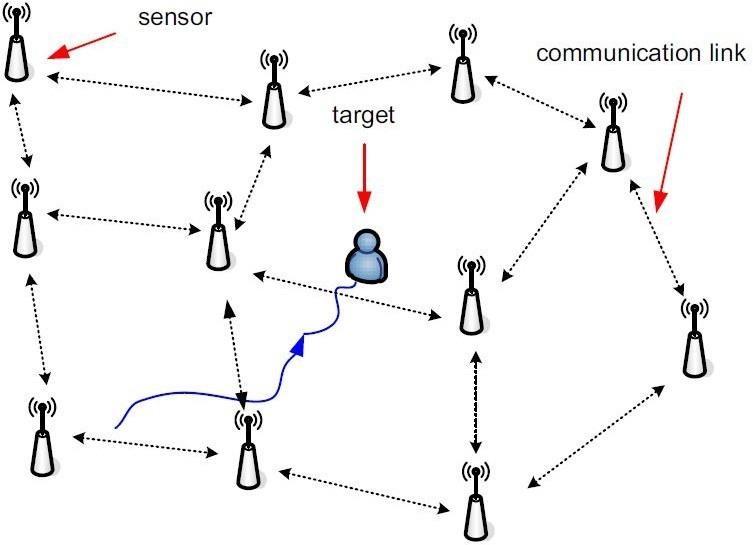
Fig.1.TargetTrackinginWSN
WSNsarecriticalinthedevelopmentofsmartenvironments, such as smart cities, smart buildings, smart grids, transportationandshippingsystems,andsoon.Itservesas alinkbetweentheactualworldandintelligentsystems.The numberofsensorsnodes(SN)inaWSNmightrangefroma few to hundreds of thousands [1], [2]. An SN might be as littleasagrainofdustoraslargeasashoesize.SNscancost anywhere from a few pennies to hundreds of dollars, depending on the node's sophistication. SNs perform a varietyofduties,includingmonitoring/sensing,processing, informationcollection,andcommunication[3].Becauseof theirlowcostandindependencefromhumanmeddling,they areutilizedinavarietyofmonitoringapplications,including environmentalmonitoring[4],[11],healthmonitoring[5], [6], subterranean and underwater systems [7], industrial equipment, and surveillance [8] [10]. Distributed SNs are linkedtogetherinsuchawaythattheyfunctionasasingle unit. SNs detect or acquire a certain sort of data and, depending on the topology, send it to the sink node or clusterhead(CH).SNsperformavarietyofduties,including monitoring/sensing,processing,informationcollection,and communication[3].BecauseSNshavesmallbatteriesthatare often them.consumptionirreplaceableandcannotberecharged,effectiveenergyisoneofthemostimportantconcernsfor
Moving item locations are likewise tracked and reported using SNs. One of the most common techniques is target tracking(asseeninFig.1).
trackingclasseshavebeenproposedinthe literature.Weexaminedwell knowntrackingtechniquesin terms of security [4], efficient energy usage [5], [8], node clustering[28],andaccuracy[12]inthisarticle.
International Research Journal of Engineering and Technology (IRJET) e ISSN: 2395 0056 Volume: 09 Issue: 01 | Jan 2022 www.irjet.net p ISSN: 2395 0072 © 2022, IRJET | Impact Factor value: 7.529 | ISO 9001:2008
Tracking can be done with the aid of a single SN or by a groupofSNsworkingtogether.Theemploymentofasingle SNresultsinfastenergydepletion,costlycomputation,and lowprecision. Whencomparedtoa singleSN,several SNs provide higher precision, more energy efficiency, and less Multiplecomputation.target
Keywords: Wireless Sensor Network (WSN), Sensor Node (SN), Cluster Head (CH), Kalman Filter (KF), Prediction, Energy Efficiency, Security, Wireless Sensor Network (WSN), Sensor Node (SN), Cluster Head (CH), Kalman Filter (KF), Prediction, Energy Efficiency, Security1.INTRODUCTION
WSN applications in which SNs follow the target and communicate its location to the user's application are crucial. Many domains, including campus monitoring, ecosystem monitoring, health monitoring, illegal border crossing, and war surveillance, can benefit from target tracking.
However, for a dependable and efficient target tracking, numerous obstacles must be solved, such as energy efficiency,precision,forwardingtechniques,load balancing, prediction, and recovery [43] [45]. For example, health related applications demand rapid and reliable data transport, while monitoring applications in smart environments necessitates energy efficient and resilient ways. Costs, device selection, and connection are also hindrancestoeffectivetracking.

I. CHALLENGES IN LOCALIZATION AND TARGET TRACKING
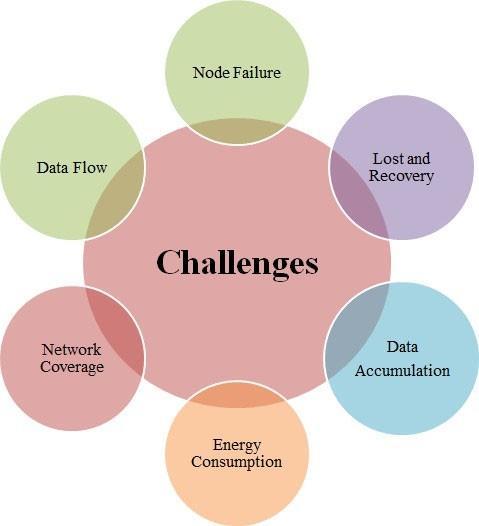
Fig ChallengesofTargettracking
Many difficulties are looked during the confinement and target following as displayed in Figure 2. These snags influence the general following productivity of WSN, for example,
International Research Journal of Engineering and Technology (IRJET) e ISSN: 2395 0056 Volume: 09 Issue: 01 | Jan 2022 www.irjet.net p ISSN: 2395 0072 © 2022, IRJET | Impact Factor value: 7.529 | ISO 9001:2008
•Lost and Recovery of Target: Prediction mistakes, obstaclesintheorganization,changeofwayorspeedcauses the deficiency of target. A strong following calculation is profoundlyexpectedtohandlethisissue.
II. CLASSIFICATIONOF TARGETTRACKING APPROACHES
•Energy Consumption:SNsrunonbatteriesthatarenon battery poweredandnowandagaininanon inconsistent climate.Becauseofwhichenergyproductivityisanintense issue in WSN explicitly in delicate objective following applications. Such energy proficient calculations are expectedtodeterminethisissueanddelaytheorganization lifetime.
•Tree Structure In tree based organization structure; conveyed SNs develop intelligent tree based engineering. Information head out from leaf SN to root SN. This way energyissavedonthegroundsthatitsavesSNsfromparcel floodingandbroadcasting.
Certified Journal | Page1527
•Hub Failure: In WSN, SNs are responsible to disappointmentbecauseofbatteryexhaustion,theeventof fiasco,equipmentdisappointment,andoutsideassault.This legitimizestherequirementforconventionsthatcanadapt uptothesedifficulties.
•Network Coverage: Target following and inclusion of organizationregionarestraightforwardlyrelatedandwork for hand in hand. The general exhibition of the following calculation relies upon the inclusion of the organization. Assuming the organization contains openings or SNs are meagerlydisseminates,theperformanceoftheorganization iscorrupted.Forbetterprecisionfromtargetfollowing,the organizationshouldnothaveanyopeningsorinadequate.
Inthe writingaudit,various pointsoftargetfollowingare considered.Targetfollowingcanbedescribedintomultiple Angles: proficient energy utilization, network structure, accuracy,targetmisfortuneandrecuperation,etc.
2:
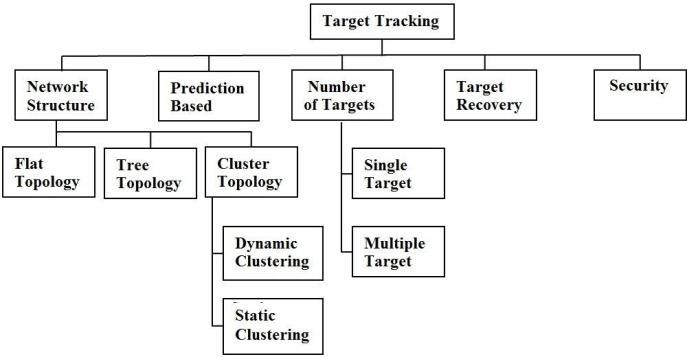
Inthissegment,we examinethescientific classificationof target following and measurements as per which we evaluatethenewcalculation.Fig.3showstheconceivable scientificclassificationoftargetfollowingWSNs.
•Group Structure is molded when the organization is conveyedanditsliabilitiesarecharacterized,forexample, the quantity of SNs, inclusion region and so forth Group
•LevelStructureItisakindofnogeographyortheabsence ofgeography.Inalevelorganization,everySNcontributes anequivalentjobinnetworkimprovementandfoundation. Inthisgeography,SNsbroadcastinformationuntilitarrived attheobjectiveSN.Thisengineeringdoesn'tthinkaboutthe productiveenergyutilizationofSNs.
•Information Flow: The requirement for information stream change from one circumstance to another like ordinarysituationorcrisissituation.Ifthereshouldarisean occurrence of crisis or strategic applications deferral and interference.plansinterferenceinfluencethefollowingeffectiveness.Thus,suchoughttobeplannedinwhichthereisnoornegligible
•Information Accumulation:Inbunchbasedfollowing,SNs forward their information parcels to their related CH. SubsequenttogettingthesebundlesfromSNs,CHcollects the asdormancyduplication.informationandpreciselyeliminatestheredundancyandDuringthiscourseofamassing,informationandenergyutilizationareattemptedtokeepleastmuchascan.
A. Network Structure In[10],thecreatorhasdispersedtheorganizationstructure into three classifications: Tree based construction, group, and pioneer based organization structure. They have coupledeveryclasswithpre stylebasedmethodologiesto makeconventionmoreenergyproductiveandlimitchances of target misfortune. In [13], the creator partitions the organization structure into two sorts: various leveled and distributed. The progressive organization further isolated into four structures: enactment based, group based, tree basedandmixture.Thesharedbasedorganizationmadeout ofinsertedchannels:appropriatedKalmansifting(DKF)and disseminated adaptable Sigma Point Kalman channel We(DSPKF).separate organization structures into three sorts: Flat design,TreebasedandClusterbasedorganizationstructure.
Target following can be isolated into two classes de forthcomingontheobjective:singleobjectivefollowingand differentobjectivefollowing.
E. Security In target following, security is one of the central points of contentionbecauseofspecificstrategicapplications.These SNs can be sent to disagreeable, unfriendly regions in mission studyapplications,andinterloper/foescanwithout much of a stretch trade off or catch these SNs. These impacted SNs might cause bogus, counterfeit information transmission, like the specific area of the target, and may makethefollowingdependabilityquestionable.
C. Number of Targets
Inlevelgeography,everyoneoftheconventionsaremaking anhonestefforttotrackdownthestreamlinedcoursefrom source to sink SN, utilizing flooding of some kind. This telecomintheorganizationcausesquickbatteryexhaustion, bundleoverheadandabbreviatestheorganizationlifetime. Somelikelihoodbasedproceduresareintendedtodiminish copybundlefloodingandtofoundsteeringwaylikeSensor Protocol for Information by means of Negotiation (SPIN), Rumordirectingandsoforth
Fig.3.TaxonomyofTargettracking
2) DynamicCluster:Thegroupsfromprogressivelyasthe objectivemoves.Itisbettercontrastedwithstaticgrouping because of its security. Because of the need, new groups arise. When the objective is entered, the bunch is framed, while different SNs stay sleeping. Only each group is empowered in turn, bringing about energy preservation; notwithstanding, the imperfection in unique bunching is informationovertrepetitivenessandmeddlingissues.
•Single Target tracking a solitary objective consumes less power and energy productive. It creates a low traffic load duringtheobjectivefollowing.
1)StaticCluster:areframedduringnetworkarrangement and stay steady all through the organization's life expectancy.Asidefromitsaccommodation,ithasnumerous disadvantages, including the way that the whole group's presence is subject to CH, and there is no probability of informationdividingorparticipationbetweenbunches.
Expectation procedures are utilized in forecast based trackingtechniquestoforeseethefutureobjectiveposition. SNsareempoweredclosetothefollowingarea,whileothers stayunconscious,savingthe energyof SNsandupgrading theabsolutelifeseasonoftheorganization.Variousmethods and models are proposed to anticipate the following expected place of the portable objective, for example, Kalmanchannel(KF),broadenedKalmanchannel(EKF)[29], [30],directexpectationmodel[17],UnscentedKalmanFilter (UKF)[40]andsoon
B. Prediction Based Tracking
D. Target Recovery ExpectationbasedcalculationinWSNnowandthenendures target misfortune because of abrupt speed change, hub disappointment,PCmisfortune,mistakeinareaassessment, forecast blunder, and organization inclusion issues. expectationbasedcalculation.Torecoverthelostobjective, itisimportanttohaveastrongrecuperationprocess.Fast, tough and energy productive recuperation instruments. Aroundhere,alotofexaminationhasbeendonetoresolve thisissue.
International Research Journal of Engineering and Technology (IRJET) e ISSN: 2395 0056 Volume: 09 Issue: 01 | Jan 2022 www.irjet.net p ISSN: 2395 0072 © 2022, IRJET | Impact Factor value: 7.529 | ISO 9001:2008 Certified Journal | Page1528 basedgeographygivesusversatilityandeffectiveutilization of transmission capacity than different geographies. Assuming CH is chosen through neighborhood network handlinglessparcelsaresenttoabasestationwhichbrings aboutproficientenergyconsumption,effectivedatatransfer capacityutilization,andsecurity.Bunchingcanbestaticor dynamic.
•Numerous Targets tracking different targets is a troublesome assignment. It turns out to be more troublesomebecauseofthedistinctionsintargetratesand headings. Numerous objective data is gotten by SNs. The mosttroublesometestisfiguringoutwhichinformationhas aplacewithwhichtarget.Theinformationaffiliationissue emergesfromthisimpossibilityofinformation.
III. COMPARISON AND ANALYSIS OF EXISTING WIRELESS TRACKING TECHNIQUES
1)SPIN [18]: InSensorProtocolforInformationbymeansof Negotiation(SPIN)messagefloodingissueisaddressedwith theassistanceofarrangement.Itcomprisesofthreekindsof messages (I) Advertisement (ADV), (ii) Request (REQ), (iii)Data (DA). When, SNs get a few new information, SN sends an ADV message to a neighbor. Intrigued SN sends REQ message to the shipper. Thus, a DATA message is shippedofftheintriguedSN.Turnfurtherdevelopnetwork lifetime by lessening flooding and repetitive information. The defect of SPIN is that it doesn't ensure information conveyance. 2) RR [19]: The creator proposes a Rumor Routing (RR) convention. RR performed uniquely for little WSN. Nonetheless,onaccountofhugeregionWSNtheupkeepof
4)ETX NH [21]: The creator proposed a novel steering supportiveoftoolinviewofNeighborhoodHeuristics(NHs) model for tree organized WSN. NH coupled SNs steering metricwithitsneighbors(likeenergy,distance)tohighlight accessiblecourses.Thisextradatainregardstoneighbors aidsthedeterminationofthecourseandfundamentaltains theingeneraldirectingquality.Theproposeddirectingplan is energy productive and performs better even in a lossy organizationclimate.
Page1529
PCTT is a brought together VANET based grouping algorithm.InPCTT,CHisanswerablefortheadministration of group and target following. Authorization to join the group, computation and determination measures for CH, principletenancechoicesallareexecutedbyCH.
10) ACDF [27]: Apowerfulgroupingbasedversatilefiltering planisproposedfortargetfollowinginaWSN.Atwo stage progressive information conglomeration method by rememberingenergyproductivity.Attheprimarystage,SN ascertains their assessed separation from the portable objective and offers it with all bunch individuals and CH. AsidefromgettingtheSNassesseddistancecomputation,CH likewiseascertainsitsdistancefromtheobjectiveandtotalit withthegotinformationfromSNs.CHwillbechoseninlight oftheofremainingenergy.Theproposedplotgivesusbetter and exact objective following in an energy productive manner.
3)RR [20]: In [20], creators proposed an item following calculation in view of the Fuzzy Sensing Model in correspondencewithRSSI(RadioSignalStrengthIndicator) tofollowtheobjective.Inthewakeoffollowingtheobjective, SNfindsitsareabymeansofGPSandsendsthedetermined objectiveareatothesinkSN.Theyproposedatreestructure based following called "caravan tree", which will be made whentheobjectiveisfollowed.Allhubsclosetotheobjective are associated with the tree. Subsequently giving us 100 percentinclusionandfarhubswillstayinrestmode,brings aboutsavingenergy.Theproposedcalculationworksbetter in term of energy proficiency and versatile objective following.
11) RSSI-LPM [28]: Aplanisproposedtofollowandforesee the following area of the objective. The organization is isolatedintostaticbunches. CHwill bechosen whether in
Journal
International Research Journal of Engineering and Technology (IRJET) e ISSN: 2395 0056 Volume: 09 Issue: 01 | Jan 2022 www.irjet.net p ISSN: 2395 0072 © 2022, IRJET | Impact Factor value: 7.529 | ISO 9001:2008 Certified | specialists(SNs)andtableineverySNisbecomeextremely complicated. Overhead of RR is connected with different elements like chance to live, number of specialists and inquiries.PioneerSNbecomesmindfuloftargetoroccasion from occasion specialists. Pioneers SN in the wake of applying the heuristics method choose the course for the followingjumpdetermination.TheprimarybenefitofRRis no geography upkeep and great nature of courses, then again, inconveniences of RR is inconsistency, high postponement,andignoranceofnewneighborappearance anddeadneighbor.
6) DHSCA [23]: A clever Dual Head Static Clustering Algorithm(DHSCA)isproposedin[23]tofurtherdevelop thegeneralorganizationlifetimeandenergyutilization.In DHSCA;theorganizationisinvolvedstaticgroupsinviewof the geophysical area of SNs to eliminate the bunch developmentoverheadlikeinuniquebunching.Twohubs arechosenasCH;oneforinformationconglomerationcalled Aggregating Cluster Head (ACH) and the other for informationtransmissioncalledTransmittingClusterHead (TCH), in view of remaining energy and distance from different SNs. DHSCA keeps up with the equilibrium of energyutilizationamongSNsandfurtherdevelopstheWSN lifetimebychoosingprogressivelyCH.
5)DLSTA [22]: Dynamic Look forward Spanning Tree Algorithm(DLSTA)isproposedin[22]tolimittheoddsofan objectivelostbypre buildinglookforwardgroupalongside theobjectiveanticipateddirectionbeforeitshowsup.The SN nearest to the objective is picked as root SN in DLSTA Root SN builds the tree group; work out the area, next anticipated position, speed. The formation of a pre developed tree relies on the speed of the objective. NumerouschannelslikebroadenedchannelsKalman(EKF) andmoleculeFilter(PF)inDLSTAareutilizedtoguarantee precise expectation. This exact earlier information helps with saving the energy of SN and further develops the generalorganizationlifetime
7) BCTT [24]: In [24], another objective following calculation; Boundary Static Clustering Target Tracking (BCTT),isproposed.BCTTtacklethelimitfollowingissues bypermittingthelimitsensortoturnintoanindividualfrom however many groups as they need. BCTT additionally permitSNtoteamupandsharedata,bypermittingthisthe general following productivity is expanded. The proposed conspireissuperiortodynamicandcrossoversincethereis nooverheadofbuncharrangementandannihilation.
8) SCDCH [25]: AStaticClusterandDynamicClusterHead (SCDCH) calculation is proposed in [25]. Author coupled SCDCH with Newton Gaussian calculation to foresee the objective direction and blunder assessment. SCDCH is utilized to gather the information from dynamic SN and forwardit totheCH. Thisconventiongiveshigh precision and lessens energy utilization; subsequently draw out the organizationlifetimegenerallyspeaking.
9)DCTT PCTT [26]: Thecreatorproposedtwoalgorithms; (I)DistributedCluster basedAlgorithmforTar getTracking (DCTT) and Prediction based Clustering calculation for Target Tracking (PCTT), for vehicular following in a Vehicular Ad hoc Network (VANET). DCTT is a powerful grouping calculation wherein CH is answerable for target areadata,collectionofinformationgotandsendingittosink hub called Command and Control Center (CC). A Target FailureProbability(TFP)iskeptupwithandsharedbySNs amongoneanother.TFPisameasurementintendedforthe choiceofCH.OntheoffchancethatCHislost,thebesthub withthebaseTFPischosenasaCH.
Certified Journal | Page1530
13) LSA RCAM [30]: Anexactandenergyproductivetarget followingplaninviewofexpectationisproposed.TheLeast Square Algorithm (LSA) is utilized to follow the portable objectiveareaandRandomwayandConstantAcceleration Model(RCAM)fortargetversatilityboundarieslikespeed, bearing,andspeedincrease.Theproposedforecaststrategy has great objective exactness, decline the quantity of dynamicSN;thejustclosesttotheobjectivewillbedynamic whiletherestwillstaysleeping,thiswillfurtherdevelopthe generalorganizationlifetime.
International Research Journal of Engineering and Technology (IRJET) e ISSN: 2395 0056 Volume: 09 Issue: 01 | Jan 2022 www.irjet.net p ISSN: 2395 0072 © 2022, IRJET | Impact Factor value: 7.529 | ISO 9001:2008
18) SSN AUKF [35]: Acleverplanisproposedtore cover the lost objective with least SN awaken. An Adaptive UnscentedKalmanFilter(AUKF)calculationiscoordinated toimprovethestrengthand precisionoftherecuperation component.Thecreatorproposedconspiresastaticbunched agreeable organization which consists of some static SN (SSN)andacoupleofversatileSNcalledportablehub(MN) to follow the objective. Unscented Kalman Filter (UKF) is utilized to anticipate the objective next area. When the objective is announced lost because of its shifting pace or becauseofopeningsinWSN,MNwillproceedwithtracking.
19) VGTR [36]: A successful camera sensor based plan calledVirtualGridTargetRecovery(VGTR)isproposedin whichjustessentialcamerasareinitiatedtoconveyvaluable dataabouttheversatileobjective.Camerasparticipatingin versatile objective following are chosen with dynamism relying upon portable objective speed. VGTR partition the entirecheckingregionintoavirtuallatticeandlevel,vertical lines. The crossing points of these lines are called Virtual Nodes(VN).EverysensorknowstheareaofitsnearestVN. Assuming that the objective is lost because of an abrupt courseadjustmentorspeed,torecuperatethelostportable objectiveallcamerasareinitiated.
Target is followed by sensors through trail alteration calculation then, at that point, advances the data to their particularCHcalled"pioneer",whichtotaltheinformation andforwardthedatatosink.Theproposedconspiregives better outcomes in term of normal energy utilization, network lifetime. Following different targets has different applications like boundary observing, war zone checking, observation, and airport regulation. The fundamental difficultiesaremulti targetfollowingtracks,theexactareaof targets, partner the messiness and boisterous estimations accurately.
16) ASMT [33]: A clever calculation is proposed for AugmentedSpecifiedMultipurposeTracking(ASMT).ASMT is a unified Bayesian calculation in light of shortsighted appraisals.ThisdataisrecognizedbytheSNtoCHandsent to CH. CH is liable for information affiliation and the objectivepositionandclosebylocalnotsetinstoneandsent to the sink hub by utilizing the Bayesian assessment estimation. ASMT offers high accuracy multi target following,lessestimationandresolvestheissueoftheWSN informationmixadequatelyutilizingareaandspeedstatus.
AUKFtweaksthecommotioncovariancenetworktofurther develop the recuperation component's precision and strength.ThisoverwhelmingbookingofMNandSSNfurther developsfollowinglikelihoodwhileconsuminglessenergy thanjustSSN.
view of leftover energy or distance from the base station. Trilaterationsystemisutilizedtofollowtheobjectiveand bring together this following instrument with a Linear Prediction model to foresee the following area of the objective. Just SN, nearest to the following area will be dynamicwhiletherestwill staysleeping.Thiscomponent keeps up with high exactness, further develop network lifetime.
17)PPHD MMA [34]: The writer has proposed the Multi waytoMeasurementAssociationapproach(MMA)andjoins itwiththeProbabilityHypothesisDensityutilizingamulti target Particle Filter (PPHD) in metropolitan regions. The PPHD MMAframeworkneednotknowaboutthenumberof targetsaresothatobjectivescanchangeoverthelonghaul.
14) DPR [31]: ThecreatorproposedaDualPredictionbased Routing(DPR)calculation.Thiscalculationfurtherdevelops net worklifetimebykeepingmosthubsinrestmode.The assessednextareaoftheobjectiveisanticipatedtwice,(I)at hubs level (ii) at sink level. On the off chance that the distinction between them is under the edge, the sink isn't refreshedwhichresultsindecreasethebundletransmission.
12) ARIMA UKF [29]: Anenergyeffectivefollowingplanis proposed by bringing together two calculations; Auto Regressive Integrated Moving Average (ARIMA) and Unscented Kalman Filter (UKF). ARIMA is a period series basedfactualtechniqueinwhichsubsequenttonoticingthe objectiveinequivalentspans,itsfutureareaisanticipatedin viewofitspastwiththemostun conceivablemistake.UKF givestheassessedtargetposition.ThisutilizationofARIMA and UKF safeguard the general energy of SN and further developtheorganizationlifetime.
15) SJPDA PUESRF [32]: In [32], to follow the different targets coordinate turn model is taken on with a non straight turning rate. Test based Joint Data Association (SJPDA) is utilized to partner or dispose of the get calculations with the relative objective. A variation of Ensemble Square root Filter called Particle astute Update form of Ensemble Square root Filter (PUESRF) is utilized because of it doesn't depend on Gaussian circulation and givesalowrootmeansquaremistake.Thiscombinationof SJPDA with PUESRF brings about exact and exact informationrelationshipjustassteadytargetsfollowing.
K meanbunchingisutilizedtogroupandtoprocessatsome randomtimethequantityoftargets.PPHD MMAworksout the likelihood way at each stage, so the likelihood for all waysisdistinguished,andthewaythatisnodoubtchosen. Because of the utilization of PPHD and regarding the got targets data as irregular limited set (RFS) estimation to followaffiliationissueiskeptawayfrom.
The huge examination in target tracking and complex applicationregionspropelledustocompletelybreakdown andthinkabouttheexhibitionofexistingstrategiesinlight oforganizationstructure,energyeffectiveness,andforecast ac curacy, number of targets, target recuperation and security. After this broad relative investigation we reason that current strategies are lingering behind explicitly in followingdifferenttargets,targetrecuperationandsecurity.
[5]Abdul Saboor, Rizwan Ahmad, Waqas Ahmed, Adnan K Kiani,YannickLeMoullec,andMuhammadMahtabAlam.On research challenges in hybrid medium access control protocols for ieee 802.15. 6 wbans. IEEE Sensors Journal, 2018.[6] K.Ramya,K.PraveenKumarandD.V.SrinivasRao,“A Survey on Target Tracking Techniquesin WirelessSensor Networks”, International Journal of Computer Science & EngineeringSurvey,vol.3,no.4,pp.93 108,2012.
[8]https://doi.org/10.3390/s21093228.Khan,MuneebA.,MuazzamA.Khan, Anis U. Rahman, Asad Waqar Malik, and Safdar A. Khan. ”Exploiting cooperative sensing for ac curate target tracking in industrial Internet of things. International Journal of Distributed Sensor Networks 15, no. 12 (2019) DOI: [9]1550147719892203. A. Oracevic and S. Ozdemir, “A survey of secure target tracking algorithms for wireless sensor networks”, World Congress on Computer Applications and Information SystemsXWCCAIS),2014.
[10]O. Demigha, W. Hidouci and T. Ahmed, “On Energy Efficiency in Collaborative Target Tracking in Wireless SensorNetwork:AReview”,IEEECommunicationsSurveys &Tutorials,vol.15,no.3,pp.1210 1222,2013.
DISCUSSION
[7]Khan,MuneebA.;Saboor,Abdul;Kim,Hyun chul;Park, Heemin. 2021. “A Systematic Review of Location Aware SchemesintheInternetofThings”Sensors21,no.9:3228.
[1]M.Safaei,A.S.Ismail,H.Chizari,M.Driss,W. Boulila,S. Asadi, and M. Safaei, “Standalone noise and anomaly detectioninwirelesssensornetworks:Anoveltime series andadaptiveBayesian network basedapproach,”Software: PracticeandExperience,vol.50,no.4,pp.428 446,2020.
[2]M. Safaei, S. Asadi, M. Driss, W. Boulila, A. Alsaeedi, H. Chizari, R.Abdullah,andM.Safaei,“Asystematicliteraturereviewon outlierdetectioninwirelesssensornetworks,”Symmetry, vol.12,no.3,p.328,2020.
International Research Journal of Engineering and Technology (IRJET) e ISSN: 2395 0056 Volume: 09 Issue: 01 | Jan 2022 www.irjet.net p ISSN: 2395 0072 © 2022, IRJET | Impact Factor value: 7.529 | ISO 9001:2008
REFERENCES
The thorough and inborn nature of Wireless Sensor Net work makes them effectively deployable wherever in the field like terrible areas, metropolitan urban communities, enterprises, submerged and homes. Among various utilizationsofWSN, forexample,moreextensiveobserving,naturallifeterritory checking,transportmeantchecking,medical services,and securityobservation,target following isconsideredasthe main one. It is essential to follow various occasions at soonestbeforeamajorharmandgototheremediallengths.
In this way there is still need to propose such procedures whichcanresolvetheseissuesandincrementitsversatility.
Instrategicapplications,forexample,frontlinekeepaneye on spear and far off wellbeing observing, security is additionally a pivotal issue. Regularly, SNs are sent in a threateningclimate,wheretheyareinclinedtoruinandtook advantage of by interlopers. A few creators reason the utilizationofcryptographyoradvancedmarkbasedsecurity.
Certified Journal | Page1531
[3]SlavisˇaTomic.Targetlocalizationandtrackinginwireless sensornetworks.2017. [4]YashwantSingh,SumanSaha,UrvashiChugh,andChhavi Gupta. Distributed event detection in wireless sensor networks for forest fires. In Computer Modelling and Simulation (UKSim), 2013 UKSim 15th International Conferenceon,pages634 639.IEEE,2013.
Moreover,itisoneoftheleastexaminationregionsamong thisfield.Notwithstanding,thisregionneedsconsideration sincewhenaclientusessuchapplicationswhichuncoversits personal data can have critical outcomes. Compromising clientareaforspecificadministrationsandapplications,for example, the wellbeing, industry and safeguard can be unsafeandhazardous CONCLUSIONS
AlotofexplorationhasbeendirectedtomakeWSNsbrilliant andenergyproductive.Aframeworkthatconsumesatonof energyisunsatisfactoryformostofutilizations.Therefore, energyutilizationstaysoneofthemaindifficultiesasfaras brilliant climate and target following. It is likewise straightforwardly connected to the idleness Furthermore execution of following. The quantity of hubs and transmission range are two significant boundaries. The quantityofSNsoccupiedwithtargetfollowingsignificantly affectsprecisionandenergyuse.Themorethecooperation of SNs in limitation, the more prominent the restriction precisionandenergyutilization.Bethatasitmay,Machine Learning (ML) brought together with energy reaping strategies can be appropriate possibility to improve and delaySNlifetime. To further develop target following, diverse expectation calculationsareexecuted.Nonetheless,theseenergy starved strategiesabbreviatetheexistencesofSNs.Lately;scientists have proposed different low obligation cycle expectation calculations in which SNs near the objective stay working whileothersarekeptinareststate.
[20]S.Khakpour,R.PazziandK.El Khatib,“Usingclustering fortargettrackinginvehicularadhocnetworks”,Vehicular Communications,vol.9,pp.83 96,2017.
[21]H.Zhang,X.Zhou,Z.Wang,H.YanandJ.Sun,“Adaptive Consensus Based Distributed Target Tracking With DynamicClusterinSensorNetworks”,IEEETransactionson Cybernetics,pp.1 12,2018. [22]P. Joshi and A. Joshi, “Prediction Based Moving Object Tracking In Wireless Sensor Network”, International ResearchJournalofEngineeringandTechnology,vol.4,no. 7,2017. [23]M.Alishahi,A.HosseinMohajerzadeh,S.AslishahiandM. Zabihi, “Adaptive Target Tracking Using Prediction in WirelessSensorNet works”,2016. [24]M. Mirsadeghi and A. Mahani, “Low Power Prediction Mechanism for Wsn based Object Tracking”, Procedia Technology,vol.17,pp.692 698,2014.
[29]H. Qian, P. Fu, B. Li, J. Liu and X. Yuan, “A Novel Loss RecoveryandTrackingSchemeforManeuveringTargetin HybridWSNs”,Sensors,vol.18,no.2,p.341,2018. [30]J. Amudha and P. Arpita, “Multi Camera Activation Scheme for Target Tracking with Dynamic Active Camera Group and Virtual Grid BasedTarget Recovery”, Procedia ComputerScience,vol.58,pp.241 248,2015.
[28]M. Zhou, J. Zhang and A. Papandreou Suppappola, “Multiple Target Tracking in Urban Environments”, IEEE TransactionsonSignalProcessing,vol.64,no.5,pp.1270 1279,2016.
Mistarihi and M. Shurman, “Static cluster and dynamic cluster head (SCDCH) adaptive prediction based algorithmfortargettrackinginwireless sensor networks”, 38th International Convention on Information and Communication Technology, Electronics andMicroelectronics(MIPRO),2015.
[16]A.Alaybeyoglu,A.KantarciandK.Erciyes,“Adynamic lookaheadtreebasedtrackingalgorithmforwirelesssensor networks using particle filtering technique”, Computers & ElectricalEngineering,vol.40,no.2,pp.374 383,2014.
[11]K. Hazra and B. N. Bhramar Ray, “Target Tracking in WirelessSensorNetwork:ASurvey”,InternationalJournalof ComputerScienceandInformationTechnologies,vol.6,no. 4, [12]2015. A.Kaswan,K.NiteshandP.Jana,“Energyefficientpath selection for mobile sink and data gathering in wireless sensornetworks”,AEU InternationalJournalofElectronics andCommunications,vol.73,pp.110 118,2017.
International Research Journal of Engineering and Technology (IRJET) e ISSN: 2395 0056 Volume: 09 Issue: 01 | Jan 2022 www.irjet.net p ISSN: 2395 0072 © 2022, IRJET | Impact Factor value: 7.529 | ISO 9001:2008 Certified Journal | Page
[25]V.DayanandK.Vijeyakumar,“TargetTrackinginSensor NetworksUsingEnergyEfficientPredictionBasedClustering Algorithm”, Procedia Engineering, vol. 38, pp. 2070 2076, [26]2012.R.JinanandT.Raveendran,“ParticleFiltersforMultiple TargetTracking”,ProcediaTechnology,vol.24,pp.980 987, [27]2016.
[13]T. Semong, S. Anokye, Q. Li and Q. Hu, “Rumor as an Energy BalancingMultipathRoutingProtocolforWireless SensorNetworks”,InternationalConferenceonNewTrends inInformationandServiceScience,2009.
[18]S.RouhaniandA.Haghighat,“Boundarystaticclustering target tracking in wirless sensor networks”, 6th [19]NetworkingInternationalConferenceonComputing,CommunicationandTechnologies(ICCCNT),2015.M.Wahdan,M.Al
[17]T. Panag and J. Dhillon, “Dual head static clustering algorithmforwirelesssensornetworks”,AEU International JournalofElectronicsandCommunications,vol.88,pp.148 156,2018.
K.Xiao,R.Wang,L.Zhang,J.LiandT.Fun,“ASMT: An augmented state based multi target tracking algorithm in wireless sensor networks”, International Journal of Distributed Sensor Networks, vol. 13, no. 4, p. 155014771770311,2017.
1532
[14]S. Bhowmik and C. Giri, “Convoy Tree Based Fuzzy TargetTrackinginWirelessSensorNetwork”,International JournalofWirelessInformationNetworks,vol.24,no.4,pp. 476 484,2017. [15]D. Delaney, R. Higgs and G. O’Hare, “A Stable Routing Framework for Tree Based Routing Structures in WSNs”, IEEESensorsJournal,vol.14,no.10,pp.3533 3547,2014.