Whenfibersofmorethantwotypewerecombinedinacombinedmatrixtoformacompositewhichcouldtakeadvantage from each of the constituent fibers and demonstrates a dynamic response, it is called hybrid composite. The addition of short discontinuous fibers improves the mechanical characteristics of concrete significantly which increases elastic modulus,reducesbrittleness,andregulatesfractureinitiation,growthandpropagation. Concreteistheutmostcommonly usedintheconstructionofthebuildingsintheworld.Concreteisstrongerincompressionbutweakintension.Ordinary cement concrete has low tensile strength, ductility and resistance to abrasion. Internal microcracks, resulting in brittle concrete fracture. Many studies have been conducted to improve the brittle fracture behavior concrete by incorporating additional ingredients into the mix. Short discontinuous and discrete fibers are added to plain concrete to improve post crackingbehavior. Effects of fiber in concrete
1. Introduction
International Research Journal of Engineering and Technology (IRJET) e-ISSN: 2395-0056 Volume: 09 Issue: 01 | Jan 2022 www.irjet.net p ISSN: 2395 0072 © 2022, IRJET | Impact Factor value: 7.529 | ISO 9001:2008 Certified Journal | Page1205 STUDY OF FLEXURAL BEHAVIOR OF HYBRID FIBRE REINFORCED CONCERETE Pawan Kumar S1 and K V Mahesh Chandra2 1PG Scholar, Structural Engineering, Bangalore Institute of Technology 2Assistant Professor, Department of Civil Engineering Bangalore Institute of Technology, Bengaluru 560004, India ------------------------------------------------------------------------***---------------------------------------------------------------------Abstract: Plainconcretehasnumerous micro cracksandisbrittleintension.Assoonastheloadisapplied,microcracks begin to propagate in the concrete matrix. Micro and macro crack propagation is slowed by the inclusion of randomly spaced discontinuous fibres. Plain concrete's mechanical qualities, such as impact resistance, fracture resistance, and dynamic load resistance, are also improved by the addition of fibres. The present study used HFRC (monofilament and fibrillatedpolypropylenefibres)withlengthsof12mmandanaspectratioof300incastconcreteinequalpercentagesof 0.9 percent by weight is added in concrete with a combination of (50% 50%) at each volume fraction, and Compressive strength,flexuralstrength,andsplittensilestrengthtestswereallcarriedout. Theresultsshowanincreaseinpercentage of0.9%ofhybridfibrereinforcedspecimencomparedwiththecontrolspecimen.Thereisanincreaseof about15.85%in ultimate load of beams with fibres compared to control specimen. The compressive strength of hybrid fibre specimen is 24.35%morethanthecontrol specimensandthetensilestrengthofthehybridfibrespecimenis11.74%more thanthe control specimen. The variation in crack number and their propagation and the increment in the ultimate load is mainly duetothehybridfibresusedinbeam.
Keywords: Monofilament & Fibrillated polypropylene fibres, Compressive strength, Flexural strength and split tensile strength.
1.2
Syntheticfibersaremostcommonlyaddedtoconcreteinordertoreducetheshrinkagecracks.
Fibersactasamulti dimensionalreinforcementandhelpsintheuniformdistributionoftensilestress.
Gradualdecreaseinthepermeabilityandreductioninbleedingofwater Greaterstrengthinimpact,abrasioninconcretecanbeachieved. Rebar’scanbecompletelyreplacedbythesyntheticfibers Benefits of fiber reinforced concrete Reducesshrinkagecracksinplasticandimprovesimpactandabrasionresistance. Reductionincrackwidththusimprovingdurability.
Shrinkagecracksaresmall,unevenfissuresthatappearinconcretewithinthefirst24hoursafterplacing.
1.1
Inscenarioofaseverefire,improveresistancetoexplosivespalling. Fibersarenaturallyhydrophobic;theydon’tabsorbwater.Asaresult,waterseepagecanbecontrolled. Itactsasecondaryreinforcementforaconcrete. Therateofspeedofconstructionisalsohigh. Fibersarelightinweightandeasytohandle. Reducessteelcorrosion,segregation,andbleedingofconcreteduringplacement.

Forbarbendingwork,thereisalowinventoryspacerequirementandhumanpowerisminimized.
International Research Journal of Engineering and Technology (IRJET) e-ISSN: 2395-0056 Volume: 09 Issue: 01 | Jan 2022 www.irjet.net p ISSN: 2395 0072 © 2022, IRJET | Impact Factor value: 7.529 | ISO 9001:2008 Certified Journal | Page1206
1.3 Polypropylene fiber reinforced concrete
Structures and pavements subjected to shatter, impact, abrasion, and shear are excellent for fiber reinforced concretewithimprovedtoughness. It is used to reduce permeability and freeze thawing conditions in water retention and reservoir constructions throughcrackmanagementandshrinkage.
1.5 Advantages and Limitation of Fiber Reinforced Concrete Itimprovesconcrete'simpactandshatterresistance,aswellasitsfatigueenduranceandshearstrength. Installingreinforcementdoesnotnecessitatetheuseofanyspecificequipment. Improvethetoughness,resistancetocracks,ductilityforlongterm,andenergyabsorptioncapacityofconcrete.
2. Literature MaheswaranSurveyChellapandian evaluated the influence of the structural fibers on behavior of beams in shear which are reinforced with Glass fiber reinforced polymer (GFRP) rebar. Finding the proficiency of the macro synthetic polyolefin (PO)polymersandfusionofPOfibersandsteelfibersinenhancementofshearbehaviorinbeamsisthemainobjectiveof this study. The fibers percentages used in this study are 0.35%, 0.70% and 1% of the volume of the concrete. The end results designated that the stiffness of the beam, ductility and the peak load resisted increased compared to the control beams. Divya S Dharan polypropylenefiberblended(24mm,40mm,55mm)invariouspercentage(0.5%,1%,1.5%and2%)were added to concrete in this project. Properties like workability, strength in compression, resistance to flexure, strength in tensileandelasticitymodulus.Cubesandcylinderswerecastedandvalidatedattheendof7th and28th dayalso100X100 X 500mm beams were casted and tested after 28 days to determine flexural strength. The results indicated that when related to conventional concrete, the strength in compression of 1.5% blended length polypropylene fiber reinforced concrete, there a 22% increment in tensile strength, 24 % increase in flexural strength and 11 % increase in modulus of elasticity.
Polypropylenefibersarehydrophobic,andtheywillnotabsorbwaterandarenotcorrosiveinnature.Theyhavegood resistancetoalkali,chemicals,andchloride,aswellastheyhavelowconductivity.Bythesecharacteristicspolypropylene fiber has no outcome on the water requirement of new concrete. They don’t interfere with cement hydration and so doesn’t have an adverse effect on the effects of all ingredients in the concrete mixture. The lightest synthetic polymer is polypropylene. As a result, in the case of polypropylene, the fiber count for a given weight is maximum. They are also available in a triangular cross section, unlike other fibers. A triangular fiber as 29% greater surface area than a circular fiber,accordingtoasimplecalculation.Thehigherthesurfacearea,thegreaterthereinforcement,anditiseasytouseand disseminate.
Inconcreteapplications,reducelaborandmaterialexpenses. Concretereinforcementinmultipledirectionsisprovided. Alltypesofcementandconcretecombinationsarecompatiblewithit. Reducetheamountofshrinkageintheplasticandthesizeofthecracksthatemerge.
1.4 Application of fiber reinforced concrete Resistanttoshrinkageandcrackingfloors,driveways,andwalkwaysarepreferred.
Fibersrangesinlengthfrom6mmto24mm,longerfibersholdvariouscomponentsofconcretetogether,but shorter fibers increase the number of fibers, resulting in improved reinforcement, crack prevention and increased concrete strength. These polypropylene fibers can be used in structural field to reduce or replace steel in concrete, especially in floors and in some precast. To achieve better outcomes, customized fiber bending can be given. The long fibersprovide betteranchoringandstrengthening,aswell asincreasingthenumberoffibersina givendosage, avoiding fracture formation. It is suitable for load bearing structures made of heavy structural concrete. It is the most often used macrofiber,anditprovidesbetterresults.
Tomakeairportrunwaysmoreresilienttofuelleaks,lowpermeable,shatter resistantfiberreinforcedconcreteis employed. Fibermakesconcreteprojectseasierandsaferbyavoidingsegregationandmakingtheconcretemorecohesive.
Its usage as alternative for temperature steel in sanitary sewage tunnels and minimizes corrosion and improves ductility.
International Research Journal of Engineering and Technology (IRJET) e-ISSN: 2395-0056 Volume: 09 Issue: 01 | Jan 2022 www.irjet.net p ISSN: 2395 0072 © 2022, IRJET | Impact Factor value: 7.529 | ISO 9001:2008 Certified Journal | Page1207 2.1 Objectives Tostudythestrengthpropertieslikecompressive,splittensile. Tostudytheflexuralbehaviorofhybridfiberreinforcedconcrete. 2.2 2.2.1MethodologyMixDesign Table 1 Material quantity in concrete mix Particulars Slump 75mm Water/cementratio 0.50 Water 209liters Cement 418kg/m3 Coarseaggregate 1254kg/m3 Fineaggregate 627kg/m3 Hybridfibers 0.9kg/m3 2.2.2 Material Test Table.2 Properties of material test Materials Properties Cement OPC53gradeconformingtoIS:12269 M20 Specificgradegravity 3.15 20mmsize
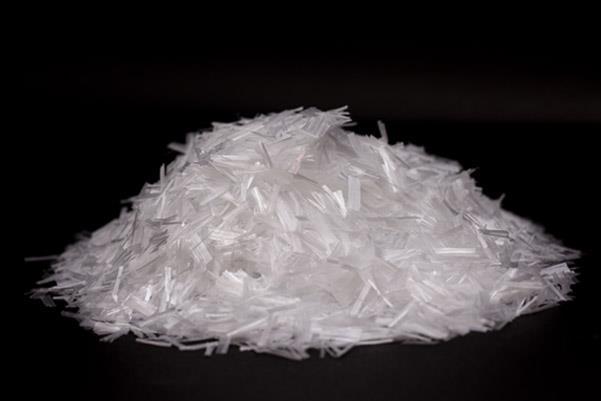
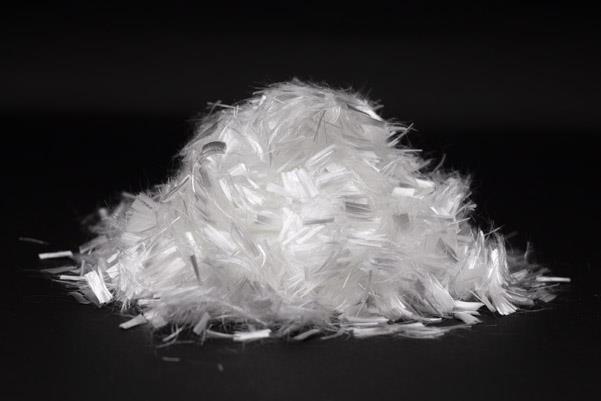
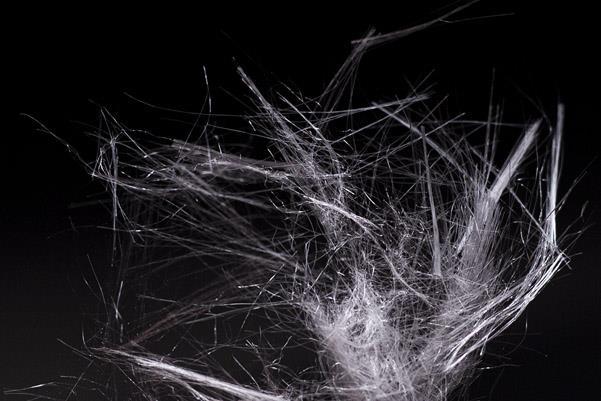
International Research Journal of Engineering and Technology (IRJET) e-ISSN: 2395-0056 Volume: 09 Issue: 01 | Jan 2022 www.irjet.net p ISSN: 2395 0072 © 2022, IRJET | Impact Factor value: 7.529 | ISO 9001:2008 Certified Journal | Page1208 Coarseaggregate Specificgravity 2.65 Waterabsorption 0.8% Specificgravity 2.5 Waterabsorption 2% Steel Fe500grade 2.2.3 Polypropylene Fiber Reinforced Concrete Polypropylenefibersof2differenttypesareusedinthisstudy.OneisSyntheticFibrillatedMeshFiberandother is Synthetic Monofilament Fiber. The fibers are provided by Kalyani polymers private limited which is located in Bangalore,India.Thefiberscomeinformof0.9kgpercubicmeterofconcrete.Lengthofthefiberis12mm.Theparameters andspecificationoffibersarelistedinatablebelow. Table 3 Synthetic Fibrillated Mesh Fiber Properties Parameters Specifications Material Polypropylene Colour Natural SpecificGravity 0.91 Meltingpoint 165℃ Diameter/Thickness 40Microns TensileStrength 600Mpa Young’sModulus 3.5Gpa AspectRatio >150 Fig 1 Synthetic Fibrillated Mesh Fiber Table 4 Synthetic Fibrillated Mesh Fiber Properties Parameters Specifications Material Polypropylene Colour Natural SpecificGravity 0.91 MeltingPoint 165℃ Diameter/Thickness 20Microns TensileStrength 1000Mpa Young’sModulus 4Gpa AspectRatio >300
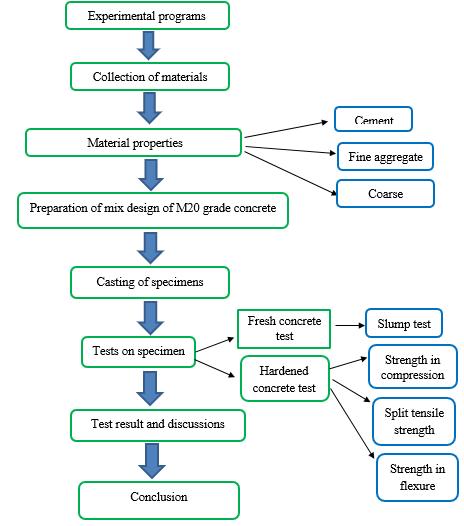
The test specimens were made using mix ratio of 1:1.5:3, which is equivalent to M20 grade concrete. To evaluate the e strength of concrete in compression, a standard cube specimen of 150mm X 150mm X 150mm was employed. For split tensilestrength,cylinderwithadiameterof150mmandheightof300mm,andforflexuraltest,beamspecimenof200mm depth150mmwidthand2000mmlengthareused.
3.0 Experimental Setup
3.2 Split Tensile Strength
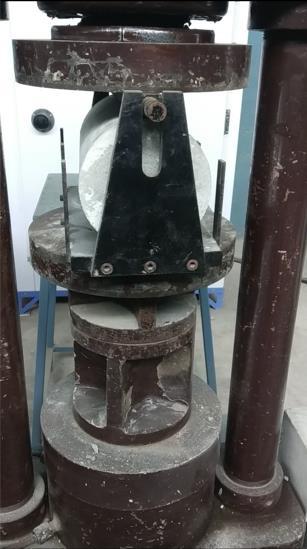
Cylindricalspecimenhavingdimension150mmdiameterand300mmheightwerepreparedtodeterminetensilestrength. ThespecimeniskeptunderCTMmachineofcapacity20tons.
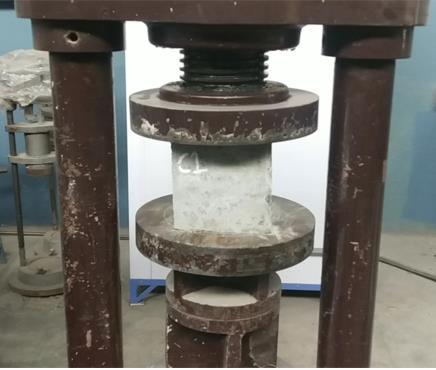
Fig 3 Compressive test of cube specimen
3.1 Compressive Strength
Fig 2
The test was performed was performed on a 150mm X 150mm X 150mm cube specimen. The compressive test was carriedoutbyplacingthecubeintheCTMmachinehavingacapacityof20ton.
Synthetic Monofilament Fiber
International Research Journal of Engineering and Technology (IRJET) e-ISSN: 2395-0056 Volume: 09 Issue: 01 | Jan 2022 www.irjet.net p ISSN: 2395 0072 © 2022, IRJET | Impact Factor value: 7.529 | ISO 9001:2008 Certified Journal | Page1209
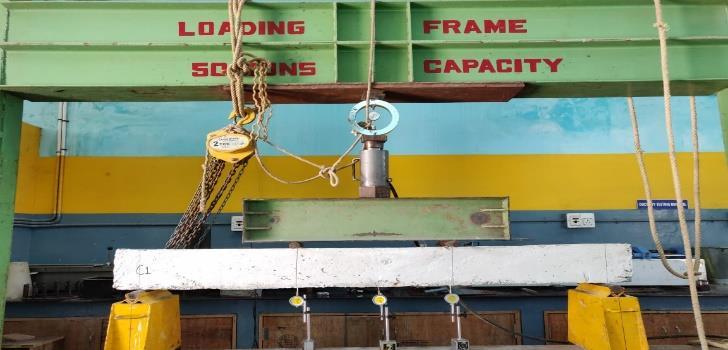
The simply supported RC beam is tested under the four point loading as shown in the figure. Firstly, the beam is lime washedtoshowthefinetextures of the crack pattern andtomake fractures obvious.A50 ton capacityof loading frame was used to test all the beam specimens without and with fiber. The effective span of all the beams was 2000mm. 3 dial gauges were to determine deflection of beam. Three dial gauges are used for deflection measurement. one dial gauge is placedexactlyatthecenterofthebeamandothertwoatthebothsidesofthecentraloneatadistanceof600mmfromthe support.Theloadisappliedforevery2KN. beam
International Research Journal of Engineering and Technology (IRJET) e-ISSN: 2395-0056 Volume: 09 Issue: 01 | Jan 2022 www.irjet.net p ISSN: 2395 0072 © 2022, IRJET | Impact Factor value: 7.529 | ISO 9001:2008 Certified Journal | Page1210 Fig 4
Split Tensile test of cylindrical specimen 3.3 Flexural Strength
Fig 5 Experimental setup of
Table 5 Load analysis of beam Specimen First crack load (kN) Ultimateload(kN) Average ultimate load(kN) Increase in strength,% CB1 18 80 83 15.85 CB2 20 82 FB1 24 96 95 FB2 26 94
4.2
C3 22.78 0.9%
Control C1
F1
Type
International Research Journal of Engineering and Technology (IRJET) e-ISSN: 2395-0056 Volume: 09 Issue: 01 | Jan 2022 www.irjet.net p ISSN: 2395 0072 © 2022, IRJET | Impact Factor value: 7.529 | ISO 9001:2008 Certified Journal | Page1211 Fig 6 variation of flexural strength of concrete Beam specimens were casted to test the flexural strength. Control specimens which are tested were failed at a load of 83KN.Thespecimenswith0.9%hybridfibersfailedataloadof95KN.Asaresult,thespecimenswith0.9%hybridfibers increasedinflexuralstrengthupto15.85%. 4.Result and Discussions 4.1 Compressive Test
F3 30.52 Cube
Table
A cylinder that splits across the vertical diameter is used to test the tensile strength of concrete. Three cylinders tested in each category and the average value is provided. Table shows the results of observing the failure load and calculatingthestrength.Totally6samples weretestedafter28daysofcuringinthat3werecontrolspecimensandtheir averagevalueisreported.Whencomparedtonormalconcrete,addinghybridfiberstoconcreteincreasedtensilestrength. Asasplittensilestrength,thefollowingformulawasused:
C2
Atotal of 6specimenswere tested, threecontrol specimensand other 3specimenswerefiber concrete mix. The resultsofcompressionstrengtharetakenfor28days.Itisnoticed thatbyaddingfiberinconcrete,compressivestrength increasescomparedtocontrolspecimenasshowninthefigure. Thestrengthincompressionofspecimenisformulatedby: strengthincompressive(Mpa)= Where,Pisloadatfailure 6 Compressive strength of the specimens of specimen Specimens (Mpa)strengthCompressive Avg. compressive strength (Mpa) Increase in strength, % 21.78 23.49 24.35 25.90 hybrid fibers 29.64 29.21 27.46 specimenswerecastedtotestthecompressivestrength.Controlspecimenswhicharetestedwerefailedata load of 23.49 MPa. The specimens with 0.9% hybrid fibers failed at a load of 29.21 MPa. As a result, the specimens with 0.9%hybridfibersincreasedincompressivestrengthupto24.77%. Split Tensile Test
F2
[VALUE] [VALUE]1009590858075 Control 0% Hybrid fibers 0.9% (KN)StrengthFlexural Fiber content %
5. K.Nagamani and Asvin Raj.K (2016), “ Experimental Study on Effect of Fibers for Reinforced Concrete”, International JournalofEngineeringResearch&Technology(IJERT), Volume04.pp.1 5.
Cylinderswerecastedtotestthesplittensilestrength.Controlspecimenswhicharetestedwerefailedataloadof 2.33MPa.Thespecimenswith0.9%hybridfibersfailedataloadof2.60MPa.Asaresult,thespecimenswith0.9%hybrid fibersincreasedintensilestrengthupto11.58%.
References:
1. Amal Dev, Maheswaran Chellapandian, and Shanmugam Suriya Prakash (2020), “Effect of Macrosynthetic and Hybrid Fibers on Shear Behavior of Concrete Beams Reinforced with GFRP Bars”, American Society of Civil Engineers(ASCE),Volume07.pp.04020031 1 04020031 16.
2. Ibrahim G. Shaaban, Mohamed Said, Sadaqat U. Khan, Mohamed Eissa, and Khalifa Elrashidy (2021), “Experimentalandtheoreticalbehaviorofreinforcedconcretebeams containinghybridfibres”,ElsevierJournal,Volume32.pp.2143 2160.
International Research Journal of Engineering and Technology (IRJET) e-ISSN: 2395-0056 Volume: 09 Issue: 01 | Jan 2022 www.irjet.net p ISSN: 2395 0072 © 2022, IRJET | Impact Factor value: 7.529 | ISO 9001:2008 Certified Journal | Page1212 Strengthintensile(Mpa)= Where,PisloadatfailureDiscylinderdiameter,Liscylinderlength Table 7 Tensile strength of specimen Type of specimen Specimens Tensile strength (Mpa) Avg. Tensile strength (Mpa) Increase in strength, % Control C1 2.20 2.33 11.58 C2 2.29 C3 2.50 0.9% hybrid fibers F1 2.56 2.60F2 2.62 F3 2.60
5.Conculsion
The study was carried on flexural strengthening of beam specimens with hybrid FRC. Two groups of beams, the first of whichconsists oftwocontrol specimens(CB)(CB 1andCB 2)andthesecondgroup(FB)hastwobeams(FB1andFB2) thatarereinforcedwithhybridfiberreinforcedconcrete.Basedonthetestsconductedonbeamsandcylindersandcubes thefollowingfindingsweremade. HFRC(polypropylene)of0.9%mixshowsariseincompressivestrengthcomparedwiththecontrolspecimen. Thereisanincreaseofabout15.85%inultimateloadofbeamswithfiberscomparedtocontrolspecimen. The compressive strength of hybrid fiber specimen is 24.35% more than the control specimens and the tensile strengthofthehybridfiberspecimenis11.74%morethanthecontrolspecimen. The various properties like failure load, compressive strength, split tensile strength were better in beams with fibers. The hybrid fibers utilized in the beam are primarily responsible for the variation in crack number and propagation,aswellastheincreaseinultimatestress.
3. Divya S Dharan and Aswathy Lal (2016), “Study the Effect of Polypropylene Fiber in Concrete”, International ResearchJournalofEngineeringandTechnology(IRJET),Volume06.pp.616 619.
4. Parveen and Ankit Sharma (2013), “Structural Behavior of Fibrous Concrete Using Polypropylene Fibers”, InternationalJournalofModernEngineeringResearch(IJMER),Volume03.pp.1279 1281.
9. AmitRana(2013)“Somestudiesonsteelfiberreinforcedconcrete”,InternationalJournalofEmergingTechnology andAdvancedEngineering(IJETAE),Volume03.pp.120 127.
International Research Journal of Engineering and Technology (IRJET) e-ISSN: 2395-0056 Volume: 09 Issue: 01 | Jan 2022 www.irjet.net p ISSN: 2395 0072 © 2022, IRJET | Impact Factor value: 7.529 | ISO 9001:2008 Certified Journal | Page1213 6. Manu P.P and Eldhose Cheriyan (2019), “Flexural Behavior of Hybrid Steel Basalt Fiber Reinforced Concrete”, InternationalResearchJournalofEngineeringandTechnology(IRJET),Volume05.pp.760 764. 7. A.AnnaduraiandA.Ravichandran(2016),“FlexuralBehaviorofHybridFiberReinforcedHighStrengthConcrete”, IndianJournalofScienceandTechnology,Volume09.pp.1 5. 8. Abid.S. Mulla and Akshata A. Mulgund (2016), “An Investigation on Mechanical Properties of Hybrid Reinforced Concrete”,InternationalResearchJournalofEngineeringandTechnology(IRJET),Volume05.pp.2680 2687.
11. V. Ramadevi, and D.L. Venkatesh Babu (2012), “Flexural behavior of hybrid (steel and polypropylene) fiber reinforcedconcretebeams,”EuropeanJournalofScientificResearch,Volume.70 pp.81 87
10. Denvid Lau and HoatJoen Pamb (2010), “Experimental study of hybrid FRP reinforced concrete beams”, EngineeringStructures,Volume.32,pp.3857 3865