
This project deals with the topic augmented reality (AR) in the field of real estate. Augmented reality (AR) is a digitally augmented version of the real physical environment created by the use of digital visual elements, music, or other sensory stimulation given through Astechnology.technology advances, Augmented Reality is becoming more prevalent in many businesses. One of which is the real estate sector. The field of augmented reality applications for real estate is vast, but unexplored. For the Real Estate sector, Augmented Reality opens up a plethora of new business prospects. The amount of time spent touring each site with consumers and not having appropriate resources to impress them is a common challenge that real estate developers face. However, by including augmented reality technology into the equation, the way commercial real estate investors, stakeholders, and clients engage with a specific area may be altered. With this project, we are aiming to create a user friendly mobile application that helps the users to view every aspect of the property virtually in 3D, without needing them to take the effort to travel there and visit the property physically. This application also allows the real estate developers to diversify their marketing methods and give the buyers a more memorable home experience.
International Research Journal of Engineering and Technology (IRJET) e ISSN: 2395 0056 Volume: 09 Issue: 01 | Jan 2022 www.irjet.net p ISSN: 2395 0072 © 2022, IRJET | Impact Factor value: 7.529 | ISO 9001:2008 Certified Journal | Page837 AUGMENTED REALITY FOR REAL ESTATE Vedika Patil1, Sonali Sathe2 , Aprajita3 , Milind Kamble4 1 4Dept. of Electronics Engineering, Vishwakarma Institute of Technology, Pune, India *** Abstract
1.INTRODUCTION
Key Words: Augmented Reality (AR), Real Estate, AR Technology, 3D, mobile application
The use of augmented reality (AR) is growing in every field.Realestateisn'tthefirstindustrythatcomestomind when considering how AR may be employed. No one can dispute, however, that it has enormous promise for improving the selling and purchasing experience in the real estate industry. Everyone nowadays has a smartphone or tablet with which they can readily access the internet, and the technology in these devices is improving by the day. As a result, using AR tools with the advanced devices we carry in our pockets is becoming easierandmorecomfortable.Thisdevelopmentpavesthe wayforanAR enhancedrealestatetechnology.
AR is used efficiently in visits for property purchase booking, progress tracking, worker preparation, risk management, time and cost executives, and quality and flaws. Furthermore, AR is used to grow an organisation that allows the possibility of having gatherings with persons who are topographically far apart from one anotheryetneedtobuyhomesfrompreciselywherethey are. It is expressly viewed as the many applications of Expanded Reality and how they are used in the Land Businesstomaketransactionssmoothandsimple.
The goal of this study was to assess and comprehend the impact of an augmented reality mobile application on
The impact of augmented reality application on learning motivationofstudents
Customerswillmainlybenefitfromthisapp.Theymaysee how their ideal house would appear using Augmented RealityinRealEstate.Forexample,whenindividualswere buying a plot, they had to deal with ambiguity and could only speculate on what they could build with it. They can nowvisualiseeverythingthankstothis augmentedreality technology. Customers can take a virtual 3D tour of each property, viewing each room and interior. As a result, customers will be able to make better purchasing decisions,makingeverypurchaseajoyousoccasion.Itnot onlyimprovesthebuyer'sexperience,butitalsoimproves the agent's by revolutionizing the selling and expanding themarketingmethods.
1.1 Literature review
There was a lack of perfection in everything when there was no augmented reality in real estate. Customers and agents both become equally irritated when visiting each and every site one by one. In the time constraints, people maymaketheincorrectdecision. Through this application, using augmented reality in real estates makes the home showing process more efficient andsuccessful.Theamountoftimespenttouringeachsite with consumers and not having appropriate resources to impress them is a common challenge that real estate developers face. Also, in this current world where everything is done virtually, one of the major problems faced by real estate developers is how to make things more convenient for the buyers. However, with the introduction of AR technology, the way commercial real estate investors, stakeholders, and clients deal with a specific location can be altered. AR can help real estate developers expand their marketing methods and give clients a more memorable home experience. Through this technology, buyers can look at every corner of the house/space just virtually and see what suits their needs, thus helping buyers to make decisions more quickly with moreaccurateinformation,resultinginlesshesitationand reducedbuyers’remorse.

Thegoalofthisreviewwastoidentifythemainareasand industries where AR is now being used, describe the technological solutions used, and highlight the primary benefits that may be obtained with this type of technology.[3]ThePast,Present, and Future of Virtual and Augmented Reality Research: A Network and Cluster Analysis of the Literature,FrontiersinPsychology
International Research Journal of Engineering and Technology (IRJET) e ISSN: 2395 0056 Volume: 09 Issue: 01 | Jan 2022 www.irjet.net p ISSN: 2395 0072 © 2022, IRJET | Impact Factor value: 7.529 | ISO 9001:2008 Certified Journal | Page838
The goal was to investigate the structural, technological, and user related factors that facilitate or impede the dissemination of augmented reality applications for real estate, and to provide a smart overview of existing applications and market potential for AR applications for real estate, as well as a visionary conclusion of expected futureReviewdevelopments.[5]andanalysisof augmented reality literature for constructionindustry
2. 2.1METHODOLOGYBlockdiagram
undergraduate health science students' learning motivation.[1]AugmentedReality in Education: Current Technologies andthepotentialforEducation
Augmented Reality technology in the manufacturing industry:Areviewofthelastdecade
Thepurposeofthisstudywastoconductasystematicand computational examination of the growing interdisciplinaryVRandAR areasintermsofmultipleco citationnetworksinordertoinvestigatethegrowthofthis knowledgedomain'sintellectualstructureovertime.[4] Augmentedrealityforrealestate
The purpose of this study was to evaluate the application areas of augmented reality technologies, including the goals for which these technologies were used in different project phases and how augmented reality models were usedtomeetprojectissues.[6]
2.2 Software Used
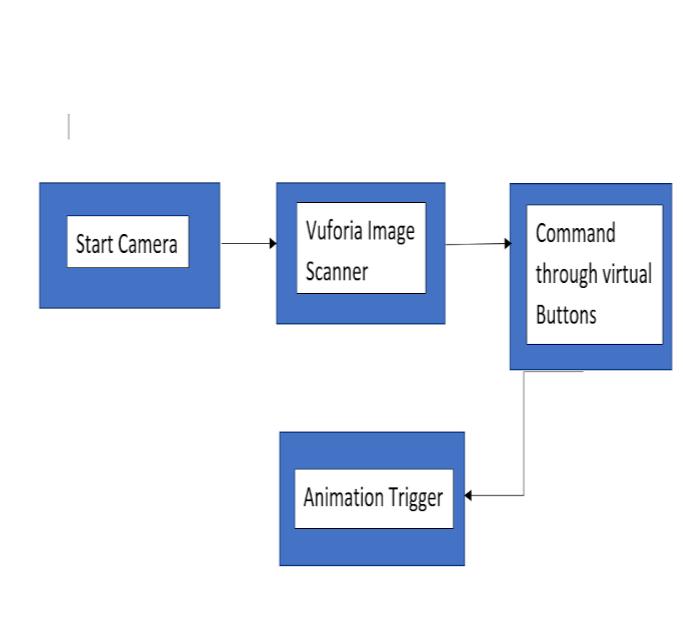
WhenauserstartstheARHOUSEapplicationfirstly,the intro scene will be there. There will be several houses in the intro scene. Users should choose one of them according to their choice. After that, the application will start the camera, and the user has to point the camera on the image target, and Vuforia will scan the picture, and showtheoutput.Thenbyclickingthevirtualbuttonsusers cangettoperformtherequiredactionsandtheanimation willbetriggered.
I. Unity The UNITY engine is capable of producing 2D, 3D, virtual reality, and augmented reality games and otherinteractiveexperiences.
Thepurposeofthispaper'sresearchwastwofold.Thefirst wastostudythetermaugmentedreality(AR)thatisused to describe this new artificial and augmented environment. The characteristics of an augmented reality system that are described, and the technologies used in this system categorized. Second, is the educational potentialinthiscontext.[2]
II. Vuforia Vuforia isa mobile based augmented reality software.Vuforia finds "feature points" in the target picture and uses the findings to compare the features in the target image with the receiving frame from the camera. Vuforia compares images captured by a cameratoapredefinedreferenceimage.Vuforiascans typically high contrast patches, curves, or edges that willnotvaryconsiderablywhenviewedfrommultiple angles.Iftheimagelacksenoughfeaturepoints,itwill most likely not be detected properly. As a result, the primary goal is to have a large number of feature points that can serve as a form of anchor for object recognition technology. The same feature extraction algorithm is used again, and if the majority of reference feature points on a camera frame are located, the image is identified as the marker. All objects are scanned with Vuforia's built in Object Scannertool.
Fig. 1. Proposed Model Flow Diagram.
International Research Journal of Engineering and Technology (IRJET) e ISSN: 2395 0056 Volume: 09 Issue: 01 | Jan 2022 www.irjet.net p ISSN: 2395 0072 © 2022, IRJET | Impact Factor value: 7.529 | ISO 9001:2008 Certified Journal | Page839 III. SKETCHUP 3DHousemodel. IV. Canva 3DHousemodel
2.3 Working
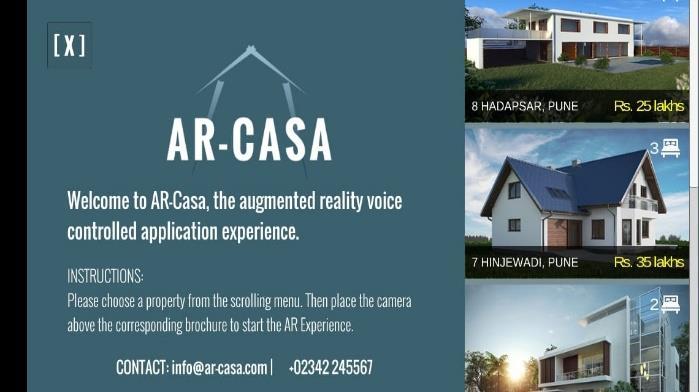
IntroScene: Fig. 2. Introduction Scene
ThetargetmanagerofVuforiahasastarratingsystem thatcomesupwithaheuristicanalysisofthegiventarget but does not necessarily appear for the actual run time detection and tracking performance. Vuforia uses the edge detection technique. If the high contrast image has more vertices or lines, Vuforia considers it a high rated image.1.
In the intro scene, the user can toggle through various housemodelsandpickthehousemodelwhichuserwants toprojectintherealworld,wherethemodelisforthefirst house only, the remaining houses were added for scroll viewso,theusercanchoosethefirsthouseforprojecting it intherealworld.
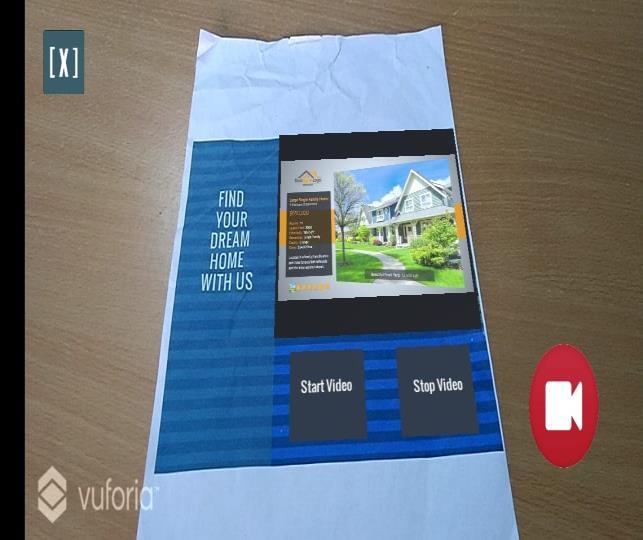
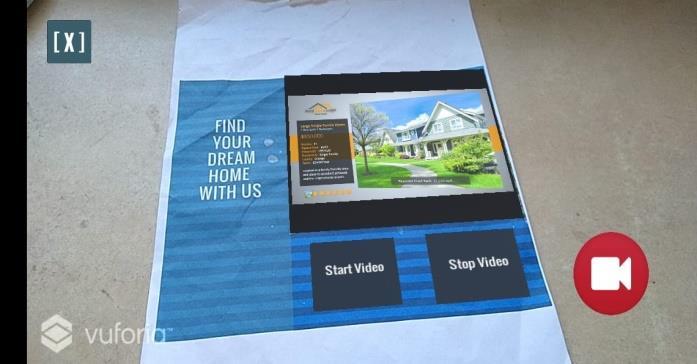
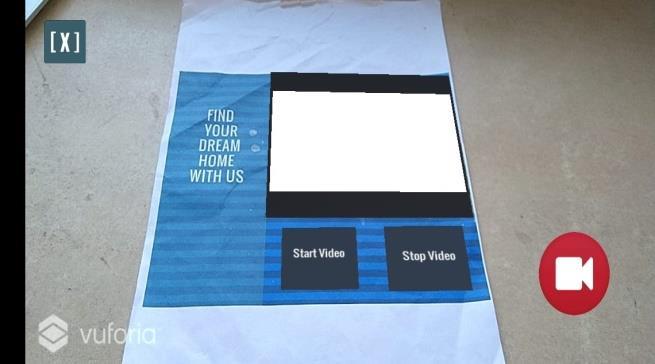
a. Target Image1forhousemodel: Fig. 3. Target Image 1 Fig. 3 is a target paper for house model. In Fig. 3 users can point the camera on the paper and here mainly we have included a promotional demo video of the company on a plane, which is augmented on one paper. There are twovirtualbuttons forstartingandstoppingthevideo. If the user presses the virtual button ‘START VIDEO’, then thevideowillbeaugmented,anditwillgetstoppedwhen theuserclicksonthevirtualbutton‘STOPVIDEO’.
There are numerous methods for image recognition in Vuforia, i.e., Model Targets Area Target Image Targets Object Targets Multi Targets Cylinder Targets VuMarks ExternalCameraGroundPlane.Thisproposedmodelused the Vuforia library for detecting a target image. Vuforia compares pictures captured by a camera to a previously given reference image. Vuforia scans the high contrast spots, curves, and edges and isolates certain areas with plentyoffeaturepoints.
Output: Fig. 4. Video Augmented on Target Image.
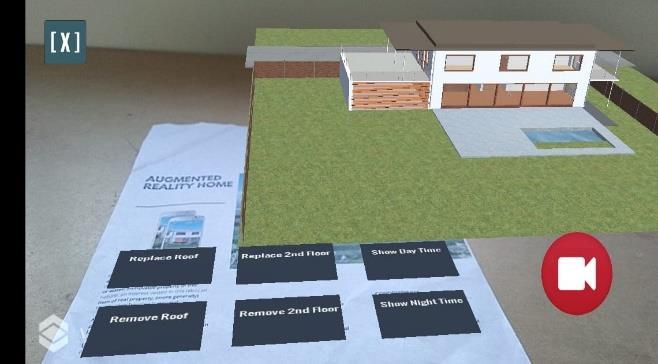
The model consists of creating an Augmented Reality based real estate application and projecting a full size home model in the real world. Then using virtual buttons for removing the roof, and the second floor, toggling into thedaymodeandnightmode,etc.Inthisproposedmodel, there are three scenes. Those scenes are the intro, house, andfirst person3 Dviewscenes.
2. HouseScene: There are 3 image targets as the user starts the camera andastheuserkeeps the printsofthese pagesinfront of them,thentheapplicationwillkeepontrackingthisimage targetandthesebuttonswillappearinfrontofthem.

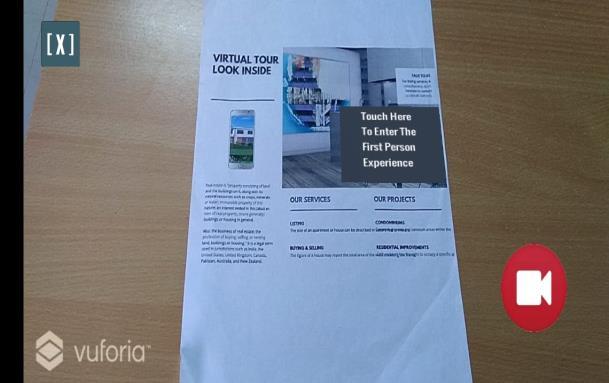
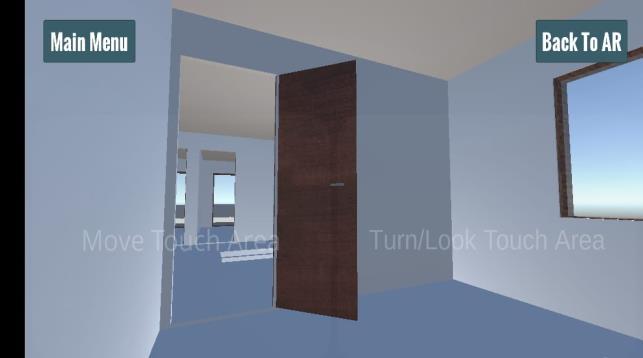
Inthisscene,theusercantakealookatthehousefrom inside.WhenauserpointstotheARcameraonthispaper no.3,avirtualbuttonforenteringintothe3 Dviewmode will appear. When the user clicks on that button, the application will ask whether to enter in first person 3 D view mode or not as shown in fig 8. So by clicking on continue Users can navigate throughout the house and actuallyobservethehousefrominsideveryclearly. Also, we have added mesh colliders to this model so thatuserswillgetarealhousenavigatingexperience.The use of these mesh colliders is that the user won’t pass through the walls until and unless he reaches the door. Also, users can take a walk around the whole house to observethehousefromallsidesasshowninFig.9.
Output: Fig. 8. Virtual Button for the first person view.
Output: Fig. 6. House Augmented on Target Image.
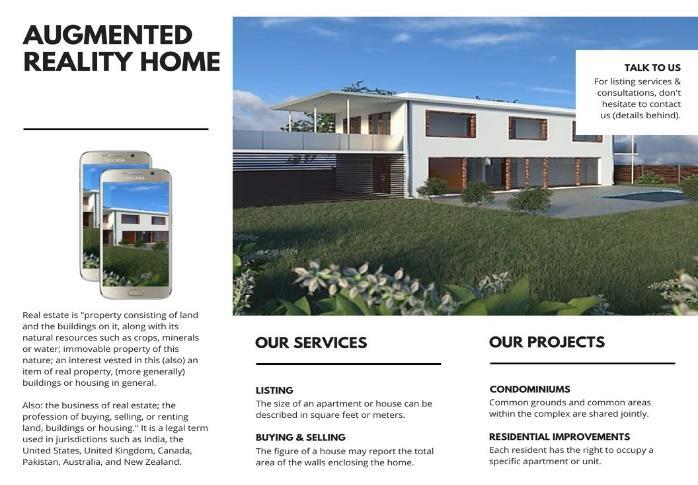
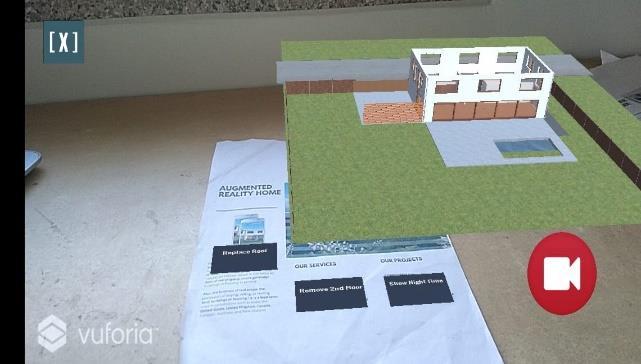
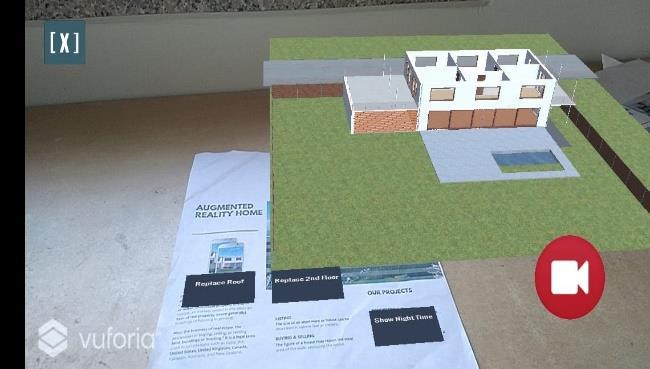
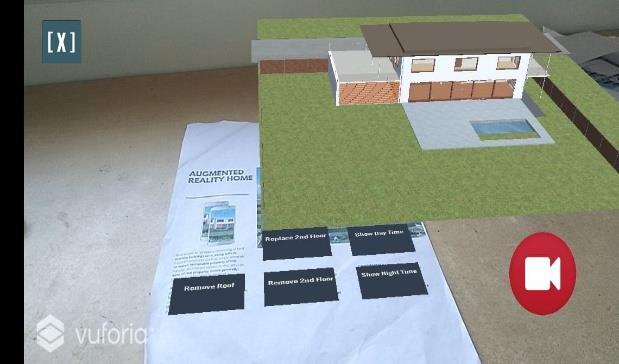
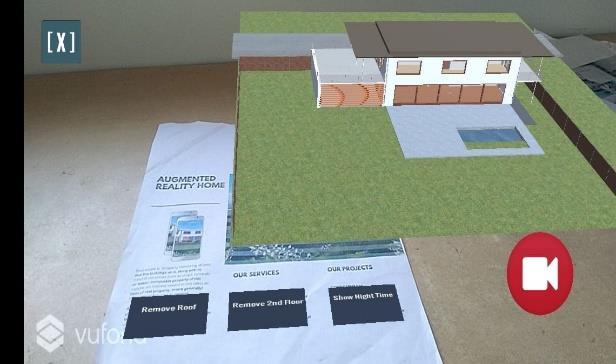
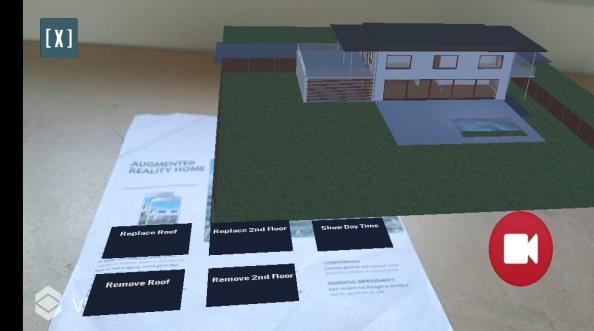
Fig. 5. Target Image 2 for House Model. Thisscenegivesalittlebitmoreinformationaboutthis property. Fig. 5 is the target image for augmentation. When the user points the camera on this paper, the primary house model will be visible. There are some virtual buttons which will get augmented on the paper. Users can use the virtual buttons for toggling the roof, second floor, day mode and night mode. This paper is used for observing how the house will look like as shown in Fig. 6. The user needs to click on the virtual buttons, which are augmented on the paper, and the actions like removing/replacing the roof, removing/replacing the second floor, etc., will be taken accordingly. By removing the roof, the user will be able to see the house from the upside. Also, users can see the alignment of rooms and also features of the second floor. By removing the second floor user can see the base floor, i.e., the ground floor of the house from upside. Also, there is a virtual button for toggling into day night mode. Users can observe the look ofthehousemodelindaymodeaswellasinnightmode. There are some point lights, which are added inside as wellasoutsidethehouse,willhelptheusertoobservethe house more efficiently and helps to differentiate between daymodeandnightmode.
3.First person3 DviewScene: a. TargetImage3forhousemodel: Fig. 7. Target Image 3 for House Model.
International Research Journal of Engineering and Technology (IRJET) e ISSN: 2395 0056 Volume: 09 Issue: 01 | Jan 2022 www.irjet.net p ISSN: 2395 0072 © 2022, IRJET | Impact Factor value: 7.529 | ISO 9001:2008 Certified Journal | Page840
b. ImageTarget2forhousemodel:

International Research Journal of Engineering and Technology (IRJET) e ISSN: 2395 0056 Volume: 09 Issue: 01 | Jan 2022 www.irjet.net p ISSN: 2395 0072 © 2022, IRJET | Impact Factor value: 7.529 | ISO 9001:2008 Certified Journal | Page841 Fig. 9. First Person View of House Model. This proposed model created four entities for the user toperformrequiredaction.Thoseentitiesareasfollows: Remove(Entity) Roof Fig. 10. “Remove roof’ action has been taken SecondFloor Fig. 11. ‘Remove 2nd Floor’ action has been taken Replace(Entity) Roof Fig. 12. ‘Replace Roof’ action has been taken SecondFloor Fig. 13. ‘Replace 2nd Floor’ action has been taken Mode(Entity)DayMode Fig. 14. Hose Model in Day Mode
3. CONCLUSION
4. Cipresso Pietro, Giglioli Irene Alice Chicchi, Raya MarianoAlcañiz,RivaGiuseppe.ThePast,Present,and Future of Virtual and Augmented Reality Research: A
1. House Script: This script handles the code to togglebetween the house models, and the roof, secondfloor,daymode,andnightmode.
4. ACKNOWLEDGEMENT
AR is predicted to be used by an even higher number of users in an increasing number of areas. AR technologies canhelpus tohandlethevastinformationflowgenerated bythe everincreasing worldwideknowledgebase.Forthe RealEstatemarket,AugmentedRealityopensupavariety ofnewbusinessprospects.Potentialrealestatebuyerscan already visit the property in 3D using AR before making the effort to travel there. AR also gives completely new marketingpotentialforrealtorsbyutilizinglocation based serviceswhilealsoofferingthebuyerwithaone of a kind experience. These days when it is becoming incredibly hard to get a buyer's undivided attention, Augmented Reality could make a significant difference in increasing engagementwithpotentialclientsanddifferentiatingyour company from the competition. AR technology will improvefurther,andtherealestatebusinesswillfindnew andfascinatingapplicationsforit.Therealestatebusiness has the potential to be reshaped by augmented reality. Embracingaugmentedrealitytechnologycanhelprealtors differentiate themselves from the competition by giving clientsaone of a kindexperience.
2. VB Button: This script handles the action of virtual buttons. The VB Button script determines what action should be done when the user hits the virtual button on thepaper.
This project was supported by Vishwakarma Institute of Technology. We thank Prof. Milind Kamble for his guidancewithARandrelatedresearch.Wewouldalsolike to show our gratitude to Prof. Milind Kamble for their constantsupportduringthecourseofthisresearch.
International Research Journal of Engineering and Technology (IRJET) e ISSN: 2395 0056 Volume: 09 Issue: 01 | Jan 2022 www.irjet.net p ISSN: 2395 0072 © 2022, IRJET | Impact Factor value: 7.529 | ISO 9001:2008 Certified Journal | Page842 NightMode Fig. 15. House Model in Night Mode VideoStart(Entity)Video Fig. 16. Video started on Target Image StopVideo Fig. 17. Video stopped on Target Image D.Script:There are several scripts written in C#, which performthe backend operation of the application. Those scriptsare:
3. Bottani, Eleonora AU Vignali, Giuseppe Y1 Augmented reality technology in the manufacturing industry:Areviewofthelastdecade 2019/03/04
REFERENCES
1. Khan, Tasneem, Johnston, Kevin, Ophoff, Jacques The Impact of an Augmented Reality Application on LearningMotivationofStudents, 2019/02/03
2. Kesim,Mehmet&Ozarslan,Yasin.(2012).Augmented Reality in Education: Current Technologies and the Potential for Education. Procedia Social and Behavioral Sciences. 47. 297 302. 10.1016/j.sbspro.2012.06.654.
3.Gamecontroller:Thisscripthandlesthechangingscene actions,suchaswhentheuserselectsthefirsthousefrom the intro scene, the scene will get changed to the house scene.
19. SANNA, Andrea; MANURI, Federico. A Survey on Applications of Augmented Reality. Advances in Computer Science : an International Journal, [S.l.], p. 18 27,jan.2016.ISSN2322 5157,13Jan.2022
7. Nilsson, Jonas, Anders C. E. Ödblom, Jonas Fredriksson, Adeel Zafar and Fahim Ahmed. “Performanceevaluationmethodformobilecomputer vision systems using augmented reality.” 2010 IEEE Virtual Reality Conference (VR) (2010):19 22. 8. J. Chun and B. Lee, "Interactive Manipulation of Augmented Objects in Marker Less AR Using Vision Based Hand Interaction," in Information Technology: New Generations, Third International Conference on, Las Vegas, Nevada, USA, 2010 pp. 398 403. doi: 10.1109/ITNG.2010.36
14. A. Arusoaie, A. I. Cristei, C. Chircu, M. A. Livadariu, V. Manea and A. Iftene, "Augmented Reality," 2010 12th International Symposium on Symbolic and Numeric Algorithms for Scientific Computing, 2010, pp. 502 509,doi:10.1109/SYNASC.2010.53.
13. R. Aggarwal and A. Singhal, "Augmented Reality and its effect on our life," 2019 9th International Conference on Cloud Computing, Data Science & Engineering (Confluence), 2019, pp. 510 515, doi: 10.1109/CONFLUENCE.2019.8776989.
15. H. Mishra, A. Kumar, M. Sharma, M. Singh, R. Sharma and A. Ambikapathy, "Application of Augmented RealityinthefieldofVirtualLabs,"2021International Conference on Advance Computing and Innovative TechnologiesinEngineering(ICACITE),2021,pp.403 405,doi:10.1109/ICACITE51222.2021.9404705.
16. J.J.Hulletal.,"Paper BasedAugmentedReality,"17th International Conference on Artificial Reality and Telexistence (ICAT 2007), 2007, pp. 205 209, doi: 10.1109/ICAT.2007.49.
20. Ronald Azuma, Yohan Baillot, Reinhold Behringer, Steven Feiner, Simon Julier, Blair MacIntyre, Recent AdvancesinAugmentedReality,2001
23. R. Silva, J. C. Oliveira, G. A. Giraldi, Introduction to Augmented Reality National Laboratory for Scientific Computation, Av. Getulio Vargas, 333 Quitandinha Petropolis RJ 24. Parekh, P., Patel, S., Patel, N. et al. Systematic review and meta analysis of augmented reality in medicine, retail, and games. Vis. Comput. Ind. Biomed. Art 3, 21 (2020).
11. F. Ababsa and M. Mallem, "Robust camera pose estimation combining 2D/3D points and lines tracking," 2008 IEEE International Symposium on Industrial Electronics, 2008, pp. 774 779, doi: 10.1109/ISIE.2008.4676964.
21. M. Hincapié, A. Caponio, H. Rios and E. González Mendívil,"AnintroductiontoAugmentedRealitywith applications in aeronautical maintenance," 2011 13th International Conference on Transparent Optical Networks, 2011, pp. 1 4, doi: 10.1109/ICTON.2011.5970856.
12. Kaufmann, Hannes. (2003). Collaborative Augmented RealityinEducation.
10. Huang, Yetao & Liu, Yuanan & Wang, Yongtian. (2009). AR View: an Augmented Reality Device for Digital Reconstruction of Yuangmingyuan. 3 7. 10.1109/ISMAR AMH.2009.5336752.
18. N.R.Raajan,S.Suganya,M.V.Priya,SruthiV.Ramanan, S. Janani, N.S. Sarada Nandini, R. Hemanand, S. Gayathri, Augmented Reality Based Virtual Reality, ProcediaEngineering,Volume38,2012
26. Sarminah Samad, Mehrbakhsh Nilashi, Rabab Ali Abumalloh, Fahad Ghabban, Eko Supriyanto, Othman Ibrahim, Associated Advantages and Challenges of Augmented Reality in Educational Settings: A Systematic Review, Journal of Soft Computing and DecisionSupportSystems,Vol8,No1(2021)
International Research Journal of Engineering and Technology (IRJET) e ISSN: 2395 0056 Volume: 09 Issue: 01 | Jan 2022 www.irjet.net p ISSN: 2395 0072 © 2022, IRJET | Impact Factor value: 7.529 | ISO 9001:2008 Certified Journal | Page843 Network and Cluster Analysis of the Literature in FrontiersinPsychologyvol.9,2018 5. Veronika Lang, Peter Sittler, Augmented Reality for Real Estate. 18TH Annual Pacific Rim Real Estate SocietyConferenceAdelaide,Australia,15 18January, 2012 6. Rankohi, S., Waugh, L. Review and analysis of augmentedrealityliteratureforconstructionindustry. Vis. in Eng. 1,9(2013).
22. DeyArindam,BillinghurstMark,LindemanRobertW., Swan J. Edward, A Systematic Review of 10 Years of Augmented Reality Usability Studies: 2005 to 2014, FrontiersinRoboticsandAI,Vol5,2018.
25. Bakka Naveen Kumar et al 2019 J. Phys.: Conf. Ser. 1362012102
17. Azuma, Ronald & Baillot, Yohan & Behringer, Reinhold&Feiner,Steven&Julier,Simon&Macintyre, Blair. (2001). Recent advances in augmented reality. IEEE Comput Graphics Appl. Computer Graphics and Applications,IEEE.21.34 47.10.1109/38.963459.
9. Zhou,F.,Duh,H.B.L.,Billinghurst,M.(2008)Trendsin Augmented Reality Tracking, Interaction and Display: A Review of Ten Years of ISMAR. Cambridge, UK: 7th IEEEandACMInternationalSymposiumonMixedand AugmentedReality(ISMAR2008),15 18Sep2008.