International Research Journal of Engineering and Technology (IRJET) e ISSN: 2395 0056 Volume: 09 Issue: 01 | Jan 2022 www.irjet.net p-ISSN: 2395-0072 © 2021, IRJET | Impact Factor value: 7.529 | ISO 9001:2008 Certified Journal | Page719 PERFORMANCE ANALYSIS OF CAR RADIATOR Rajput Aniket H.1, Chaudhari Dnyanraj A.2, Pawar Jeevan H.3 , Dombale Aditya N.4 1,2,3,4Students, Mechanical Engineering , Vishwakarma Institute of Information Technology , Pune Guided by : Dr. Sandeep S. Kore , Professor, Vishwakarma Institute of Information Technology , Pune *** Abstract: InCurrentera,itbecomesanneedtoDesignanAutomobilewithhigherefficiency,morelifeand environment friendly. For that purpose it is necessary to run the engine at favourable condition; so Radiator acts as an catalyst in the functioning of Engine. Radiator is Cross flow type Heat Exchanger which cools the coolant used in heat source (ex. Engine). Generally Staggered type Radiator with Turbulator type of fin and ethylene glycol as a coolant usedin radiator. Heat transfer between air and coolant is take place through Convection and Conduction mode. Nano particles(TiO2) are also used for effective heat transfer. This Paper includesthe Mathematical calculation for finding the heat transfer parameters by using analytical method andprogramming. Temperatureandvelocitydistributioninradiator. AnalysisaboutShape,CoolantandNanofluids.
pharmaceutical
Applications
Keywords: Staggered,Programming, Coolant,NanoFluids,Turbulence,Fins. :
For everyautomobile it isnecessary tomaintain enginetemperaturesotheseistakecarebyradiatorinmore 2thanwheelervehicalsandincaseof2wheeleritisdonebyfins. In an automobile engine rejects 33% of heat producedbycombustionoffuel.Soiftheseheatisnotget rejected toatmosphereorheatsink itwillcause Overheatingofenginesofollowingproblemscanoccur. applicationComponentlikeBoiler. Enginestruckdown So aboveissuesare addressed byCoolingsysteminautomobile.Coolingsystemrejects theexcess amountof heatproducedinengine.MostautomotivecoolingsystemsconsistofRadiator,Waterpump,fan,pressurecap, andthermostat.TheRadiatoristhemostprominentpart ofthesystembecauseittransfersheat.Radiatoris an cross flow type heat exchanger which maintain the temperature of engine in within a adequate limit by reducingtemperatureofcoolantwhichextracttheheat fromengineandrejectthesameheattoatmosphere throughair.Modeofheattransferbetweencoolantandairisconvection conduction convection. DryingdevicesinIndustry ChemicalandfireIndustry industry Devicesusedinairheatingintheleatherindustry breakdownoflubricatingoil metalweakeningofengineparts significantwearbetweenengineparts undesirablethermalstressesgeneration. Overheating permits the Creep in case higher
1.Introduction

Working: When engine is in running condition about 33% excess amount heat is generate by engine by combustion of fuel; so these heat is need to liberate to atmosphere; so in these sphere radiator function is comesintopicture.Generally,whenenginetemperaturereachesto700to800 Thermostatvalveswitchonthefan which sucks the atmospheric air and at same time coolant pump circulating the coolant around the engine blocks; from where it absorbed the heat by conduction and convection mode. Now, Coolant carries the same heattoinlettankthroughhosepipe;frominlettankcoolantflowthroughradiatortubes. Tabulator typeoffin are provided inside the tubes to create the turbulence effect inside the tubes; because if the fluid flows very smoothlythroughthetubes;thenonlythepartofthe fluid whichdirectlytouchingthesurfaceofthetubes is cooled rapidly than the part of fluid which do not share the tube surface. So it will cause insufficient heat transferandhencenoteffectivecoolingwilltakesplace;ThereforetoaddressedtheseissueTabulatortypeof finsareinsertedinsidethetubestheycreatestheturbulenceeffect;allpartoffluidiscoolrapidlyandalmostat same rate; Therefore effective cooling will takes place. When coolant flowing through the tubes it reject it’s heat to atmospheric air which sucks by fan continuously. Mode of heat transfer between coolant and air is Conduction and convection.After leaving the tubes coolant comes into Transmission cooler where coolant coolstheoil.Nowagainittransferstotheengineandcycleisrepeatwithrespecttotemperatureofengine. Calculations
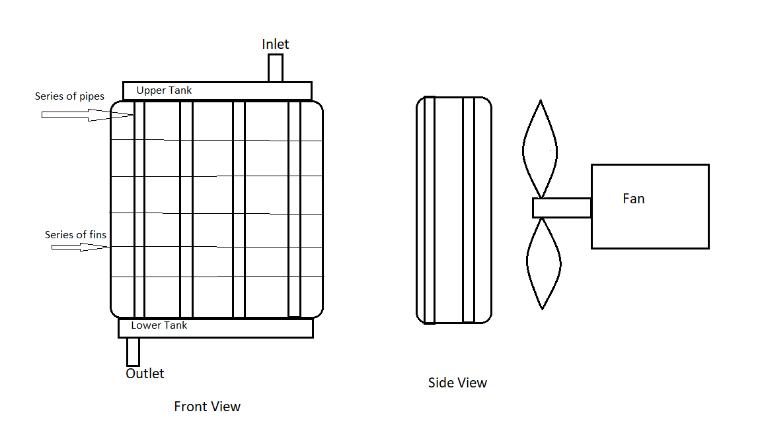
Construction: Radiator has inlet tank, outlet tank, tubes, radiator cap, fins, fan transmission cooler. Mostly manyRadiatoraremadeupofAluminumandhavingaluminumfinsprovidedbybrazing. Tubesareconnectedinparallelwaybetweeninletandoutlettank. Turbulatortypeoffinsareprovidedovertubes. Fan is provided behind the Radiator to pull theair.
2.Construction and Working of Radiator: Radiatorislocatedunderthehoodbeforetheengineandatthe frontofvehicle.Radiatoriscrossedflowtypeheatexchanger.Coolantusedinmanycarradiatorismixtureof ethyl glycol (70%) and water (30%) with these Tio2Nanofluidalsousedforimprovingtheheattransferrate.
Working principle: As coolant travels through theengine’s cylinder block, itaccumulates heat produced in engine;So when coolant’s temperaturerises aboveacertainthreshold value, the vehicle’sthermostat actuate the pumpwhich force the coolant to flow through the radiator. As the coolant flows through the tubes of the radiator,itabsorbed theheatfromengine throughConductionandconvection. Furthercoolantrejectsitheat toatmospherethroughair.
International Research Journal of Engineering and Technology (IRJET) e ISSN: 2395 0056 Volume: 09 Issue: 01 | Jan 2022 www.irjet.net p-ISSN: 2395-0072 © 2021, IRJET | Impact Factor value: 7.529 | ISO 9001:2008 Certified Journal | Page720
Transmission cooler is providedat bottom or atoutlettanktocooltheoil.
Inthese Studies;Thereare 2 methods are used for findingthe Heat Transfer diamension andHeat Transfer Efficiency. Method
3.Mathematical
Programming
Analytical
Radiator pressure cap is used to release theexcessivepressuregeneratedbyradiator.
International Research Journal of Engineering and Technology (IRJET) e ISSN: 2395 0056 Volume: 09 Issue: 01 | Jan 2022 www.irjet.net p-ISSN: 2395-0072 © 2021, IRJET | Impact Factor value: 7.529 | ISO 9001:2008 Certified Journal | Page721 56 42 35.40 8 28 AnalyticalMethod: UsingEnergybalanceequation, (mc*Cpc )(Tic Toc )=(ma*Cpa )(Toa Tia)100 2.78 (56 42)=525.35 1 (Toa 28)Toa= So35.408°Coutlettemperatureofairis=35.408Weknowthat, Q=mc Cpc (Tic Toc)=3892watt AvailableData OuterDiameter=11.25mm=0.01125m InnerDiameter=10mm=0.01m Thickness=0.0000625m OverallHeattransfercoefficient(U)=350W/m2 1 =(56 35.408)=20.592 2 =(42 28)=14 m=(1 2)/ln(1/ 2)=(20.592 14)/ln(20.592/14) LMTD=17.084392°C Now,usingtheaveragevelocityofcoolantintubesanditsflowratethetotalflowareaisgivenas, Af=mc/Vcx c=100/65*1036 Af=1.485 10 3m2 Butweknowthat, Af=n ( /4) d2 Bysubstitutingallvalues 1.485 10 3 =n ( /4) (0.01)2 weget, NoSr. observations (Cold)Air Coolant 1 InletTemperature(°C) 28 56 2 OutletTemperature(°C) 35.408 42 3 Mi.e.,massflowrate(kg/hr) 525.35 100 4 Cp.SpecificHeat(kJ/kg°C) 1 2.78 5 K ConductivityThermal(W/mK) 0.024 0.402 6 Density(kg/m3) 1.1 1036


International Research Journal of Engineering and Technology (IRJET) e ISSN: 2395 0056 Volume: 09 Issue: 01 | Jan 2022 www.irjet.net p-ISSN: 2395-0072 © 2021, IRJET | Impact Factor value: 7.529 | ISO 9001:2008 Certified Journal | Page722 n= approximate18.90n=19 fcorrectionfactoris0.96 Now,HeatTransferareaisgivenas, A=Q/(U·f· m)(counterflow) =3892/(350*0.96*17.08) A=0.678007m2 Lengthofthetubeisgivenby L= EffectivenessL=19.18A/(pie*D)mofHeatExchanger Ch=(m Cpc)coolant=(100*2.78*1000)/3600=77.22W/K Cc=(m Cpa )air=(525.35*1*1000)/3600Cc=145.931W/K Cmin=77.22W/K ; Cmax=145.931W/K Capacityratio(C): C=Cmin/Cmax =77.22/145.931 NTUC=0.52917=U·A/Cmin=350*0.678007/77.22 NTU=3.073841 =((1 e( (1 C)*NTU))/(1 (C*e( (1 C)*NTU)))) So=0.873510wegeteffectivenessequalto0.873510 MaxHeatTransferRate Qmax=Cmin*(Tic Tia)=77.22*(56 28)=2161.6168watt ActualHeatTransfer Qact= *Qmax=1888.193watt HeatTransferefficiencyEfficiency=(Qact/Qmax)*100 Efficiency=87.35% Programming: Variables and their meaning Tia=inlettemperatureofairinindegree Tic=inlettemperatureofcoolantindegree Toc=OutletTemperatureofCoolantindegree Toa= OutletTemperatureofairindegree ma =massofairinkg/hr mc=massofCoolantinkg/hr Cpa=SpecificHeatofairinkj/kgC Cpc=SpecificHeatofCoolantinkj/kgC Ka =ThermalConductivityofairinW/mk Kc=ThermalConductivityofCoolantinW/mk D=outsideDiameteroftubeinm;d=insideDiameteroftubeinm; t=Thicknessinm U=overallHeatTransfercoefficientinW/m2k Vc=Velocityofcoolantinm/hr a=EnterDensityofairinkg/m3 c=EnterDensityofCoolantinkg/m3 f=EntervalueofCorrectionfactor
International Research Journal of Engineering and Technology (IRJET) e ISSN: 2395 0056 Volume: 09 Issue: 01 | Jan 2022 www.irjet.net p-ISSN: 2395-0072 © 2021, IRJET | Impact Factor value: 7.529 | ISO 9001:2008 Certified Journal | Page723 StartInput: Tia, Tic, Toc, ma, mc, Cpa, Cpc, Ka , Kc, D, d, t, U, Vc, a, c, f Q= mc * Cpc * (Tic Toc ) Toa= (Q/(ma * Cpa)) +Tia 1= Tic Toa 2= Toc Tia m = (1 2) /ln (1/ 2) Af = mc /Vc x c n=Af/(0.7853*d2) A=Q/(U*f*m) Cmin=(mL=A/(pie*D) c*Cpc Cmax=(ma*Cp*0.2777) a*0.2777) C=Cmin/CmaxNTU=U·A/Cmin = ((1 exp( (1 C)*NTU))/(1 (C*exp( (1 C)*NTU)))) Qmax= Cmin*(Tic Tia) Qact= Efficiency=*Qmax(Qact/Qmax)*100 Print: Q, Toa, m, n, A, L, C, NTU, , Efficiency End



6.Coolant used in Radiator: FunctionofCoolantistoactsascarrierwhichcarrytheheatfromengineanddischargeittoatmosphere throughConvectionmode.Generally,Ethylglycolisusedasacoolantinradiatorbecause 4. ithasmuchlowerfreezingpointthanwater
AlthoughFollowingarethereasonforthe scope of Circular shape car radiator. Less material requirement: Since material savingis about 24%, cost saving on mass scaleproduction willbeabout20%,oncethediesaremanufactured. For optimum efficiencyeliminationofcorner is essentialtoreducepressuredropsoitcanbedoneby CircularshapeRadiator.
6. Takescarethecorrosionproblem
DuetofollowingReasonsCircularshapeofcarRadiatorisnotpreferred:
5. Itkeepsthecarenginefromfreezinginwinterandreduceoverheatinginsummer.
Advantagesofcircularshaperadiator:
Mainlyduetofollowing Reasons Square orRectangular shape car radiator isused:
3. Easyandleasefordesignandproduction. Spiral or Circular shape of Radiator
1. ItrequireslessspaceascomparetoRectangularmodelby 21.46%.
1. SpaceRequirementisless.
2. Itrequireslessmaterial,Thereforerequiresless.production costoncediesgetproduced.
2. ProvideHighHeattransferareaandalsohaveanaccesstoTabulatortypeoffinsoeffectivecoolingis takesplace.
3. PossibilityofDirectcooling;sonoeffectivecoolingcanoccur.
Difference Between antifreeze and Coolant : Antifreezeisan100%EthylglycolWhilecoolantisa mixtureofethylglycol(70%)andwater(30%).
2. Lesssurfaceareagetavailableforheattransferwithoutfins.
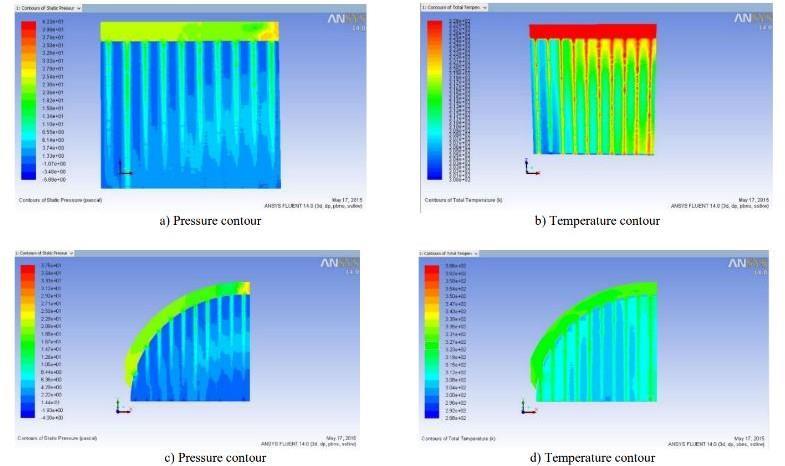
Pressure and temperature variation for rectangularand optimized circular radiator. SofromshownanalysisitisclearthatPressureandTemperaturedropinRectangularshaperadiatoris highascomparetocircularshape;henceefficiencycanbeoptimize byusingCircularshaperadiator.
International Research Journal of Engineering and Technology (IRJET) e ISSN: 2395 0056 Volume: 09 Issue: 01 | Jan 2022 www.irjet.net p-ISSN: 2395-0072 © 2021, IRJET | Impact Factor value: 7.529 | ISO 9001:2008 Certified Journal | Page724 4. Temperature and velocity Distribution in Rectangular shape car radiator: VelocityDistribution:Velocityofairatthebeginningofradiatorishighandgraduallydecreasingtowardsthe end Temperatureside.Distribution:Temperaturevariationisdeclinetowardstheendofradiator.
4. Insertingoffinsisalsodifficult.
1. DesignandProductionisHard.
5.Shape of Car Radiator:
Duetofollowing3reasonsfullyconcentratedethylglycolisnotusedinradiator:
3. Itgivesmoreheattransferrateby7.8%thanRectangular model. [6]
1. Antifreezefreezes between0degreeto minus 5degree;Sotohavetheprotectionbelowzeromarkit
International Research Journal of Engineering and Technology (IRJET) e ISSN: 2395 0056 Volume: 09 Issue: 01 | Jan 2022 www.irjet.net p-ISSN: 2395-0072 © 2021, IRJET | Impact Factor value: 7.529 | ISO 9001:2008 Certified Journal | Page725 % of nano fluid VS Thermal conductivity (w/mk ) 0.78 0.76 0.74 0.72 0.7 0.68 0.66 0.64 0 2 4 % of nano fluid 6 8 isnecessarytomixthewaterinadequateamountprescribedbymanufacturer. 2. Heattransfercapacityofantifreezeislessascomparetocoolant 3. In antifreeze; additives (silicates, phosphates and nitrates) are not properly suspended because of more viscosity while in case coolant due to presence of 30% water there is less viscosity and hence additivesareproperlysuspendedandhenceincreasesheattransferrate. 4. If antifreeze is allow to flow through the pump it will damage the pump because of high viscosity thereforecoolantissuitabletoused. 7.Significance of nano particles MostlyTiO2 Nanoparticlesareusedincarradiatorbecauseitisnontoxicinnature. Characteristics of TiO2 nanoparticles % of Nano fluids and Thermal Conductivity(W/mk)Parameter Value Purity 99% Colour White Diameter 42/nm SSA 1044/m2g Density 0.45g/cm3 HeatTransferCoefficientisimprovesby0.2%byaddition Ofnanoparticles.ThishappensduetoTio2 hasgreater ThermalConductivity,lowerspecificgravity,largesuface AreaandlowThermalResistance. Disadvantages about Nano Fluid: NanoFluidsaremoreviscousinNatureso Causesaproblemtocoolantflow,insamesense Itwillreducethelifeofcoolantpump. Homogeneoussuspensionofnanofluid Causesatechnicalproblemduetostrong Vanderwallsinteraction. ItwillincreasesPumpingpowerandpressure Drop. 8.Future Scope Use of nano fluids: application of nano fluid with coolant improve heat tarnsfer rate by about 0.2%.MostlyTiO2nanofluidisusedwithEthylglycolcoolant. S shaped fins: S shape fins are narrower; Therefore they gives more heat heat transfer area than conventional.Ifhigherisareahigherwillbeheattransferrate.Soitwillincreasetheefficiencyofheat transfer.
Increasing turbulence of coolants: The effectiveness of the radiator can be increased bycreating turbulence effectinside the tube. Inconventional radiator itis produced byprovidingtabulator fins. BestwaytoproducedTurbulenceeffectisStaggeredarrangement. Use of carbon foam fins: Aluminum fins can be replaced by Carbon foam fins because carbon foam hasthermalconductivitykisupto175w/mk.Thereforeitcangivehighheattransferrateandhence itcanpossibletoreduceoverallsizeofRadiator. Thermal conductivity (w/mk )
0 0.660225 1 0.678279 3 0.696671 4 0.753975 6 0.757485



International Research Journal of Engineering and Technology (IRJET) e ISSN: 2395 0056 Volume: 09 Issue: 01 | Jan 2022 www.irjet.net p-ISSN: 2395-0072 © 2021, IRJET | Impact Factor value: 7.529 | ISO 9001:2008 Certified Journal | Page726 CircularRadiator: 1. ItrequireslessspaceascomparetoRectangularmodelby21.46%. 2. Itrequireslessmaterial,Thereforerequiresless.productioncostoncediesgetproduced. 3. Itgivesmoreheattransferrateby7.8%thanRectangularmodel. 9. Design criteria: 1. HeatTransferRateQ 2. FlowRates 3. FoulingFactor 4. OuterShape&OverallDimensions 5. StrengthFactor 6. PressureDrop&PumpingPowerRequirement 7. Cost 10. Conclusion: 1. Radiatormaintainstheenginetemperatureandspeeduptheengineperformanceaswellascools the oil. 2. Nanofluidwithapplicationofcoolantimprovetheheattransferby0.2%;butitshighviscositycausesa problemtofluidflow. 3. Ethyl glycol (70%) + water (30%) is found as more effective coolant because it it has lower freezing andhigherboilingpoint;alsotakescarethecorrosion. 4. Any programming method is used for calculating the heat transfer parameters and efficiency of Radiatorbyfollowingthesameflowchart. 5. CircularshapeRadiatorwillalsobecameanoptioninfuture 6. ForeffectiveutilizationofRadiatorFollowingchangescanbemade Usedofnanofluid S shapedfins Increasingturbulenceofcoolants Useofcarbon foamfins CircularRadiator 11. References 1. Study on Performance Evaluation of AutomotiveRadiator Article in SAMRIDDHI A Journal of Physical SciencesEngineeringandTechnology·June2015 2. ImprovingCarRadiatorPerformanceByusingTiO2 waterNanofluidArticleinEngineeringScienceand TechnologyanInternationalJournalNovember2017 DOI:10.1016/j.jestch.2018.07.008 3. Noise and vibration analysis for automotive radiator cooling fan To cite this article: N FD Razaketal 2017IOPConf.Ser.:Mater.Sci.Eng.257012083 4. PerformanceAnalysisofAutomobileRadiatorArticle·May2016 5. CFD and Heat Transfer Analysis of Automobile Radiator Using Helical Tubes Kola David1 , Abhishek kumar2 M. Tech Student, QIS Collegeof Engineering and Technology, Ongole, AndhraPradesh, India1 Associate Professor, Departmentof Mechanical Engineering, QIS College of Engg&Technology Ongole, AndhraPradesh,India2 6. InternationalJournalofInnovativeResearchinScience,EngineeringandTechnology OptimizationofCircularShapedAutomobile RadiatorEbinJose1,A.VRamesh2andNidheeshP3