
Traditionally, convolutional neural networks were used for object classification. However, in recent years, convolutionalneuralnetworkshavebeenadaptedforobject detectiontaskswherelocalizationisrequiredinadditionto classification. A typical convolutional neural network achieves this by using alternating convolutional layers for feature extraction followed by max pooling or average pooling layers to reduce the number of parameters in the network.However,training a convolutional neural network from scratch using randomly initialized weights is impractical, as it requires considerable computational resources and takes considerable amount of time. To overcome this problem, most neural networks are initially trained on a large and varied dataset and the pre trained weights are used as a starting point for the specific object detection task at hand. The rest of the paper is organized as follows. In the next section, we give an overview of convolutional neural networks and transfer learning. In section III, we briefly survey some ofthe works which have been carried out on transfer learning. Section IV talks about the methodology used and contains the experimental results obtained. In Section V, we analyze our results and list some of the potential applications of our work. Finally, we conclude the paper in Section VI.
Abstract
Convolutional neural networks have been used for computer vision based tasks from around 1998. However, withtheintroductionofAlexNet[1]in2012whichharnessed the power of GPUs during training, several novel architecturesfor object recognition have been proposed and implemented.A convolutional neural network generally used forobjectdetection tasks is shown in Fig. 1.
II. BACKGROUND
Index Terms Transfer learning, TinyYOLOv3, Mean AveragePrecision
International Research Journal of Engineering and Technology (IRJET) e-ISSN: 2395-0056 Volume: 09 Issue: 01 | Jan 2022 www.irjet.net p ISSN: 2395 0072 © 2022, IRJET | Impact Factor value: 7.529 | ISO 9001:2008 Certified Journal | Page622 Easily Trainable Neural Network Using TransferLearning Varghese P Kuruvilla1 Department of Electronics and Communication Engineering,Sir M. Visvesvaraya Institute of Technology Bengaluru, India Vishnu Sodishetty3 Department of Electronics and Communication Engineering, Sir M. Visvesvaraya Institute of Technology Bengaluru, India V N Naveen Raju2 Department of Electronics and Communication Engineering,Sir M. Visvesvaraya Institute of Technology Bengaluru, India Phaninder Ravi Parimi4 Department of Electronics and Communication Engineering,Sir M. Visvesvaraya Institute of Technology Bengaluru, India phaninder ***
Fig.1. Architectureofatypicalconvolutionalneuralnetwork
Convolutional neural networks are growing increas inglypopularinthefieldofcomputervision.Oneof the most common problems encountered when using convolutional neural networks for computer vision tasks is that of transfer learning, where a pre trained model should be adapted to the specific task at hand. This paper investigates the performance of theTiny YOLOv3 neural network for transfer learning. Specifically, we aim to minimize the time taken for the pre trained networkto converge byvaryingthenumberoftrainablelayersandthe number of images used for training. For this experiment, Tiny YOLOv3 was used to detect a specific window of a buildingafteritwastrainedonalargeandvarieddatasetof real world images of windows. The resulting mean average precisionscoreswerecomparedanditwasfoundthat even for a shallow networklike Tiny YOLOv3, transfer learning greatly improved the mean average precision scores and minimized the convergence time. The neural network was trained using an Nvidia Tesla K80 GPU and the model was deployed on the Nvidia Jetson TX2 embedded platform. Usingtransferlearningweobtainedan83%decreaseinthe timetakentoachieve the required meanaverageprecision. Our work could be applied in scenarios where the neural network needs to be retrained quickly with a limited numberoftrainingsamples.
I. INTRODUCTION
A. Convolutional Neural Networks

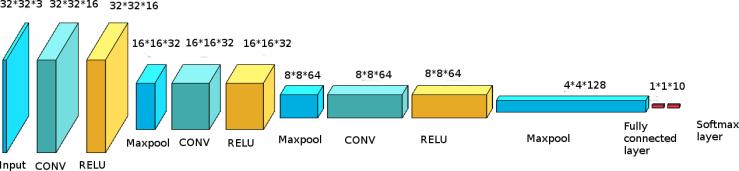
Fig.2. Windowstructuretobedetected
B. Tiny YOLOv3
C. Transfer Learning
International Research Journal of Engineering and Technology (IRJET) e-ISSN: 2395-0056 Volume: 09 Issue: 01 | Jan 2022 www.irjet.net p ISSN: 2395 0072 © 2022, IRJET | Impact Factor value: 7.529 | ISO 9001:2008 Certified Journal | Page623
A. Model trained using ImageNet weights
The concept of Multitask learning and transfer learning wasinitially introduced in [5], where it was postulated that learningseveral tasks in parallel can be beneficial, as the features learnt in one task could help the neural network perform better in other similar tasks. This work was improved upon in[6] whereitwasobserved thatalmostall taskssharecertaininvarianceswhichneuralnetworkscould potentially learn and transfer across different tasks. The work in [7] investigatesthe structural learning problem where predictive functional structures were learnt by simultaneously considering multiple prediction problems.
IV. METHODOLOGY
This section outlines the methodology we use for our experiment. The aim of investigating various transfer learning approaches is to train a neural network in a limited amount of timetodetectthewindowstructureshowninFig. 2. The neuralnetwork used for the detection task was Tiny YOLOv3. Tiny YOLOv3 was used since the model had to be deployed on a drone and carry out detections in real time with reasonable accuracy. The neural network was trained using an Nvidia Tesla K80 GPU following which it was deployed on an NvidiaJetson TX2 which was mounted on a drone. The experiments conducted are summarized in the following two sections
A typical neural network has a very large number of parameters. YOLO has approximately 50,000 parameters and training the network from scratch would take several days. Transfer learning is used to avoid this problem.
III. RELATED WORKS
Thepaperproposedasemi supervisedlearningapproachto achievethesame.Transferlearningisclosely linked with the generality and specificity of featuresin a neural network. Theworkcarriedoutin[8]attemptstoquantifythedegreeof generality and specificity associated with each layer of a neural network. It observed that the general features are learnt in the first layers while the last layers learn more specific features. It attempts to find outthelayerorlayers in the neural network where this transition from general to specific features occur. This knowledge can be used to optimize the transfer learning process. More recent works such as [9] try to reduce the model selection and hyperparameter tuning that is usually required when using traditional transfer learning approaches. The work in [9] proposes a model called Easy TL (Transfer Learning) which exploits intra domain structures to learn features.
Thesteps followed in object detectionare asfollows: The input image is fed into the first convolutional layer where theimageisconvolvedwithafilterofappropriatesizeusing nec essary stride and padding. The activation map output fromtheconvolutionlayerispassedthroughapoolinglayer to reduce the computational complexity of the model. The convolutional and downsampling (pooling) layers were initially introduced by Kunihiko Fukushima in [2]. In a typical neural network, several convolutional and pooling layers are stacked together to extract features from the image. Finally, the activation map of the last layer is flattened and passed as the input to afully connected layer which is responsible for predicting the probability associated with each class. Using an appropriate loss function, the error is computed and is backpropagated to update the weights and bias values.
TheauthorsofTinyYOLOv3provideconvolutionalweights for the darknet network that are pre trained on ImageNet. TinyYOLOv3isbuiltbasedonthedarknetframeworkwhichit usesforfeatureextraction.Whentheseconvolutionalweights are used for training, the additional weights specific to Tiny YOLOv3 are randomly initialized. Various trials were con ductedwheredifferentlayersofthenetworkwerefrozenand the corresponding mean average precision (mAP) scores
We used the Tiny YOLOv3 neural network for our exper iment. It is a state of the art object detection model and has achievedathroughputof30framespersecondontheNvidia Pascal Titan X GPU. YOLO (You only look once) worksby dividing the input image into a grid of 26 by 26 cells. Eachcellpredictsacertainnumberofboundingboxesalong with a confidence score that represents the probability thattheboundingboxenclosesanobject.Thearchitectureof TinyYOLOv3 is clearly explained in [3].
Transfer learning refers to a machine learning method where a model initially developed for a particular task is used as a starting point for some other specific task.This concept was initially introduced in the NIPS 95 workshop ”Learning to Learn”. A detailed explanation of transfer learning is given in [4]. Thisis the focus of this paper.
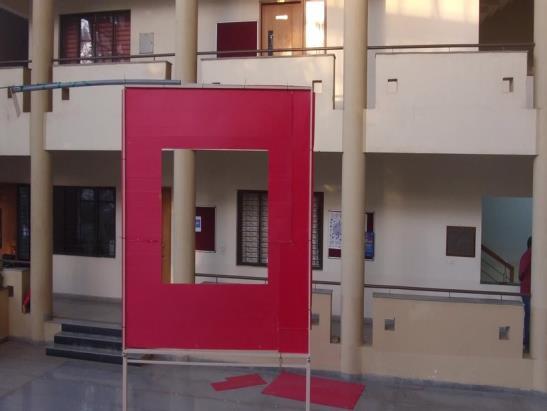
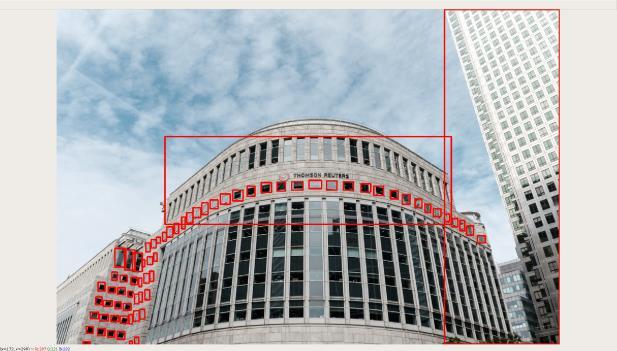
The method that we followed to further improve the perfor mance of the detector is as follows: Initially, the networkistrainedonalargenumberofimagesofreal world windows, these weights were then used as a starting point for training the detector to detect the specific type of window shown inFig. 2. We made use of the Google Open Images Dataset which contains approximately 55,000 images ofwindowssplitintotrain, test and validation sets. Whenall50,000imageswereinitiallyusedfortrainingthe network, it failed to converge. Upon further investigation, it wasfoundthatseveralimagesliketheoneshowninFig.3con tained annotations that could potentially confuse the detector. Furthermore, the dataset contained windows of different sizes and shapes which does not help our specific case. To solve theproblem, we combed through the dataset manually in order to extract 2000 images of reasonably annotated windows. Even after extracting windows of roughly similar shapes andsizes, the network failed to achieve a satisfactory mAP score
International Research Journal of Engineering and Technology (IRJET) e-ISSN: 2395-0056 Volume: 09 Issue: 01 | Jan 2022 www.irjet.net p ISSN: 2395 0072 © 2022, IRJET | Impact Factor value: 7.529 | ISO 9001:2008 Certified Journal | Page624 were recorded. The results of these trials are summarized inTab.I. B. Model trained using COCO weights The authors also provide yolov3 tiny.weights which containweights for the entireTiny YOLOv3 network trained on the COCO dataset, after being initialized with the pre trainedImageNetweights.Weightscorrespondingtothefirst 15layers TABLEI PERFORMANCEOF THE MODEL TRAINED USING IMAGENET WEIGHTS nsIteratio Mean Average Precision Number of layers frozen = 10000 35 1500 67 1800 92 2000Number91of layers frozen = 100013 0.4 1500 5 1800 3 2000Number2.98of layers frozen = 100020 0.7 1500 0.7 1800 0.7 2000 0.8 Were extracted and the model was trained for the windowdetection task. The results are summarized in Tab. II. TABLEII PERFORMANCE OFTHEMODELTRAINEDUSINGCOCO WEIGHTS nsIteratio Mean Average Precision Number of layers frozen = 10000 89 1500 96 1800 96.4 2000Number98of layers frozen = 100013 60 1500 77 1800 80 2000Number79of layers frozen = 100020 4 1500 23 1800 23 2000 27 C. Transfer Learning
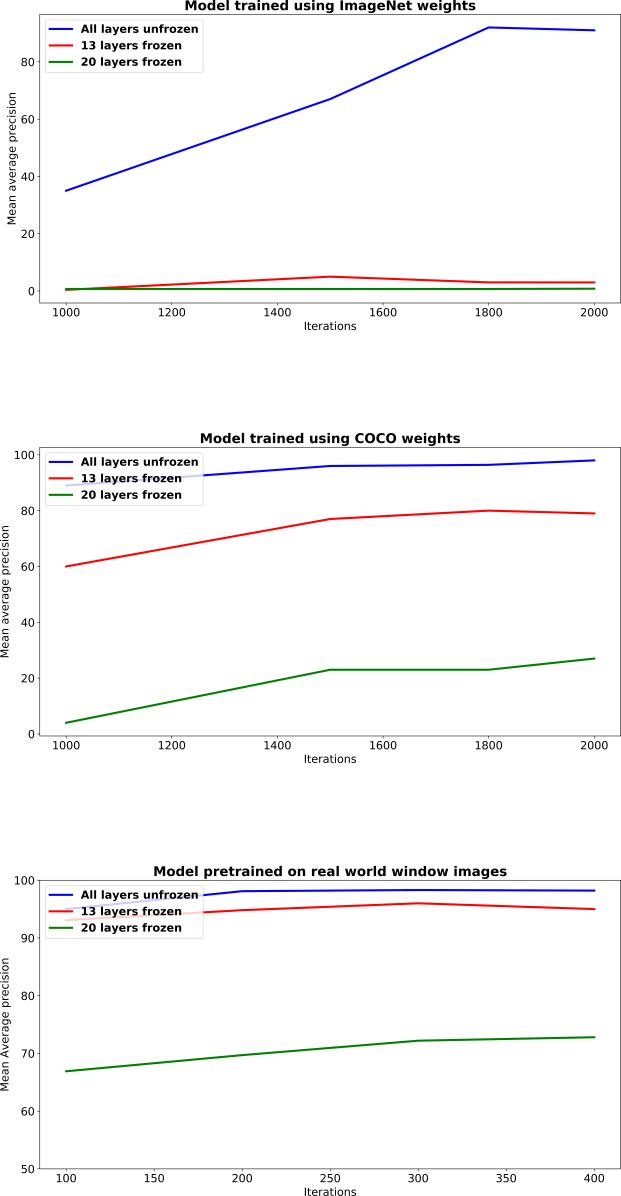
From Tab. I, we can observe that the performance of the model trained using the pre trained ImageNet weights with none of the layers frozen is reasonable, however, the perfor manceofthemodeldropsdrasticallywhenafewofitslayers are frozen. This could imply that the pre trained ImageNet weights have not captured all of the low level features required for the window detection task. Tab. II shows a relative increasein the performance of the model trained usingCOCOweights.This increase in performance is because the authors obtained Fig.4. Comparisonof themAPscores obtained using models
International Research Journal of Engineering and Technology (IRJET) e-ISSN: 2395-0056 Volume: 09 Issue: 01 | Jan 2022 www.irjet.net p ISSN: 2395 0072 © 2022, IRJET | Impact Factor value: 7.529 | ISO 9001:2008 Certified Journal | Page625 when trained on the 2000 window images using the pre trainedCOCOweightsasastartingpoint.Aftervarioustrials in whichdifferent number of layers were frozen, the best mAP score obtained was around 60 percent after 1800 iterations.However,astheseweightsaregoingtobeusedfor transfer learning, the mAP score achieved on the Open Images dataset is not of great importance. Using these weightsasastartingpoint,transferlearningwascarriedout andtheresultsobtainedaretabulatedin Tab. III. Fig.3. Exampleofabadannotationthatcouldbringdownthe performanceofthedetector TABLEIII PERFORMANCEOFTHE PRE TRAINED MODEL nsIteratio Mean Average Precision Number of layers frozen = 1000 95 200 98.1 300 98.3 400Number98.2of layers frozen = 10013 93.08 200 94.81 300 96.8 400Number95.1of layers frozen = 10020 66.9 200 69.7 300 72.2 400 72.8 Fig. 4 is a plot of the mAP score versus the number of iterations for the models trained using ImageNet weights, COCO weights and the model pretrained on real world windowimages.
V. RESULTS AND DISCUSSIONS
different
REFERENCES
International Research Journal of Engineering and Technology (IRJET) e-ISSN: 2395-0056 Volume: 09 Issue: 01 | Jan 2022 www.irjet.net p ISSN: 2395 0072 © 2022, IRJET | Impact Factor value: 7.529 | ISO 9001:2008 Certified Journal | Page626
VI. CONCLUSIONS:
[1] A. Krizhevsky, I. Sutskever, and G. Hinton, “Imagenet classificationwith deep convolutional neural networks,” Neural InformationProcessingSystems,vol. 25, 01 2012.
[7] R.K.AndoandT.Zhang,“Aframeworkforlearningpredictivestructuresfrom multiple tasks and unlabeled data,” J. Mach. Learn. Res., vol. 6,pp.1817 1853,Dec. 2005.
Further from Fig. 4, it is observed that transfer learning greatly improves the performance of the detector, even on an almost featureless object like a window. Using the same testingand training dataset, the model achieves a mAP score of 98 percentafteronly300iterations.Evenafterfreezing13layers of the network, it achieves a mAP score of 96 percent after 300iterations.Aslightdegradationinperformancecanbeseenonly after 20 layers of the network were frozen. Along with anincrease in the mAP score, the time taken for the networkto converge greatly decreased as a result of transfer learning. Wedemonstratethattransferlearningcangreatlyaidin improvingtheperformanceofobjectdetectors,evenifthe objects inquestionarealmostfeatureless.Transferlearning canbeusedinscenarioswherethereisascarcityin theamountofdata availablefortheobjectdetectiontask.IftransferlearningisperformedonlargermodelslikeYOLOv3,thenetworkwouldlearn moregeneralfeaturesandcouldthereafterbeusedforawidevarietyofobjectdetectiontasks.
[3] J.RedmonandA.Farhadi,“Yolov3:Anincrementalimprovement,”2018.
[2] K.Fukushima,“Neocognitron:Aself organizingneuralnetworkmodelforamechanismofpatternrecognitionunaffectedby shiftinposition,”Biological Cybernetics,vol. 36,pp. 193 202,1980.
[6] S.ThrunandL.Pratt,eds.,LearningtoLearn Norwell,MA,USA:KluwerAcademic Publishers, 1998.
[5] R.Caruana,“Multitasklearning,”MachineLearning,vol.28,pp.41 75,Jul 1997.
[8] J.Yosinski,J.Clune,Y.Bengio,andH.Lipson,“Howtransferablearefeaturesindeepneuralnetworks,”inAdvancesinNeural Information Processing Systems 27 (Z. Ghahramani, M. Welling, C. Cortes, N. D. Lawrence, and K. Q. Weinberger, eds.), pp. 3320 3328,CurranAsso ciates, Inc., 2014.
[4] S. J. Pan and Q. Yang, “A survey on transfer learning,” IEEE Transactionson Knowledge and Data Engineering, vol. 22, pp. 1345 1359,Oct2010.
Thepre trainedCOCOweightsbytrainingtheentirenetwork ontheCOCOdatasetafterloadingitwiththeImageNetweights. ItisalsoobservedthatfreezingalargenumberoflayersforashallownetworksuchasTinyYOLOv3leadstoadegradationin its performance. One of the drawbacks of usingCOCO weights is that the network requires a large number of iterations to produce a reasonable mAP score.
[9] J.Wang,Y.Chen,H.Yu,M.Huang,andQ.Yang,“Easytransferlearningby exploiting intra domainstructures,” 2019.