
IRJET- Application of E-Bike Chain-Drive Transmission in Stair Climbing Trolley

Page 1

International Research Journal of Engineering and Technology (IRJET)

e-ISSN: 2395-0056

Volume: 07 Issue: 07 | July 2020

p-ISSN: 2395-0072

www.irjet.net

Application of E-Bike Chain-Drive Transmission in Stair Climbing Trolley Eeshan Nandkumar Chaudhari1, Hrugved Bharat Pawar2, Akshay Suhas Oak3, Kimaya Pradeep Patil4 1,2,3,4B.E.

(Mechanical), Sinhgad College of Engineering, Pune, Maharashtra, India ---------------------------------------------------------------------***----------------------------------------------------------------------

Abstract - This project aims at developing a mechanism for

easy transportation of heavy loads over stairs. Devices such as hand trolleys are used to relieve the stress of lifting while on flat ground: however these devices usually fail when it comes to carrying the load over short fleet of stairs. Hence the need for using staircase climbing trolley has been greatly felt to ease the effort required to carry the heavy loads manually. The main objective of the project is to find an effective and user friendly method of carrying loads through stairs using minimum efforts from the user and to provide a smooth movement. A few issues of vibrations, speed control, and so forth greatly affect the working of the trolley. Hence this project involves the design of an ergonomic staircase climbing trolley for a variety of staircase types. The model is an application of the E-Bike Chain-Drive Transmission system. The frames and wheels are designed and developed according to the statistical data of dimensions of staircases in Indian buildings. Key Words: Tri-star, E-Bike Transmission, Stair Climbing, Failure Analysis, Motor, Throttle

1. INTRODUCTION Customary hand trucks function well on level ground, yet their handiness decreases when it gets necessary to move a load over an unpredictable surface. Package deliverymen, for instance, frequently think that it is important to drag stacked hand trucks up short stairwells just to arrive at the front entryway of a building. The whole reason for utilizing an ordinary hand truck is to avoid from lifting and haul substantial objects around. Lifting a hand truck up the stairs nullifies the purpose of the device, since the user must provide enough upward force to lift the entire weight of the trolley and its load. Moreover, the geometry of a hand truck makes it difficult to lift with one's legs as is the proper form. Much amount of strain is placed on the back muscles and the risk of operator injury is sharply increased. The pulling up of a standard hand truck up the stairs results in a uneven and vibrating motion. This movement may harm the items loaded on the hand truck or cause them to collapse entirely. A hand truck that could climb stairs without requiring the user to lift would improve the safety of moving heavy objects over irregular surfaces. The stair-climbing hand truck is designed to reduce burdens rather than increase them. A special type of wheel © 2020, IRJET

|

Impact Factor value: 7.529

|

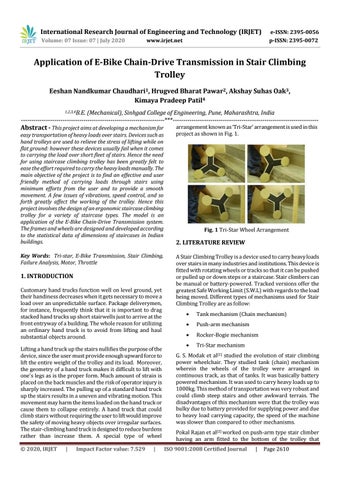
arrangement known as ‘Tri-Star’ arrangement is used in this project as shown in Fig. 1.

Fig. 1 Tri-Star Wheel Arrangement

2. LITERATURE REVIEW A Stair Climbing Trolley is a device used to carry heavy loads over stairs in many industries and institutions. This device is fitted with rotating wheels or tracks so that it can be pushed or pulled up or down steps or a staircase. Stair climbers can be manual or battery-powered. Tracked versions offer the greatest Safe Working Limit (S.W.L) with regards to the load being moved. Different types of mechanisms used for Stair Climbing Trolley are as follow: 

Tank mechanism (Chain mechanism)

Push-arm mechanism

Rocker-Bogie mechanism

Tri-Star mechanism

G. S. Modak et al[1] studied the evolution of stair climbing power wheelchair. They studied tank (chain) mechanism wherein the wheels of the trolley were arranged in continuous track, as that of tanks. It was basically battery powered mechanism. It was used to carry heavy loads up to 1000kg. This method of transportation was very robust and could climb steep stairs and other awkward terrain. The disadvantages of this mechanism were that the trolley was bulky due to battery provided for supplying power and due to heavy load carrying capacity, the speed of the machine was slower than compared to other mechanisms. Pokal Rajan et al[2] worked on push-arm type stair climber having an arm fitted to the bottom of the trolley that ISO 9001:2008 Certified Journal

|

Page 2610


Turn static files into dynamic content formats.
Create a flipbook
IRJET- Application of E-Bike Chain-Drive Transmission in Stair Climbing Trolley by IRJET Journal - Issuu