International Research Journal of Engineering and Technology (IRJET)
e-ISSN: 2395-0056
Volume: 07 Issue: 07 | July 2020
p-ISSN: 2395-0072
www.irjet.net
FRICTIONLESS BRAKING SYSTEM Akash Sawant1, Myron Pereira1, Roger Pereira1, Yogesh Ingavale1 1Department
of Mechanical Engineering, DBIT, University of Mumbai, Mumbai, Maharashtra, India ---------------------------------------------------------------------***----------------------------------------------------------------------
ABSTRACT: MOST OF BRAKING SYSTEM RUN ON THE PRINCIPLE THAT RELEASE OF KINETIC ENERGY TO THE HEAT ENERGY. THIS IS THE METHOD WHICH HAS ITS OWN DISADVANTAGES AND MUST BE REPLACED WITH MORE EFFICIENT BRAKING SYSTEM THAT I RESPOND QUICKLY, DOESN’T HEAT AND ALSO MAINTENANCE FREE. IN THIS PROJECT, A FRICTIONLESS BRAKING SYSTEM IS PROPOSED USING EDDY CURRENT PHENOMENON. THIS PHENOMENON IS ADMINISTRATED BY FARADAY’S LAW OF ELECTROMAGNETIC INDUCTION AND LENZ’ LAW. EDDY CURRENT IS GENERATED BY THE RELATIVE MOTION BETWEEN A METAL, ALLOY CONDUCTOR AND A MAGNET. THE CURRENT INDUCES MAGNETIC FIELDS IN THE CONDUCTOR WHICH OPPOSES THE ACTUAL MAGNETIC FIELD OF THE MAGNET AND RESULTS IN THE DECELERATION OF MOTION (LENZ LAW). THE CONSTANT MAGNETIC FIELD IS THE EASIEST DESIGN TO IMPLEMENT. THE MECHANISM WHICH IMPLEMENTS THIS PHENOMENON IN EVOLVING BRAKING SYSTEM. THIS BRAKING SYSTEM IS FRICTIONLESS, HENCE IT’S ADVANTAGEOUS OVER CONVENTIONAL FRICTION BRAKES IN TERMS OF PERFORMANCE AND MAINTENANCE. THE PROPOSED SYSTEM IS IMPLEMENTED IN REAR WHEEL OF VEHICLES.
History
It is found that magnetic brakes can develop a minus power which represents almost double the highest power output of a regular engine, and a minimum of thrice the braking power of an exhaust brake. (Reverdin, 1994). These activities of magnetic brakes make them much more useful contender for supplementary deceleration equipment compared with other decelerators. By using by using the magnetic brakes as a supplementary deceleration equipment, the friction brakes can be used less often, and so really never reach big temperatures. The brake linings would last more longer longer before requiring repair and the dangerous “brake fade” problem could be dodged. In a research conducted by a truck producing company, it was shown that the magnetic brake assumed 80% of the load which would else have been demanded of the regular service brake (Reverdin, 1974). Furthermore, the magnetic brakes prevent the danger that can arise from the continuos use of brake beyond their capacity to spread away heat.
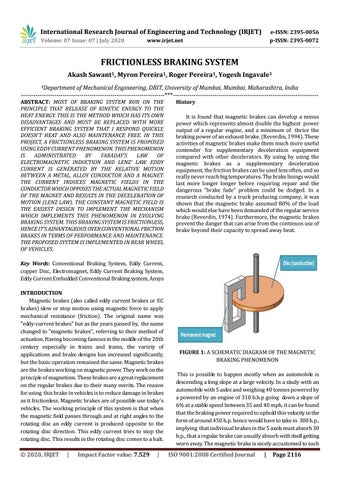
Key Words: Conventional Braking System, Eddy Current, copper Disc, Electromagnet, Eddy Current Braking System, Eddy Current Embedded Conventional Braking system, Ansys INTRODUCTION Magnetic brakes (also called eddy current brakes or EC brakes) slow or stop motion using magnetic force to apply mechanical resistance (friction). The original name was "eddy-current brakes" but as the years passed by, the name changed to "magnetic brakes", referring to their method of actuation. Having becoming famous in the middle of the 20th century especially in trains and trams, the variety of applications and brake designs has increased significantly, but the basic operation remained the same. Magnetic brakes are the brakes working on magnetic power. They work on the principle of magnetism. These brakes are a great replacement on the regular brakes due to their many merits. The reason for using this brake in vehicles is to reduce damage in brakes as it frictionless. Magnetic brakes are of possible use today’s vehicles. The working principle of this system is that when the magnetic field passes through and at right angles to the rotating disc an eddy current is produced opposite to the rotating disc direction. This eddy current tries to stop the rotating disc. This results in the rotating disc comes to a halt.
© 2020, IRJET
|
Impact Factor value: 7.529
|
FIGURE 1: A SCHEMATIC DIAGRAM OF THE MAGNETIC BRAKING PHENOMENON This is possible to happen mostly when an automobile is descending a long slope at a large velocity. In a study with an automobile with 5 axles and weighing 40 tonnes powered by a powered by an engine of 310 b.h.p going down a slope of 6% at a stable speed between 35 and 40 mph, it can be found that the braking power required to uphold this velocity in the form of around 450 h.p. hence would have to take in 300 h.p., implying that indivisual brakes in the 5 axels must absorb 30 h.p., that a regular brake can usually absorb with itself getting worn away. The magnetic brake is nicely accustomed to such
ISO 9001:2008 Certified Journal
|
Page 2116