International Research Journal of Engineering and Technology (IRJET)
e-ISSN: 2395-0056
Volume: 07 Issue: 06 | June 2020
p-ISSN: 2395-0072
www.irjet.net
Introduction and Controlling of Wind Turbine in Wind Energy Conversion System Divyansha Pandey1, Swati Singh2 1PG Student [Power System], Dept. of EEE, Maharishi University of Information Technology, Lucknow, U.P., India 1 2Assistant Professor, Dept. of EEE, Maharishi University of Information Technology, Lucknow, U.P., India 1
----------------------------------------------------------------------***--------------------------------------------------------------------2. MAIN COMPONENT OF WIND TURBINE Abstract - The present scenario of India is total wind power generated about 37 GW. This is possible by better monitoring and controlling of wind turbine by power electronics devices and recent controlling technologies. in this paper wind turbine main component of wind turbine, its types are represented and different controlling method discuss for maximum efficiency. the non conventional energy resource are used to promote low carbon energy in India to maintain our economical as well as ecological system. In wind turbine the output torque and power depends on the incoming wind speed. Due to the rapid changes in the incoming wind speed the quality of output power becomes a serious problem. Many controls are introduced in wind turbines in order to get a constant output rated power. In this research work we have focused on dynamic analysis and Pitch control of horizontal axis wind turbine. Pitch control is one of the most useful and important control that is present in all of the current wind turbine models
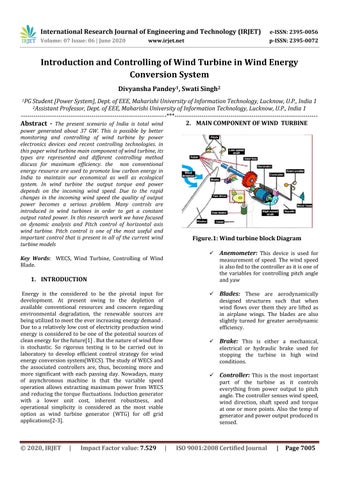
Figure.1: Wind turbine block Diagram
Key Words: WECS, Wind Turbine, Controlling of Wind Blade.
measurement of speed. The wind speed is also fed to the controller as it is one of the variables for controlling pitch angle and yaw
1. INTRODUCTION Energy is the considered to be the pivotal input for development. At present owing to the depletion of available conventional resources and concern regarding environmental degradation, the renewable sources are being utilized to meet the ever increasing energy demand . Due to a relatively low cost of electricity production wind energy is considered to be one of the potential sources of clean energy for the future[1] . But the nature of wind flow is stochastic. So rigorous testing is to be carried out in laboratory to develop efficient control strategy for wind energy conversion system(WECS). The study of WECS and the associated controllers are, thus, becoming more and more significant with each passing day. Nowadays, many of asynchronous machine is that the variable speed operation allows extracting maximum power from WECS and reducing the torque fluctuations. Induction generator with a lower unit cost, inherent robustness, and operational simplicity is considered as the most viable option as wind turbine generator (WTG) for off grid applications[2-3].
© 2020, IRJET
|
Impact Factor value: 7.529
Anemometer: This device is used for
Blades: These are aerodynamically designed structures such that when wind flows over them they are lifted as in airplane wings. The blades are also slightly turned for greater aerodynamic efficiency.
Brake: This is either a mechanical, electrical or hydraulic brake used for stopping the turbine in high wind conditions.
Controller: This is the most important part of the turbine as it controls everything from power output to pitch angle. The controller senses wind speed, wind direction, shaft speed and torque at one or more points. Also the temp of generator and power output produced is sensed.
|
ISO 9001:2008 Certified Journal
|
Page 7005