International Research Journal of Engineering and Technology (IRJET) e-ISSN: 2395-0056 Volume: 07 Issue: 06 | June 2020
www.irjet.net
p-ISSN: 2395-0072
NOISE DETECTION WITH AN AUTOMATIC RECORDING SYSTEM Bujagale Akash 1 1Student,
Department of ECE, Sreenidhi Institute of Science and Technology, Hyderabad, India ---------------------------------------------------------------------***--------------------------------------------------------------------
Abstract - Increase in sound in schools and office have
the Arduino is connected to the Bluetooth module HC 05 the recorded clips are directly shown in the MIT app as a file.
proven to be a major problem. A pedagogue or a praepostor can’t monitor every last one around the clock. To solve this, we have designed a Noise detection with an automatic recording system using Arduino. This device notifies us whenever it detects loud conversation (the sound level above 120dB to 140dB) and it also records the conversation and saves in a file. These devices are used in silent zones like hospitals, libraries, labs, and also in schools and colleges to maintain decorum. This helps us to maintain silence and also to identify noisy people so that necessary action can be against them.
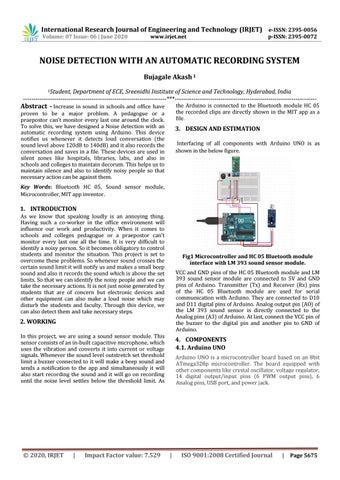
3. DESIGN AND ESTIMATION Interfacing of all components with Arduino UNO is as shown in the below figure.
Key Words: Bluetooth HC 05, Sound sensor module, Microcontroller, MIT app inventor.
1. INTRODUCTION As we know that speaking loudly is an annoying thing. Having such a co-worker in the office environment will influence our work and productivity. When it comes to schools and colleges pedagogue or a praepostor can’t monitor every last one all the time. It is very difficult to identify a noisy person. So it becomes obligatory to control students and monitor the situation. This project is set to overcome these problems. So whenever sound crosses the certain sound limit it will notify us and makes a small beep sound and also it records the sound which is above the set limits. So that we can identify the noisy people and we can take the necessary actions. It is not just noise generated by students that are of concern but electronic devices and other equipment can also make a loud noise which may disturb the students and faculty. Through this device, we can also detect them and take necessary steps.
Fig1 Microcontroller and HC 05 Bluetooth module interface with LM 393 sound sensor module. VCC and GND pins of the HC 05 Bluetooth module and LM 393 sound sensor module are connected to 5V and GND pins of Arduino. Transmitter (Tx) and Receiver (Rx) pins of the HC 05 Bluetooth module are used for serial communication with Arduino. They are connected to D10 and D11 digital pins of Arduino. Analog output pin (AO) of the LM 393 sound sensor is directly connected to the Analog pins (A3) of Arduino. At last, connect the VCC pin of the buzzer to the digital pin and another pin to GND of Arduino.
2. WORKING In this project, we are using a sound sensor module. This sensor consists of an in-built capacitive microphone, which uses the vibration and converts it into current or voltage signals. Whenever the sound level outstretch set threshold limit a buzzer connected to it will make a beep sound and sends a notification to the app and simultaneously it will also start recording the sound and it will go on recording until the noise level settles below the threshold limit. As
© 2020, IRJET
|
Impact Factor value: 7.529
4. COMPONENTS 4.1. Arduino UNO Arduino UNO is a microcontroller board based on an 8bit ATmega328p microcontroller. The board equipped with other components like crystal oscillator, voltage regulator, 14 digital output/input pins (6 PWM output pins), 6 Analog pins, USB port, and power jack.
|
ISO 9001:2008 Certified Journal
|
Page 5675