International Research Journal of Engineering and Technology (IRJET)
e-ISSN: 2395-0056
Volume: 07 Issue: 06 | June 2020
p-ISSN: 2395-0072
www.irjet.net
Seismic Performance Evaluation of RC Building Connected With and Without X-Braced Friction Dampers Ansa Haseeb T A1, Geethika G Pillai2 1PG Student Indira Gandi Insitute of Engineering and Technology, kothamangalam,kerala
2Assistant Professor Indira Gandi Insitute of Engineering and Technology, kothamangalam,kerala
---------------------------------------------------------------------***--------------------------------------------------------------------1.1 Objectives Abstract – The paper presents a comparison of RC earthquake estimations with buildings with and without friction dampers, whose implementation is consistent with IS 1893:20029(part 1), equivalent static, response spectrum and pushover analysis, code G+5, G+10 and G+15 story building respectively are considered for the different analysis. The comparison of equivalent static analysis method and response spectrum analysis method by using finite element software ETABS. In this study building model analysis values of the coded values of gravity, longitudinal direction and horizontal direction. Results will be discussed in terms of time limit, store displacement, store drift and base shear.
1. 2. 3.
To study the seismic behavior of selected G+25 R.C.C building with bracing and damper by using ETABS2015 software by Time history Analysis. To compare various parameters namely base shear, story drift and story displacement To determine whether damper or bracing which will be more resistant to earthquake for the selected building
1.2 Methodology
Key Words: Pushover Analysis, Storey Drift, Different Types of Dampers.
1. 2. 3. 4.
1. INTRODUCTION
5.
An earthquake is a sudden movement of the earth that ejects energy stored in the earth crust and generates seismic waves. These elastic waves radiate out from the source and touch the ground. Structures or large lateral displacements are caused by earthquakes, and special care is needed to limit the displacement. This ductile behavior is achieved by the constant plastic deformation of the structural members. To control this lateral displacement, different engineers used different techniques.
6. 7. 8.
Literature review Fixing the objectives Validation of building modal Analysis of Multi storied RC building without bracing or damper Analysis of Multi storied RC building with different types of bracings Analysis of Multi storied RC building with bracings at different story levels. Analysis of Multi storied RC building with damper Comparison of results and determination of best model
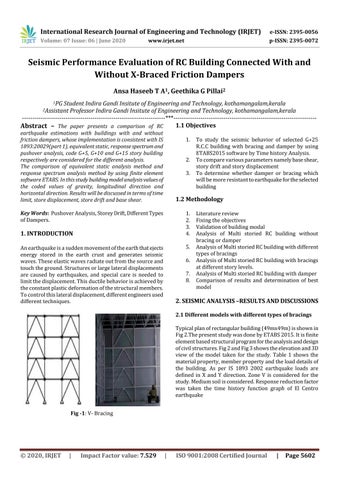
2. SEISMIC ANALYSIS –RESULTS AND DISCUSSIONS 2.1 Different models with different types of bracings Typical plan of rectangular building (49mx49m) is shown in Fig 2.The present study was done by ETABS 2015. It is finite element based structural program for the analysis and design of civil structures. Fig 2 and Fig 3 shows the elevation and 3D view of the model taken for the study. Table 1 shows the material property, member property and the load details of the building. As per IS 1893 2002 earthquake loads are defined in X and Y direction. Zone V is considered for the study. Medium soil is considered. Response reduction factor was taken the time history function graph of El Centro earthquake
Fig -1: V- Bracing
© 2020, IRJET
|
Impact Factor value: 7.529
|
ISO 9001:2008 Certified Journal
|
Page 5602
International Research Journal of Engineering and Technology (IRJET)
e-ISSN: 2395-0056
Volume: 07 Issue: 06 | June 2020
p-ISSN: 2395-0072
www.irjet.net
Table -1: Details of building frame
frame is considered for the present study as shown in Fig 3. The height of each storey is 3m.The frame is designed according to IS 456-2000.The compressive strength of concrete is taken as 35MPa and yield strength reinforcement steel is 500MPa.The building configuration details given in Table 1.
MATERIAL PROPERTY Grade of concrete M35 Grade of steel Fe 500 MEMBER PROPERTIES Thickness of slab 150 mm Beam size 250 mm X 500 mm Column size 250 mm X 550 mm Bracing ISMB300 LOAD DETAILS Dead load for Floor 1kN/m2 finishes Live load (roof and 2kN/m2 floor)
Chart -1: Base shear The base shear value for rectangle, pentagon, hexagon and L shaped models with shear wall at corner position are 4431.1624kN, 4180.56kN, 6154.5915kN, 5400.09kN in the second case the base shear value reduced for all the four shapes.
Fig -2: Plan of the building
Fig -4: X- 3D view
Fig -3: X-Elevation view
Fig -5: Damper position
The time history analysis was carried out using the analysis software ETABS 2015.The response of the building without bracing& damper, are obtained and results are compared. The response parameters considered in this study is Base shear, Maximum storey displacement and Maximum storey drift. Dynamic response spectrum analysis was performed on the structure. A 25 storey, seven bay 2-D RC building
© 2020, IRJET
|
Impact Factor value: 7.529
Chart -2: Maximum storey displacement
|
ISO 9001:2008 Certified Journal
|
Page 5603
International Research Journal of Engineering and Technology (IRJET)
e-ISSN: 2395-0056
Volume: 07 Issue: 06 | June 2020
p-ISSN: 2395-0072
www.irjet.net
bracings at soft storey level, World Multidisciplinary Civil Engineering-Architecture-Urban Planning Symposium, Vol.161, Pg. No: 9-17. [5] 5]Arshad K. Hashmi, Alok Madan (2008)Damage forecast for masonry infilled reinforced concrete framed buildings subjected to earthquakes in India,CurrentScience,Vol.94,Pg. No:61-73 [6] Danish Khan, ArunaRawat (2016) Nonlinear seismic analysis of masonry infill RC buildings with eccentric bracings at soft storey level, World Multidisciplinary Civil Engineering-Architecture-Urban Planning Symposium, Vol.161, Pg. No: 9-17. [7] 5]Arshad K. Hashmi, Alok Madan (2008)Damage forecast for masonry infilled reinforced concrete framed buildings subjected to earthquakes in India,CurrentScience,Vol.94,Pg. No:61-73
The displacement value of the building without shear wall and bracing at roof level is 155.3 mm in the case of model with bracing it is reduced into 109.7 mm and in the case of model with shear wall it is again reduced to 57 mm. The displacement value at ground level is 10.1mm and it is reduced to 9 mm in the case of model with bracing and again reduced to 1.4 in the case of model with shear wall.
3. CONCLUSIONS Steel bracing is economical, easy to erect and occupies less space and has flexibility to design for meeting the required strength and stiffness. Reduction in lateral displacement is the major advantage. The main parameters studied are the base shear, storey displacement and store drift. The building is modeled using the finite element software ETABS 15.From the analysis of the results, the following conclusion can be made. In the case of X,V, Inverted V and damper building the base shear value is higher for the buildings with damper than with bracing and without bracing and damper.
The storey displacement values of the X,V ,Inverted V and damper building without bracing and damper is very high than the model with bracing and damper. In the case of building with damper the storey displacement value is very less. The storey drift value of the X, V, I inverted V and damper, building without bracing and damper is high storey drift than the modal with bracing and damper. By comparing the bracings and damper at 9m interval, building with damper has high base shear value. By comparing the bracings and damper at 9m interval, building with damper has less storey displacement and storey drift. From the all different comparative studies building with damper is the best.
REFERENCES S.P. Nirkhe1, A.G. Dahake, V.R. Upadhye (2016) Seismic Behavior of Soft Storey Building With Static and Dynamic Earthquake Loading, International Journal of Structural Engineering and Analysis, 2016, Vol.2,Pg. No:1-7 [2] Ari Wibowo, John L Wilson, Nelson TK Lam, Emad F Gad (2015) Collapse behavior assessment of precast soft storey building, Engineering Structures Journal, Elsevier., Vol.125, Pg. No: 1036-1042. [3] Adrian Fredrick C.Dya,C Andres Winston. Oreta (2015) Seismic vulnerability assessment of soft story irregular buildings using pushover analysis, Engineering Structures Journal, Elsevier, Vol.125, Pg. No: 923-932. [4] Danish Khan, ArunaRawat (2016) Nonlinear seismic analysis of masonry infill RC buildings with eccentric [1]
© 2020, IRJET
|
Impact Factor value: 7.529
|
ISO 9001:2008 Certified Journal
|
Page 5604