International Research Journal of Engineering and Technology (IRJET)
e-ISSN: 2395-0056
Volume: 07 Issue: 06 | June 2020
p-ISSN: 2395-0072
www.irjet.net
Application of Fire Dynamics Simulator in Warehouse Fires: A Case Study Aditya Kumar Pandey1, Manish Kumar Mishra2 1P.G.
Research Scholar, Bhilai Institute of Technology, Raipur Professor, Bhilai Institute of Technology, Raipur -----------------------------------------------------------------------***-----------------------------------------------------------------------simultaneously providing assessment tool to study ABSTRACT: In the case study presented in this paper, fire 2Associate
dynamics of a warehouse stock room containing papers and books in racks is predicted using computational fluid dynamics (CFD) technique which provides estimation for propagation of fire and its dynamics. That is why it is more pertinent for the study of plume and smoke spread behavior to be carried out. This paper covers the research area which aims to reduce the fire hazards by anticipating the movement of smoke computationally in real-life conditions. Accordingly, evacuation plans can be prepared to avoid any loss to human life by predicting the direction of smoke and its density. In the assessment various factors were considered such as the location of fire, windows, doors and quantity of burning fuel. Key findings and noteworthy conclusions were recorded. Keywords: Fire safety assessment; Fire dynamic simulator, fire dynamics , smokeview
1. INTRODUCTION A fire safety assessment is an structured and methodological analysis of a workplace, storage area & premises , the activities carried out on regular basis and the likelihood that a fire could initiate and cause damage to those in and around the specific area. The objective of the fire safety assessment is to identify and recognize the potential fire hazard at or near the working area, to prepare strategies and arrangements to ensure safety of people in case of fire break out, to bring out the flaws and imperfections of current fire protection system implemented in the workplace etc. Statistically, of all the deaths in fires, deaths because of suffocation with smoke, fumes and toxic gases are significant. Few places where smoke control and its path prediction play a vital role includes Colleges, Shopping malls, hotels, industries, warehouse etc. Fire Dynamics Simulator (FDS), is a computational fluid dynamics (CFD) model of fire-driven fluid flow.[1] FDS is driven by LES (large eddy simulation) and works on low speed thermal driven model. It solves Navier-stokes equation to derive result from input data. Smokeview is a graphical interface that visualizes the input FDS file and is used to display the results of an FDS simulation. .[1] FDS has been developed in order to evaluate practical problems related to fire in fire protection engineering, while
© 2020, IRJET
|
Impact Factor value: 7.529
|
fundamental fire dynamics and combustion chemistry. FDS is a computer program engineered to solve equation and physics that recount the advancement of fire and its effect. Smoke view is a graphical interface program that reads out the FDS output files and produces visualization of data from FDS file on the computer screen. PyroSim and BlenderFDS are examples of programs used to generate the input file for FDS. They uses graphical UI to create an input file and alongside aids to run the file via smokeview. Huo et al. [6] used FDS to simulate the typical ventilation in an air-conditioned office. Zhang et al. [7] assessed the exactness of FDS by using the heat flux and flame heights of flame for a single burning item tests. Smardz [8] tested the exactness of FDS envisage for smoke spreading from a small compartment into an adjacent larger space. The main purpose of the current work is to foresee the scenarios of smoke circulation and it’s propagation in the warehouse to put forward simple control measures to diminish smoke hazards. This objective with no trouble can be adapted to further large buildings and structures.
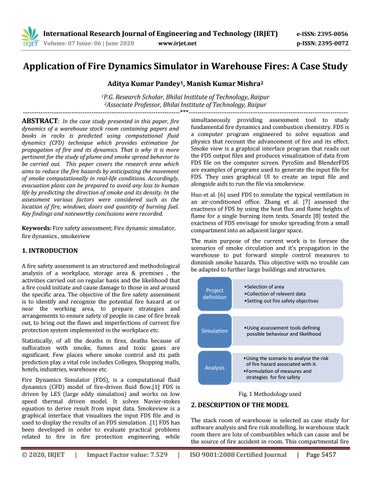
Project definition
•Selection of area •Collection of relevent data •Setting out fire safety objectives
Simulation
•Using assessement tools defining possible behaviour and likelihood
Analysis
•Using the scenario to analyse the risk of fire hazard associated with it. •Formulation of measures and strategies for fire safety
Fig. 1 Methodology used
2. DESCRIPTION OF THE MODEL The stack room of warehouse is selected as case study for software analysis and fire risk modelling. In warehouse stack room there are lots of combustibles which can cause and be the source of fire accident in room. This compartmental fire
ISO 9001:2008 Certified Journal
|
Page 5457