
IRJET- Design and Analysis of Microstrip Patch Antenna Suitable for KU Band Satellite Communicat

Page 1

International Research Journal of Engineering and Technology (IRJET)

e-ISSN: 2395-0056

Volume: 07 Issue: 05 | May 2020

p-ISSN: 2395-0072

www.irjet.net

DESIGN AND ANALYSIS OF MICROSTRIP PATCH ANTENNA SUITABLE FOR Ku BAND SATELLITE COMMUNICATION Mr.S.Dhamodharan, K.Shanmugapriya2, S.Sindhuja3, S.Sruthi4, I. Stephypraba5 Assistant Professor, Department of ECE, SSM Institute of Engineering and Technology, Dindigul, Tamilnadu624002 2,3,4Department of ECE, SSM Institute of Engineering and Technology , Dindigul, Tamilnadu-624002 ---------------------------------------------------------------------***---------------------------------------------------------------------1

Abstract This paper represents the well formed rectangular shape truncated micro strip patch antenna. The proposed antenna is simulated using High-Frequency Structure Simulator (HFSS) tool. The purpose of this paper is to design the rectangular micro strip patch antenna and concentrating on the effect of antennas radiation pattern and gain. By considering the parameters of relative dielectric constant (), substrate material and thickness, length& width of the patch. Conducting patch is formed by using rectangular configuration. Microstrip patch antennas are low cost, small size and easy to fabricate and they play a dominant role in wireless communication .The antenna is designed at Ku band frequency(17.5 GHz) with multiple slots on the rectangular patch. These slots on the patch shift the resonant frequency to the lower side and also affect various antenna paramaters. The antenna is designed by using RT duroid material that has relative permittivity of 2.2 and loss tangent 0.0009. Key Words: HFSS, Microstrip, RT duroid, Relative permittivity, Satellite communication. 1. INTRODUCTION 1.1

ANTENNA

Antenna is an electrical device which converts electrical power into radio waves and vice versa without an efficient antenna, EMF (electro magnetic energy would not be radiated and wireless communication over the long distance would be impossible. Antennas can be designed to transmit and receive radio waves in all horizontal directions equally (omnidirectional antenna), or preferentially in a particular direction called directional or high gain antennas. Radio waves are electromagnetic waves which carry signals through the space or air at the speed of light with almost no transmission loss.

Š 2020, IRJET

|

Impact Factor value: 7.529

|

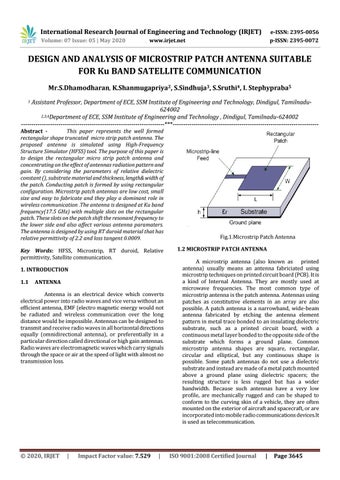
Fig.1.Microstrip Patch Antenna 1.2 MICROSTRIP PATCH ANTENNA A microstrip antenna (also known as printed antenna) usually means an antenna fabriciated using microstrip techniques on printed circuit board (PCB). It is a kind of Internal Antenna. They are mostly used at microwave frequencies. The most common type of microstrip antenna is the patch antenna. Antennas using patches as constitutive elements in an array are also possible. A patch antenna is a narrowband, wide-beam antenna fabricated by etching the antenna element pattern in metal trace bonded to an insulating dielectric substrate, such as a printed circuit board, with a continuous metal layer bonded to the opposite side of the substrate which forms a ground plane. Common microstrip antenna shapes are square, rectangular, circular and elliptical, but any continuous shape is possible. Some patch antennas do not use a dielectric substrate and instead are made of a metal patch mounted above a ground plane using dielectric spacers; the resulting structure is less rugged but has a wider bandwidth. Because such antennas have a very low profile, are mechanically rugged and can be shaped to conform to the curving skin of a vehicle, they are often mounted on the exterior of aircraft and spacecraft, or are incorporated into mobile radio communications devices.It is used as telecommunication.

ISO 9001:2008 Certified Journal

|

Page 3645


Turn static files into dynamic content formats.
Create a flipbook
IRJET- Design and Analysis of Microstrip Patch Antenna Suitable for KU Band Satellite Communicat by IRJET Journal - Issuu