
IRJET- Study of Biodiesel based on Algae and Palm Oil Properties and Characteristics for Enhanci

Page 1

International Research Journal of Engineering and Technology (IRJET) Volume: 07 Issue: 05 | May 2020

www.irjet.net

e-ISSN: 2395-0056 p-ISSN: 2395-0072

Study of Biodiesel based on Algae and Palm Oil Properties and Characteristics for Enhancing Performance of 4 Stroke CI Engine Akash Sagari1, Sagar Gahire2, Sameer Shaikh3, Vinay Alte4, Rishikesh More5 1Professor,

Dept. of Automobile Engineering, Marathwada Mitra Mandal’s Polytechnic, Maharashtra, India Dept. of Automobile Engineering, Marathwada Mitra Mandal’s Polytechnic, Maharashtra, India ---------------------------------------------------------------------***---------------------------------------------------------------------2-5Student,

Abstract - Now a days various biodiesels are being tested

and used in various industries over the globe. Moreover, there is a huge scope in the enhancement of fuel efficiency, performance and ignition characteristics of these biodiesels. These biodiesels can be used in cars, trucks and airplanes. In this research paper, our aim is to investigate performance characteristics of non-edible oil, palm oil and algae oil biodiesel which is extracted by esterification, demoisturization, transesterification process with oil and identify the properties of these hybrid blends such as calorific value, density, cetane no, flash point, fire point etc. In this study B9, B18, B27, B36 blends are used.

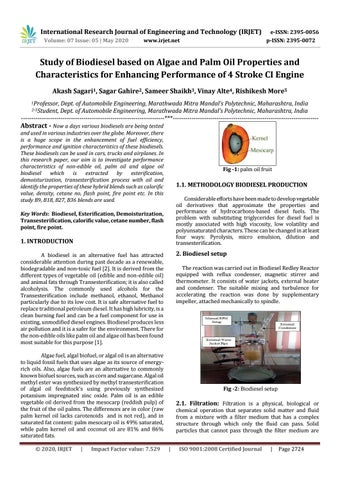
Fig -1: palm oil fruit

1.1. METHODOLOGY BIODIESEL PRODUCTION Considerable efforts have been made to develop vegetable oil derivatives that approximate the properties and performance of hydrocarbons-based diesel fuels. The problem with substituting triglycerides for diesel fuel is mostly associated with high viscosity, low volatility and polyunsaturated characters. These can be changed in at least four ways: Pyrolysis, micro emulsion, dilution and transesterification.

Key Words: Biodiesel, Esterification, Demoisturization, Transesterification, calorific value, cetane number, flash point, fire point.

1. INTRODUCTION

2. Biodiesel setup

A biodiesel is an alternative fuel has attracted considerable attention during past decade as a renewable, biodegradable and non-toxic fuel [2]. It is derived from the different types of vegetable oil (edible and non-edible oil) and animal fats through Transesterification; it is also called alcoholysis. The commonly used alcohols for the Transesterification include methanol, ethanol, Methanol particularly due to its low cost. It is safe alternative fuel to replace traditional petroleum diesel. It has high lubricity, is a clean burning fuel and can be a fuel component for use in existing, unmodified diesel engines. Biodiesel produces less air pollution and it is a safer for the environment. There for the non-edible oils like palm oil and algae oil has been found most suitable for this purpose [1].

The reaction was carried out in Biodiesel Redley Reactor equipped with reflux condenser, magnetic stirrer and thermometer. It consists of water jackets, external heater and condenser. The suitable mixing and turbulence for accelerating the reaction was done by supplementary impeller, attached mechanically to spindle.

Algae fuel, algal biofuel, or algal oil is an alternative to liquid fossil fuels that uses algae as its source of energyrich oils. Also, algae fuels are an alternative to commonly known biofuel sources, such as corn and sugarcane. Algal oil methyl ester was synthesized by methyl transesterification of algal oil feedstock’s using previously synthesized potassium impregnated zinc oxide. Palm oil is an edible vegetable oil derived from the mesocarp (reddish pulp) of the fruit of the oil palms. The differences are in color (raw palm kernel oil lacks carotenoids and is not red), and in saturated fat content: palm mesocarp oil is 49% saturated, while palm kernel oil and coconut oil are 81% and 86% saturated fats. © 2020, IRJET

|

Impact Factor value: 7.529

Fig -2: Biodiesel setup

2.1. Filtration: Filtration is a physical, biological or

chemical operation that separates solid matter and fluid from a mixture with a filter medium that has a complex structure through which only the fluid can pass. Solid particles that cannot pass through the filter medium are |

ISO 9001:2008 Certified Journal

|

Page 2724


Turn static files into dynamic content formats.
Create a flipbook