
IRJET- Car Elevator Platform using Arduino-Uno

Page 1

International Research Journal of Engineering and Technology (IRJET)

e-ISSN: 2395-0056

Volume: 07 Issue: 05 | May 2020

p-ISSN: 2395-0072

www.irjet.net

CAR ELEVATOR PLATFORM USING ARDUINO-UNO Sanket Gosavi1, Pratik Jambhulkar2 1,2Students,

Dept. of Mechanical Engineering, P.E.S’s Modern College of Engineering, Pune, Maharashtra, India ---------------------------------------------------------------------***----------------------------------------------------------------------

Abstract - This paper aims to explain the application of

using 89c52 microcontroller. When a car arrives at the gate, it is detected by the IR sensor installed at entry gate. The microcontroller receives this signal, checks for vacant spaces in the parking and displays the count of cars in parking on the LCD display. If there is a vacant space for parking, the entry gate opens. Similarly, the system works for exit of cars. Finally, the paper concludes by reducing manual work and saving time.

mechatronics in the development of an Arduino-Uno based car elevator platform. A mechanism to elevate the car/vehicle to a desired level has been proposed. The proposed system assists to transport the cars/vehicles to and from over-ground parking spaces while minimizing the land usage. Such a system will help in accommodating several vehicles at two different floors in a building. It can be efficiently implemented in residential as well as commercial buildings.

3. PROBLEM STATEMENT

Key Words: Elevator Platform, Arduino Uno, Infrared Sensor, L298N Motor Driver, 12 V Dc Motor, Rack and Pinion.

The goal is to manufacture a prototype for an automated car elevator platform while taking into account the size (5cm*5cm*2cm) and weight (20g) of a miniature car model as the design parameter.

1. INTRODUCTION

4. COMPONENTS USED

In modern world, where parking space has become a very big problem, it has become very essential to circumvent this particular problem by implementing mechatronics system. Nowadays parking systems are equipped with sensors and microcontrollers which makes the task a lot easier. The system being designed can be used in a parking tower at its entry points and exit points. The proposed system will help avoid the tedious driving efforts required to reach the different floors in a building that has circular roadways progressing towards the top. Hence the automated platform will thus be very advantageous to take the vehicles at different floors.

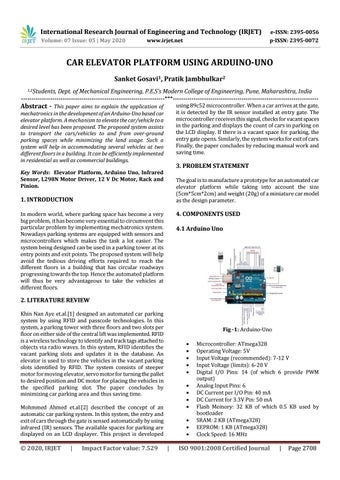
4.1 Arduino Uno

2. LITERATURE REVIEW Khin Nan Aye et.al.[1] designed an automated car parking system by using RFID and passcode technologies. In this system, a parking tower with three floors and two slots per floor on either side of the central lift was implemented. RFID is a wireless technology to identify and track tags attached to objects via radio waves. In this system, RFID identifies the vacant parking slots and updates it in the database. An elevator is used to store the vehicles in the vacant parking slots identified by RFID. The system consists of steeper motor for moving elevator, servo motor for turning the pallet to desired position and DC motor for placing the vehicles in the specified parking slot. The paper concludes by minimizing car parking area and thus saving time.

Fig -1: Arduino-Uno         

Mohmmed Ahmed et.al.[2] described the concept of an automatic car parking system. In this system, the entry and exit of cars through the gate is sensed automatically by using infrared (IR) sensors. The available spaces for parking are displayed on an LCD displayer. This project is developed

© 2020, IRJET

|

Impact Factor value: 7.529

  

|

Microcontroller: ATmega328 Operating Voltage: 5V Input Voltage (recommended): 7-12 V Input Voltage (limits): 6-20 V Digital I/O Pins: 14 (of which 6 provide PWM output) Analog Input Pins: 6 DC Current per I/O Pin: 40 mA DC Current for 3.3V Pin: 50 mA Flash Memory: 32 KB of which 0.5 KB used by bootloader SRAM: 2 KB (ATmega328) EEPROM: 1 KB (ATmega328) Clock Speed: 16 MHz

ISO 9001:2008 Certified Journal

|

Page 2708


Turn static files into dynamic content formats.
Create a flipbook