International Research Journal of Engineering and Technology (IRJET)
e-ISSN: 2395-0056
Volume: 07 Issue: 05 | May 2020
p-ISSN: 2395-0072
www.irjet.net
Method Comparison of Pavement Condition Rating based on IRC & ASTM Guidelines Anurag Sinha1, Pratik Hagawane2 1M.Tech
Student, Deptt of Civil Engineering, G.H.Raisoni University, Maharashtra, India Professor, Deptt of Civil Engineering, G.H.Raisoni University, Maharashtra, India ---------------------------------------------------------------------***--------------------------------------------------------------------2Assistant
pavement distresses through visual observations; cracking, raveling, potholes, shoving, patching, settlement and rut depth. Based on the measured distresses the standard condition is as below in Table 1.
Abstract – In a developing country highway infrastructure
is the backbone for economic development. With increase in traffic and loading, pavement detoriation occurs which needs to be monitored and captured continuously for preparing efficient maintenance proposals. Pavement condition rating through various distress identification and measurement is the need of an hour. The paper reviews the methodology and result of pavement condition rating by IRC & ASTM method over the four lanes 80 Km flexible pavement section. The pavement rating obtained by both of the methods are compared to each other to find out the correlation, accuracy and precision in results. The paper gives the concise view of pavement performance rating. This will help in finding the effectiveness and usefulness of each model of pavement ratings.
Table 1: Pavement Distress Rating for Highways Defects (Type) Cracking % Ravelling % Potholes % Shoving % Patching % Settlement & Depression % Rut depth in mm Rating Condition
>10 >10 >1 >1 >10 >5 >10 1 Poor
Range of Distress 5 to 10 <5 1 to 10 <1 0.1 to 1 <0.1 0.1 to 1 <0.1 1 to 10 <1 1 to 5 <1 5 to 10 <5 1.1 - 2.0 2.1 - 3.0 Fair Good
After assigning rating to each parameter, an appropriate weightage is given to rating value of each parameter for calculation of Weighted Rating Value of each parameter. The following weightage has been fixed for each parameter as shown below in Table 2.
Key Words: Pavement Distress, ASTM, IRC, Pavement Condition Rating, Evaluation, Indexation.
1. INTRODUCTION
Table 2: Pavement Distress Weightage
The analysis and interpretation of various pavement performance parameter data as collected during NSV survey has been performed to assess the existing pavement condition of the project road and rate the pavement on its condition termed as Pavement Condition Rating (PCR). PCR provides a measure of present condition of pavement based on distress observed on surface of pavement. It provides an objective and rational basis for determining maintenance and repair needs and priorities. Continuous monitoring of the PCR is used to establish the rate of pavement deterioration, which permits early identification of major rehabilitation needs.
S. No.
Defects (Type)
1 2 3 4 5
Cracking Ravelling Potholes Shoving Patching Settlement & Depression Rut depth
6 7
Weightage (Fixed) (multiplier factor) 1.00 0.75 0.50 1.00 0.75 0.75 1.00
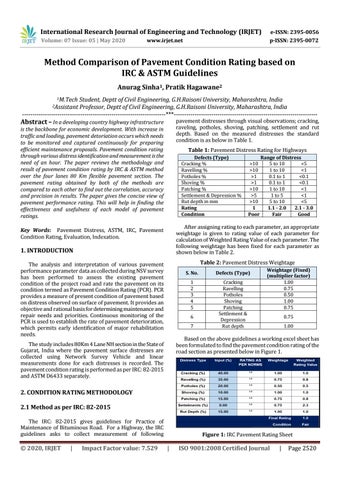
Based on the above guidelines a working excel sheet has been formulated to find the pavement condition rating of the road section as presented below in Figure 1.
The study includes 80Km 4 Lane NH section in the State of Gujarat, India where the pavement surface distresses are collected using Network Survey Vehicle and linear measurements done for each distresses is recorded. The pavement condition rating is performed as per IRC: 82-2015 and ASTM D6433 separately.
2. CONDITION RATING METHODOLOGY 2.1 Method as per IRC: 82-2015 The IRC: 82-2015 gives guidelines for Practice of Maintenance of Bituminous Road. For a Highway, the IRC guidelines asks to collect measurement of following
Š 2020, IRJET
|
Impact Factor value: 7.529
Figure 1: IRC Pavement Rating Sheet
|
ISO 9001:2008 Certified Journal
|
Page 2520