International Research Journal of Engineering and Technology (IRJET) Volume: 07 Issue: 05 | May 2020 www.irjet.net
e-ISSN: 2395-0056 p-ISSN: 2395-0072
Survey On Artificial Intelligence and Machine Learning in Health Care System to Diagnose and Cure Mr.Aashish Kapure1, Prof.Shrikant Nagure2 1T.E. Computer Engineering ,RMD School of Engineering ,Warje,Pune-58,Maharashtra ,India
2Asst.Prof.of Computer Engineering ,RMD School of Engineering ,Warje,Pune-58,Maharashtra ,India
---------------------------------------------------------------------***---------------------------------------------------------------------
Abstract - A health care system is crucial as it reflects
directly in well being of humans and quality of life. People and particularly patient demands of health care service have been recognized throughout the globe and cannot be ignored. Diagnosis and Cure are the factors in health care that determines its quality. Artificial Intelligence and Machine Learning reduces the cost and time efficiency thus simplifies lives of patients, doctors and hospital systems. Various algorithms in machine learning are being used to provide information to machines that can analyze human body dis functions and diagnose the disease early on. Drug development and existing drug trial for various diseases can be maximized to full efficiency using artificial intelligence. The aim of this work is to incorporate machine learning and artificial intelligence techniques to improve diagnosis and cure in health care system.
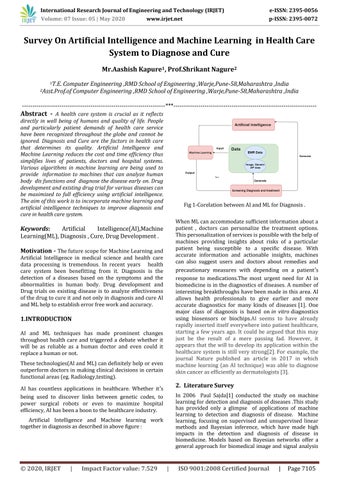
Fig 1-Corelation between AI and ML for Diagnosis . When ML can accommodate sufficient information about a patient , doctors can personalize the treatment options. This personalization of services is possible with the help of machines providing insights about risks of a particular patient being susceptible to a specific disease. With accurate information and actionable insights, machines can also suggest users and doctors about remedies and precautionary measures with depending on a patient’s response to medications.The most urgent need for AI in biomedicine is in the diagnostics of diseases. A number of interesting breakthroughs have been made in this area. AI allows health professionals to give earlier and more accurate diagnostics for many kinds of diseases [1]. One major class of diagnosis is based on in vitro diagnostics using biosensors or biochips.AI seems to have already rapidly inserted itself everywhere into patient healthcare, starting a few years ago. It could be argued that this may just be the result of a mere passing fad. However, it appears that the will to develop its application within the healthcare system is still very strong[2]. For example, the journal Nature published an article in 2017 in which machine learning (an AI technique) was able to diagnose skin cancer as efficiently as dermatologists [3].
Keywords: Artificial Intelligence(AI),Machine Learning(ML), Diagnosis , Cure, Drug Development . Motivation - The future scope for Machine Learning and Artificial Intelligence in medical science and health care data processing is tremendous. In recent years health care system been benefitting from it. Diagnosis is the detection of a diseases based on the symptoms and the abnormalities in human body. Drug development and Drug trials on existing disease is to analyze effectiveness of the drug to cure it and not only in diagnosis and cure AI and ML help to establish error free work and accuracy.
1.INTRODUCTION AI and ML techniques has made prominent changes throughout health care and triggered a debate whether it will be as reliable as a human doctor and even could it replace a human or not. These technologies(AI and ML) can definitely help or even outperform doctors in making clinical decisions in certain functional areas (eg. Radiology,testing).
2. Literature Survey
AI has countless applications in healthcare. Whether it’s being used to discover links between genetic codes, to power surgical robots or even to maximize hospital efficiency, AI has been a boon to the healthcare industry.
In 2006 Paul Sajda[1] conducted the study on machine learning for detection and diagnosis of diseases .This study has provided only a glimpse of applications of machine learning to detection and diagnosis of disease. Machine learning, focusing on supervised and unsupervised linear methods and Bayesian inference, which have made high impacts in the detection and diagnosis of disease in biomedicine. Models based on Bayesian networks offer a general approach for biomedical image and signal analysis
Artificial Intelligence and Machine learning work together in diagnosis as described in above figure :
© 2020, IRJET
|
Impact Factor value: 7.529
|
ISO 9001:2008 Certified Journal
|
Page 7105
International Research Journal of Engineering and Technology (IRJET) Volume: 07 Issue: 05 | May 2020 www.irjet.net
e-ISSN: 2395-0056 p-ISSN: 2395-0072
in that they enable one to directly model the uncertainty and variability inherent to biomedical data.
3. Live survey
IgorKononenko[4] has done great work in medical diagnosis using ML which provides directives for applying machine learning in medical diagnosis .Here the focus is on Naive Bayesian Classifier, neural network and decision trees.Based on the study of above algorithms future trends for AI in medical service is described.
In their research “Medical-assisted Diagnosis Model as a Service with Artificial Intelligence and Trust”Guo, K., Ren, S., Bhuiyan, M. Z. A., Li, T., Liu, D., Liang, Z., & Chen, X.[9]have proposed medical-assisted diagnosis model as a service,The model training and model application in this machine learning task are assigned to both ends respectively; the service provider trains and provides a variety of medical-assisted diagnosis models, and institutions directly use the models; this system helps medical institutions obtain trustworthy medical-assisted diagnosis models efficiently.
In the research topic “Handling limited datasets with neural networks in medical applications: a small-data approach”Shaikhina, T., & Khovanova[5] decribes developing a novel framework for application of artificial neural networks (NNs) for regression tasks involving small medical datasets. The significance of this work is two-fold: the practical application allows for nondestructive prediction of bone fracture risk, while the novel methodology this study provides a general framework for application of regression NNs to medical problems characterized by limited dataset sizes.
In the early 2020 N. Zheng et al [10] has proposed a hybrid artificial-intelligence (AI) model is proposed for COVID-19 prediction.This model is proposed to estimate the variety of the infection rates for analyzing the transmission laws and development trend. Second, considering the effects of prevention and control measures and the increase of the public’s prevention awareness, the natural language processing (NLP) module and the long short-term memory (LSTM) network are embedded into the ISI model to build the hybrid AI model for COVID19 prediction.
In 2019 Samira Yeasmin[6] in research Benefits of Artificial Intelligence in Medicine[6]examines how artificial intelligence assists the medical field as well as how patient’s health is affected in diagnosing diseases, patients treatment, reducing errors, and virtually being present with the patients.AI providing support to tackle many problems of healthcare. Therefore, it is beneficial in diagnosing, treating diseases, reducing human errors, and it will also be virtually present with the patients.
Lakkamraju, P., Anumukonda, M., & Chowdhury, S. R.[11] in 2020 presents an approach of apt prognostic diagnostics of cardiac health by using Artificial Intelligence (AI) in safety-related based bio-medical systems. This approach addresses the challenge in identification of the actual abnormality of the vital cardiac signal from the various factors like bio-signal faulted due to high noise signal interference, electronic fault, mechanical fault like sensor contacts failures, wear and tear of equipment.The implementation of this safe segregation function feature is able to identify the peaks and then detect the apt artifacts and determine the pulse rate of the subject.Diseases like bradycardia and arrhythmias can be diagnosed in advance from a set of selected combinations of sensors data along with safety function enhances in prognostic health diagnostics for accurate predictions of cardiac abnormalities.
Muhammad Faisal Siddiqui, Ahmed Wasif Reza, Jeevan Kanesan[7] research describes classification technique to classify the human brain magnetic resonance image (MRI) as normal or abnormal, to cater down the human error during identifying the diseases in brain MRIs.The classification performance of this research work on different dataset groups with various diseases shows that it has an impressive generalization capability. Hence from the time analysis that the proposed automated intelligent health care system accomplishes the real time diagnosis challenges. Abdulkadir Sengur[8] has demonstrated system based on principal component analysis, artificial immune system and fuzzy k-NN for diagnosis of valvular heart diseases.heart valve disorder detection system is composed of three stages. The first stage :- pre-processing stage. Filtering and normalization are the processes used in this stage. The feature extraction is the next stage. During feature extraction stage, wavelet packet decomposition was used. As a next step, wavelet entropy was considered as features.
© 2020, IRJET
|
Impact Factor value: 7.529
4.Algorithm Survey In 2017 Pouria Kaviani1, Mrs. Sunita Dhotre[12] in their research survey on Naive Bayes Algorithm described it simplifies learning by assuming that features are independent of given class.Naive Bayes Classification is prominently used in ML for medical services.
|
ISO 9001:2008 Certified Journal
|
Page 7106
International Research Journal of Engineering and Technology (IRJET) Volume: 07 Issue: 05 | May 2020 www.irjet.net
e-ISSN: 2395-0056 p-ISSN: 2395-0072
IgorKononenko, “Machine learning for medical diagnosis: history, state of the art and perspective” in Artificial Intelligence in Medicine Volume 23, Issue 1, August 2001, Pages 89-109, 2001 [https://doi.org/10.1016/S0933-3657(01)00077-X] [5] ]TorgynShaikhina, Natalia A.Khovanova, “Handling limited datasets with neural networks in medical applications: A small-data approach” in Artificial Intelligence in Medicine Volume 75, January 2017, Pages 51-63, 2017 [https://doi.org/10.1016/j.artmed.2016.12.003 [6] Yeasmin, S. (2019). Benefits of Artificial Intelligence in Medicine. 2019 2nd International Conference on Computer Applications & Information Security (ICCAIS). doi:10.1109/cais.2019.8769557 [7] Siddiqui, M. F., Reza, A. W., & Kanesan, J. (2015). An Automated and Intelligent Medical Decision Support System for Brain MRI Scans Classification. PLOS ONE, 10(8), e0135875. doi:10.1371/journal.pone.0135875 [8] Sengur, A. (2008). An expert system based on principal component analysis, artificial immune system and fuzzy -NN for diagnosis of valvular heart diseases. Computers in Biology and Medicine, 38(3), 329– 338. doi:10.1016/j.compbiomed.2007.11.004 [9] Guo, K., Ren, S., Bhuiyan, M. Z. A., Li, T., Liu, D., Liang, Z., & Chen, X. (2019). MDMaaS: Medical-assisted Diagnosis Model as a Service with Artificial Intelligence and Trust. IEEE Transactions on Industrial Informatics, 1–1. doi:10.1109/tii.2019.2937547 [10] N. Zheng et al., "Predicting COVID-19 in China Using Hybrid AI Model," in IEEE Transactions on Cybernetics, doi: 10.1109/TCYB.2020.2990162. [11] Lakkamraju, P., Anumukonda, M., & Chowdhury, S. R. (2020). Improvements in Accurate Detection of Cardiac Abnormalities and Prognostic Health Diagnosis Using Artificial Intelligence in Medical Systems. IEEE Access, 1–1. doi:10.1109/access.2020.2965396 [12] Kaviani, Pouria & Dhotre, Sunita. (2017). Short Survey on Naive Bayes Algorithm. International Journal of Advance Research in Computer Science and Management. 04. [13] Himani Sharma, Sunil Kumar, "A Survey on Decision Tree Algorithms of Classification in Data Mining", International Journal of Science and Research (IJSR), https://www.ijsr.net/search_index_results_pap d.php?id=NOV162954, Volume 5 Issue 4, April 2016, 2094 - 2097
Advantages
[4]
Simple algorithm to understand and build. It is faster to predict classes than many other classification algorithms. It can be easily trained using a small dataset. Disadvantages Problem is known as the "Zero Conditional Probability Problem." This problem wipes out all the information in other probabilities too." The very strong assumption of independence class features that it makes. It is near to impossible to find such data sets in real life. Complexity :- O(nK) Where n is the number of features and K is the number of label classes Himani Sharma , Sunil Kumar[13] described CART Algorithm which builds both classifications and regression trees. The classification tree construction is based on binary splitting of the attributes.CART algorithm and the regression trees are used for making decisions diagnosis of the diseases. Advantages Non parametric (no probabilistic assumptions). Automatically perform variable selection.)Use any combination of continuous or discrete variables.Establish “interactions” among variables Complexity :- O(vnlogn) where v is the number of features and n the number of records
Conclusion From the above conducted survey and reviews, It can be concluded that the use of artificial intelligence, machine learning algorithms acquired the field of medical science resulting accurate and precise output. In upcoming days, it may possible that each and every field has the influence of AI with great use. This survey provides a snapshot of how various medical services automated using AI and ML thus increasing the efficiency and reducing the errors in a fraction of cost .
REFERENCES Sajda P “Machine learning for detection and diagnosis of disease” in Annu Rev Biomed Eng. 2006; 8: 537– 565 [doi: 10.1146/annurev.bioeng.8.061505.095802] [2] Topol EJ. High-performance medicine: the convergence of human and artificial intelligence. Nat Med. 2019;25(1):44. [3] Esteva A, Kuprel B, Novoa RA, Ko J, Swetter SM, Blau HM, et al. Dermatologist-level classification of skin cancer with deep neural networks. Nature. 2017;542(7639):115–8. [1]
© 2020, IRJET
|
Impact Factor value: 7.529
|
ISO 9001:2008 Certified Journal
|
Page 7107