International Research Journal of Engineering and Technology (IRJET)
e-ISSN: 2395-0056
Volume: 07 Issue: 05 | May 2020
p-ISSN: 2395-0072
www.irjet.net
Design of Sewage Treatment Plant with Sequential Batch Reactor for Public Buildings Complex Shubham M. Dongre1, Dr. Maya R. Ray2 Student, Dept. of Civil Engineering, G.H. Raisoni College of Engineering, Nagpur, Maharashtra, India Professor, Dept. of Civil Engineering, G.H. Raisoni College of Engineering, Nagpur, Maharashtra, India
1 2
---------------------------------------------------------------------***---------------------------------------------------------------------
Abstract - Sequential batch reactor (SBR) is one of the most budding options in the treatment of municipal sewage. SBR operating is in a single tank which operates in time rather than in space. It requires less area to operate easy to function and is economical even in small scales. This research focuses on designing of sewage treatment plant with sequential batch reactor for public building Complex in Shantivan, Chicholi, Nagpur area. The total sewage generated in one-day was estimated to be 100 KLD. The various components of sewage treatment plant are bar screen chamber, equalization tank, SBR tank and treated wastewater collecting tank. By considering the various permissibility limits and various standards of treated sewage water it is proposed to design the many components of wastewater treatment facilities. The treated wastewater will be used for gardening proposes, sludge product which are produced by the treatment procedure can be suggested to be used as fertilizers to increase the fertility of the land this reduces the ground water utilization. Key words: Sequential batch reactor (SBR), municipal sewage, sewage treatment plant, permissibility limits
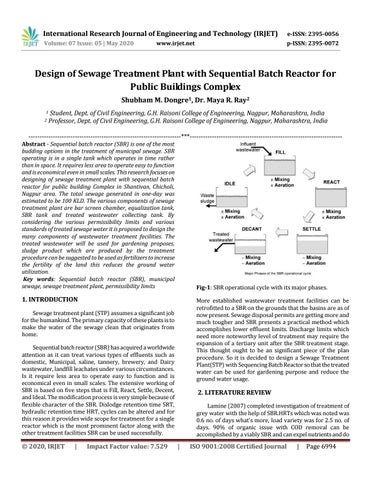
Fig-1: SBR operational cycle with its major phases.
1. INTRODUCTION
More established wastewater treatment facilities can be retrofitted to a SBR on the grounds that the basins are as of now present. Sewage disposal permits are getting more and much tougher and SBR presents a practical method which accomplishes lower effluent limits. Discharge limits which need more noteworthy level of treatment may require the expansion of a tertiary unit after the SBR treatment stage. This thought ought to be an significant piece of the plan procedure. So it is decided to design a Sewage Treatment Plant(STP) with Sequencing Batch Reactor so that the treated water can be used for gardening purpose and reduce the ground water usage.
Sewage treatment plant (STP) assumes a significant job for the humankind. The primary capacity of these plants is to make the water of the sewage clean that originates from home. Sequential batch reactor (SBR) has acquired a worldwide attention as it can treat various types of effluents such as domestic, Municipal, saline, tannery, brewery, and Dairy wastewater, landfill leachates under various circumstances. Is it require less area to operate easy to function and is economical even in small scales. The extensive working of SBR is based on five steps that is Fill, React, Settle, Decent, and Ideal. The modification process is very simple because of flexible character of the SBR. Dislodge retention time SRT, hydraulic retention time HRT, cycles can be altered and for this reason it provides wide scope for treatment for a single reactor which is the most prominent factor along with the other treatment facilities SBR can be used successfully.
Š 2020, IRJET
|
Impact Factor value: 7.529
2. LITERATURE REVIEW Lamine (2007) completed investigation of treatment of grey water with the help of SBR.HRTs which was noted was 0.6 no. of days what's more, load variety was for 2.5 no. of days. 90% of organic issue with COD removal can be accomplished by a viably SBR and can expel nutrients and do
|
ISO 9001:2008 Certified Journal
|
Page 6994