
IRJET- Iot Based Advanced underground Coal Mine Environment Detection and Auto Alert System for Coal

Page 1

International Research Journal of Engineering and Technology (IRJET)

e-ISSN: 2395-0056

Volume: 07 Issue: 05 | May 2020

p-ISSN: 2395-0072

www.irjet.net

IoT based Advanced Underground Coal Mine Environment Detection and Auto Alert System for Coal Mine Workers using Blynk Application Tirunahari Sri Sharan1, Hitesh Dammu2, Mahendarkar Karthik3, Sai Akhil M4 1-4UG

Student, Dept of Mechatronics Engineering, Mahatma Gandhi Institute of Technology, Telangana, India ---------------------------------------------------------------------***----------------------------------------------------------------------

Abstract – Coal Mining is a dangerous and potentially

lethal job. Workers in coal mines face many environment related problems such as high temperature, humidity, release of harmful gases to name a few. As a means of reducing the intensity of the problem, our present work focuses on sensing these environmental parameters from different locations in the mines and sends alert to the mine control room operator who uses a Blynk Application whenever there seems to be a dangerous situation. Key Words: Temperature Sensor, Humidity Sensor, Gas Sensor, APR9600 Voice Module, Buzzer, Blynk Application.

1. INTRODUCTION Coal Mining is inherently dangerous with zero margin for error even under the best conditions. Even a small lapse in safety can be catastrophic. The principal airborne hazards in the mining industry include several types of particulates, naturally occurring gases, engine exhaust and some chemical vapours; the principal physical hazards are noise, segmental vibration, heat, changes in barometric pressure and ionizing radiation. The present paper is about the system which uses an IoT platform as a medium to transmit data. The system is implemented to monitor various parameters in the coal mines such as light detection, leakage of gas, temperature and humidity conditions and fire detection in the coal mine. These all sensors are together placed as a unit and sent into the coal mine and can be monitored by the operator using Blynk Application.

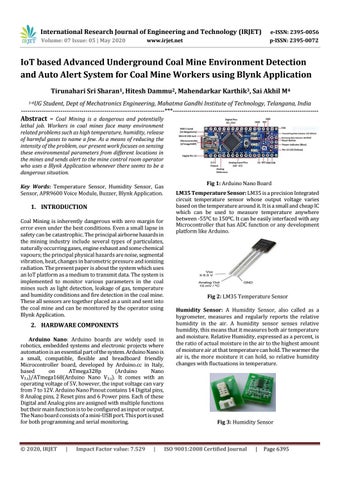
2. HARDWARE COMPONENTS Arduino Nano: Arduino boards are widely used in robotics, embedded systems and electronic projects where automation is an essential part of the system. Arduino Nano is a small, compatible, flexible and breadboard friendly Microcontroller board, developed by Arduino.cc in Italy, based on ATmega328p (Arduino Nano V3.x)/ATmega168(Arduino Nano V3.x). It comes with an operating voltage of 5V, however, the input voltage can vary from 7 to 12V. Arduino Nano Pinout contains 14 Digital pins, 8 Analog pins, 2 Reset pins and 6 Power pins. Each of these Digital and Analog pins are assigned with multiple functions but their main function is to be configured as input or output. The Nano board consists of a mini-USB port. This port is used for both programming and serial monitoring.

Š 2020, IRJET

|

Impact Factor value: 7.529

|

Fig 1: Arduino Nano Board LM35 Temperature Sensor: LM35 is a precision Integrated circuit temperature sensor whose output voltage varies based on the temperature around it. It is a small and cheap IC which can be used to measure temperature anywhere between -550C to 1500C. It can be easily interfaced with any Microcontroller that has ADC function or any development platform like Arduino.

Fig 2: LM35 Temperature Sensor Humidity Sensor: A Humidity Sensor, also called as a hygrometer, measures and regularly reports the relative humidity in the air. A humidity sensor senses relative humidity, this means that it measures both air temperature and moisture. Relative Humidity, expressed as a percent, is the ratio of actual moisture in the air to the highest amount of moisture air at that temperature can hold. The warmer the air is, the more moisture it can hold, so relative humidity changes with fluctuations in temperature.

Fig 3: Humidity Sensor

ISO 9001:2008 Certified Journal

|

Page 6395


Turn static files into dynamic content formats.
Create a flipbook