International Research Journal of Engineering and Technology (IRJET)
e-ISSN: 2395-0056
Volume: 07 Issue: 04 | Apr 2020
p-ISSN: 2395-0072
www.irjet.net
Electrical Design and Drafting Analysis of Real Time Building Project Jayshri D. Kalmegh1, Prof. Chetan M. Bobde2 Student, G.H.Raisoni College of Engineering, Amravati of Department, Electrical Engineering, G.H.Raisoni College of Engineering, Amravati ---------------------------------------------------------------------***---------------------------------------------------------------------2Head
1PG
Abstract - In recent years there has been a push within the
electrical power industry for additional client involvement within the electricity markets. Historically the tip user has contend a passive role within the coming up with and operation of the power system grid. However, several energy markets have begun gap up opportunities to consumers United Nations agency would like to commit an exact quantity of their electrical load underneath numerous demand aspect management programs. The potential edges of additional demand participation embody reduced operative prices and new revenue opportunities for the buyer, yet as additional reliable and secure operations for the utilities. The management of those load resources creates challenges and opportunities to the tip user that weren't gift in previous market structures. This work examines the behavior of commercial-type building electrical hundreds and their capability for supporting demand aspect management actions. This work is intended by the necessity for correct and dynamic tools to assist within the advancement of demand aspect operations. This paper is reviewing the different types of approach for design of load distribution system for commercial or industrial building load management. This paper will be very much useful in future for students and researchers those work in the field of load management or load dispatched of distribution areas.
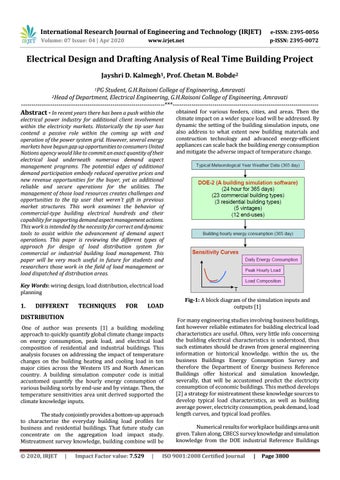
obtained for various feeders, cities, and areas. Then the climate impact on a wider space load will be addressed. By dynamic the setting of the building simulation inputs, one also address to what extent new building materials and construction technology and advanced energy-efficient appliances can scale back the building energy consumption and mitigate the adverse impact of temperature change.
Key Words: wiring design, load distribution, electrical load planning
1.
DIFFERENT
TECHNIQUES
FOR
LOAD
DISTRIBUTION One of author was presents [1] a building modeling approach to quickly quantify global climate change impacts on energy consumption, peak load, and electrical load composition of residential and industrial buildings. This analysis focuses on addressing the impact of temperature changes on the building heating and cooling load in ten major cities across the Western US and North American country. A building simulation computer code is initial accustomed quantify the hourly energy consumption of various building sorts by end-use and by vintage. Then, the temperature sensitivities area unit derived supported the climate knowledge inputs. The study conjointly provides a bottom-up approach to characterize the everyday building load profiles for business and residential buildings. That future study can concentrate on the aggregation load impact study. Mistreatment survey knowledge, building combine will be Š 2020, IRJET
|
Impact Factor value: 7.529
|
Fig-1: A block diagram of the simulation inputs and outputs [1] For many engineering studies involving business buildings, fast however reliable estimates for building electrical load characteristics are useful. Often, very little info concerning the building electrical characteristics is understood, thus such estimates should be drawn from general engineering information or historical knowledge. within the us, the business Buildings Energy Consumption Survey and therefore the Department of Energy business Reference Buildings offer historical and simulation knowledge, severally, that will be accustomed predict the electricity consumption of economic buildings. This method develops [2] a strategy for mistreatment these knowledge sources to develop typical load characteristics, as well as building average power, electricity consumption, peak demand, load length curves, and typical load profiles. Numerical results for workplace buildings area unit given. Taken along, CBECS survey knowledge and simulation knowledge from the DOE industrial Reference Buildings
ISO 9001:2008 Certified Journal
|
Page 3800