International Research Journal of Engineering and Technology (IRJET)
e-ISSN: 2395-0056
Volume: 07 Issue: 01 | Jan 2020
p-ISSN: 2395-0072
www.irjet.net
Comparison of Seismic Response of RCC Framed Structure With FPB & HDRB Isolators Samiksha Pachbiye Department of Structural Engineering, Govt Engineering College Jagdalpur Bastar, Chhattisgarh Swami Vivekanand Technical University Bhilai C.G India ---------------------------------------------------------------------***----------------------------------------------------------------------
Abstract - Base isolation technique is introduced to improve the performance of the building. The base isolation technique is used to decouple the base from its superstructure during the ground motion caused by earthquakes. The installation of isolator in a building at a base level significantly increases the time period of the structure which means it reduces the possibility of resonance of the structure giving rise to better seismic performance of the building. The main aim of this paper is the use of Friction Pendulum Bearing (FPB) and HighDensity Rubber Bearing (HDRB) as an isolation device and then to compare various parameters between fixed base condition and base-isolated condition. The modeling procedure for both buildings has been done using ETABS 2017 software for a regular (G+5) storied OMRF building. Linear analysis using Time History Analysis (THA) for the records of Elcentro earthquake (1940) and Response spectrum analysis (RSA) has been carried out
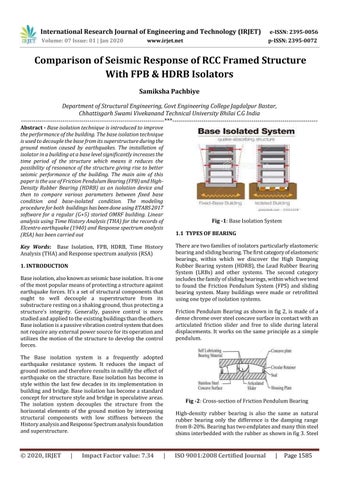
Fig -1: Base Isolation System 1.1 TYPES OF BEARING There are two families of isolators particularly elastomeric bearing and sliding bearing. The first category of elastomeric bearings, within which we discover the High Damping Rubber Bearing system (HDRB), the Lead Rubber Bearing System (LRBs) and other systems. The second category includes the family of sliding bearings, within which we tend to found the Friction Pendulum System (FPS) and sliding bearing system. Many buildings were made or retrofitted using one type of isolation systems.
Key Words: Base Isolation, FPB, HDRB, Time History Analysis (THA) and Response spectrum analysis (RSA) 1. INTRODUCTION Base isolation, also known as seismic base isolation. It is one of the most popular means of protecting a structure against earthquake forces. It’s a set of structural components that ought to well decouple a superstructure from its substructure resting on a shaking ground, thus protecting a structure’s integrity. Generally, passive control is more studied and applied to the existing buildings than the others. Base isolation is a passive vibration control system that does not require any external power source for its operation and utilizes the motion of the structure to develop the control forces.
Friction Pendulum Bearing as shown in fig 2, is made of a dense chrome over steel concave surface in contact with an articulated friction slider and free to slide during lateral displacements. It works on the same principle as a simple pendulum.
The Base isolation system is a frequently adopted earthquake resistance system. It reduces the impact of ground motion and therefore results in nullify the effect of earthquake on the structure. Base isolation has become in style within the last few decades in its implementation in building and bridge. Base isolation has become a standard concept for structure style and bridge in speculative areas. The isolation system decouples the structure from the horizontal elements of the ground motion by interposing structural components with low stiffness between the History analysis and Response Spectrum analysis foundation and superstructure.
© 2020, IRJET
|
Impact Factor value: 7.34
Fig -2: Cross-section of Friction Pendulum Bearing High-density rubber bearing is also the same as natural rubber bearing only the difference is the damping range from 8-20%. Bearing has two endplates and many thin steel shims interbedded with the rubber as shown in fig 3. Steel
|
ISO 9001:2008 Certified Journal
|
Page 1585
International Research Journal of Engineering and Technology (IRJET)
e-ISSN: 2395-0056
Volume: 07 Issue: 01 | Jan 2020
p-ISSN: 2395-0072
www.irjet.net
shims can provide the capability of the horizontal stiffness but have no effect on the horizontal stiffness.
Non-linear Stiffness ((U2&U3) Damping Friction co-efficient, Slow Friction co-efficient, Fast Radius of Sliding Surface
8699.06 kN/m
19256.25kN/m 0.05
0.05
0.03 0.05 1.5m
Fig 3 Cross-section of High-Density Rubber Bearing 2. OBJECTIVE OF THESIS
Model and analyze the response of an RCC structure with a fixed based. To compare the response of the building such as time period , base shear storey drift and storey displacement of RC building with and without base-isolation in Etabs by considering time history analysis for Elcentro earthquake and response spectrum analysis. Analyze the seismic effect on the base-isolated structure. Evaluate the analysis technique and design criteria used in base-isolated structure To study the behavior of earthquake resisting baseisolated buildings.
Fig 4: Plan of a proposed building
3. MODELING AND ANALYSIS The modeling of fixed base and base-isolated building is done by ETABS 2017 software. G+5 stories RCC building is considered with fixed base and base-isolated with two different isolators they are friction pendulum bearing and High density rubber bearing. Time history analysis and response spectrum analysis is done by using Elcentro data. Table -1: Building Description Type of building Height of building
Residential apartment 18m
Floor height-
3m
Grade of concerte
M25
Steel grade Slab thickness Size of beam Size of column Live load on floor Floor Finish
Fe415 150mm 300mmx500mm 300mmx500mm 4kN/ m2 1 kN/m2
Fig 5: 3D view of the proposed building 4. RESULT The results shows that the time period and storey displacement are increased in both the isolated building as compared to fixed base and base shear and storey drift is reduced by using the isolator. This suggested that baseisolation is an effective earthquake resistant technique for medium-rise structures.
Table 2 Properties of isolators for G+5 Type Vertical Stiffness (U1) Linear Stiffness (U2&U3)
© 2020, IRJET
|
FPS 19256250kN/m 6355.2kN/m
HDRB 12081.8kN/m 227.84 kN/m
Impact Factor value: 7.34
|
ISO 9001:2008 Certified Journal
|
Page 1586
International Research Journal of Engineering and Technology (IRJET)
e-ISSN: 2395-0056
Volume: 07 Issue: 01 | Jan 2020
p-ISSN: 2395-0072
www.irjet.net
Storey Displacement The graph shows the storey displacement for the structure, it is observed that the total maximum displacement is higher in the case of an isolated building.
Chart 4: Graph of Overturning Moment Base Shear The graph shows that the base shear is reduced in baseisolated structure as compared to a fixed base. Chart 1: Graph of Storey Displacement Storey Drift It is observed that the story drift for the fixed base building is much more than that of base-isolated building.
Chart 5: Graph of Base Shear 5. CONCLUSIONS
Chart 2: Graph of Storey Drift
1.
Base isolation method has proved as a promising solution of earthquake-resistant design
2.
The result shows that the response of the structure can be reduced by using Friction Pendulum bearing and High-Density Rubber Bearing.
3.
Time period of both the base-isolated structure increases as compared to the fixed base.
4.
The result shows that the storey displacement increases and storey drift reduced in both the isolated building over the conventional structure.
5.
The base shear is reduced in both the building by using FPS and HDRB.
Storey Shear The graph shows the storey shear which is reduced in base-isolated buildings compared to fix based.
REFERENCES
[1] [2]
Chart 3: Graph of Storey Shear Storey Overturning Moment The graph shows the overturning moment of the structure.
© 2020, IRJET
|
Impact Factor value: 7.34
[3] |
Ashish R Reddy, Tejas R, Wankhade, “Seismic performance of RC structure using the different base isolator.” M. Rajesh Reddy, Dr. N. Srujana and N. Lingeshwar, Effect of Base Isolation in Multistoried Reinforced Concrete Buildings. International Journal of Civil Engineering and Technology, 8(3)2017. S.J.Patil, G.R. Reddy, "State Of Art Review- Base Isolation Systems For Structures", International
ISO 9001:2008 Certified Journal
|
Page 1587
[4]
[5]
International Research Journal of Engineering and Technology (IRJET)
e-ISSN: 2395-0056
Volume: 07 Issue: 01 | Jan 2020
p-ISSN: 2395-0072
www.irjet.net
Journal of Emerging Technology and Advanced Engineering, Vol. 2(7), July 2012. PAN Wen and SUN Baifen, “ Two-step design method for base-isolated structure”, World Conference on Earthquake Engineering October 1217 2008, Beijing China Zuhair Abd Hacheem and Israa Khudhair ALShimmari, “Finite element analysis of friction. Pendulum bearing base isolation system for earthquake loads”, Journal of Engineering, Vol. 16(3), September 2010.
BIOGRAPHIES Samiks ha Pachbiye PG student GEC Jagdalpur C.G
© 2020, IRJET
|
Impact Factor value: 7.34
|
ISO 9001:2008 Certified Journal
|
Page 1588