International Research Journal of Engineering and Technology (IRJET)
e-ISSN: 2395-0056
Volume: 06 Issue: 06 | June 2019
p-ISSN: 2395-0072
www.irjet.net
Standard Work Documents(SWD) Development and Implementation of New Production Line(M4A) at Continental Automotive pvt. Ltd. Harshith S1, Pranav Sirish2, Nagaraj P.M.3 1,2UG
students, Industrial Engineering and Management, Siddaganga Institute of Technology, Tumakuru, 572103, India 3Assistant Professor Industrial Engineering and Management, Siddaganga Institute of Technology, Tumakuru, 572103, India ---------------------------------------------------------------------***---------------------------------------------------------------------Abstract - Standard routines are part of the daily work in a lean organization and are the basis for continuous improvement in production. The main goals of standard work are: Standardize all work activities, controlling the process, quick identification of process deviation & design. In this work, it is aimed to standardize the working process in the M4A production line, develop the check sheet from 7QC tools to obtain the continuous improvement and zero defect products as output, implement the 5S in the M4A line to maintain the quality of working conditions in the production line, identify and implement the Poka-Yoke to eliminate product defects by preventing, correcting or drawing attention to human errors as they occur,& prepare the virtual workstation. Data such as standard work instruction, check sheet, Poka-yoke has been collected and analysed from existing MR2 line in the company. For the first work station in M4A product line, it has been tried to keep up the ergonomics between machine, operator and raw material. Many discussions were made to sort the bins and worker position in handling the raw materials. After discussing with the supervisor of the line, we wrote the Standard Work Instruction (SWI) for the first work station. After approved from production and quality departments, the same was implemented to rest of the 13 work stations of the M4A product line. The software Filmora, version 8.0.78 is used to create the virtual workstation as it is user friendly which helps in making videos, audios and many more.
b) Throttle position sensor (TPS) to monitor the opening and closing of a throttle plate. c) An air intake temperature sensor (ITS). d) A manifold pressure sensor (MAP). e) An idle actuator. f) A 3 axis accelerometer (Tilt switch).
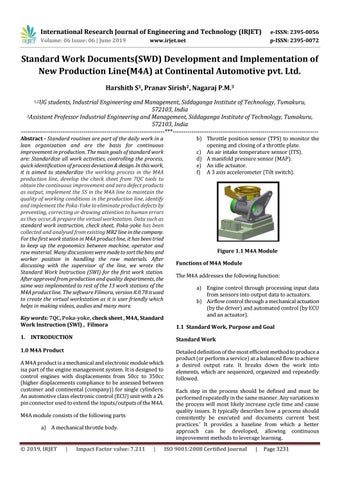
Figure 1.1 M4A Module Functions of M4A Module The M4A addresses the following function: a) Engine control through processing input data from sensors into output data to actuators. b) Airflow control through a mechanical actuation (by the driver) and automated control (by ECU and an actuator).
Key words: 7QC, Poka-yoke, check sheet , M4A, Standard Work Instruction (SWI) , Filmora
1.1 Standard Work, Purpose and Goal
1. INTRODUCTION
Standard Work
1.0 M4A Product
Detailed definition of the most efficient method to produce a product (or perform a service) at a balanced flow to achieve a desired output rate. It breaks down the work into elements, which are sequenced, organized and repeatedly followed.
A M4A product is a mechanical and electronic module which isa part of the engine management system. It is designed to control engines with displacements from 50cc to 350cc (higher displacements compliance to be assessed between customer and continental (company)) for single cylinders. An automotive class electronic control (ECU) unit with a 26 pin connector used to extend the inputs/outputs of the M4A. M4A module consists of the following parts a) A mechanical throttle body.
© 2019, IRJET
|
Impact Factor value: 7.211
|
Each step in the process should be defined and must be performed repeatedly in the same manner. Any variations in the process will most likely increase cycle time and cause quality issues. It typically describes how a process should consistently be executed and documents current ‘best practices.’ It provides a baseline from which a better approach can be developed, allowing continuous improvement methods to leverage learning. ISO 9001:2008 Certified Journal
|
Page 3231