International Research Journal of Engineering and Technology (IRJET)
e-ISSN: 2395-0056
Volume: 06 Issue: 06 | June 2019
p-ISSN: 2395-0072
www.irjet.net
Experimental Investigation on Compressive Strength of Cement Mortar using m Sand, p sand, g Sand and Dolomite Sand kannan l1, sundareswari p2 1Assistant 2UG
Professor, Department of Civil Engineering, Trichy Engineering College, Trichirapalli, Tamil Nadu, India.
Student, Department of Civil Engineering, Trichy Engineering College, Trichirapalli, Tamil Nadu, India.
----------------------------------------------------------------------***--------------------------------------------------------------------Abstract - Manufactured sand is the most commonly used in fine aggregates for construction purpose throughout India. The research focused on comparing the compressive strength of cement mortar cubes produced using fine aggregate from different sources. This project involves preparation of cement mortar cube of CM (1:3) proportions and also fine aggregate is replaced with 100 percentages using P-sand, G-sand and Dolomite sand for 53 grade of OPC cement at uniform water cement ratio and tested to determine the compressive strength of cement mortar cubes for 7 & 14 days under normal curing conditions. Finally the graph is prepared using the obtained results for comparative analysis.
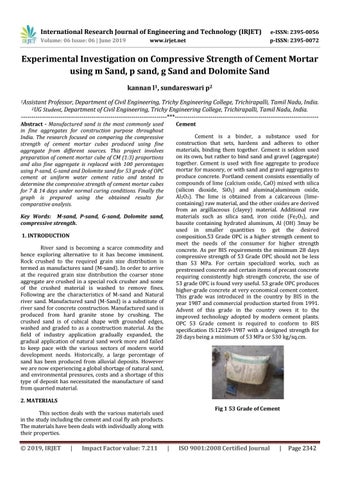
Cement Cement is a binder, a substance used for construction that sets, hardens and adheres to other materials, binding them together. Cement is seldom used on its own, but rather to bind sand and gravel (aggregate) together. Cement is used with fine aggregate to produce mortar for masonry, or with sand and gravel aggregates to produce concrete. Portland cement consists essentially of compounds of lime (calcium oxide, CaO) mixed with silica (silicon dioxide, SiO2) and alumina(aluminum oxide, Al2O3). The lime is obtained from a calcareous (limecontaining) raw material, and the other oxides are derived from an argillaceous (clayey) material. Additional raw materials such as silica sand, iron oxide (Fe2O3), and bauxite containing hydrated aluminum, Al (OH) 3may be used in smaller quantities to get the desired composition.53 Grade OPC is a higher strength cement to meet the needs of the consumer for higher strength concrete. As per BIS requirements the minimum 28 days compressive strength of 53 Grade OPC should not be less than 53 MPa. For certain specialized works, such as prestressed concrete and certain items of precast concrete requiring consistently high strength concrete, the use of 53 grade OPC is found very useful. 53 grade OPC produces higher-grade concrete at very economical cement content. This grade was introduced in the country by BIS in the year 1987 and commercial production started from 1991. Advent of this grade in the country owes it to the improved technology adopted by modern cement plants. OPC 53 Grade cement is required to conform to BIS specification IS:12269-1987 with a designed strength for 28 days being a minimum of 53 MPa or 530 kg/sq.cm.
Key Words: M-sand, P-sand, G-sand, Dolomite sand, compressive strength. 1. INTRODUCTION River sand is becoming a scarce commodity and hence exploring alternative to it has become imminent. Rock crushed to the required grain size distribution is termed as manufactures sand (M-sand). In order to arrive at the required grain size distribution the coarser stone aggregate are crushed in a special rock crusher and some of the crushed material is washed to remove fines. Following are the characteristics of M-sand and Natural river sand. Manufactured sand (M-Sand) is a substitute of river sand for concrete construction. Manufactured sand is produced from hard granite stone by crushing. The crushed sand is of cubical shape with grounded edges, washed and graded to as a construction material. As the field of industry application gradually expanded, the gradual application of natural sand work more and failed to keep pace with the various sectors of modern world development needs. Historically, a large percentage of sand has been produced from alluvial deposits. However we are now experiencing a global shortage of natural sand, and environmental pressures, costs and a shortage of this type of deposit has necessitated the manufacture of sand from quarried material. 2. MATERIALS
Fig 1 53 Grade of Cement
This section deals with the various materials used in the study including the cement and coal fly ash products. The materials have been deals with individually along with their properties.
Š 2019, IRJET
|
Impact Factor value: 7.211
|
ISO 9001:2008 Certified Journal
|
Page 2342