International Research Journal of Engineering and Technology (IRJET)
e-ISSN: 2395-0056
Volume: 06 Issue: 06 | June 2019
p-ISSN: 2395-0072
www.irjet.net
DESIGN, ANALYSIS AND OPTIMISATION OF SHOCK ABSORBER KARAN CHOUGULE1, ADITYA PARTE1, MILIND DEEPAK HAVAL1, MANIK RAJANGALE2 1Student,
Dept. of Mechanical Engineering, Maratha Mandal Engineering College, Belagavi Professor, Dept. of Mechanical Engineering, Maratha Mandal Engineering College, Belagavi -------------------------------------------------------------------------***-----------------------------------------------------------------2Assistant
Abstract:- A suspension system or shock absorber is a mechanical device designed to smooth out or damp shock impulse, and dissipate kinetic energy. The shock absorbers duty is to absorb or dissipate energy. In this project a shock absorber is designed and a 3D model is created using CATIA. Structural analysis and modal analysis are done on the shock absorber by varying material for spring, Spring Steel and Phosphor Bronze. Structural analysis is done to validate the strength and modal analysis is done to determine the displacements for different frequencies for number of modes. Comparison is done for two materials to verify best material for spring in Shock absorber. Modeling is done in CATIA and analysis is done in ANSYS.
In most dashpots, energy is converted to heat inside the viscous fluid. In hydraulic cylinders, the hydraulic fluid will heat up, while in air cylinders, the hot air is usually exhausted to the atmosphere. In other types of dashpots, such as electromagnetic ones, the dissipated energy can be stored and used later. In general terms, shock absorbers help cushion cars on uneven roads. 1.3 Applications Shock absorbers are an important part of auto mobile and motorcycle suspensions, aircraft landing gear, and the supports for many industrial machines. Large shock absorbers have also been used in structural engineering to reduce the susceptibility of structures to earthquake damage and resonance. A transverse mounted shock absorber, called a yaw damper, helps keep railcars from swaying excessively from side to side and are important in passenger railroads, commuter rail and rapid transit systems because they prevent railcars from damaging station platforms. The success of passive damping technologies in suppressing vibration amplitudes could be ascertained with the fact that it has a market size of around $ 4.5 billion.
1. INRODUCTION A shock absorber or damper is a mechanical device designed to smooth out or damp shock impulse, and dissipate kinetic energy. When a vehicle is traveling on a level road and the wheels strike a bump, the spring is compressed quickly. The compressed spring will attempt to return to its normal loaded length and, in so doing, will rebound past its normal height, causing the body to be lifted. The weight of the vehicle will then push the spring down below its normal loaded height. This, in turn, causes the spring to rebound again. This bouncing process is repeated over and over, a little less each time, until the up-and-down movement finally stops. If bouncing is allowed to go uncontrolled, it will not only cause an uncomfortable ride but will make handling of the vehicle very difficult. The design of spring in suspension system is very important. 1.1 Description Pneumatic and hydraulic shock absorbers commonly take the form of a cylinder with a sliding piston inside. The cylinder is filled with a fluid (such as hydraulic fluid) or air. Though is fluid-filled piston/cylinder combination is a dashpot.
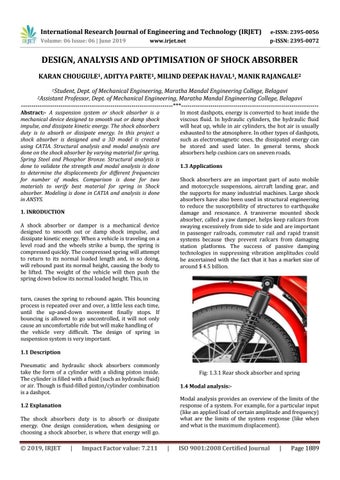
Fig: 1.3.1 Rear shock absorber and spring 1.4 Modal analysis:Modal analysis provides an overview of the limits of the response of a system. For example, for a particular input (like an applied load of certain amplitude and frequency) what are the limits of the system response (like when and what is the maximum displacement).
1.2 Explanation The shock absorbers duty is to absorb or dissipate energy. One design consideration, when designing or choosing a shock absorber, is where that energy will go.
Š 2019, IRJET
|
Impact Factor value: 7.211
|
ISO 9001:2008 Certified Journal
|
Page 1889