International Research Journal of Engineering and Technology (IRJET)
e-ISSN: 2395-0056
Volume: 06 Issue: 05 | May 2019
p-ISSN: 2395-0072
www.irjet.net
Frequency Variation in Rotor Current on Changing Mechanical Load in Three Phase Induction Motor Shubhang Dwivedi1, Ankur Dubey2, Richa Tiwari3 Electrical Engineering Department, United college of Engineering and Management Allahabad, U.P., 211010, India. ---------------------------------------------------------------------***---------------------------------------------------------------------
Abstract - This paper presents a practical as well as
widely used in both fixed-speed and variable-frequency drive (VFD) applications.
theoretical study of the frequency variation behavior of an electric three-phase induction machine under different load condition (from no load to full load condition gradually up to some extent). In this paper authors studied and verified the power factor improvement by Phasor diagram and by observed tabulated value of induction machine on increasing mechanical load. The observation is done by hardware analysis on 5HP, 300V, 50Hz three-phase squirrel cage induction machine in the lab under normal conditions. The result is shown at the graph which is drawn by using Microsoft excel 2007. Key Words: Introduction, Frequency of stator current, Rotor current, Variation in frequency of rotor emf, Power factor analysis.
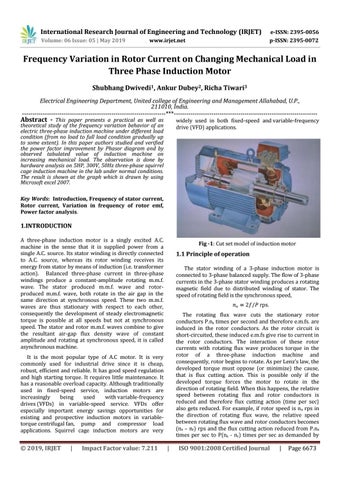
1.INTRODUCTION A three-phase induction motor is a singly excited A.C. machine in the sense that it is supplied power from a single A.C. source. Its stator winding is directly connected to A.C. source, whereas its rotor winding receives its energy from stator by means of induction (i.e. transformer action). Balanced three-phase current in three-phase windings produce a constant-amplitude rotating m.m.f. wave. The stator produced m.m.f. wave and rotorproduced m.m.f. wave, both rotate in the air gap in the same direction at synchronous speed. These two m.m.f. waves are thus stationary with respect to each other, consequently the development of steady electromagnetic torque is possible at all speeds but not at synchronous speed. The stator and rotor m.m.f. waves combine to give the resultant air-gap flux density wave of constant amplitude and rotating at synchronous speed, it is called asynchronous machine.
Fig -1: Cut set model of induction motor
1.1 Principle of operation The stator winding of a 3-phase induction motor is connected to 3-phase balanced supply. The flow of 3-phase currents in the 3-phase stator winding produces a rotating magnetic field due to distributed winding of stator. The speed of rotating field is the synchronous speed, rps. The rotating flux wave cuts the stationary rotor conductors P.ns times per second and therefore e.m.fs. are induced in the rotor conductors. As the rotor circuit is short-circuited, these induced e.m.fs give rise to current in the rotor conductors. The interaction of these rotor currents with rotating flux wave produces torque in the rotor of a three-phase induction machine and consequently, rotor begins to rotate. As per Lenz’s law, the developed torque must oppose (or minimize) the cause, that is flux cutting action. This is possible only if the developed torque forces the motor to rotate in the direction of rotating field. When this happens, the relative speed between rotating flux and rotor conductors is reduced and therefore flux cutting action (time per sec) also gets reduced. For example, if rotor speed is n s rps in the direction of rotating flux wave, the relative speed between rotating flux wave and rotor conductors becomes (ns – nr) rps and the flux cutting action reduced from P.ns times per sec to P(ns - nr) times per sec as demanded by
It is the most popular type of A.C motor. It is very commonly used for industrial drive since it is cheap, robust, efficient and reliable. It has good speed regulation and high starting torque. It requires little maintenance. It has a reasonable overload capacity. Although traditionally used in fixed-speed service, induction motors are increasingly being used with variable-frequency drives (VFDs) in variable-speed service. VFDs offer especially important energy savings opportunities for existing and prospective induction motors in variabletorque centrifugal fan, pump and compressor load applications. Squirrel cage induction motors are very
© 2019, IRJET
|
Impact Factor value: 7.211
|
ISO 9001:2008 Certified Journal
|
Page 6673