International Research Journal of Engineering and Technology (IRJET)
e-ISSN: 2395-0056
Volume: 05 Issue: 05 | May-2018
p-ISSN: 2395-0072
www.irjet.net
Analysis and Design of Pre-stressed Concrete I-Girder Bridge Shubham Landge1, Umesh Bhagat2, Shubham Bhaisare3, Ved Prakash4, Dr. I. P. Khedikar5 1234U.G.
students, Civil Dept. G. H. Raisoni College of Engineering Nagpur, Maharashtra, India, Engineer, Oriental Structural Engineer Pvt. Ltd. Nagpur, Maharashtra, India, 5Professor, Civil Dept. G.H. Raisoni College of Engineering Nagpur, Maharashtra, India ---------------------------------------------------------------------***--------------------------------------------------------------------a. Cross section of I-Girder with cast in situ deck Abstract - Bridge construction today has achieved a 1234Trainee
worldwide level of importance. Bridges are the key elements in any road network and use of pre-stress girder type bridges gaining popularity in bridge engineering fraternity because of its better stability, serviceability, economy, aesthetic appearance and structural efficiency. I-beam bridges are one of the most commonly used types of bridge and it is necessary to constantly study, update analysis techniques and design methodology. Structurally they are simple to construct. Hence they are preferred over other types of bridges when it comes to connecting between short distances. This present paper describes the analysis and design of longitudinal girder bridge. In this case analysis is done using STAAD- Pro software.
Key Words: Girder Analysis, STAAD PRO V8i, IRC 6:2010
b. I-Girder with cast in situ deck
c. Box girder with cast in situ deck
(Section II) , PSC I-Girder, Principal Stresses, Shear And Moments.
1. INTRODUCTION A girder bridge can be defined as a crossing the road, railway and river (or) a natural obstacle (Water coarse, sound, valley etc…) and allowing people, vehicles etc… to go easily from a spot to another. There are different design shapes of bridges and each of them has a particular purpose. Bridges are classified on the basis of how principal stress, shear stress, bending moments, compression, tension are distributed in any type of structure.
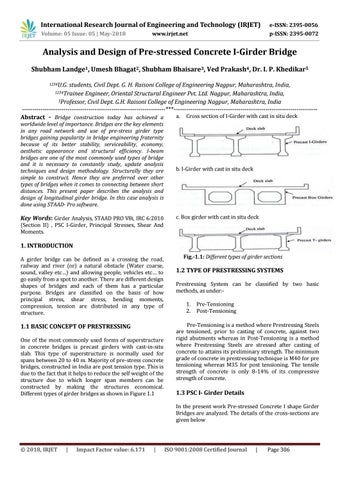
1.1 BASIC CONCEPT OF PRESTRESSING One of the most commonly used forms of superstructure in concrete bridges is precast girders with cast-in-situ slab. This type of superstructure is normally used for spans between 20 to 40 m. Majority of pre-stress concrete bridges, constructed in India are post tension type. This is due to the fact that it helps to reduce the self weight of the structure due to which longer span members can be constructed by making the structures economical. Different types of girder bridges as shown in Figure 1.1
Fig.-1.1: Different types of girder sections
1.2 TYPE OF PRESTRESSING SYSTEMS Prestressing System can be classified by two basic methods, as under:1. 2.
Pre-Tensioning Post-Tensioning
Pre-Tensioning is a method where Prestressing Steels are tensioned, prior to casting of concrete, against two rigid abutments whereas in Post-Tensioning is a method where Prestressing Steels are stressed after casting of concrete to attains its preliminary strength. The minimum grade of concrete in prestressing technique is M40 for pre tensioning whereas M35 for post tensioning. The tensile strength of concrete is only 8-14% of its compressive strength of concrete.
1.3 PSC I- Girder Details In the present work Pre-stressed Concrete I shape Girder Bridges are analyzed. The details of the cross-sections are given below
© 2018, IRJET
|
Impact Factor value: 6.171
|
ISO 9001:2008 Certified Journal
|
Page 306