International Research Journal of Engineering and Technology (IRJET)
e-ISSN: 2395-0056
Volume: 05 Issue: 10 | Oct 2018
p-ISSN: 2395-0072
www.irjet.net
Design of Two-Stage Single Speed Gearbox for Transmission System of SAE BAJA Vehicle Chetan Chaudhari1, Aditya Pasalkar2, Akshay Gavade3, Ashish Jagtap4 1,2,3,4Bachelor’s student, Dept. of Mechanical Engineering, RMD Sinhgad School of Engineering, Pune, India ---------------------------------------------------------------------***----------------------------------------------------------------------
Abstract – This paper focuses on the design of constant speed two stage reduction gearbox for SAE Baja ATV. This season, RMD Sinhgad School of Engineering college Baja team has developed a customised gearbox drivetrain which is efficient, lightweight and durable. The drivetrain consists of a continuously variable transmission device and a single speed two stage reduction gearbox. This gearbox conformed with all SAE BAJA design rules to precisely integrate with all subsystems. The gearbox was modelled on CATIA and analysed on ANSYS workbench and this testing was effective. Key Words: Off-road vehicle, Single speed Two stage reduction gearbox, Continuously variable transmission device. 1. INTRODUCTION SAE BAJA is an international competition organised for students pursing engineering course where student teams are provided an opportunity to design and build an ATV. These teams have liberty to design the vehicle as it pleases them although it must conform with the rulebook. However, the teams have to use Briggs and Stratton 10 HP engine in stock condition which is provided [1]. The transmission along with the drive-train is one of the most crucial systems in the vehicle. Its purpose is to transfer the power generated by the engine to the wheels with minimum losses.
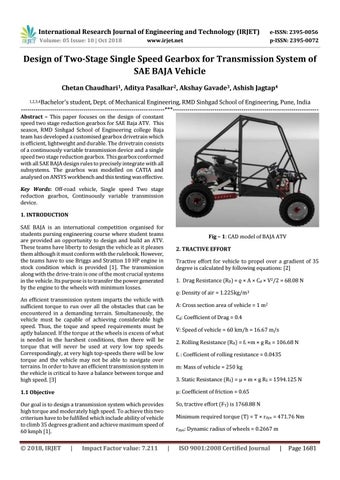
Fig – 1: CAD model of BAJA ATV 2. TRACTIVE EFFORT Tractive effort for vehicle to propel over a gradient of 35 degree is calculated by following equations: [2] 1. Drag Resistance (RD) = ϱ × A × Cd × V2/2 = 68.08 N ϱ: Density of air = 1.225kg/m3
An efficient transmission system imparts the vehicle with sufficient torque to run over all the obstacles that can be encountered in a demanding terrain. Simultaneously, the vehicle must be capable of achieving considerable high speed. Thus, the toque and speed requirements must be aptly balanced. If the torque at the wheels is excess of what is needed in the harshest conditions, then there will be torque that will never be used at very low top speeds. Correspondingly, at very high top-speeds there will be low torque and the vehicle may not be able to navigate over terrains. In order to have an efficient transmission system in the vehicle is critical to have a balance between torque and high speed. [3]
A: Cross section area of vehicle = 1 m2 Cd: Coefficient of Drag = 0.4 V: Speed of vehicle = 60 km/h = 16.67 m/s 2. Rolling Resistance (RR) = fr ×m × g RR = 106.68 N fr : Coefficient of rolling resistance = 0.0435 m: Mass of vehicle = 250 kg 3. Static Resistance (RS) = µ × m × g RS = 1594.125 N
1.1 Objective
µ: Coefficient of friction = 0.65
Our goal is to design a transmission system which provides high torque and moderately high speed. To achieve this two criterium have to be fulfilled which include ability of vehicle to climb 35 degrees gradient and achieve maximum speed of 60 kmph [1].
So, tractive effort (FT) is 1768.88 N
© 2018, IRJET
|
Impact Factor value: 7.211
Minimum required torque (T) = T × rdyn = 471.76 Nm rdyn: Dynamic radius of wheels = 0.2667 m
|
ISO 9001:2008 Certified Journal
|
Page 1681