International Research Journal of Engineering and Technology (IRJET)
e-ISSN: 2395 -0056
Volume: 03 Issue: 03 | Mar-2016
p-ISSN: 2395-0072
www.irjet.net
UTILIZATION OF POND ASH AS PARTIAL REPLACEMENT OF CEMENT CONCRETE MIX ADITYA VERMA1, ABHISHEK KUMAR2, ASHISH MISHRA3, ARJIT VERMA4 1M.tech Scholar (Structures), BBDU, Lucknow, Uttar Pradesh, India
2Astt. Professor, Dept. of Civil Engineering, BBDU, Lucknow, Uttar Pradesh, India 3Research Scholar, Dept. of Civil Engineering, MNNIT Allahabad, Uttar Pradesh, India 4M.tech, Dept. of Civil Engineering, MNNIT Allahabad, Uttar Pradesh, India
---------------------------------------------------------------------***---------------------------------------------------------------------
Abstract – This paper presents a review on utilization
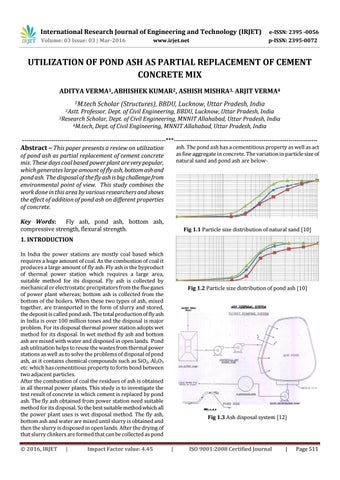
ash. The pond ash has a cementitious property as well as act as fine aggregate in concrete. The variation in particle size of natural sand and pond ash are below-
of pond ash as partial replacement of cement concrete mix. These days coal based power plant are very popular, which generates large amount of fly ash, bottom ash and pond ash. The disposal of the fly ash is big challenge from environmental point of view. This study combines the work done in this area by various researchers and shows the effect of addition of pond ash on different properties of concrete. Key Words: Fly ash, pond ash, bottom ash, compressive strength, flexural strength.
Fig 1.1 Particle size distribution of natural sand [10]
1. INTRODUCTION In India the power stations are mostly coal based which requires a huge amount of coal. As the combustion of coal it produces a large amount of fly ash. Fly ash is the byproduct of thermal power station which requires a large area, suitable method for its disposal. Fly ash is collected by mechanical or electrostatic precipitators from the flue gases of power plant whereas; bottom ash is collected from the bottom of the boilers. When these two types of ash, mixed together, are transported in the form of slurry and stored, the deposit is called pond ash. The total production of fly ash in India is over 100 million tones and the disposal is major problem. For its disposal thermal power station adopts wet method for its disposal. In wet method fly ash and bottom ash are mixed with water and disposed in open lands. Pond ash utilization helps to reuse the wastes from thermal power stations as well as to solve the problems of disposal of pond ash, as it contains chemical compounds such as SiO2, Al2O3 etc. which has cementitious property to form bond between two adjacent particles. After the combustion of coal the residues of ash is obtained in all thermal power plants. This study is to investigate the test result of concrete in which cement is replaced by pond ash. The fly ash obtained from power station need suitable method for its disposal. So the best suitable method which all the power plant uses is wet disposal method. The fly ash, bottom ash and water are mixed until slurry is obtained and then the slurry is disposed in open lands. After the drying of that slurry clinkers are formed that can be collected as pond © 2016, IRJET
|
Impact Factor value: 4.45
Fig 1.2 Particle size distribution of pond ash [10]
Fig 1.3 Ash disposal system [12]
|
ISO 9001:2008 Certified Journal
|
Page 511
International Research Journal of Engineering and Technology (IRJET)
e-ISSN: 2395 -0056
Volume: 03 Issue: 03 | Mar-2016
p-ISSN: 2395-0072
www.irjet.net
2. EFFECTS OF ADDITION OF POND ASH ON PROPERTIES OF CONCRETE
Remya raju et. al. (2014) investigate the effect of use of coal bottom ash as partial replacement of fine aggregates in various percentages (0–30%), on concrete properties. Compressive strength reduced marginally on the inclusion of bottom ash in concrete. No significant strength gain in concrete observed when percentage of micro silica is more than 8%. Abhishek Sachdeva et al. (2015) carried out experimental investigation to study the effect of use of coal bottom ash as a partial replacement of fine aggregates in concrete. An experimental program is planned in which controlled concrete of grade M40 is prepared. Fine aggregate is partially replaced with coal bottom ash by 10%, 20%, 30% and 40%. A marginal decrease was observed, in the compressive strength up to 20% replacement level. Therefore, 20% of fine aggregates may be replaced with coal bottom ash and a concrete with good strength may be produced with coal bottom ash in concrete. Aparna K.A et. al (2015) performed partial replacement of cement and sand using fly ash and pond ash. The grade of concrete is M40, cube and beam specimens are casted and cured for 28 and 56 days. The 20%FA, 18%PA mix will give a high compressive strength of 47.52 N/mm2 for 56 days curing period. The 20%FA, 16%PA mix will give a low compressive strength of 33.77 N/mm2. The 20%FA, 18%PA mix will give 8% of higher strength compared to normal concrete. The 56 days cured concrete of 20%FA, 18%PA will give 6% higher strength compared to 28 days cured concrete mixes. Shekhar Mahat et. al (2015) carried experimental studies on the use of Pond ash as Fine Aggregate (FA) in concrete. The properties of Pond Ash were compared to the standard sand. The pond ash added by weight is 10%, 20%, 30%, 40%, 50% and 60% respectively as replacement of FA in concrete. The compressive strength of the concrete with 10% Pond ash replacement as Fine aggregate has higher strength for 3,7 and 28 days of curing but the strength is higher for 20% replacement for 56 days of curing.
2.1 Compressive Strength Abdulhameed Umar Abubakar et.al. (2012) The fly ash and coal bottom ash samples were collected from the tanjung bin power plant from this study he concluded that for M35 grade concrete has got a compressive strength of 30N/mm2 for a curing period of 28 days. By increase in the curing period the strength of this particular concrete gets increased. S.A. Haldive et.al. (2013) studied the fly ash and pond ash are obtained as the by product from the thermal power plants and got to the conclusion that this replaced concrete will give higher compressive strength compared to the normal concrete with OPC of 53 grade. P. P. Bhangale et.al. (2013) studied the cost analysis and came to conclusion that replacement of fine aggregate with pond ash is acceptable and variation of strength of pond ash concrete in comparison to normal concrete lies within plus or minus 10% up to 28days curing for various mixes. A. K. Dwivedi et. al (2013) studied experimental investigation on the effect of addition of pond ash partially replaced with cement and sand in the mortar. Pond ash of 0% to 40% (with increase of 5%) by weight to cement and sand replacement respectively were used. The specimens were casted and cured under standard curing conditions for 3, 7, 28 and 90 days. In case of pond ash mortar, the compressive strength containing 30 % replacement is higher than standards and mortar for 28 days curing period. The strength development is quite slowly in case of all replacement after 3 and 7 days. Incorporating the 40 % pond ash decreases compressive strength after 28 and 90 days. Compressive strength for other case (Cement Replacement), which is also increasing with time, but it is observed that the rate of strength gaining decreases with increased rate of replacement incorporating pond ash percentage. Jay Patel et. al (2013) replaced alccofine and fine fly ash partially with cement and pond fly ash as a replacement of fine aggregate. In mix G1, G2, G3 we will replace cement with alccofine 4% and fine fly ash 26% and pond fly ash varies 10%, 20%, and 30% as replacement of F.A. Similarly in mix G4,G5,G6 alccofine 6% and fine fly ash 24% and pond fly ash same as 10%,20%,30%. According to analysis highest strength for using 6% alccofine as a cement replacement and 10% pond ash as a replacement in fine aggregate. Also 50.4 MPa compressive strength at 7 days and 62.0 MPa compressive strength at 28 days for water curing samples and 67.7 MPa compressive strength at 28 days for self-curing samples for above mentioned usage.
© 2016, IRJET
|
Impact Factor value: 4.45
2.2 Flexural Strength Jay Patel et al (2013) replaced alccofine and fine fly ash partially with cement and pond fly ash as a replacement of fine aggregate. According to analysis 4.84Mpa flexural strength for 6% alccofine and 10%pond ash usage at 28 days. The Flexural strength of cylinder shows that tensile strength up to desired limits of 5.42 Mpa are not obtained. A. K. Dwivedi et al (2013) studied experimental investigation on the effect of addition of pond ash partially replaced with cement and sand in the mortar. Flexural strength values for pond ash replacement mortar in comparison with standard |
ISO 9001:2008 Certified Journal
|
Page 512
International Research Journal of Engineering and Technology (IRJET)
e-ISSN: 2395 -0056
Volume: 03 Issue: 03 | Mar-2016
p-ISSN: 2395-0072
www.irjet.net
2.3 Splitting Tensile Strength
cement mortar strength are observed to be increase in 5% and 10% replacement. In the further increased percentage replacement the flexural strength decreases. This is related with decrease in cement content and increase in water/binder ratio in the comparison of standard cement mortar. Kadam et. al (2013) studied effects of coal bottom ash as fine aggregates in place of sand on properties of concrete. The natural sand was replaced with coal bottom ash by 0%, 10%, 20%, 30%, 40%, 50%, 60%, 70%, 80%, 90%, and 100% by weight. The flexural strength was increased for 10 %, 30 % replacement and after that it was decreased. Kadam et. al (2013) studied effects of coal bottom ash as fine aggregates in place of sand on properties of concrete. The natural sand was replaced with coal bottom ash by 0%, 10%, 20%, 30%, 40%, 50%, 60%, 70%, 80%, 90%, and 100% by weight. The compressive strength for 7, 28, 56 and 112 days was increased up to 20% replacement and after that compressive strengths were decreased from 30% to 100% replacement. Remya raju et. al. (2014) investigate the effect of use of coal bottom ash as partial replacement of fine aggregates in various percentages (0–30%), on concrete properties. The flexural strength of concrete almost linearly decreased as the replacement level of bottom ash was increased. Abhishek Sachdeva et. al. (2015) carried out experimental investigation to study the effect of use of coal bottom ash as a partial replacement of fine aggregates in concrete. A marginal decrease was observed in the Flexural strength upto 20% replacement level. A decrease in strength of concrete with the increase in levels of fine aggregate replacement by coal bottom ash is due to the replacement of the stronger material with the weaker material. Aparna K.A et. al (2015) performed partial replacement of cement and sand using fly ash and pond ash. The grade of concrete is M40, cube and beam specimens are casted and cured for 28 and 56 days. The 20%FA, 18%PA mix will give a high flexural strength of 11.16 N/mm2 for a curing period of 56 days. The 20%FA, 18%PA mix will give 25% higher strength compared to normal concrete. The 56 days cured concrete will give 10% higher strength compared to 28 days cured concrete of other mixes. Shekhar Mahat et. al (2015) carried experimental studies on the use of Pond ash as Fine Aggregate (FA) in concrete. The properties of Pond Ash were compared to the standard sand. The pond ash added by weight is 10%, 20%, 30%, 40%, 50% and 60% respectively as replacement of FA in concrete. The Flexural strength of the Pond ash replaced concrete decreases with increase in the percentage of replacement.
© 2016, IRJET
|
Impact Factor value: 4.45
Jay Patel et al (2013) replaced alccofine and fine fly ash partially with cement and pond fly ash as a replacement of fine aggregate. According to analysis 3.98 Mpa splitting tensile strength for 6% alccofine and 10 % pond ash usage at 28 days. The split tensile strength of cylinder shows that split tensile strength up to desired limits of 5.42 Mpa are not obtained. Kadam et al (2013) studied effects of coal bottom ash as fine aggregates in place of sand on properties of concrete. The natural sand was replaced with coal bottom ash by 0%, 10%, 20%, 30%, 40%, 50%, 60%, 70%, 80%, 90%, and 100% by weight. The split tensile strength was increased at 7, 28, 56 and 112 days for 10% to 30% replacement and after that it was decreased for remaining replacement. Remya Raju et. al. (2014) investigate the effect of use of coal bottom ash as partial replacement of fine aggregates in various percentages (0–30%), on concrete properties. Splitting tensile strength of concrete improved on use of coal bottom ash as fine aggregate in partial replacement of sand and also when micro silica was added to the optimum mix.
2.4 Workability Abubakar et. al (2012) utilized Coal bottom ash (CBA) and fly ash in partial replacement for fine aggregates and cement respectively in the range of 0, 5, 10, 15 & 20% (equal percentages). The results at 7, 28, 56 & 90 days curing are presented. The workability of the fresh concrete measured in terms of slump and compacting factor decreased as the percentage replacement increases. Jay Patel et al (2013) replaced alccofine and fine fly ash partially with cement and pond fly ash as a replacement of fine aggregate. The workability of concrete decreased with the increase in Pond fly ash content due to the increase in water demand, which is incorporated by increasing the dosage of Super plasticizer. Remya raju et. al. (2014) investigate the effect of use of coal bottom ash as partial replacement of fine aggregates in various percentages (0–30%), on concrete properties. The workability of bottom ash concrete decreased on use of coal bottom ash in partial replacement of fine aggregate in concrete. When micro silica was added to bottom ash concrete workability again decreases. Abhishek Sachdeva et al. (2015) carried out experimental investigation to study the effect of use of coal bottom ash as a partial replacement of fine aggregates in concrete. Workability decreases with the increase in levels of sand replacement by coal bottom ash because bottom ash is more porous; therefore absorb more water than sand. Shekhar Mahat et al (2015) carried experimental studies on the use of Pond ash as Fine Aggregate (FA) in concrete. According to him Workability of concrete decreases with the |
ISO 9001:2008 Certified Journal
|
Page 513
International Research Journal of Engineering and Technology (IRJET)
e-ISSN: 2395 -0056
Volume: 03 Issue: 03 | Mar-2016
p-ISSN: 2395-0072
www.irjet.net
increase in Pond ash hence the super- plasticizer Glenium3030 is used in increasing dosage as the Pond ash percentage replacement increases.
can be used in increasing dose as percentage of pond ash is increased. The densities of hardened concrete linearly decreased as the replacement ratio of ash was increased from 10% to 100% as compared to standard concrete.
2.5 Density of concrete Abubakar et. al (2012) utilized Coal bottom ash (CBA) and fly ash in partial replacement for fine aggregates and cement respectively in the range of 0, 5, 10, 15 & 20% (equal percentages). The results at 7, 28, 56 & 90 days curing are presented. The density of the resulting concrete samples with replacement of equal percentage of bottom ash fluctuates at smaller percentages in all curing ages. As the percentage replacements began to increase from 15% to 20%, a decline of density was observed. A. K. Dwivedi et. al (2013) studied experimental investigation on the effect of addition of pond ash partially replaced with cement and sand in the mortar. For replacement up to 40% it is observed that the dry density decreases with increase in pond ash content in mortar. For series-II (cement replacement) the bulk densities for all replacement is gradually decreases with increased percentage of pond ash content. Hence it was concluded that the bulk dry density reduces with increase in percentage replacement of pond ash when compared with OPC mortar. Kadam et. al (2013) studied effects of coal bottom ash as fine aggregates in place of sand on properties of concrete. The natural sand was replaced with coal bottom ash by 0%, 10%, 20%, 30%, 40%, 50%, 60%, 70%, 80%, 90%, and 100% by weight. The densities of hardened concrete linearly decreased as the replacement ratio of bottom ash was increased from 10% to 100% as compared to controlled concrete.
References
The compressive strength for 7, 28, 56 and 90 days was increased up to 15-20% replacement and after that compressive strengths were decreased for further more replacement. A marginal decrease was observed in the flexural strength upto 15-20% replacement level. A decrease in strength of concrete with the increase in levels of fine aggregate replacement by coal bottom ash is due to the replacement of the stronger material with the weaker material. Splitting tensile strength of concrete improved on use pond ash as fine aggregate in partial replacement of sand. Workability of concrete decreases with the increase in percentage of Pond ash, as it is more porous, therefore absorb more water than sand hence some super plasticizer
[1] Abdulhameed Umar Abubakar, "Properties of concrete using tanjung bin power plant coal bottom ash and fly ash," International Journal of Sustainable Construction Engineering & Technology (ISSN: 2180-3242) Vol 3, Issue 2, 2012. [2] Abdulhameed Umar Abubakar, Khairul Salleh Baharudin “Properties of concrete using tanjung bin power plant coal bottom ash and fly ash” International Journal of Sustainable Construction Engineering & Technology (ISSN: 2180-3242) Vol 3, Issue 2, 2012. [3] S.A.Haldive, "Experimental study on combined effect of flyash and pond ash on strength and durability of concrete", International journal of scientific and emgg. Research Vol 4, Issue 5, May 2013. [4] Prof. P. P. Bhangale" Study of Pond ASH (BTPS) Use as A Fine Aggregate in Cement Concrete "- Case Study, International jornal of latest trends in Engg. And Technology, Vol 2, Issue 2, March 2013. [5] Jay Patel, Kunal Patel, Gaurav Patel “Utilization of pond fly ash as a partial replacement in fine aggregate with using fine fly ash and alccofine in hsc” IJRET: International Journal of Research in Engineering and Technology 2013 eISSN: 2319-1163 | pISSN: 2321-7308 [6] Arunkumar Dwivedi, Dhiraj Kumar S. Lal “Influence of Addition of Pond Ash as Partial Replacement with Sand and Cement on the Properties of Mortar” International Journal of Innovative Technology and Exploring Engineering (IJITEE) ISSN: 2278-3075, Volume-2, Issue-4, March 2013. [7] M.P.Kadam, DR.Y.D. Patil “Effect of coal bottom ash as sand replacement on the properties of concrete with different w/c ratio” International Journal of Advanced Technology in Civil Engineering, ISSN: 2231 –5721, Volume-2, Issue-1, 2013. [8] Remya Raju, Mathews M. Paul & K. A. Aboobacker “Strength performance of concrete using bottom ash as fine aggregate” International Journal of Research in Engineering & Technology (IMPACT: IJRET) ISSN(E): 2321-8843; ISSN(P): 2347-4599 Vol. 2, Issue 9, Sep 2014, 111-122. [9] Aparna K.A., Dr. V. Ramesh “Comparative Study of Fly Ash and Pond Ash on Compressive and Flexural Strength of Concrete” International Journal of Civil and Structural Engineering Research 2015 ISSN 2348-7607 Vol. 3, Issue 1, pp: (345-348).
© 2016, IRJET
|
3. CONCLUSION Based on the work of various researchers it was seen that pond ash can be a suitable material for replacement of concrete mix. Following conclusions can be drawn.
|
Impact Factor value: 4.45
ISO 9001:2008 Certified Journal
|
Page 514
International Research Journal of Engineering and Technology (IRJET)
e-ISSN: 2395 -0056
Volume: 03 Issue: 03 | Mar-2016
p-ISSN: 2395-0072
www.irjet.net
[10] Shekhar Mahat, Manikanta K V “Studies On Strength Characteristics Of Pond Ash Replaced Pavement Quality Concrete” International Journal of Computational Science, Mathematics and Engineeringm Volume2 , Issue7, July 2015 ISSN 2349-8439 Copyright-IJCSME. [11] Abhishek Sachdeva, Gobind Khurana “Strength Evaluation of Cement Concrete Using Bottom Ash as a Partial Replacement of Fine Aggregates” International Journal of Science, Engineering and Technology, 2015, Volume 3 Issue 6 ISSN (Online): 2348-4098, ISSN (Print): 23954752. [12] Md. Ghazali, Prof. O.P. Kaushal., “Characteristics of fly ash from thermal power plants and its management along with settling pond design” IJOER Vol. 1,Issue-4, July-2015.
Mr. Ashish Mishra was born in 1993 in Lucknow city. He received his Bachelor of Technology degree in Civil Engineering from Babu Banarasi Das National Institute of Technology and Management, Lucknow in 2013. In 2015 he received his Master’s degree in Geotechnical Engineering from MNNIT, Allahabad. He is right now a Research Scholar at MNNIT Allahabad. E-mail:ashmishra100@gmail.com Mr. Arjit Verma was born in 1991 in Faizabad city. He received his Bachelor of Technology degree in Civil Engineering from IEC college of Engineering and Technology in 2012. In 2015 he received his Master’s degree in Geotechnical Engineering from MNNIT, Allahabad. E-mail:arjit0808@gmail.com
BIOGRAPHIES
Mr. Aditya verma was born in 1992 in Lucknow city. He received his Bachelor of Technology degree in Civil Engineering from Babu Banarasi Das National Institute of Technology and Management, Lucknow in 2013. He is right now pursuing her Master of Technology in Structural Engineering from School of Engineering (Babu Banarasi Das University) Lucknow. E-mail: aditya91verma@gmail.com Mr. Abhishek Kumar was born in 1986 in Patna city. He received his Bachelor of Technology degree in Civil Engineering from School of Engineering (Cochin University of Science and Technology) Kochi, Kerala in 2009. In 2011 he received his Master’s degree in Structural Engineering from MNNIT, Allahbad. He joined Babu Banarasi Das Engineering College, Lucknow in 2011 as a faculty. He was Head of the Department in Babu Banarasi Das University, Lucknow and is now working as an Assistant Professor in Babu Banarasi Das University, Lucknow (Department of Civil Engineering) with a total of 5 years of experience. E-mail: rajaabhis@gmail.com
© 2016, IRJET
|
Impact Factor value: 4.45
|
ISO 9001:2008 Certified Journal
|
Page 515